Sexy Art for Women.

Harems 2.

Female Erotica and Feminine Beauty.

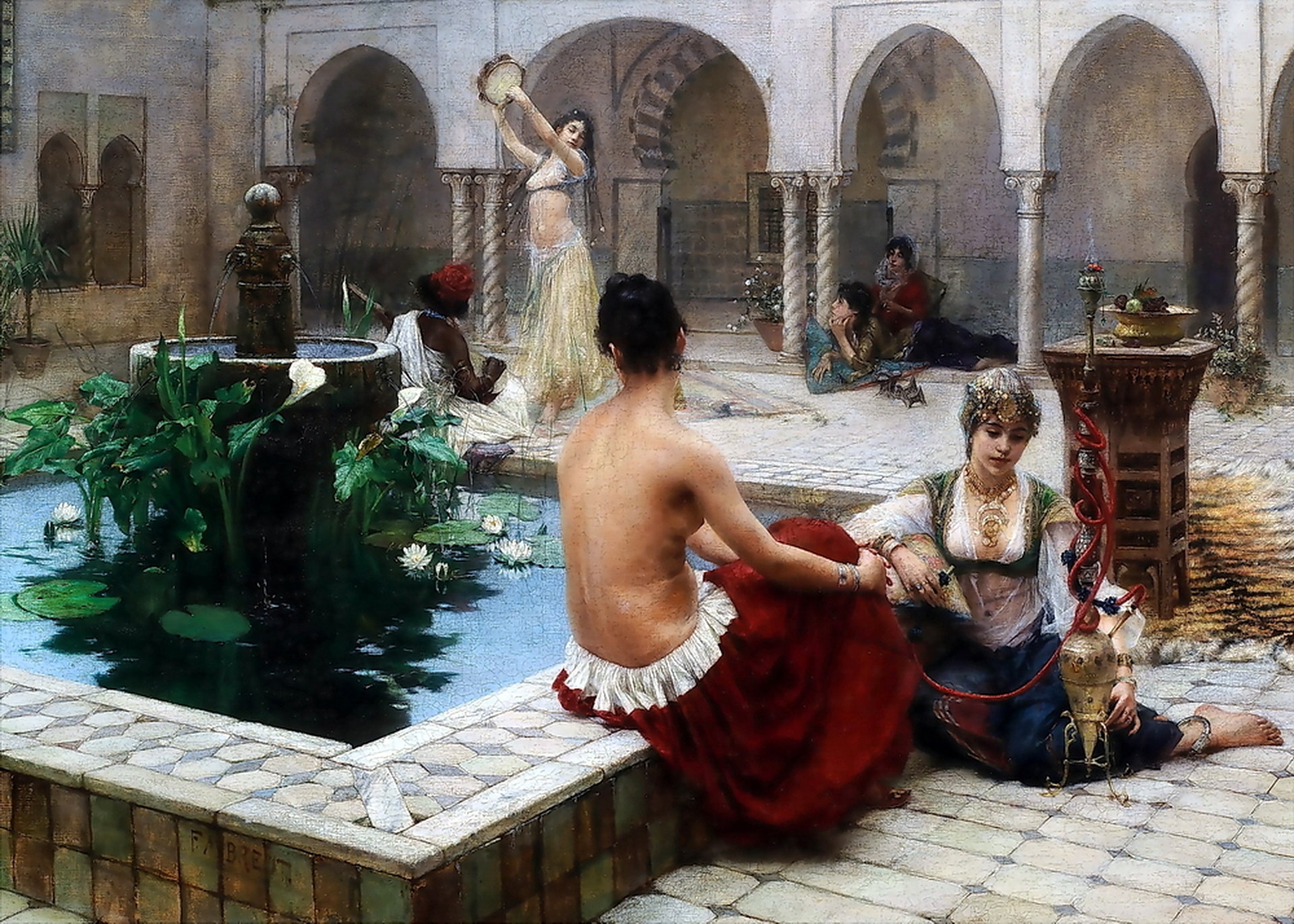
The Harem girls are sitting around the fountain with a bong one woman is semi naked


By The Fountain. Ferdinand Max Bredt.

There are lilies and other white flowers in the fountain. While harem girl is playing a tambourine and two girls are using a bong.


Harems page 1 The women who make up the harems and provide their services.
Paintings of famous Lesbians and Lesbian love.


Lite Erotic Art 1 Find pretty paintings of lovely ladies and beautiful naked women.
Sensuous paintings of feminine beauty and lovely nude ladies with flowers and roses.
Paintings of very famous lesbians and their lovers.
Naughty nymphs lust for sexy. They are always horny. The Sirens are close relatives of them.


This post contains affiliate links, we may receive a commission if you make a purchase using these links.
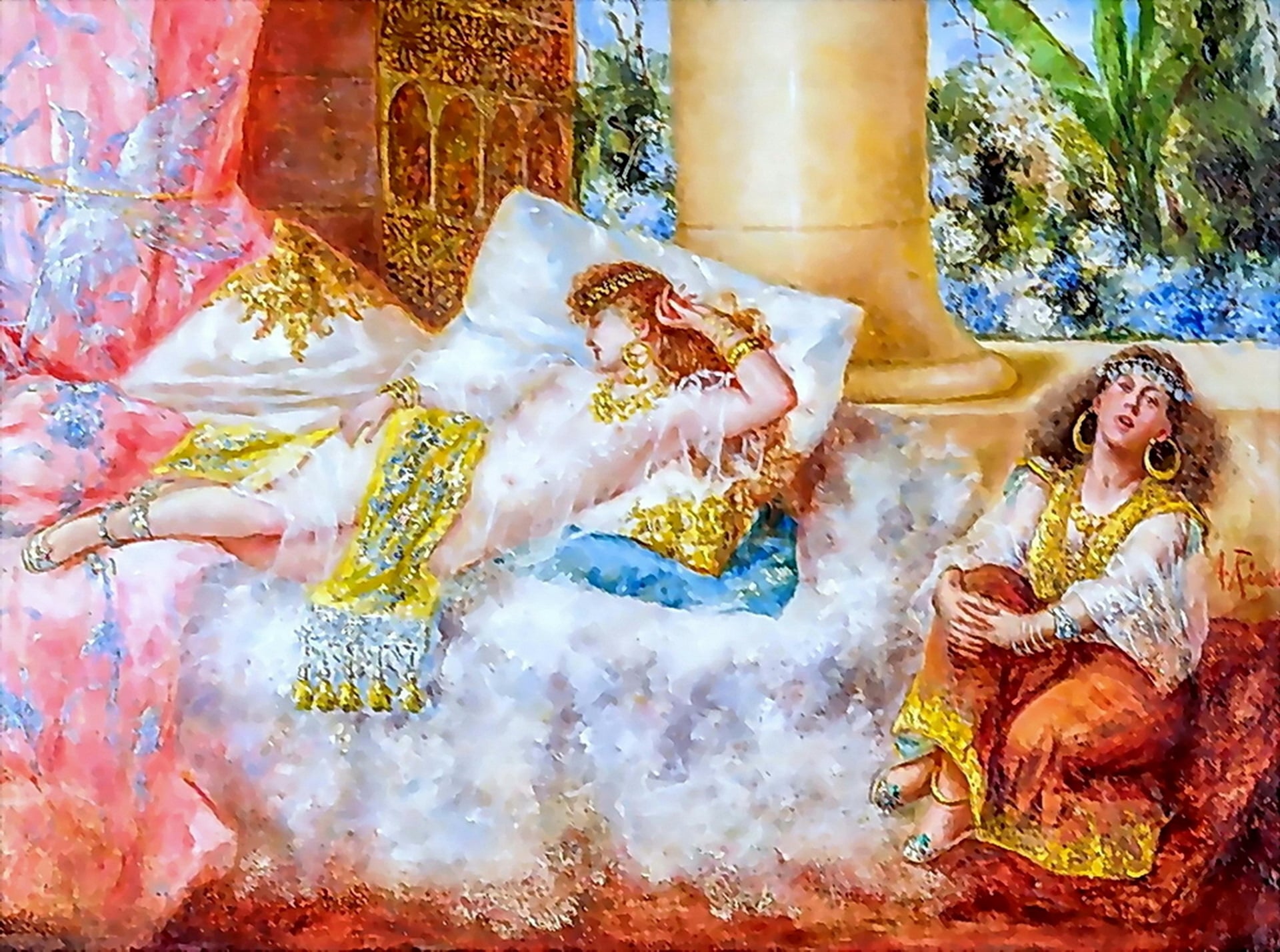
The Sultan's Mistress in the Harem This sexy girl is the best of the females.


A Sultan's Concubine in the Harem Antonio Rivas.

The Sultans Mistress is enjoying her luxurious surroundings in her sheer garment that she is wearing.

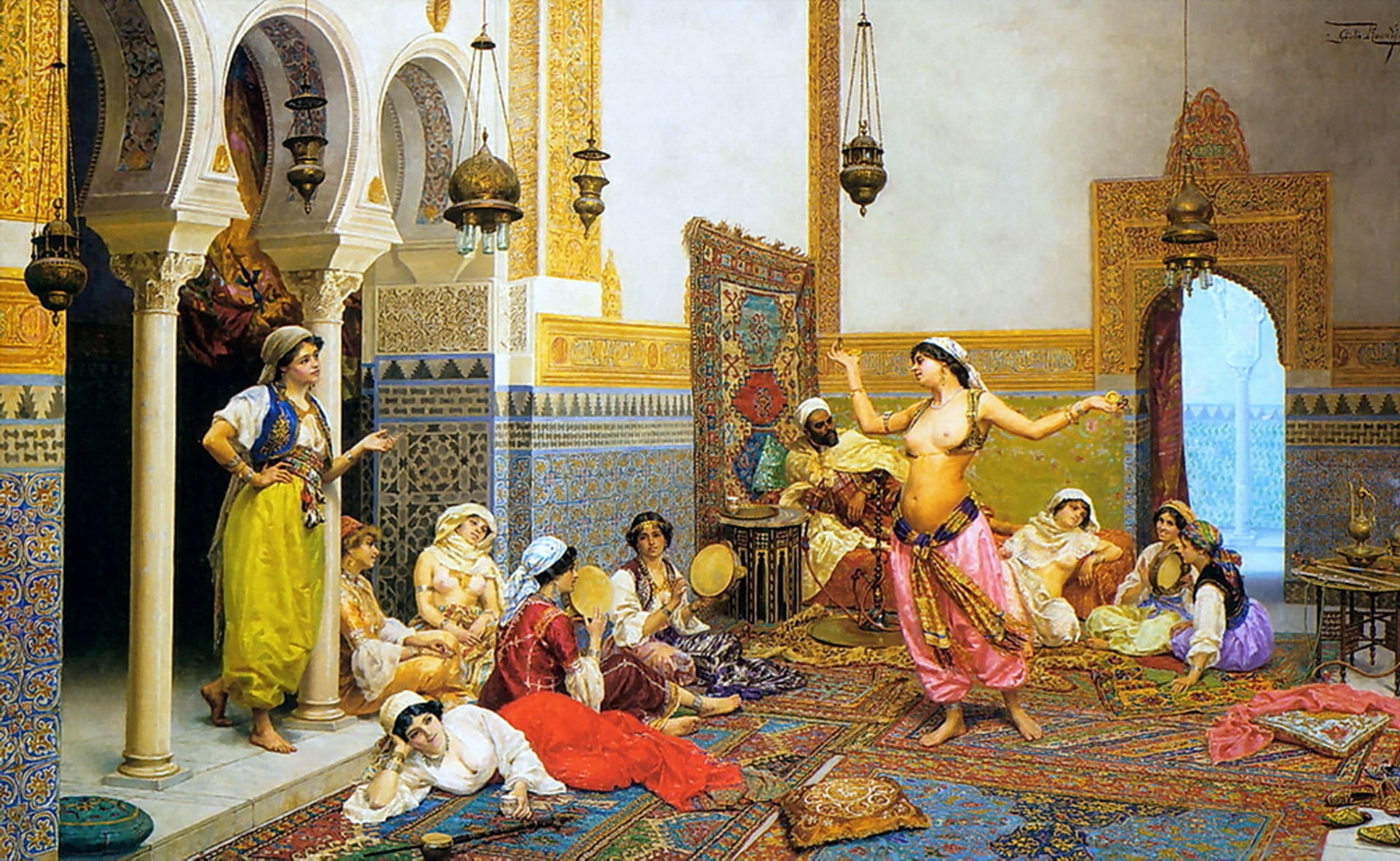
Harem woman is putting on a show for the other ladies. Girls just want to have fun.


The Harem Dance. Giulio Rosati.

The dancer has grabbed the attention of the other harem ladies as she dances away in front of them.


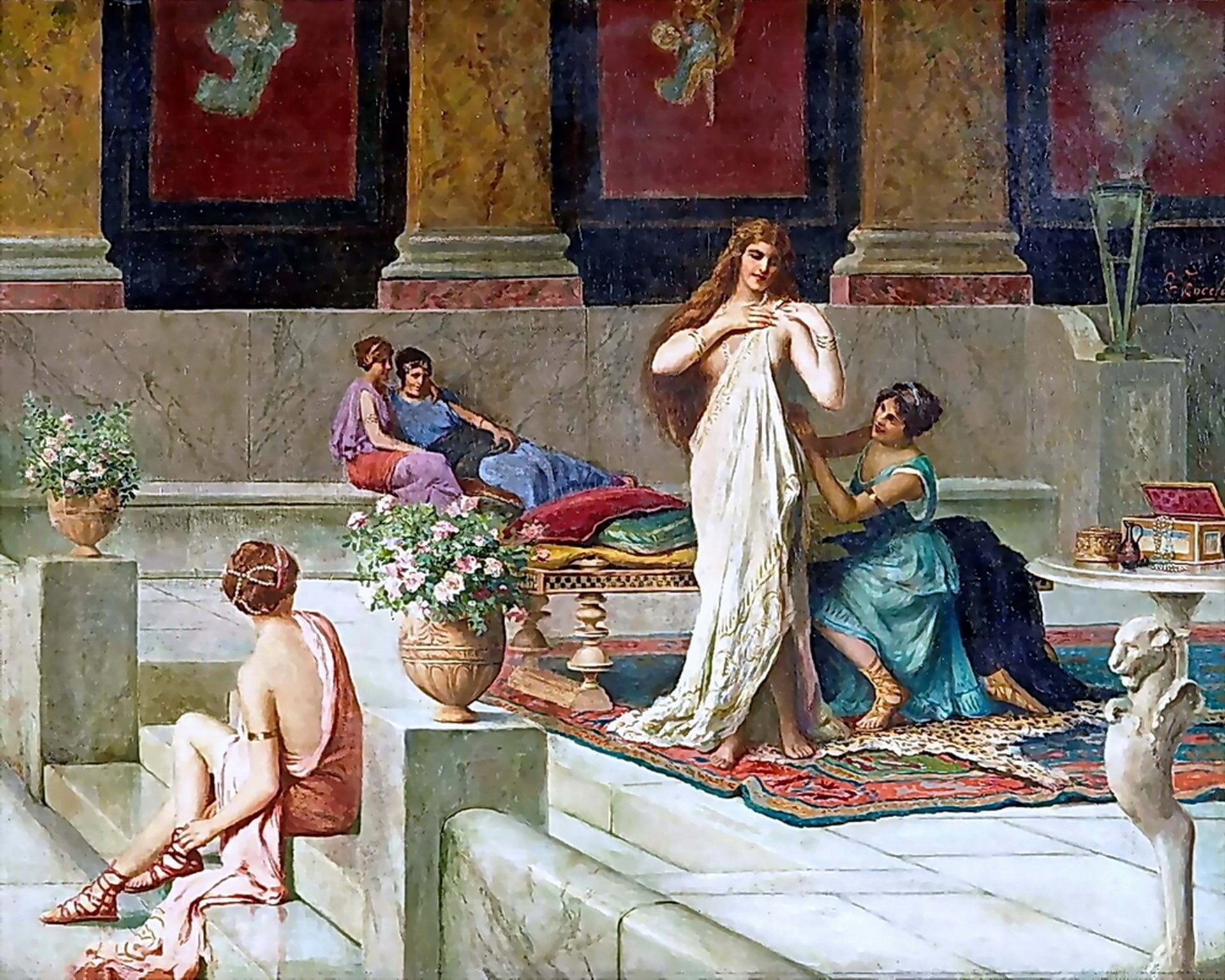
Five lovely ladies in a harem having a quiet time. There are two pots of pink flowers.


Harem Scene. Guglielmo Zocchi.
Five beautiful young women in a Harem with their relaxant smoking over to right hand side. It saves them sharing one around maybe. There are two pots of pretty pink flowers by the stairs.


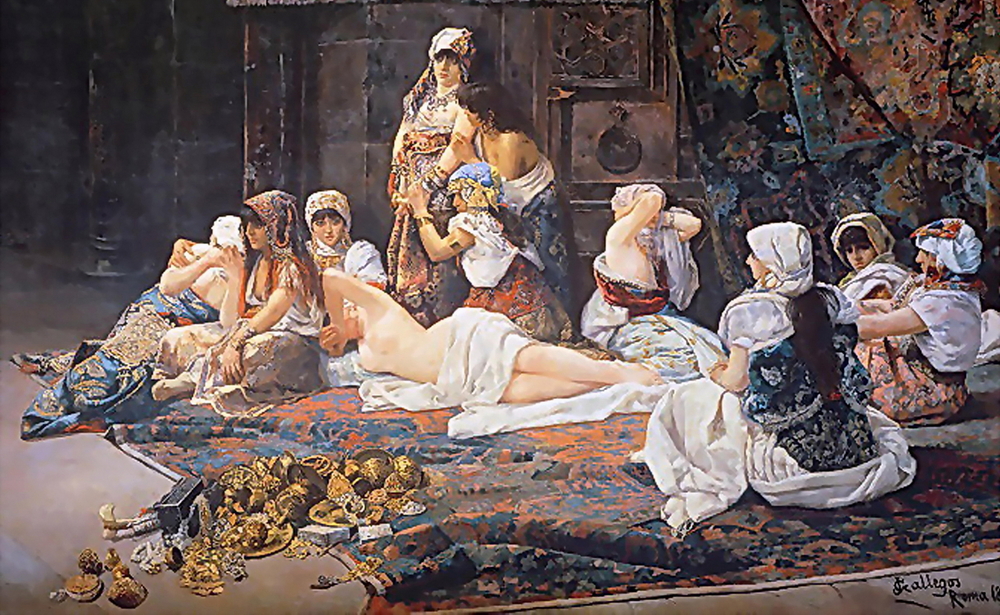
All the young ladies in the Harem. Women sitting around talking.


In the Harem. Jose Gallegos Arnosa.

Eleven women in a harem sitting around enjoying each others company. One girl is crying. Maybe she has just joined the Harem!


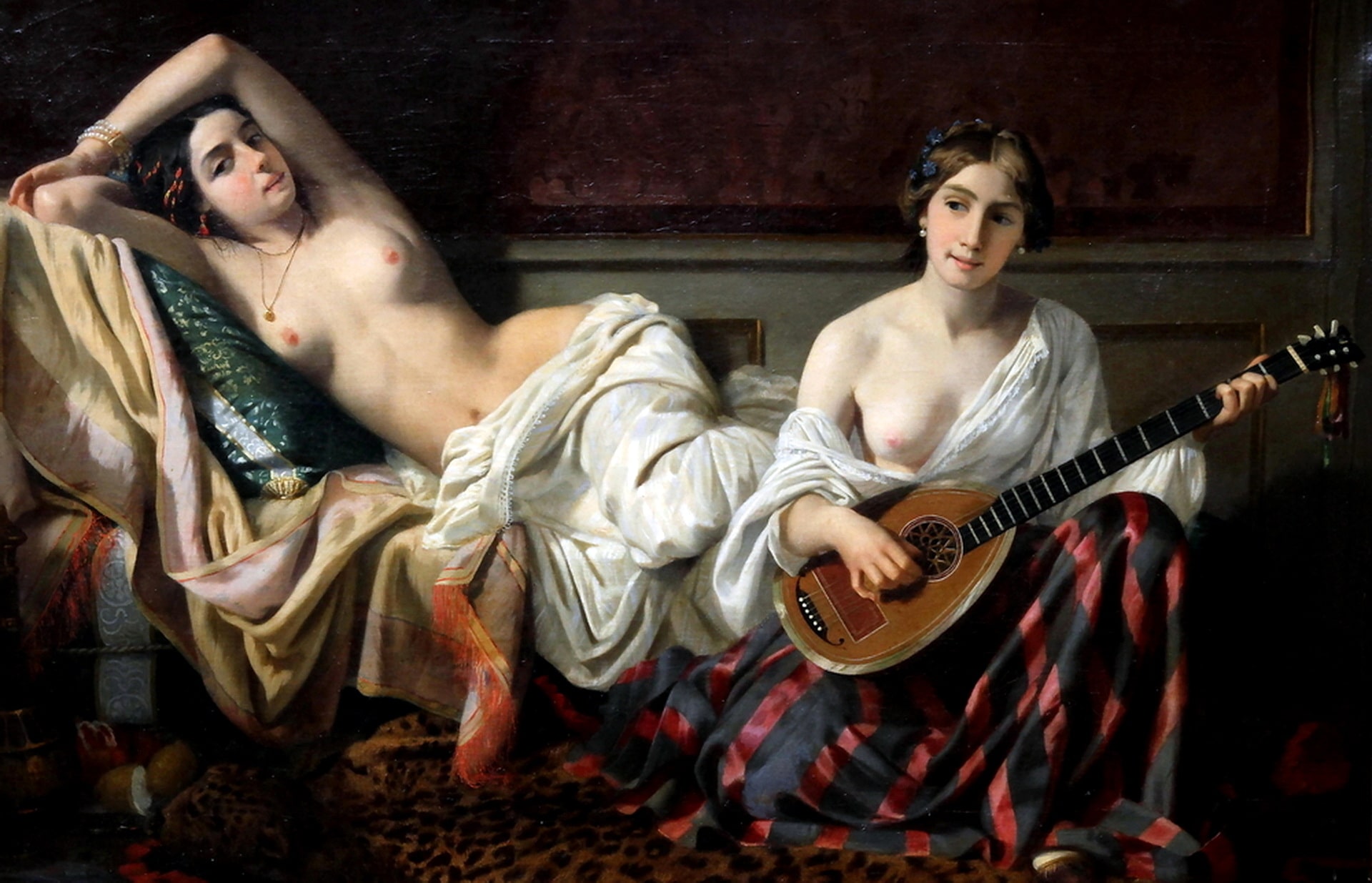
Singing in the harem while playing a guitar for the other lady.


Serenade in the Harem. Joseph Caraud.
One of the girls in the harem is singing and playing the guitar for the other woman on a couch, who is relaxing and displaying her nice breasts.

Lingerie for lovely ladies and hot sexy girls for horny sex.

Kyria Lingerie for luring lovers to make love. Seduce your lover with horny lingerie. Give your tunnel of Love some Love Juice! Whoops! You provide that!

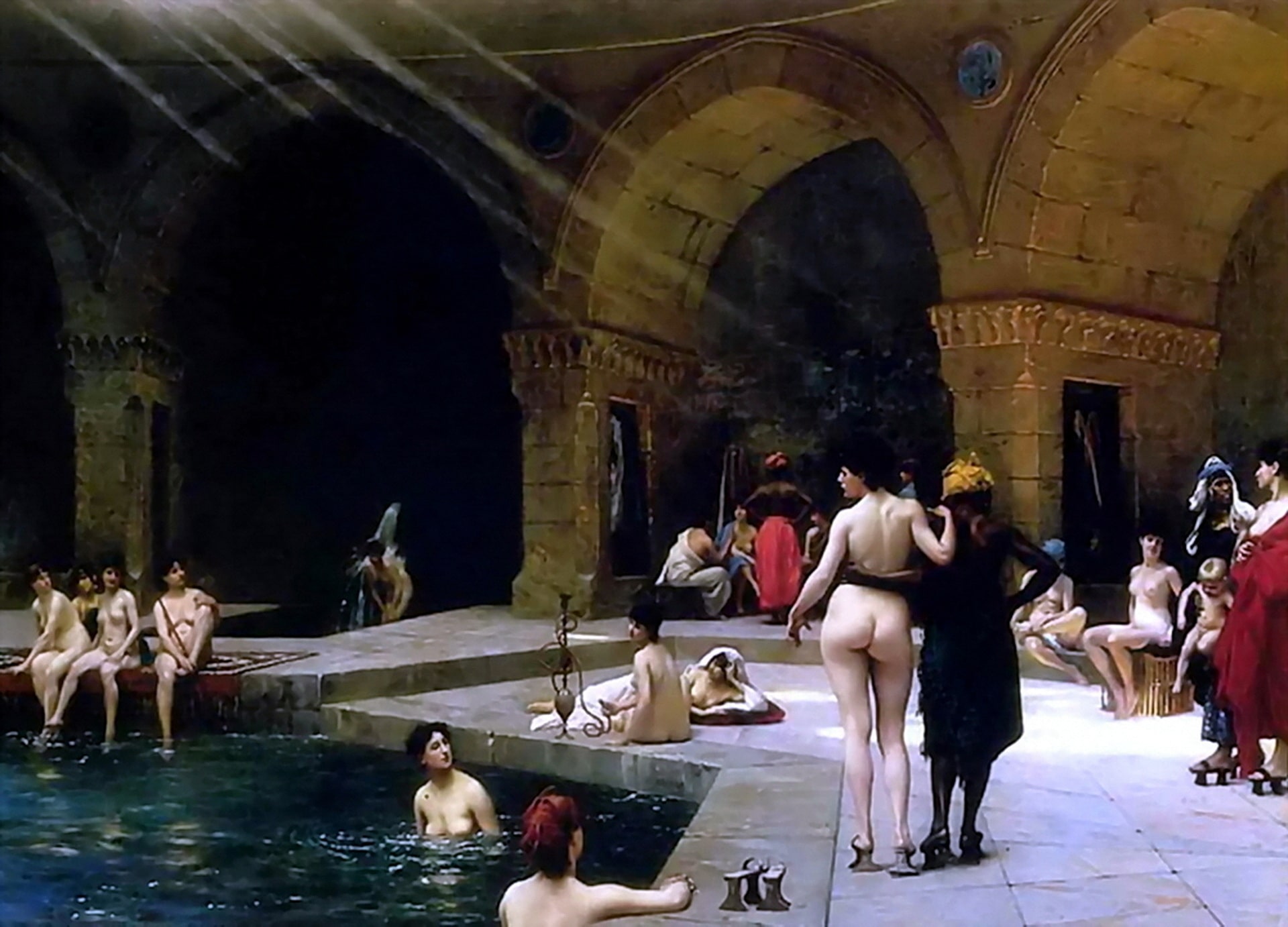
A very big pool for the ladies of the harem. The girls are making good use of the bathing area.


The Grand Bath at Bursa. A painting by Jean Leon Gerome.

There are many girls in this harem using this huge pool. The women are sitting around the pool enjoying the facilities and relaxing.


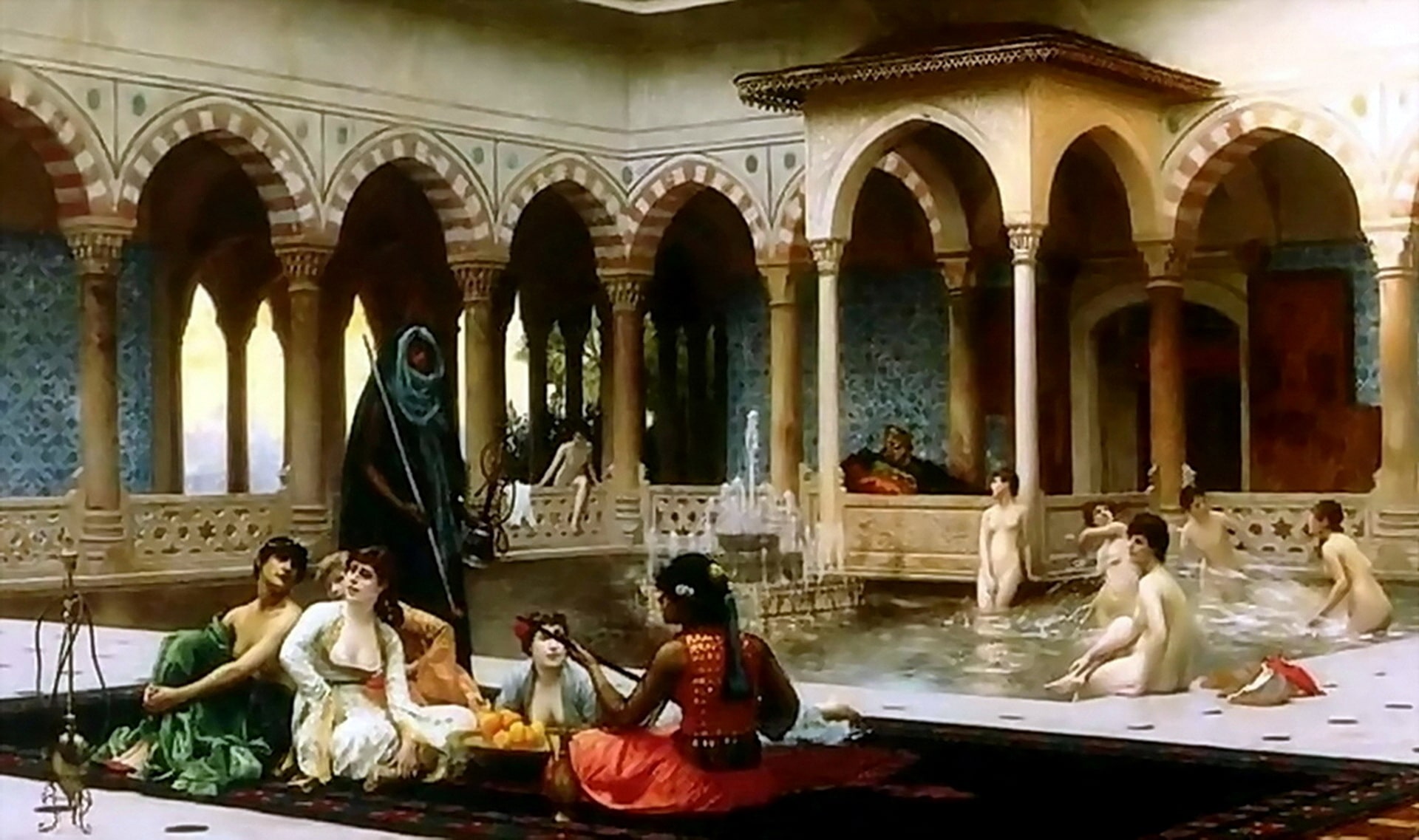
A terrace with a pool and a fountain. The harem girls are having fun in the pool.


The Harem on the Terrace. The artwork is by Jean Leon Gerome.

The girls are are enjoying their balcony area with a swimming pool and a fountain, while others are sitting around sharing a bong and listening to music. Some of the women are playing in the swimming pool. What a great way to relax!


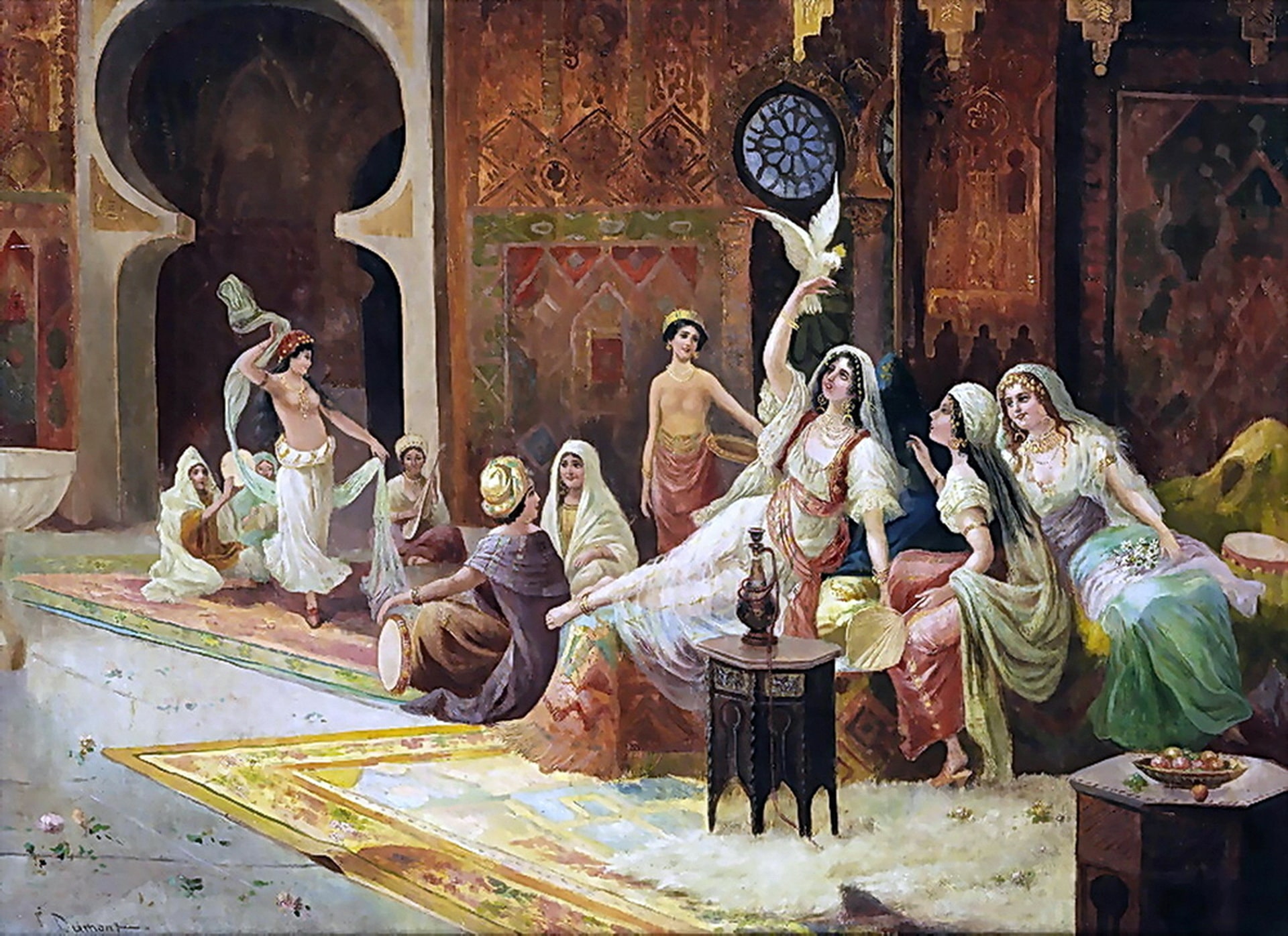
Eleven harem girls having fun and playing with a cockatoo. There are flowers on the floor.


Odalisques in a Harem. By an unknown artist.
Girls from the harem singing and dancing and having fun. They seem to have an Australian Sulphur Crested Cockatoo on the girls hand. It's worth two in the bush! There are flowers scattered around the floor as well.


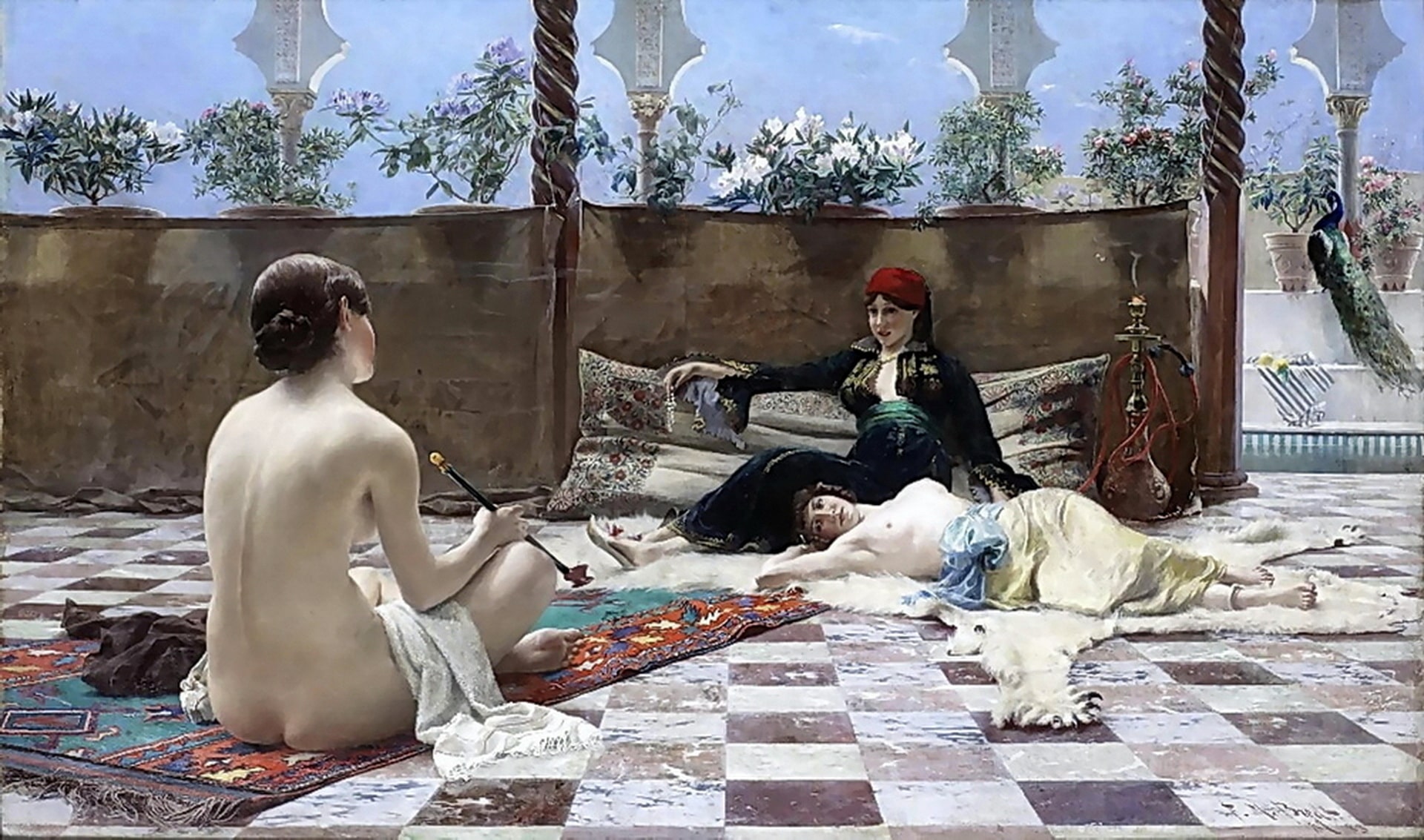
Three harem girls relaxing in a courtyard with one nude woman and pretty flowers.

Turkish Women. Ferdinand Max Bredt.

Three women sitting around sharing a bong while surrounded by lots of lovely flowers and there is a peacock sitting on the fence. One lady is lying back and showing off her bare breasts in a Harem.


Satisfy your desires for pleasure. Boost your orgasms and love making.


Sex toys for boosting a woman's sexuality. They help with bigger orgasms and satisfy a horny girls desires for sexual pleasure.

Sexy Art for Women 1 Find pretty paintings of lovely ladies and beautiful naked women 2.
Sensuous paintings of feminine beauty and lovely nude ladies with flowers and roses 2.
Paintings of very famous lesbians and their lovers 2. Gay ladies and famous females
The naughty nymph’s, sirens, fairies (related) all lust for sex. They are always hot and horny. They are very wicked girls and have sex with males, females, and Satyrs. Even all three at once!.
Harems are the home to Odalisques who provide sexual favours to Sultans.
Odelisques are the girls who provide sexual favours to the Sultans.
Venus the Goddess of Love. Lust,desire and sexual pleasure are what Venus gives to you.
Sexy Art for Women Page 2 Paintings of nude girls and foxy females Lusty ladies showing off their naked bodies in the name of art.
 
Sexy Art for Women 03 Nude paintings can help to improve a woman's sexuality and love.
Sexy Art for Women 04 Naked paintings of sexy women can help girls with better lovemaking.
Sexy Art for Women 5 Discover naked paintings of foxy females and lusty ladies in portraits.
Sexy Art for Women 6 Find nude portraits of sensuous women and flirty females having sexy fun.
 
Sexy Art for Women 7 Find vintage portraits of cute girls showing their sexy breasts.
Sexy Art for Women 8 Beautiful paintings of sexy nude girls and lovely females.
Sexy Art for Women 9 Elegant portraits of sensuous women and seductive females.
Sexy Art for Women 10 Pretty paintings of luscious ladies and dainty females.
Harems page 1 Girls in harems playing while waiting to fulfill their duties.
Vintage paintings of famous Lesbians along with Lesbian love.

IV

MONET’S GARDEN--THE POND IN THE "WATER GARDEN"

Water drew Monet’s brush: the sea, the Seine, the limpid, slumbering surface where the pink and white corollas of Water Lilies summon swarms of will-o’-the-wisps. He rested his brush there for a time, following the parade--which we shall examine in due course--of haystacks, poplars, cathedrals, and Thames scenes, all painted in series. Seen on the gallery wall today, Monet’s early Water Lilies--with their singular allure--seem quite restrained beside the apotheosis of the Tuileries series. At one point, there was talk of expanding the scope of these floral waters to the scale of panels for a banquet hall. Monet watched, listened, said nothing, and pondered, besieged by haunting temptations.
He had already created his garden, the centerpiece of which was a pond filled with Water Lilies. The edge of a large meadow, where a branch of the Epte had been diverted, provided the necessary space, and Monet brought to it the fervor of a determined imagination. Soon, his horticultural successes surpassed all expectations. Even the indifferent came to marvel at the miracle--if only to say: "I have seen Monet's garden."{46}


Monet’s garden ranks among his masterpieces, embodying the charm of nature adapted to the work of the painter of light. It is an extension of the studio into the open air, featuring color palettes lavishly spread in every direction to exercise the eye--feeding a craving for vibrations that a feverish retina seeks to satisfy with joys that are never fully appeased. It is like an infant, newly arrived in the world, groping for the breast it does not yet know, and--once found--loath to let go.
Not that artificial lighting was Monet’s concern. The full intensity of brilliant daylight was not too much for an eye thirsting for the unknown. It was the *plein air* school in the fullest sense of the term: taking a man out under the open sky and inviting him to open his eyes--a task that might seem simple enough. Yet nature arranges nothing for the sake of preconceived effects. It falls to the retina to interrogate the elements, to break them apart and regroup them into a coherent sensory experience--a convergence point within the eye that the painter’s gift lies in expressing. To complete such a work, he needs as much of the universe as possible before his eyes, at every hour of the day. Without knowing why, even the idle among us expend energy on aimless wanderings, trying to discover what they have encountered everywhere but never truly seen--blinded by a retinal inadequacy that the very problem of art seeks to awaken.
The man who sets out to truly express some aspect of the world must himself possess a particularly receptive nature. The entire planet, the whole sky, and all the worlds--nothing less will suffice for him. He senses, and knows, that the diversity of things is boundless. The marvelous fortune of the eye lies in the eternal elemental radiance--the reverberation of shocks as swift as they are distant--where, through eternal sequences, one encounters only moments of space and time: surges of the Infinite within the simultaneous activities of universal interdependence.


The reactions of our visual surfaces are almost instantaneous, allowing for every adaptation of the subject to the object--the primary condition of the art of painting. Fortuitous harmonies and the chance play of the hours provide us with scenes we celebrate as "beautiful landscapes"--unless, of course, we simply pass by without discovering anything at all. It depends above all on what we are capable of seeking there. One of the glories of the modern school was recognizing that even a barren plain can, through the interplay of light, offer a fertile source of the profoundest emotions of beauty.
Although the sea had not spared him the allure of its call, Monet was a man who stayed close to home. Not that he disdained any part of the planet; but life is short, and his artistic calling anchored him to the ground, facing the challenges of the easel. That work was a labor in itself--an organic activity unfolding in methodical successions of effort, in pursuit of an interpretation that was often arduous. Yet what of the gymnastics--whether natural or acquired--of the retinal surface as it captures, for a fleeting moment, the act of transposition through the reactions of sensibilities drawn from everywhere and every era? Where could one find the opportunity, the means, and the methods for the day-to-day realization of this art?
"Everywhere," was Monet’s answer.
The Renaissance placed the school within the Master’s studio--an arrangement that facilitated empirical learning but was all too likely to stifle originality. People had discovered Greece--or rather, a degenerate form of Hellenism. They had not yet thought to look to the sky, the earth, and the waters as interpreters of the world’s ceaselessly renewing creation. If the true aim was to give expression to earth and sky, had the time not come to step outside the walled enclosure and look the world--as the saying goes--straight in the eye?

To speak frankly, I do not believe Monet began by asking himself so many questions. The general balance of his nature inclined him toward a philosophical mindset, yet he lacked the time and means for such broad generalizations. Nevertheless, he would stand joyfully before the challenges of the outside world and view them with a steady eye. Confident in the integrity of his sensibilities, he surrendered himself without reservation to the natural inclinations of his honest conscience--as both man and artist--which never misled him, since he sought success only in truth. He loved fields, flowers, woods, plains, and thickets; skies of every light; mountains under sun or snow; shores; and waters--from ponds and rivers to the Ocean, whether calm or turbulent; he loved every aspect of

Claude MONET.--Waterloo Bridge, Grey Weather, Smoke (1904)
{49}
human existence--joyful or sorrowful--within the various settings of his eventful life. It was his friend Renoir, I believe, who said: "A stream running through the grass is worth the smile of the "Mona Lisa."
The studio, unfortunately, does not provide those outdoor specimens that present themselves freely under the open sky--subjects that "study" seeks out wherever it can, only to transpose them within the confines of an enclosed space. Moreover, the necessity of laboring toward a successful outcome often imposes itself. Monet could not escape this aspect of the general problem when the time came for him to move from "study" to "painting"--that is, from the enclosed world of the studio to the public arena of the Salon. He was truly himself only in the open air. With the *Water Lilies*, towards the end of his life, we see him bringing his studies of the "Water Garden" back to the studio to refine sensations so vivid that no compartmentalization could ever distort them. Such was the nature of working on a grand scale. Moreover, his familiarity with the light had elevated the artist’s eye above any potential shortcomings. It was, in fact, the finest moment of the subtle visual refinements Monet brought back from the depths of his garden’s waters.

For this garden was, in short--as I have said--nothing more than an open-air studio. Monet had no theory regarding it; his empiricism was guided by an instinct too sure for the idea of ​​codifying it to ever cross his mind. Through his travels and by immersing himself in nature wherever he went, he had simply learned what his eye required in the directions where the genius of his art--ever in pursuit of consummate perfection--beckoned him.
There is no need to know how he created his garden. It is certain that he shaped it exactly as his eye dictated, responding to the promptings of each passing day and satisfying his voracious appetite for color. When you learn that Monet’s garden is cut across by a road for automobiles, the Gisors railway line, and a branch of the Epte River, you might well assume that unity is not its defining characteristic. What does it look like? Everything and nothing. Without the road, the railway, and the river--which draws in anglers--one might perhaps have found seclusion there. Yet that is precisely the miracle: one is sheltered there from all intruders.
From the house to the road, sheaves of rainbows--comprising every flower and every magical hue--cascade down from the heavens in a dazzling display, summoned by the painter’s eye at specific moments to provide great torrents of luminous light. Monet loved the flower for its own sake--for the airy lightness and soaring grace of its form, for the drama of love it radiated with such brazen brilliance, and for the profusion of flickering hues--tender or violent--that spread aggressively amidst the giant rosebushes, enchanting eyes weary of life’s prosaic routine.
A wall topped with an iron railing, along with the surrounding trees and the sunken level of the road, ensured there was no need to fear the gaze of passersby. Along those modest garden paths--his alone to roam--Monet, intimately familiar with every clump of blossoms, whether understated or flamboyant, never failed to perform each morning the ritual of that first greeting demanded by the insatiable appeal of the flowers.

A gate allows one to cross the road, and a key grants passage over the railway embankment--screened on all sides by dense thickets of large rhododendrons and a high trellis of climbing roses. Travelers could hardly complain of passing alongside such a vast bouquet of blossoms, while Monet, just a few steps away and absorbed in the mirror of his pond, did not even hear the train.
As for the rest of the garden, strictly speaking, it is little more than a silent pond abloom with brilliant Water Lilies, extending right up to the wisteria-draped arch of a Japanese bridge that forms a perfect picture--the site’s only concession to Romanticism. On the railway side stand tall poplars and willows--whose branches recall those in the Tuileries--alongside a peninsula of tall, bushy bamboo; it is a jungle encircled by a flowing current where lively aquatic grasses weave their way. A perimeter path, trellised with climbing roses, frames vibrant arches of color against the green expanse of the vast meadow stretching toward the slopes of the Seine. Nothing more is needed to create a paradise where the human eye--feasting on incomparable visual delights--can wander through every harmony of light; here, amidst the humming life of the earth, the sun and soil conspire to exalt the fleeting, blissful spark of visions both grandiose and delicate.{52}
In the mirror of the pond--amidst the heavy pads of aquatic foliage framed by reflections of clouds--a burst of petals shimmers, caught in the shifting movements of the sky above, from which the fiery glow of the water or the splendor of celestial calm will alternately emerge. It was here that Monet came to seek the refinement of the most acute sensations. For hours, he sat motionless and silent in his armchair, probing with his gaze--seeking to decipher, within their reflections, the hidden depths of things illuminated in passing by elusive glimmers where mysteries lie concealed. He disdained speech in favor of confronting the silence of fleeting harmonies. Was seeing not understanding? And to see, one needed only to learn how to look. To look outward and inward, to look in every direction, so as to heighten human sensation amidst the universe’s every tremor. The water drank in the light, transposing and sublimating it to a vivid intensity before returning it to retinas startled by unfamiliar reactions.


Therein lies, strictly speaking, the miracle of the "Water Lilies", presenting the order of things to us in a way we had not previously observed. New relationships, new lights. The ever-changing aspects of a universe unaware of itself, yet expressing itself through our sensations. To be granted emotions hitherto unknown--is this not to derive new states of assimilation from the mute Infinite? Is this not to penetrate further into the world itself--into that impenetrable world? This is what Monet discovered while gazing at the sky reflected in his garden pond. And this is what he, in turn, seeks to reveal to us. Many people will be resistant; most will be indifferent. "The public," one might say, is little more than a clamor of misunderstanding. Yet let us be grateful for the silences that are, at times, among the first forms of admiration.
I shall say nothing yet of the execution. It is exactly what it had to be, for it grants us the ecstasy of an unfolding of realities. Who has not felt this emotion--even without fully grasping it at first--when confronted with the dramatic spectacle of the "Water Lilies"?
Ultimately, the workings of the universal world are so closely bound to the forces that stir within us that they can only manifest through corresponding activities--connections sometimes too distant for us to easily perceive. Yet perceive them we must, for our awareness of things is nothing but the world reflected in human sensibility as we witness the unfolding spectacles conjured by the interplay of our sensations. What conclusion can be drawn, other than that there are as many aspects of the world as there are response times--times which, moreover, merge in the flash of universal waves where our evolution may offer us the chance for gradual discernment? It is the fortunate nature of these images (with their margin of the unknown) that they reveal to us the universal connections linking antecedents to successions of consequences that are eternally in motion.

Thus, we simultaneously receive on our visual screen{54}--itself in perpetual flux--indications, more or less coordinated, of what has been and what is coming into being through the elusive relays of Infinity. And for this very reason, the eye--engaged with the inverted planes of still water and sky, and their profound stirrings--imaginatively pursues the phenomenon without ever finding a point where time and space might be fixed within this eternal becoming.
Thus, Monet painted action--the action of the universe grappling with itself to create and perpetuate itself through a series of snapshots caught on the reflective surfaces of his Water Lily Pond. It is a drama crowned by the fiery flash--blinding us in the final Tuileries panel--of the setting sun amidst the withered reeds of the winter marsh, where the enchanting flowers of spring will be reborn, already in preparation within the unfathomable abyss of eternal renewal.{55}

V

THE PUBLIC
Art requires a public for communication and the contagion of sensibilities--that is, a chance encounter of "judges" variously qualified to pass judgment, with provisional authority, on matters where many ought to learn before deciding. It is through this same empirical process that the authority of early human "knowledge" was established. Since the advent of experimental verification, the question of whether one is knowing or dreaming has been referred to the checks of positive observation; this observation delivers a verdict that holds until the next experimental development, reinforced by further verification. When it comes to the emotion evoked by nature--or by the art that purports to express it--the situation is not very different; the issue is less one of a specific emotion than of its justification in the eyes of a public armed with the right to speak and to contradict itself endlessly.


In matters of both intellectual and emotional development, each individual halts at the point that seems best suited to the measure of their own intelligence. Whether faced with revelations, myths, legends, or doctrines of varying soundness, everyone takes--or is expected to take--a stand on humanity’s many disputes. One says yes, another no; and those who, for public or private reasons, prefer to remain silent are graciously spared the Place de Grève--where the practice of having the executioner burn books has long since been abandoned.
In truth, we shall never prevent men from disagreeing, yet approximate common ground can allow for the provisional truces necessary for the evolution of our sensibilities. This forms the very foundation of our "civilization," in which the acquisition and development of both knowledge and emotion are inextricably linked.
The experiences of sensibility that give rise to knowledge lead us to a state of insight into empirically observed relationships; yet, even though this insight constitutes the profound criterion of our intelligence, it is only with great difficulty--and after ages have passed--that we manage to reach agreement on certain points. Conversely, if our sensibility--instead of organizing itself to move toward the determination of relationships that constitute knowledge--surrenders to the full force of its reactions (whether valid or distorted), the result will be states of visceral emotion. These may well, at times, magnificently unite the masses in explosions of shared enthusiasm, but they will not long withstand the test of time. It is in the wake of these flares of fleeting emotion--which momentarily exert such powerful sway over us--that there may emerge, as chance dictates, that common stock of mediocre opinions whose authority the crowd so eagerly seeks as infallible pronouncements.


What, then, is this art-loving public--which differs from the scientific public only in that the latter is required to analyze its judgment within a framework of objectivity, whereas the bearer of emotional interpretations is permitted to appeal merely to the satisfaction of his own sensibility? Hence Sainte-Beuve’s classic retort to Chateaubriand, the apologist of the faith: The question is not whether it is beautiful; the question is whether it is true.
Primitive man--whose legacy is so remarkably perpetuated by our theology--still provides us today with obsolete judgments regarding the world and man himself, judgments to which most of our contemporaries attach greater value than to the most reliably verified empirical observations. The so-called "judge" may possess sound judgment, or his judgment may be flawed; he may possess some knowledge or none at all. An instinctive judgment may hit the mark just as easily as it may go astray. It is itself subject to haphazard criticisms, the accumulation of which--for many--comes to stand in for truth. What combination of ignorance, misunderstanding, and actual knowledge, then, is required for an "authoritative" judgment?
The public for whom Monet was preparing his work was Romantic in spirit--that is, composed of the sort of aesthetes who cannot accept nature without a human veneer. A part of ourselves must inevitably enter into our understanding of elemental relationships, since the infinite world is to man what the absolute is to the relative. Yet this does not seem to me a necessary justification for subjective embellishments. When a neurotic proposes to set the universe right according to the whims of his own decrees, I first take refuge in the wisdom--as it seems to me--of accepting the universe just as it is.
Monet’s "public" had admired great painters who, in their interpretation of light, remained far removed from the sensations of our own day.

Yet Monet paid little heed to the public he nonetheless needed--wholly intent on remaining true to the impulses of his inspiration. I still vividly recall his early sketches of the port of Le Havre, and I retain a clear memory of the surprise caused by that novel quality of light, which conveyed a sense of vibrant reality. Nothing at that stage hinted at the paths that would open up for his restless, searching gaze. A master of synthesis, Monet freely employed the analysis required to assemble the elements of his light-filled compositions. This was evident even in those early Le Havre sketches--works we shall soon see going under the auctioneer’s hammer.
It was in the Latin Quarter that I first met him. My own experiences--ranging from the hospital to the Mazas prison--kept me very busy. He was painting somewhere or other. We quickly hit it off, though we did not meet often. Mutual friends would occasionally bring us together: Dr. Paul Dubois from Nantes, who settled on Rue de Maubeuge immediately after defending his thesis, and Antonin Lafont from Castelsarrasin, who later became a deputy for Paris. He had given a few seascapes to these two friends. People were already saying, with a touch of pride: "It’s a Monet." And the phrase carried weight, for it expressed astonishment--even admiration--at a bold brushstroke: one that was still inexperienced, yet honest in execution and swift to give form to the artist's intent. Upon the deeply lamented death of our dear friend Dr. Paul Dubois, his furnishings were put up for auction; I recall a ripple of surprise running through the crowd when a small, respectable-looking man--with eyes like black diamonds and a smile of intense satisfaction--secured two sketches by Monet without any competition. He had spontaneously offered three hundred francs apiece for them before the auctioneer could even name a price, which would undoubtedly have been far lower. Everyone gazed at this strange Croesus with keen curiosity as, having settled his bill, he walked away carrying under his arm the two paintings that no one had contested.

Soon the man’s identity became known. It was none other than M. Durand-Ruel--well known as one of our finest painting experts--whose action could only be explained by a determination to establish, from that moment on, a price floor below which he would not allow the reputation of an artist with such a promising future to fall. Monet had met him in London in 1870, having been introduced by Daubigny.
While a staunch conservative regarding general ideas, M. Durand-Ruel was--and remained--a resolute innovator when it came to painting. His keen eye for light had recognized the future painter of the *Haystacks* series in that young, bold brushwork which so decisively balanced the red smokestacks against the swell at the harbor entrance. Driven by an unerring sureness of judgment--and with a daring that matched the artist’s own--Durand-Ruel undertook the "artistic promotion" of the future leader of the so-called "Impressionist" school, basing his decision on a sunset painting titled *Impression*. Monet was thirty years old at the time.
A friendship blossomed between the expert and the artist. Thanks to this, Monet was able to give free rein to the inspirations that would carry him to the pinnacle of his art. Who knows? Perhaps the painter’s dogged perseverance might eventually have met with a stroke of luck in the form of an influential admirer. Yet, equally, Monet might have found himself condemned to stockpile masterpieces whose merit would only be recognized after his death.

The self-confidence that characterizes genius does not always--contrary to what one might think--preclude a need (sometimes a pathological one) for external approval. It is a matter of degree. Monet did not need the public to pass personal judgment on his own work. Yet the greatest painter does not paint exclusively for himself; and since his visual perception evolves--like everyone else’s--in relation to a public of varying degrees of enlightenment, a general consensus regarding his name inevitably forms over time. The crucial point{61} is that, for us, time represents life slipping away--uncounted--through the hourglass of eternal flux, and what is lost can never be reclaimed. Time is a joy that beckons, only to flee the moment it appears. It is also a pain that one avoids in the passing, only to encounter it later where one least expected it.
A man intent on living life on his own terms is thought to slight the majority of his contemporaries--people who, for the most part, rely on others to construct a utilitarian, neutral existence, careful not to offend those who, for very good reasons, never let their own personalities give offense to anyone. What torments did Durand-Ruel spare Monet by enabling him to be--and remain--himself, despite the machinations of coalitions of mediocrity! Let thanks be given to him. Through him, Monet received far more than mere financial support from purchases. At the height of the battle, when the good idealist felt beside him the spirited, steadfast confidence that heralded faith in the future, a deep-seated reassurance emboldened that wondrous brush--a brush that could only carry its work forward by daring ever more, meaning it could never fully attain the sought-after result. The greatest success is often wrapped in a tapestry of setbacks. A soldier who dwells on his wounds risks missing out on the finest victory of all: the one won over oneself at the end of the day.
It was already a truly remarkable "success."

Before Durand-Ruel threw his three hundred francs onto the auction block at the Hôtel des Ventes for a mere sketch, the early period saw Monet’s paintings selling for 50 francs apiece. Since this paltry sum left no room for a dealer’s profit, Monet had to offer his wares to collectors himself.
Were there any collectors? Indeed; Paris is a city of miracles. No intellectual movement arises there without encountering--alongside vociferous opponents--adherents ready to embrace new ideas and band together under some grand-sounding name as a group of "forerunners." The name of Édouard Manet had already made waves. Other names, destined for greatness, would follow. A fine artistic contingent would emerge to bring honor to our country: Manet, Boudin, Monet, Renoir, Pissarro, Sisley, Degas, Jongkind, Caillebotte, Cézanne, Berthe Morisot, and Miss Cassatt. It is worth noting that Cézanne had to overcome resistance from Monet himself, who eventually granted him the honor of a place in his room--a space where outstanding works by his fellow fighters were prominently displayed. To say the least, the teachings of the "Impressionist" school--with Claude Monet at its helm--dominated the artistic output of the era.
No one would have dreamed of such a verdict back when the painter was going from door to door, showing his daring canvases to collectors. For 50 francs, you could own a Monet. Yet there were also plenty of worthy souls who declined to share in the glory of that adventure. And yet, a few of these hasty early works have survived--pieces that museums now vie for at unexpected prices.


Foremost among the bourgeois patrons of the new school was Faure, the renowned baritone, who cultivated a reputation as an "art connoisseur"--a status painstakingly earned within the social sphere stretching from Opera subscribers to the stars themselves. This excellent man had reached a point where he could indulge his whims with impunity, and the most natural of these was to adopt a few eccentricities that defied the conventions of the day. He chose the Impressionist school as the object of his enthusiasm, becoming a patron--and even a "friend"--to its leading "masters." He owned fine Manets that hadn't cost him a fortune, and would occasionally place his bets on simple Monets to highlight his benevolent patronage. To this end, good Claude Monet would drop by his famous client’s home from time to time to offer him canvases at fifty francs apiece--purchases the great baritone would make whenever he was in a good mood.
One fine morning, the artist quietly appeared at the celebrated buyer’s home with a painting tucked under his arm. Faure was welcoming and affable.
"I’m glad to see you, my dear friend--especially if you’ve brought me a masterpiece."
"I don’t know. I did my best."
"Let’s have a look. Aha! But this isn't it at all, my dear fellow. If I buy your paintings without haggling, it’s for the *painting* itself. There’s no painting here. You forgot, obviously. Nothing but canvas--that’s not enough. Take it back. Put some paint on it, and I might buy it. You see I’m a good sort, eh? By the way, you can tell me now: what do you think it represents?"
"I don't think." I know it depicts sunrise in the fog at Vétheuil, on the Seine. I was out early in my little skiff, waiting for the light effect. The sun appeared, and--at the risk of displeasing you--I painted what I saw. That may be why you do not like it.


"Ah! Ah! I understand perfectly now. One has to know. Ah! Yes, the Seine, and then the mist that blurs one’s vision at the first flares of light. You can’t see very clearly. But that’s the fog’s fault, isn’t it? Still, there isn’t enough paint. Put a little more paint on it, and I might well buy the painting."
Monet, like a philosopher, goes home and sets his canvas in a corner, facing the wall.
Six years later, in 1879, he has a studio where "connoisseurs" visit him, hoping for a second chance. Here is Faure himself, looking for "some-

Claude MONET.--Vétheuil.
{65}
thing" to his liking. *Sunrise at Vétheuil* is on an easel.
"Ah! You have a rather lovely thing there, my dear friend. A mist of light. The church, the turrets, the houses, the white cornices piercing the clouds... the village--which one cannot see--reflected in the river... Will you take six hundred francs for it?"


And Monet, standing tall, quivering with emotion:
"So, have you forgotten that you refused to pay me fifty francs for it six years ago? Well, let me tell you something today. Not only will you not get it for fifty francs, nor for six hundred, but even if you offered me fifty thousand francs, you still wouldn't have it."
And the baritone walked away, deflated.
The beautiful thing about the story is that *Sunrise at Vétheuil* is still there; the artist never agreed to part with it. It hangs on the wall of the ground-floor studio at Giverny, in full view of visitors, bearing witness to the historic glory of a once-rejected canvas. Monet was thirty-three years old. Here we have striking evidence of the arduous journey from obscurity to apotheosis--a path marked by cruel trials that reveal the incomprehension of a blinded public claiming the right to pass final judgment. It is the most precious document regarding the evolution of our painting as it painstakingly explored the most subtle ways light scatters. *Sunrise at Vétheuil*--with its misty reflections and white tones shimmering on the Seine--sounded the clarion call that heralded the rising of the curtain on the Water Lily Pond.{67}{66}


VI

THE ALL-OUT STRUGGLE
Even today, after a fierce half-century-long battle--the crowning event of which was the unveiling of the *Water Lilies*--one might still encounter more than one "trained" eye putting up a final stand against the fanfare of victory. This might surprise some. Since fortune allowed me to play a tiny part--as a spectator--in a few episodes of the fray, I feel entitled to recall the nature of that merciless struggle in which men like Monet, Degas, and others staked their lives, facing the savage cannonade of a troop of men born blind, waging war against the rays of the sun.
Consider that Faure, who refused to pay 50 francs for *Sunrise at Vétheuil*, had been heaped with abuse for his earlier purchases of those reviled canvases. It is all too easy to forget the nature of that ruthless clash, in which for a long time it seemed the enemy would triumph decisively over innovators who were insulted, mocked, and treated with utter contempt by the most authoritative critics of the official establishment--that dispenser of budgetary absurdities. It took a unique set of circumstances{68} to get *Olympia* into the Louvre. Nor has it likely been forgotten that *A Burial at Ornans* long remained hidden in the shadows of a dark recess where visitors to our great museum had no chance of discovering it. One day, while passing that immortal masterpiece with Monet, I said to him:
"You know, if--after everything we’ve just seen--I were allowed to take away just one canvas, this is the one I would choose."


“Well, for my part, if--after everything we’ve just seen--I were allowed to take one canvas with me, this is the one I’d choose.”
“And I,” he replied without hesitation, “would choose *The Embarkation for Cythera*.”
Thus, the leader of the school--denounced so vehemently by official critics as a denier of art--ranks himself, above all, among the devotees of Watteau’s ethereal light; a master he joins with a smile, even amidst a torrent of abuse. Today, we discover that he had fundamental reasons for doing so.
Let us briefly examine a few aspects of the battle. Gustave Geffroy has provided a summary account--backed by documentary evidence--in his thoroughly researched book on Claude Monet; I can only refer the reader there. I shall take the liberty of offering just a few brief quotations to illustrate the prevailing state of mind at the time. The outrageous nature of the controversy makes such documentation necessary, for in the current triumph of the new school of painting, we may have forgotten--perhaps too quickly--the torrents of crude abuse that greeted young men whose only offense was seeking a greater degree of truth in their interpretation of nature.{69}
At the first Impressionist exhibition (1874)--followed by a sale at the Hôtel Drouot--the journal *Le Charivari* wrote, without any systematic malice: “This painting, at once vague and brutal, strikes us as both an assertion of ignorance and a denial of the beautiful and the true. We are already plagued enough by contrived eccentricities; it is all too easy to attract attention by producing work worse than anything anyone has ever dared to create before.”
That was merely the beginning. The prices fetched were derisory. *Le Figaro*’s commentary was not intended to pave the way for a comeback: “It is the visual equivalent of certain reveries by Wagner in music. The impression created by the ‘Impressionists’ is that of a cat walking across a piano keyboard, or a monkey that has got hold of a paint box.”


The final exhibition (1876). An assessment by M. Albert Wolff in the same *Figaro*:
"Rue Le Peletier is dogged by misfortune. After the fire at the Opera, a new disaster has befallen the neighborhood. An exhibition--purportedly of paintings--has just opened at Durand-Ruel’s. The unsuspecting passerby, drawn by the flags adorning the façade, steps inside, only to be confronted by a ghastly spectacle: five or six madmen--including a woman--a group of wretches afflicted with the delusion of grandeur, have gathered there to display their works... They take canvases, paint, and brushes, slap on a few tones at random, and sign the lot. It is just like at Ville-Évrard, where deranged minds pick up pebbles from the path and imagine they have found diamonds."{70}
After explaining that one must speak "neither of drawing nor of color" to Degas, the same Albert Wolff continues: "And it is this jumble of crude objects that is being exhibited to the public, without a thought for the dire consequences that might ensue. Yesterday, a poor wretch was arrested on Rue Le Peletier; upon leaving the exhibition, he was biting passersby... The members of this coterie, knowing full well that a complete lack of artistic training forever bars them from crossing the deep chasm separating a mere attempt from a work of art, etc., etc..."
I regret having to include the name of M. Huysmans (1880) in this unfortunate list. He refers Monet and his friends to Dr. Charcot, "author of experiments on color perception among hysterics at the Salpêtrière and patients with nervous system disorders." By that time, Monet had already painted some of his powerful canvases. M. Huysmans has effectively answered his own question by contributing to the subscription to gift "Olympia" to the Louvre.
Finally, here is the verdict of M. Roger Ballu, Inspector of Fine Arts (1877): "Messrs. Claude Monet and Cézanne, eager to show their work, have exhibited--the former thirty canvases, the latter fourteen. One must see them to imagine what they are like. They provoke laughter and are pitiful. They betray the most profound ignorance of drawing, composition, and coloring. When children play with paper and paints, they do better."


After this initial burst of extravagance, a few defenders did, however, step forward. Yet it took time to forge them into a force that the "Philistines" of the artistic establishment would be compelled to reckon with. As early as 1876, Castagnary--albeit choosing his words carefully--took a clear stand. "I saw the dawn of this return to honest simplicity breaking," he wrote in *Le Siècle*, "but I did not think such progress would be so rapid. It is undeniable. It is strikingly evident this year. The younger generation has thrown itself into it wholeheartedly, and--without even realizing it--the public is vindicating the innovators. It is the paintings executed *en plein air*--with the sole aim of capturing the truth--that draw the crowds... Well, the Impressionists have played a part in this movement... For these painters, working outdoors is a delight; the pursuit of light tones and the rejection of bitumen are a true act of faith."
Burty--no less qualified--wrote the catalogue for the 1875 exhibition in glowing terms, though not without expressing "reservations regarding the roughness of the brushwork, the sketchiness of the drawing, and the affectation in certain details." For one could not--or rather, dared not--defend "the Impressionists" without adding caveats intended not to alienate the public.
All this led these spirited young artists into a struggle with financial hardship--a plight all too lamentably illustrated by the following letter (1875) from Édouard Manet to Théodore Duret:
"My dear Duret,
"I went to see Monet yesterday. I found him in despair and completely down on his luck. He asked me to find someone who would buy ten to twenty of his paintings--his choice--at a hundred francs apiece. Would you like us to handle this together--five hundred francs each?" "Of course, everyone--he first and foremost--will be unaware that we are the ones behind the deal. I had considered a dealer or some random collector, but I foresee the possibility of a refusal.
"Unfortunately, it takes someone with our expertise to pull off such an excellent deal--despite any potential qualms--while simultaneously doing a talented man a good turn. Please reply as soon as possible, or arrange a meeting.
"Best regards."


"E. MANET."
This letter, so honorable to all concerned, needs no commentary. There was no lack, moreover, of other expressions of friendship that--in moments of doubt and even in times of success--were no less precious to him. Witness the following letter from Octave Mirbeau, which should likely be dated between 1885 and 1890:
"Come now, come now, be reasonable. You feel you are done for because the snow melted instead of staying on the ground as you had wished. That is childishness. There is only one thing that should concern you: your art. Are you progressing, or are you in decline? Those are the only two questions you should ask yourself. Well, my friend--take my word for it--in the last three years you have made giant strides. You have discovered new things. Your art has expanded; it has embraced the realm of the possible.{73} You are, in this day and age, the only artist who has endowed painting with something it did not possess before. And your vision is widening still. You are at the height of your powers. You are the strongest, and the most subtle too; the one who will leave behind the greatest influence. And you say you are done for? Yet the other day you told me, regarding your figure in the sunlight: 'It was something I hadn't done before; a thrill my painting hadn't yet conveyed.' And now, you say you are done for... You are talking nonsense, my dear Monet; it is sad to see a man of your stature--rare indeed--and of your unique talent, reduced to drivelling on about such stupidities. And it is not just my view. It is the opinion of everyone who follows your work and loves you." With every new series, they say, that devil of a Monet gives us something else again. There is even more depth, more penetration, more mastery of execution. And that is the absolute truth. The truth, too, is that you are experiencing--perhaps without realizing it--a sense of unease that is purely physical and purely critical in nature. It affects your morale, as most ailments do. The task is to dispel this unease, and the rest will vanish. Every man of your age has gone through this, and will go through it.»


Édouard Manet died poor, having succumbed too soon, whereas Monet grew wealthy as he aged. When Manet offered 500 francs to help his friend, he was likely giving every penny he had available. Later, when Monet finally sold his paintings, he lavished assistance on everyone around him. The two men were worthy of one another.{74}
“And the vindication?” Durand-Ruel was asked later.
He replied:
“It is complete. A painting I remember withdrawing from sale at 110 francs later fetched 70,000 francs at auction. Another, bought for 50 francs and resold I know not how many times--driving every successive collector to distraction--has recently risen to over 100,000 francs.”
That vindication strikes me as remarkable, indeed; yet I admit it would satisfy me no more than it did Monet himself, were this rise in monetary value not matched by a sincerely enthusiastic appreciation of the work actually achieved. I do not forget that the public can be mistaken--even the so-called “enlightened” public that foists upon us, in the Louvre’s great gallery, *The Apotheosis of Homer*, *Joan of Arc*, and *The Sultana*, alongside Monet’s *Self-Portrait*, *Olympia*, *A Burial at Ornans*, and so many other masterpieces. Yet one can expect this same public to undergo the inevitable evolution, as the natural development of its vision draws it toward states of sensibility that will enable it to assimilate, ever more closely, the spectacles of a changing world. The world is governed by laws--not, as was too long believed, by whims--and since the supreme law is one of continuous evolution toward successive harmonies, whatever accords with this state of affairs may provisionally be taken for granted.{75}

Harems page 1 Girls in harems playing while waiting to fulfill their duties.
Vintage paintings of famous Lesbians along with Lesbian love.


©7th June 2024 sexyartforwomen.

Lovely ladies and beautiful women who keep the Sultan sexually satisfied! Hot sex! Sexy Art of Women in a Harem 2. Female Erotica and Feminine Beauty.