Sexy Art for Women 6.
Female Erotica and Feminine Beauty.
![]() |
|||
This post contains affiliate links, we may receive a commission if you make a purchase using these links.


|
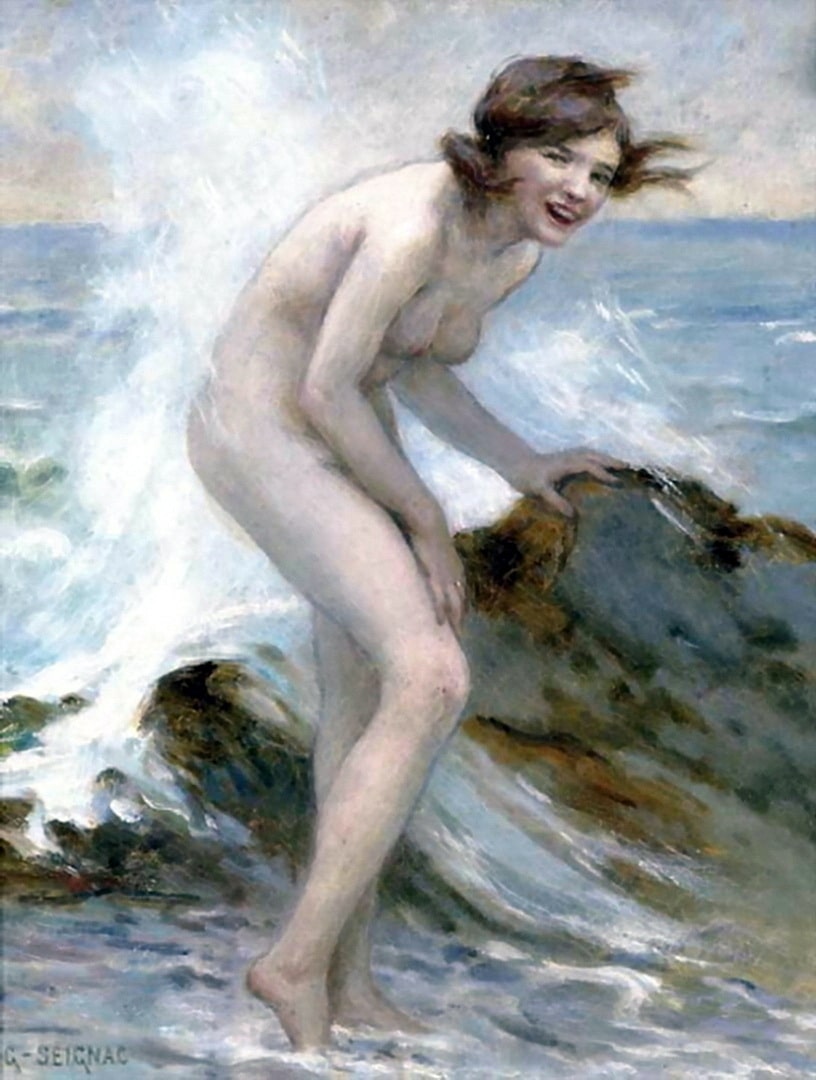
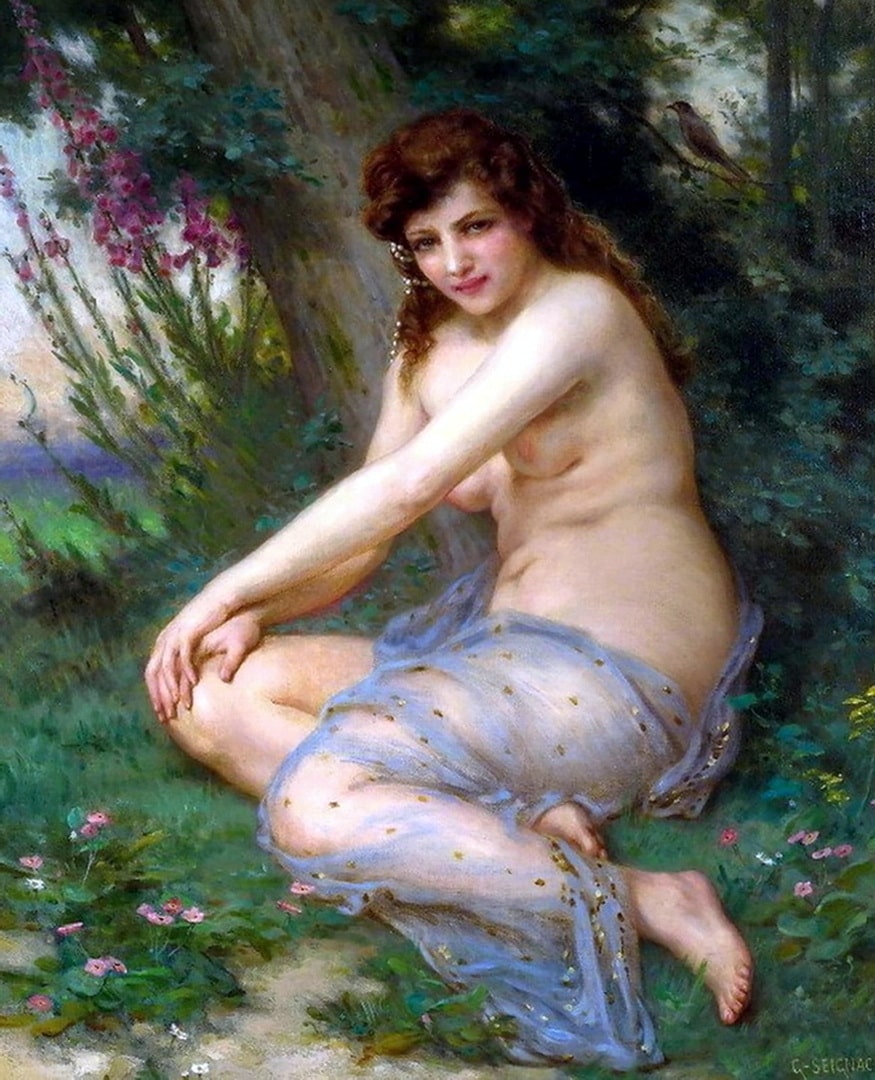
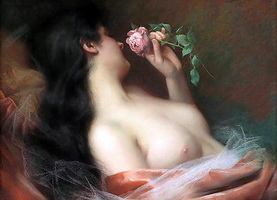
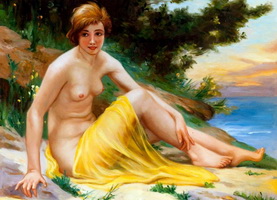
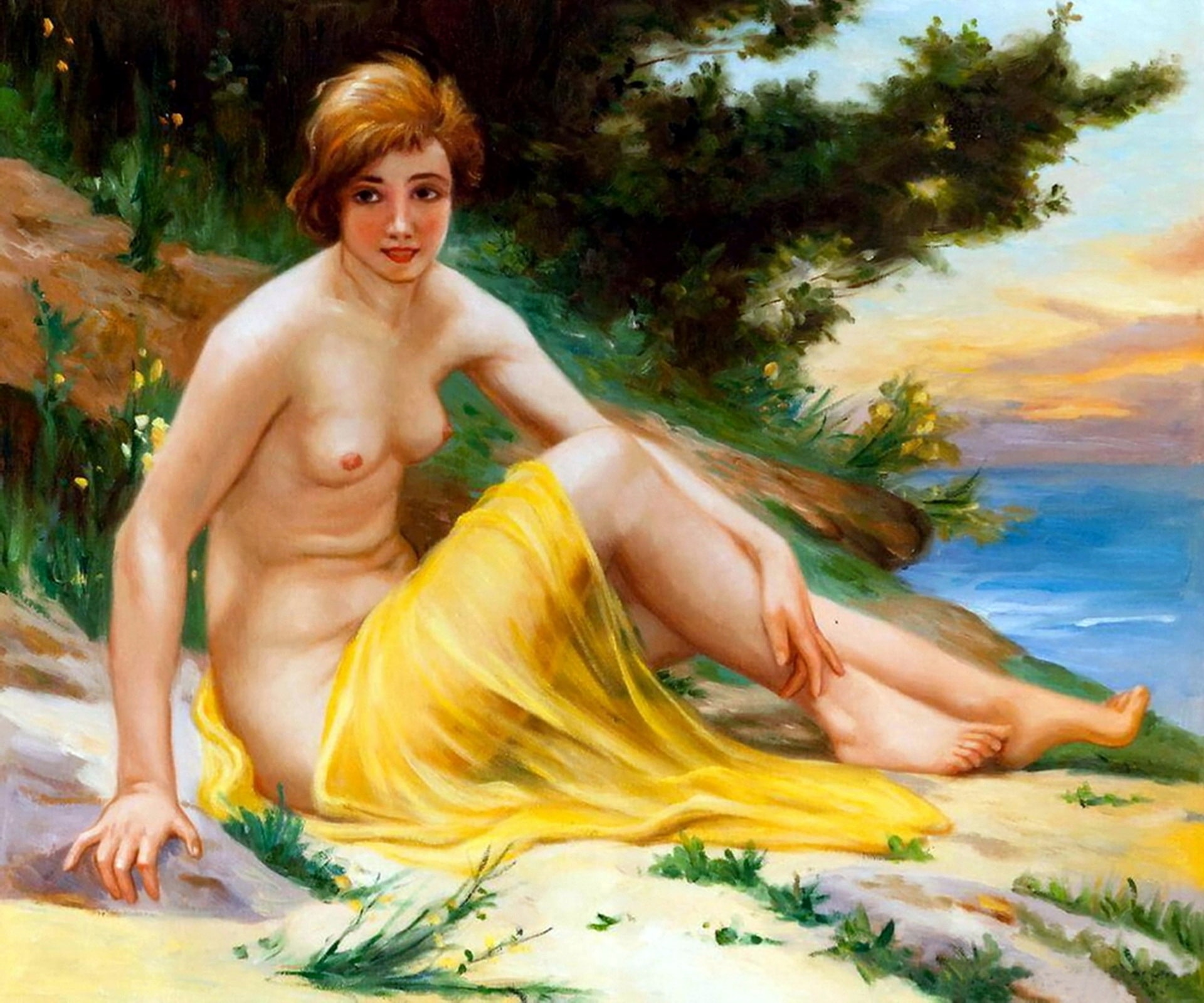
She is having fun in the sun and letting her tits hang loose!The beautiful girl has a pretty smile and lovely eyes. Her buxom breasts are enjoying some salt air. This happy young woman certainly knows how to have a good time on her own. All I can say is keep up the good work! Salt water is very good for you. The Polish people that were hiding in salt caves from The Germans in War War 2 had many of their ailments disappear! Pilots who crashed and burned in the sea recovered from their injuries much faster than those who didn't! Salt water gets rid of acne fast and it's free! We are pleased to offer adult this content to you. |



More paintings this way. |
|||
![]() |
THE NEO-IMPRESSIONISTS. THE Impressionists, although they turned their backs upon casual selectivism and branched out into analytic research, had contrary to the generally accepted opinion no precise and scientific method of colour application. This came later with the advent of a group of painters who have been called, in turn, Pointillists, Divisionists, Chromo-luminarists and Neo-Impressionists, but who chose to regard themselves only as the last of these four designations. And there is perhaps more logic in this nomenclature, for it is not limited technically; it contains no claim to achievement as does Chromo-luminarism; and it suggests this new school’s consanguinity with the movement out of which it grew. With Delacroix’s Journal, the pictures of Claude Monet and Chevreul’s pioneer treatise on colour, De la Loi du Contraste Simultané des Couleurs, the Neo-Impressionists evolved a coldly scientific method of technique. By carrying a simple premise to its ultimate conclusion, regardless of everything save the exacting demands of logic, they endeavoured to heighten the emotional effect of the Impressionist vision. In this movement, as in other similar ones, can be detected the spirit165 which animates the ardent visionary when he contemplates a novel method the spirit which invites him to go to even greater extremes. In it there is as much enthusiasm as serious purpose, as much of the essence of youth as of the arriviste. In no instance has such a spirit led to significant results; and the Neo-Impressionists prove no exception. In looking too fixedly at means, they lost sight of their ends. Their début took place at the last concerted exhibition of the Impressionists in 1886 where the canvases of Seurat and Signac were hung beside those of Cassatt, Bracquemond, Morisot, Camille and Lucien Pissarro, Gauguin, Guillaumin, Redon, Schuffenecker, Tillot, Degas, Forain and Vignon. Here was seen for the first time the logical extension of the earlier methods of Monet and Pissarro. Georges Seurat had once been a good student at the Beaux-Arts, but his quick, precise and questioning intelligence had saved him from falling under the professorial injunctions. Most of his studying was done in the art museums where he contemplated for long the old masters. Here he discovered that “there are analogous laws which govern line, tone, colour and composition, as much with Rubens as with Raphael, with Michelangelo as with Delacroix: rhythm, measure and contrast.” (By rhythm, measure and contrast he meant curved lines, space and opposition.) Still searching for the secrets of art he studied the works of the Orient and the writings of Chevreul, Superville, Humbert, Blanc, Rood and Helmholtz. Then, by analysing Delacroix, he found substantiation for his discoveries. The result of this study 166was, as Signac tells us, his “judicious and fertile theory of contrasts.” From 1882 on he applied it to all his canvases. The theory in brief was to use scientifically opposed spots of colour of more or less purity. This method he might have learned direct from the first modern French master, for in that artist’s Journal are discussed at length colour division; optical admixture; the dramatic unity of colour, line and subject; and the juxtaposition of complementaries for brilliancy. Paul Signac’s evolution was different. He had first been under the influence of Pissarro, Renoir, Monet and Guillaumin, and though being a zealous pupil of their methods, he knew little of their motives. It was only after he had observed the interplay and contrast of colours in nature that he sought explanation in the works of his masters, the Impressionists. Failing, he turned again to nature. In copying it, he discovered that in the gradation from one colour to another, let us say from blue to orange, the transition was always muddy and disagreeable when mixed on the palette, although if distinct spots of these two colours were juxtaposed in alternating ratio, the modulation would be smooth and clean. This observation impelled him to seek a method whereby this “passage” could be highly clarified. Consequently he completely divided the Impressionists’ spots so that each individual touch remained pure and at the same time left patches of the white canvas showing for purposes of brilliancy. His next step led him to Chevreul whose theory of complementaries he 167committed to memory. His technical education he now deemed complete. Seurat and Signac first met at the Salon des Artistes Indépendants in 1884, and their discoveries were at once mutually appropriated. Signac’s colour divisions, combined with Seurat’s more scholarly equilibrium of elements, formed the nucleus from which evolved the Neo-Impressionists who later repudiated Impressionism, using it only as the point from which they leapt off into a morass of set formulas. It was a laudable desire on the part of these new men, especially of Seurat, to try to snatch from a purely inspirational school its halo of mystery and to place painting methods on a sound rationalistic basis. But while they were right in believing a picture should be more than the visual accompaniment to sentiments, they should have gone deeper than the mere exterior of painting. For example, they should have tried to see in what plastic way their colour theories could be used, instead of limiting themselves to the synthetic unity of aesthetic illustration. And they should have tried to make a form-producing faculty of their light instead of introducing into it another poetic element in the shape of dramatic line. But they were more concerned with the clothes in the wardrobe of art than in its body. Their painting, as-a result, was without sustaining structure.
With the Impressionists, as with all significant art movements, the desire for change and for higher emotional power came first: the method came later. With the Neo-Impressionists this order was reversed. Their canvases for this reason are less emotional than those of their forerunners. By limiting their palettes to168 certain pure colours they restricted their diversity of interest. Even their aim at a scientific art has gone far of the mark because their science was in many instances faulty. By conditioning their methods on the observations of inaccurate writers they were able to progress only so far as these observations went. Chevreul is far from authoritative today: in fact there is no comprehensive scientific work on colour in existence. Tudor-Hart, the greatest of all colour scientists, has blasted many of the older accepted theories of such men as Helmholtz, Rood and Chevreul, and his experiments have shown conclusively that many of their postulates are unreliable. The Neo-Impressionists were unaware of Chevreul’s errors, and their minds were too literal to enable them to make new and more advanced observations in the realm of colour. The meagre attention paid them is not due to their novelty, but to the fact that they have done nothing the Impressionists did not do better. They are like a cartridge which, having all the combustible ingredients, fails to explode because it is wet. The Neo-Impressionists may, in refutation, point to music as a scientific art. But it must be remembered that taste brought about the construction of chords and that the mathematical explanation came later. The primitive peoples who found an aesthetic pleasure in broken-up major chords were ignorant of nodal points and the laws of vibration. The early Assyrians had a pipe of three notes, C, E and G, perfectly attuned, yet they were ignorant 169of the science of harmony. Taste in the arts has always come first: science follows with its interpretations. The Impressionists, through instinct, created their marvels of light and atmosphere. Afterward the science of optics explained their efforts. Personal taste was their only criterion, and no books could have taught them their lesson, because their methods were so plastic that whatever was to them artistically consistent was right. Had they been familiar with science, it still would have remained to be applied: and it is only by the superimposition of taste that knowledge in the artist becomes pregnant. The Divisionists, by making a hard and fast code of science, enslaved themselves to the demands of theories. The functioning of their tastes was nullified. They therefore fell short of art. In Signac’s book, D’Eugène Delacroix au Néo-Impressionnisme, are explained many points of divergence between this school and that of the Impressionists. The difference of the two methods may be exemplified by describing the manner in which each approached a landscape wherein the grass and foliage were partly in shadow and partly in sunlight. In such a landscape the artist’s eye records a fleeting, dimly-felt impression of red in that part of the green of the shadow which is nearest the light region. The Impressionists, satisfied with having experienced this sensation, hastened to put a touch of red on their canvas, while the actual colour in nature might have been an orange, a vermilion, or even a purple. In this haphazard choice of a red Signac detected slovenliness. He says that the shadow of any colour is always lightly tinted with the colour’s complementary; that if the light is yellow-green the shadow will be touched170 with violet; if orange, the shadow will contain blue-green. Had the Impressionists known this fact and cared to use it, says Signac, they could have made their pictures scientifically correct by posing the exact complementary of light in their shadow. And he adds that it is difficult to see in just what way this process would have harmed their work. It is, however, not so difficult as he imagines. If, in copying nature by a strictly scientific vision as the Neo-Impressionists advocate, we closely study the light, we will discover not only that a local colour is modified by the colour of the sun’s rays, but that an added suite of colours is introduced by the absorption of some of the object’s particles, by the encompassing air, and by the circumjacent reflections. We may have (1) the local colour which, let us say, is green, (2) the colour of sunlight, (3) the colour caused by atmospheric conditions, (4) the reflection of sky, and (5) the reflection of the ground. Furthermore, if the object has any indentures their shadows will lower to a limited degree the whole tone of the object. At the least calculation then we have (1) green, (2) yellow-orange, (3) any colour in the cold region of the spectrum, (4) blue or violet, and (5) green, brown, Venetian red or any colour in the warm region of the spectrum: all of which colours change and shift unceasingly, dependent on the density of the air which obscures, to a lesser or greater degree, the sun’s rays and hence changes the reflection from sky and ground, thereby modifying the local colour. Thus it is impossible when copying nature even to determine the colour of its lightened parts. And if a colour premise cannot be established, it is obviously 171impossible to find its exact complementary. Suppose we admit that an approximate colour can be recorded for that part of the landscape’s green which is in the light, that is, the green whose complement is to be placed on the outskirts of the shadow. Let us say that this green is technically a yellow-green, since it is in the sun. Now the complement of yellow-green is not, as the Neo-Impressionists hold, violet, but red-violet or purple. But, were red-violet used in the shadow, its effect would be false, because, in order for yellow-green to call up its pure complementary, the light itself must be an intense yellow-green so intense in fact that the local colour of the object (whatever it is) is entirely absorbed and unable to influence the light. Then, and only then, would the shadow be pure purple, for the local colour, being nullified, would not interfere with the optical sensation of complementaries. But on an object which appears yellow-green in the light, the yellow of which is the sun’s rays and the green the local colour, the shadow also is modified by the local colour in the same proportion that the light is modified, only its modification is in an opposite direction; that is, the yellow of the sun’s rays, in raising green to yellow-green, lowers the green of the shadow to blue-green. Therefore the shadow is not the complementary of the light colour. But in the darkest part of the shadow, which is the boundary dividing it from the light, there is a sensation of red derived from purple, purple being the complementary of the yellow-green. Thus in a blue object, though the pure complementary of the lighted part would be orange, the shadow in sunlight is merely dark blue with that fugitive sensation of red through it. In the shadow on such an object172 Signac calls for pure orange, claiming that a vermilion, a lake or a purple is out of place. His colour science in the abstract may be unimpeachable, but his physics is faulty. The sensation caused by the complementary of the lighted part is that of a reddish tint; and so long as the painter introduces a colour into the shadow so as to give this impression of red, he is at least empirically, though not scientifically, correct. There is only a sensation of red, not a definite spot where red can be placed; and for the canvas to be truthful emotionally there must be only that sensation of red in the painted shadow. And the only way to produce it without making a spot of orange, which is a light colour and which in its pure state has no properties in common with shadow, is to use a colour which is intimately connected with shadow and which contains the elements of both light and shadow. Thus in the cold bluish-orange shadow of a blue object there must be placed a cold lake or a purple which partakes of both the light and shadow and therefore does not offend the eye by its isolation. In the bluish or blue-green shadow of a yellow-green object, a purple is too aggressive and blatant, while a blue-violet or an attenuated violet is doubly harmonious. Indeed there is another reason why complementaries should not be used, but merely their approximations set down. Perfect complementaries neutralise each other and, when optically mixed or applied in such small particles in a pure state that at a short distance the eye cannot distinguish their limitations, produce a metallic and acid grey173 which is to colour harmony what noise is to music. When C and G? are struck together the sensitive ear revolts in the same way a sensitive eye revolts at complementaries in colour. But while in music a minor, or diminished, fifth is displeasing, by increasing or reducing the interval a semitone, by making it, for instance, C F or C G, a pleasing effect can be obtained. In colour also this principle holds good. The complementary combination of red and green is harsh, but by placing red with one of the spectrum tones on either side of green a pleasurable harmony is at once established. The Impressionists through instinct generally made use of colours which primitively or softly harmonised, again proving the ascendency of taste over system, for if taste is sensitive it will be verified by science. Science, however, cannot create taste. When we consider the Neo-Impressionists’ antagonistic and neutralising complementaries, it is difficult to understand their criticism of Impressionism. The Impressionists, they said, “put a little of everything everywhere, and in the resulting polychromatic tumult there were antagonistic elements: in neutralising each other, they deadened the ensemble of the picture.” Now in the entire range of colour from violet to yellow there is hardly a possible dual combination which cannot be made harmonious by the addition of one or two other colours. In this process of complication lie the infinite harmonic possibilities of sound as well as of colour. There are no two notes in music which, though when struck together are jarring, cannot be drawn 174into a perfect chord by the introduction of certain other notes. And any two lines, no matter how inapposite, can be aesthetically related by other lines properly placed. Even were the Neo-Impressionists, in their criticism, referring to the placing of blue in light and of yellow in shadow, they would still be open to refutation, for their predecessors, by placing on their canvases the colours they had felt in contemplating their models, were once more emotionally right although not exactly right from the standpoint of abstract science. With all the brilliancy of their pure pigments the Neo-Impressionists have yet to produce a canvas as brilliant or as harmonious as those of the Impressionists. The reason is not far to seek. In an Impressionist picture there is a certain amount of neutrality caused by mixing the colour of light with that of blue shadow; and this mixture heightens the scintillation of the ensemble. The Divisionists, on the other hand, went so far as to abolish neutrality altogether. In raising all values to a point of saturation, they diminished the brilliancy of the picture as a whole. It is to be doubted seriously if even Signac is still of the belief that the Pointillists’ squares of colour blend optically. Theoretically they should, but actually the impression we receive is not one of vibrant light. We see only an extended series of spots which are all about the same size a size which was varied but little as the dimensions of the canvas varied, as was the case with the Impressionists. But these latter artists mixed their spots not only on the palette but on the canvas as well, and blent them into neighbouring spots. The result was a richly decorated surface175 whose minute parts do not foist themselves upon our sight. But in Signac, Cross, Van Rysselberghe, Dubois-Pillet, Luce, Petitjean, Van de Velde or Augrand, who developed these means to their ultimate limits, these spots are so displeasing and obtrusive that it is mentally impossible to lose sight of them in the contemplation of the pictures. All of these artists produce flat work, with the possible exception of Van Rysselberghe who has merely superposed this technique on an obvious and insensitive academism. He is to the Neo-Impressionists what Henri Martin is to Monet.
There has been too much credit taken by the Neo-Impressionists for the discovery of this stippling technique. As a matter of fact it is not wholly original with them. Turner, Constable, Delacroix, Jongkind, Fantin-Latour, Cézanne and the Impressionists were all interested in breaking nature up into parts in order to arrive at a dynamic representation of the whole. The process with them was commendable, but the Chromo-luminarists carried it to such an extreme that they saw nature only in order to break it into spots. They repudiate vehemently the appellation of Pointillists, and the name that Émile Bernard gave them Pointists has remained beneath their notice. They point out that one may be a Pointillist without being a Divisionist, for Pointillism is the using of colour in spots so as to avoid its flat application, while “division” is the application of separated spots of pure pigment for the purpose of bringing about an optical admixture. The idea of optical admixture was born when some one placed several planes of different colours on a disc and, by revolving it rapidly, caused them to blend perfectly. Immediately the Neo-Impressionists jumped to the conclusion that176 distance would accomplish the same result with any-sized spots. This assumption was their initial error. There is a very definite limit to the size of colour spots which at a distance will blend optically, and the artists of this school, with the one exception of Seurat, made their spots too large. Delacroix never juxtaposed large strips of complementaries in45 one plane, but applied hachures of almost the same tint. The effect would have been little different had he painted flatly, except for the richer matière this method produced. The Impressionists mixed their colours both on the palette and on the canvas, except when they wished to reproduce a certain texture that called for small lights and shadows placed side by side. And Cézanne modulated his colour spots so that there were no jumps or hiatuses between them. The Neo-Impressionistic methods have no such subtleties. In applying their colour these painters keep each spot separated from its neighbour by a tiny bit of white canvas which is intended to give added light to each part. The spots are unmixed and are applied straight from the palette in preponderating proportions to obtain certain general colour impressions. They use only the seven colours of the prismatic spectrum, and in thus restricting their palette they have limited their range of greys. Since nature itself is a series of high-pitched greys in which only occasionally does a pure colour appear, they were inadequately equipped for reproducing it. If, by raising all tints to their purity, they hoped to obtain the maximum of colouration and therefore the maximum of luminosity, they overlooked the fact that to produce any177 light whatever there must be negation or shadow. They failed to achieve light because they equalised the brilliancy of all colours. Even to produce colour there must be black or grey. Their equilibrium of elements led to the cold grey aspect of their work and to the acid and inharmonious effect of their colour. The desire of the Neo-Impressionists to improve upon the Impressionistic vision was a sincere one, and in their striving for dramatic means for heightening the already intense emotional power of their forerunners’ work, they showed themselves to be animated by an ambition for change and improvement without which no vital innovation can be made. Their desire was commendable, but their science was inadequate. Their modern spirit was best shown in their search for the significance of line in its harmonic relation to colour and tone. The impetus to this search emanated from Seurat who dictated to his biographer, Jules Christophe: “Art is harmony; harmony is the analogy of contraries (contrasts), the analogy of likes (gradated), of tone, of tint, of line; tone, that is to say, the light and dark; tint, that is to say, red and its complement green, orange and blue, yellow and violet; line, that is to say, horizontal directions.... The means of expression is the optical admixture of tones and tints and of their reactions (shadows) following fixed laws.” Delacroix had already turned his eyes in the direction of the harmony of lines and colours. It will be recalled that he wrote in his Journal: “If to a composition, interesting in its choice of subject, you add a disposition of lines, which augments the impression, a chiaroscuro which178 seizes the imagination, and a colour which is adapted to the characters, it is then a harmony, and its combinations are so adapted that they produce a unique song..... It is good not to let each brush stroke melt into the others; they will appear uniform at a certain distance by the sympathetic law which associates them.” The Neo-Impressionists, taking their cue from Seurat’s observations, state that the first consideration of a painter before a blank canvas should be to determine what curves and what arabesques are going to divide the surface, and what colours and tones cover it. Even in this aim they went further than the Impressionists who neither ordered nor synthesised their works formally. The Neo-Impressionists say they do not commence a canvas until they have determined its complete arrangement. Then, guided by tradition and science, they harmonise the composition with their conception. That is to say, they adapt the lines, colours and tones to an order which aesthetically expresses the character of emotion their model calls up in them. They hold that horizontal lines give calm; ascending lines, joy; descending lines, sorrow; and that the intermediary lines represent the infinite variations of emotions that lie outside these first three types. But they offer no explanation of the analogies between these intermediate lines and the kinds of emotion they are supposed to call up. They go on to explain that hot tints and light tonalities should be applied to ascending lines, cold tints and sombre tonalities to descending lines, and an equal amount of light and dark to 179the horizontal lines. “Thus,” they add, “the painter becomes a creator and a poet.” All this theorising would be important for the dramatic illustrators were it entirely true. But while a line placed horizontally may represent calm, the same line made perpendicular or laid at an angle of forty-five degrees will also produce calm. The straight line varies so little in its significance, no matter at what angle it is placed, that its direction is negligible from an emotional standpoint. The degree of curve in a line is its emotional element, and only when varying curves come in contact is the highest formal emotion obtained. The straight line is the lifeless, the static, the immobile. As such it can serve only as a foil to the curved line, for it is the straight that makes the curved of value. Their theory concerning hot colours and high tones is sounder than their linear theory; but in copying a joyous landscape is one not forced to put on high tonalities and hot colours, since it is in seeing these high values that we experience the sensation of joy? And is it not from the low values in nature that we receive our sensation of sorrow? One may accentuate the colours and tones, but if they are too strongly intensified they will approach the other extreme and produce dead and mournful landscapes. This accentuation the Neo-Impressionists carried to the limit permitted by their pigments. Their ideas of line and of joyous and sombre colours are undoubtedly of value if profoundly and extensively comprehended and properly applied. But, in order to become significant, line must only delimit organisation and become volume; and colour, instead of merely producing joy and sorrow, must180 bring about form. Then again, there is that world lying on the further side of flatness which must be explored. With all their theorising and attempts to obtain brilliancy, the Neo-Impressionists produce only grey work. From the first these artists were too coldly intellectual, and it matters little whether their science was right or wrong when we contemplate their pictures. Were their science perfect they could never have created art which goes beyond the arabesque and the poetry of arrangement, for they were not fundamental even in their aims. They have all painted different subjects in slightly varying manners, but, apart from Seurat’s, all their canvases have these things in common: a uniform range of colour, a set method of technique, and the hard and “noisy” contrasts which in their larger works produce a veritable din. Those of the Neo-Impressionists who are still living claim to have completed Cézanne, Pissarro and Delacroix, to have perfected a method, to have expanded logically the Impressionists to something worth while, to be in accord with Rood and Chevreul, to have brought great harmony into painting, to have taken painting into the pure realms of poesy and symphonic musical composition. Alas, that their claims have no substantiation in our receptivities!
Seurat, the founder, was the only genuinely artistic man of the movement, and an early death denied him his chance to develop. Though seduced by too exacting a process, he has nevertheless given us some sensitive and delicately beautiful canvases. Le Chahut, Le Cirque and Un Dimanche à la Grande-Jatte are saturated with light, and in them is an undeniable order181 of parallel lines. His colours were never as harsh and acid as those of his confrères, and his pictures have a blond tonality which the other men of the movement entirely lack. His crayon drawings, from the standpoint of tonal experimentation, are interesting and seem almost like paintings. He had a great talent, and had he lived we might have expected great things from it. He was more vitally interested in style than in technical methods, and in his conclusions stemmed directly from Delacroix. His spottings were much smaller and more effective than those of the other Pointillists. His desire was to express an idea through the medium of nature, not to copy nature in order to relate the sensation it gave the artist. His painting was synthetic. All details and accidents of colour and silhouette he set aside as useless. His is an art of parallels and analogies, of sensitivity and analysis; in fact, it has all those qualities which, were they present in greater strength, would produce significant pictures. He was of one piece; and his development, once he had begun to paint, was an even one toward a definite goal. In him, alone of the members of the group, we find an artist and not an illustrator. Those who liken him to Aubrey Beardsley have less reason for their comparison than the ones who see parallels between Gainsborough and Renoir. Compare the quoted remarks of Seurat concerning tone, line and colour with Signac’s summing up of his method, and the temperamental differences between the artist and the scientist will at once be seen. Signac says his method is “observation of the laws of colour, the exclusive use of pure tints, the renunciation of all attenuated mixings, and 182the methodical equilibrium of elements.” One of the most noted followers of the Neo-Impressionistic methods was the Hollander, Vincent van Gogh. Although generally considered in critical essays as an unrelated phenomenon in the art heavens, he is closely allied to Signac and to Delacroix through Seurat. He adopted painting, one is inclined to believe, because his verbal eloquence was inadequate to bring the Belgian miners to repentance. He had studied for the ministry, but like most men who, finding themselves strictly limited in one vocation, essay another, he found himself equally limited in his second. He drifted back to Holland and began to study painting in the studio of Mauve, a relative of his by marriage. His ardent, even flamboyant, desire to do good to everyone who crossed his path needed an outlet, and he found an emotional substitute for pamphleteering in the physical and mental exertion of painting. In this work he could preach unchecked, secure from arrest. He loved Millet because Millet loved the down-trodden. He loved Delacroix because of that artist’s dramatic inspiration. He loved Daumier because he imagined he saw in Daumier a satire on the beast in man. He loved Monticelli because in that Provençal he sensed a wild gypsy mind and a kindred unrestraint in the use of colour. And he loved Diaz because Diaz was a poetic woodman. Before coming to Paris Van Gogh had studied in the Antwerp Academy, and while in the French capital he met and183 was influenced by Pissarro. Here he also became acquainted with Bernard and Gauguin, adopting the Divisionistic methods from Seurat. He used only pure colours on his palette and mixed them only with white and black. Later he went to Arles where in two years, from 1887 and 1889, he painted the great bulk of his work, averaging four canvases a week through sickness, drink, insanity and disease. In him we have a perfect example of just how little can be done with pure enthusiasm unorganised by intellectual processes. His pictures display an entire lack of order, whether it be of colour, line or silhouette: there was never any form in them. His work is plainly the labour of the fanatic who, in a fury of pent-up desire to express himself, suddenly seizes a palette and brush and applies colours almost at random. Indeed, some of his pictures were completed in a few minutes. Even many of those in which the symbology had to be thought out at length, were painted in an hour. That Van Gogh was an illustrator is undeniable; but he was an illustrator of the abstract gropings of an unbalanced mind avid for dramatic emotions, rather than of exterior nature. His landscapes seem to portend the calm before some great upheaval, or to express a supernatural energy poised for an act of total annihilation. In them there are frenzied lines running zigzag and at random, and rolling clouds of purple and lurid yellow hanging over raucously bright roofs. His portraits remain with us as memories of a feverish nightmare. They are too hollow and immaterial to appear even as a depiction of form. His colours carried out this feeling of dramatic terror, and because they were not harmonised with either line or tone, they became all the more184 chaotic. He never kept to the spots that Signac and Seurat had given him. His impatience was too great; the fire burned too furiously. He elongated them into strips like straw, and they give his work the appearance of haystacks. He covered with one stroke more space than Seurat covered with twenty strokes. This has been called his own apport to art. In Gauguin, however, the same stroke is used, not so heavily loaded with pure colour, to be sure, but just as long. But in Gauguin the strokes are less noticeable because they all have an analogous direction. With Van Gogh they rush wildly about, now one way, now another, sometimes covering the canvas entirely, sometimes separated to let the white show through. This separating was not done for the same reasons as in Signac, but because Van Gogh’s impatience was too great to permit him to go back and cover. His figures are outlined in broad black or coloured lines, and colours are juxtaposed with their complementaries. In a Portrait d’Homme, done in 1889, the background is laid in with a bright green over which are superimposed polka-dots of pure vermilion surrounded by a darker green, the whole striped with yellow and light vermilion flourishes. On this is a yellowish face whose pompadour hair is made of black, vermilion and light violet. The collar is light green, red and blue; the striped cravat, red and white; the coat, violet and green; the shirt, pure green outlined in pure lake, 185with orange buttons on it; and the picture’s inscription Vincent, Arles, ’89 is signed in vermilion. In this painting is evidenced his impetuous method. He seemed to feel that the greater the exertion, the greater the relief from that repressed passion which egged him on to action.
Landscapes he liked, and he took pleasure in doing copies of other men. In such works there was no hard and set reality to follow as in still-lives and portraiture. Here the colour could be splashed on almost haphazardly. He himself said that still-life was a relaxation. He felt this because to paint still-life his enthusiasm was restricted. Anything served for a subject an old boot, a single vase, a coffee-pot. One imagines he tossed these models onto a table from the opposite side of the room, and painted them in whatever position they fell. In this carelessness the public sees “inspiration.” And indeed his canvases were inspired, but only in the same way a starving man is inspired to throw himself upon a sumptuous meal. He painted because he was forced to, and when painting is merely a physical necessity indulged in to express an unordered religious mania, it ceases to interest the aesthetician who searches for a complete cosmos bodied forth in subjective form. As a decorator Van Gogh is too turbulent and forward; as a painter of easel pictures he is too chaotic and unintelligible; but as a blast of misdirected enthusiasm he is not without power. His symbolism, while not being of the variety which presents Grecian figures as abstract virtues, is nevertheless of the same order. He tells us that in painting a young man he loved, he would make the head a golden yellow and orange, and the background 186a rich and intense blue, as well as transcribing the physical likeness to epitomise his love. Thus depicted the young man would be “like a bright star in the boundless infinite taking on a mysterious importance.” Again he writes: “Had I had the strength to continue, I would have done saints and holy women from nature, who would have seemed to belong to another age. They would have been the bourgeois of the present, having many parallels with the old primitive Christians.” We see what he was after. Van Gogh possessed all the modern socialistic ideals. He held that individuals could do nothing alone, but should work in communities, one doing the colour, one the drawing, another the composition, etc. In his desire for this democratic art factory is seen his absence of self-confidence. It is not strange when we consider his adherence all his life to so childish a technical programme as Divisionism. This adherence marked the main difference between him-and Gauguin. The latter detested the Divisionistic method. He wanted to adapt nature’s colour and effect to decoration, while Van Gogh wanted to make only abstract dramatic tapestries. They both succeeded; and though the canvases of Gauguin have the peaceful utilitarian destiny of interior decoration awaiting them, Van Gogh’s work, once we are rid of the modern habit of welcoming all disorganised and purely enthusiastic work as profound, will be laid aside forever. He was psychiatric and expended the greater part of his feverish energy through the channel of painting. But he did little more than use a borrowed and inharmonious palette to express ideas wholly outside the realm of art. Continued at the bottom of the next page. |
|||
![]() |
Improving female sexuality using sexy pleasures such as nude art.
Boost your sexual desires here!
© 7th June 2024 sexyartforwomen.
Sexy Art for Women of hot sexy girls and horny women along with a foxy lady or two.
Female Erotica and Feminine Beauty.