SexyArt forWomen 3.

Female Erotica and Feminine Beauty.

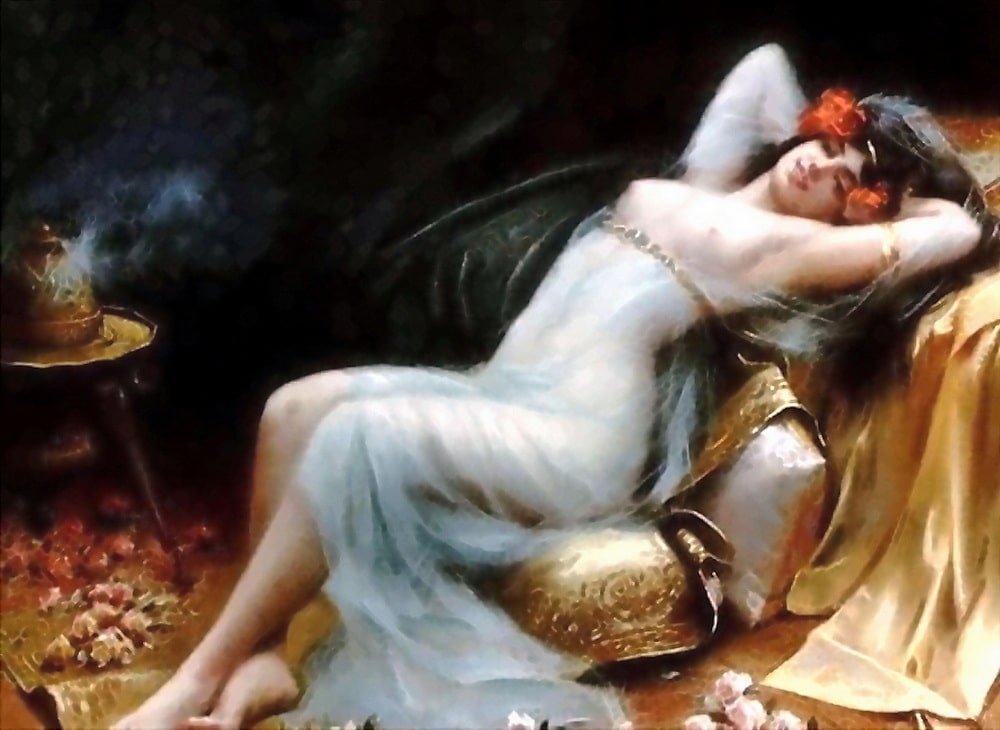
The pretty odalisque is wearing a see-through light blue dress and she has alluring eyes.


Odalisque With Flowers. Delphin Enjolras.

The sexy girl is displaying her alluring breasts. The young lady is wearing as see-through pale blue dress & has red roses in her hair. The cute woman is in a harem and she gives sexual favours to the Sultan, because that's what harem girls do. This cute young lady just might be a favourite of the Sultan's. If she is hot for sex every time she goes to the Sultan, she probably will get looked after better. Having said that, there is a relaxant going beside her which would boost her amorousness. By the time she gets to the Sultan she might be very hot and horny for sex. Her breasts are outstanding and apparently her nipples seem to be in the mood for sex already. She has lovely eyes and luscious lips, all the better to eat him with. The young lady seem totally relaxed and ready to fuck! What do they put in that steamer??? There's quiet a few ladies that could use a bit of help from these steamers. Especially, the women who had a traumer when they were younger. That sort of thing on the mind doesn't help a relationship. A romance like that can only go so far before it hits a road block. Meanwhile, enjoy the nude art & erotica for sexy women.

Sexy Art for Wome Page 2 with saucy paintings of naked women as well as hot nude girls and fleshy females You will also find wicked art of luscious ladies There are many naughty females on here for you to look at for sexy fun!
Sexy art for Women page 4 with sexy paintings of horny nude women and lusty ladies Discover many seductive paintings of arousing naked females for your pleasure Be happy with lovely paintings of hot girls


Lite Erotic Art 1 Find pretty paintings of lovely ladies and beautiful naked women.
Sensuous paintings of feminine beauty and lovely nude ladies with flowers and roses.
Paintings of very famous lesbians and their lovers.
Naughty nymphs lust for sexy. They are always horny. The Sirens are close relatives of them.


This post contains affiliate links, we may receive acommission if you make a purchase using these links.


Contents.

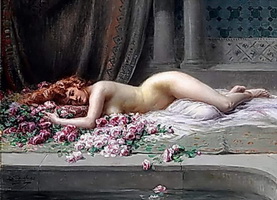
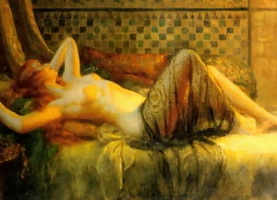
A lovely naked lady is lying on a bed of pink roses. A beautiful painting of a girl.

Naked. Delphin Enjolras.

The sensuous girl is nude and lying on a bed of roses. There are flowers everywhere! The saucy lady with sexy breasts. Not only that, the steamy girl looks very comfortable on the roses. Just watch out for the pricks! Somebody is going to get very lucky tonight! They'll get ravished, then ravished again. Just for giving someone lots and lots of flowers. Roses do that to a girl, don't they? That is, make her all hot and steamy. She'll have some fun tonight. Some guys are a bit slow and don't realise what an effect flowers have on a woman! It's like magic!

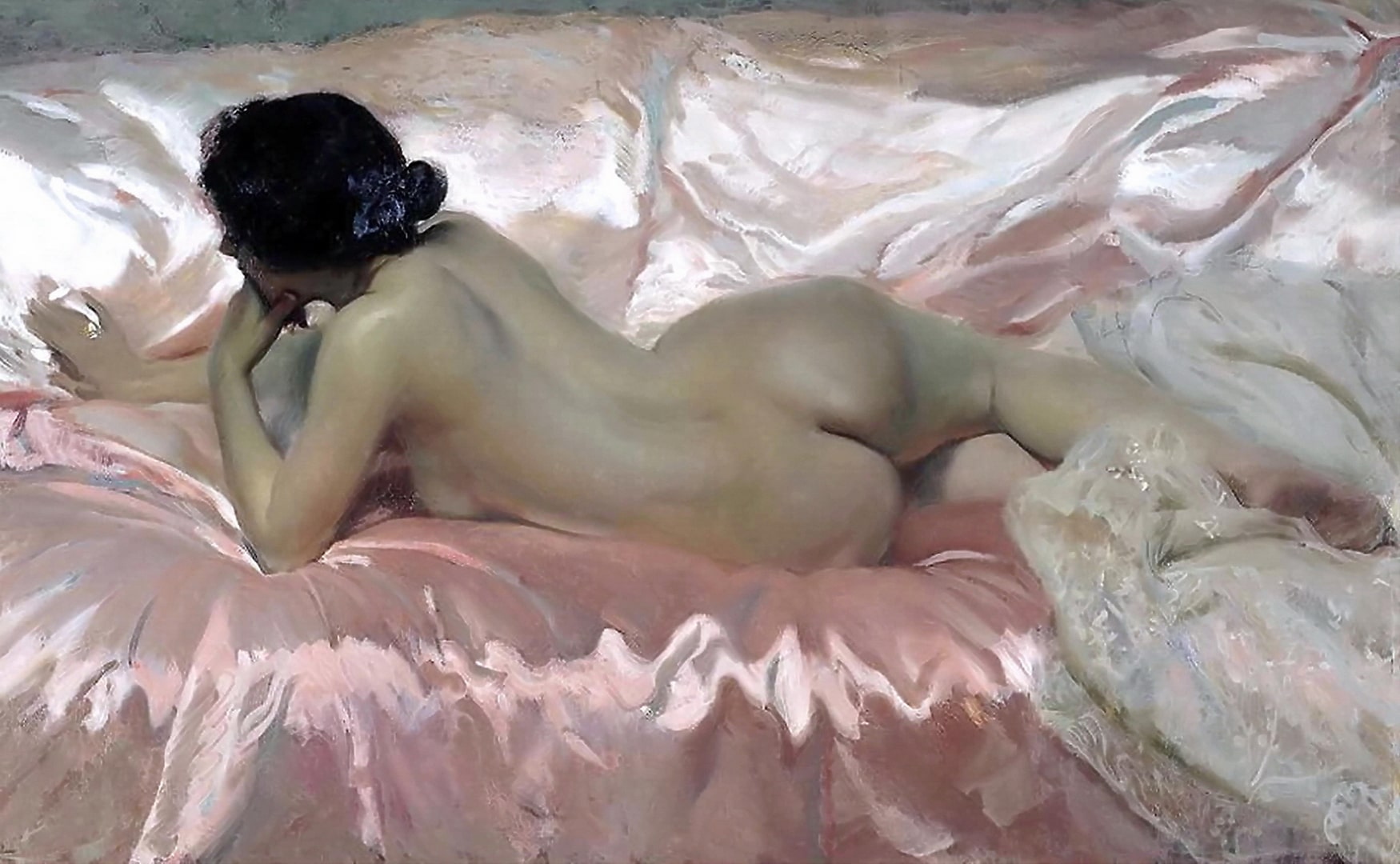
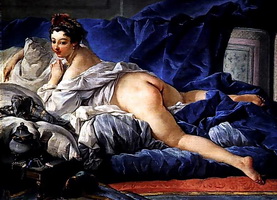
A nude woman is displaying her erotic bottom. Her sexy body looks very alluring.

Female Nude. Joaquin Sorolla.

The naked woman is lying on pink satin sheets and showing off her cute bum. The sexy nude lady really likes the feeling of slinky satin against her naked body. The naughty girl! Such a beautiful naked lady with a hot sexy bottom for you to enjoy looking at! This is one very amorous woman. Her bottom looks very kissable. I suspect she is already in a horny mood just lying there rubbing her beautiful bare body against the sheets. Watch out when her partner comes home! The lusty lady will be ready and waiting for a hot passionate session of making love!

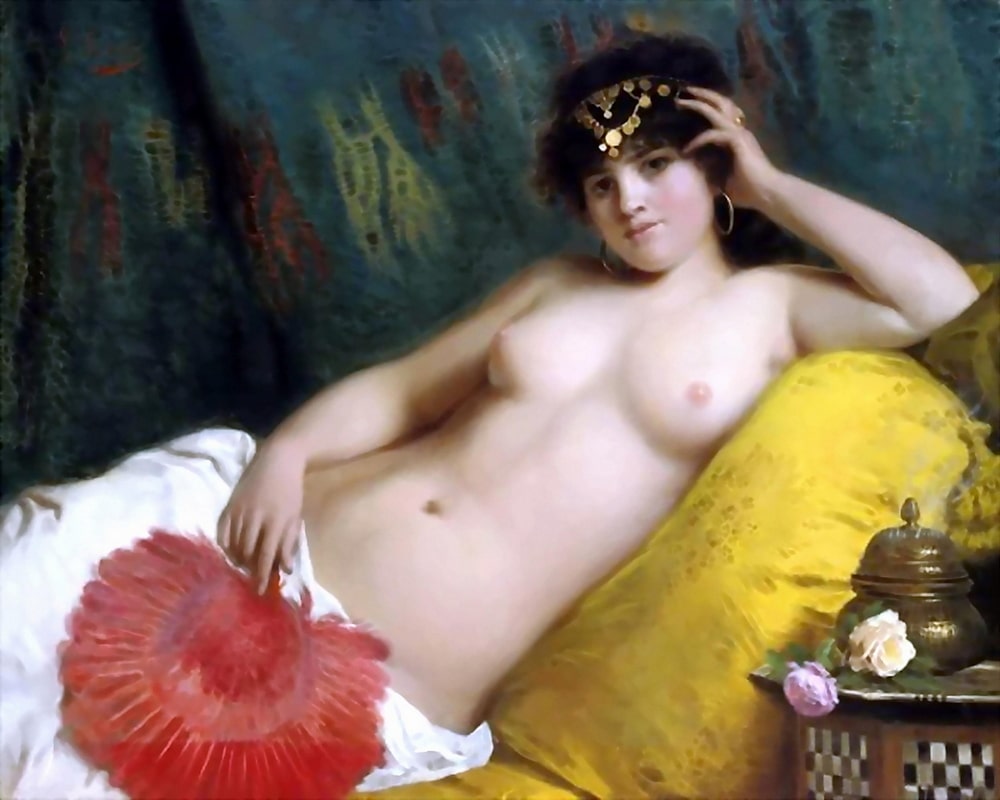
An Odalisque with a Red Fan Giovanni Costa

An Odalisque with a Red Fan. Giovanni Costa.

A nude girl with lusty bosoms and nice nipples. A white rose and another mauve flower on the table beside her. Maybe the lady is a favorite? The voluptuous woman likes to keep herself cool between her duties as a provider of sexual favors. The relaxant is already spreading its beautiful fumes around the room as it sits next to the flowers. I bet a lot of women would love to know what they are using. I would expect the World Wide Survivors of Catholic Church priest abuse would find that very handy to help with a relationship. If it works in a harem, it may help these victims. Maybe the relaxant is marijuana? Imagine how much happier the world would be! It's amazing how the worst sex offenders have been denied sex. The religious are usually the offenders. Most religions have it! The Fun Busters! They want people to be miserable!

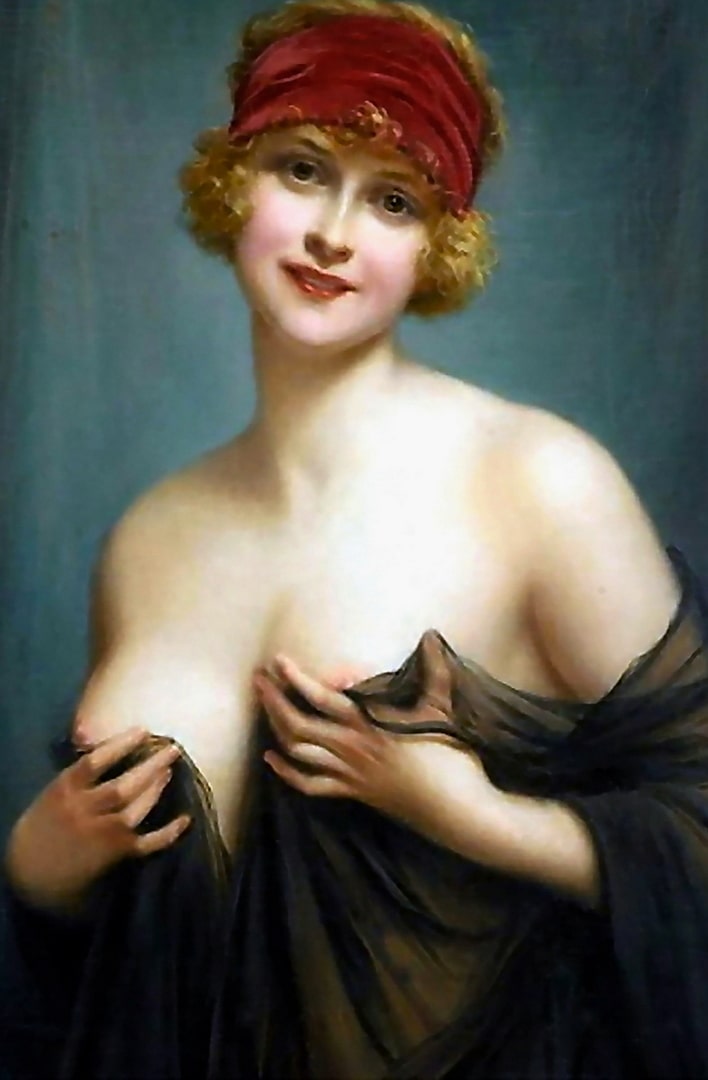
A young girl in a sheer black negligee with nice breasts and pretty lips. A sexy woman.

Young Woman in Negligee. Francois Martin Kavel.

The pretty girl is wearing a sheer negligee and showing off her bosoms and dainty nipples. What a temptress! It would be very hard for a straight man to say no or to ignore her! The lovely young woman will have no trouble luring her lover to passionate lovemaking, which I think she is already in a very horny mood. You can NEVER have to much sex! The Fun Fusters will tell you their own set of facts to ruin your sex drive. Don't listen to them, they are the evil one's. The biggest sex organ is the one between your ears! So keep the nay sayers out and feed your mind lots of dirty stories and dirty movies. One famous female movie star says she reads and watches a lot of porn and has a very hot sex life. But don't tell the Fun Busters!


Buy Elite Jewells here.


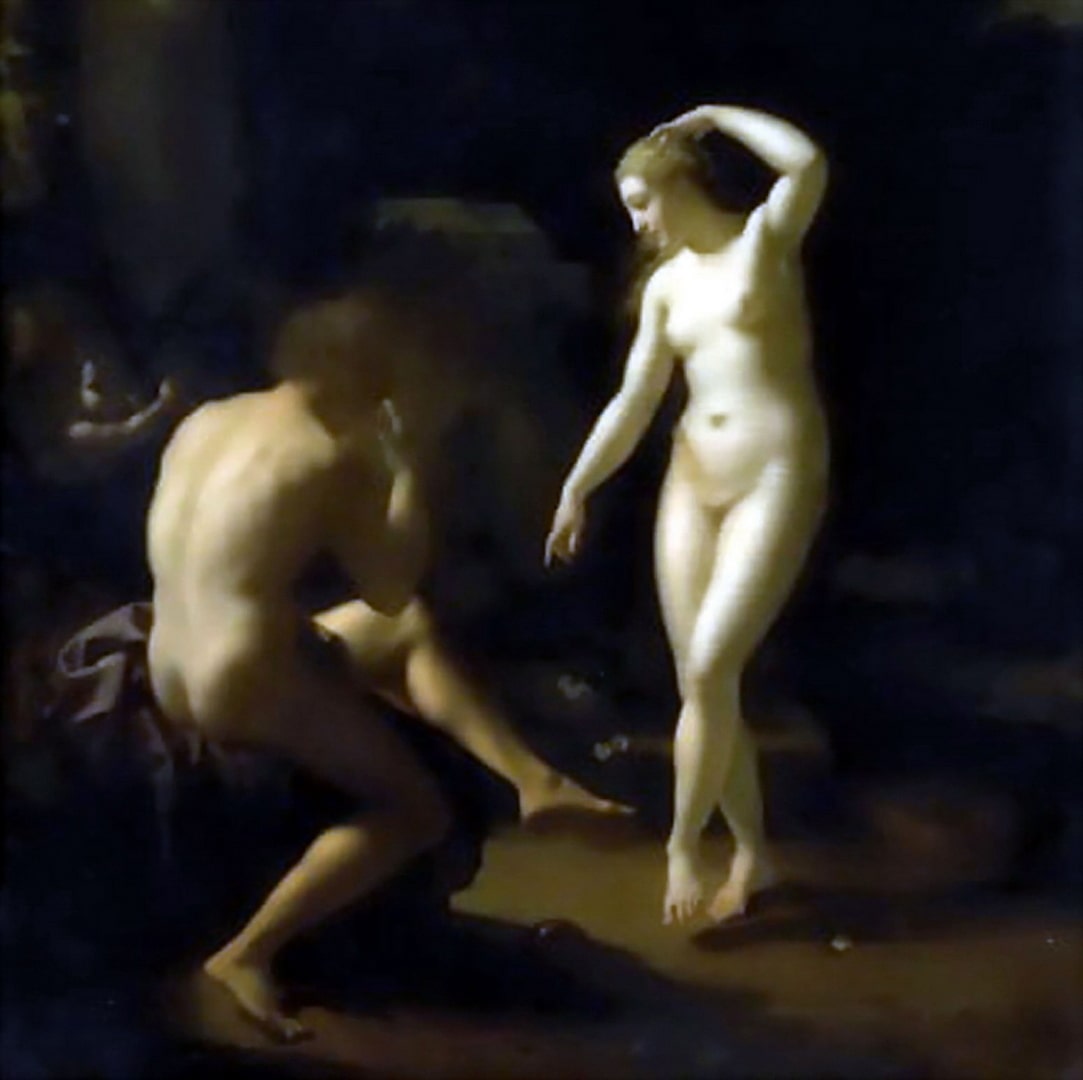
A naughty nymph is using her seductive dancing to lure her desire for sexual passion.


A Dancing Nymph. Adriaen van der Werff.


What a naughty naked girl! The a lustful lady has her heart set on lecherous Love Making with the man playing the music. Nymphs Love sex and lots of it! I wonder if he has noticed the hot girl is using her seductive talents to win him over? Surely he couldn't be that slow?


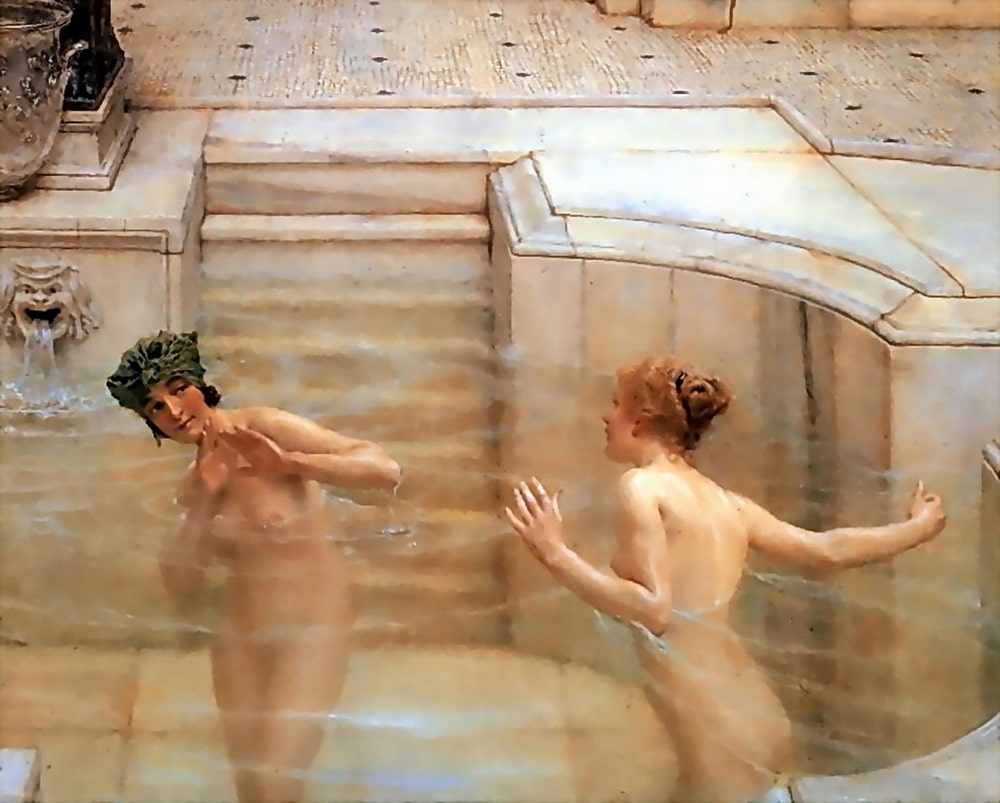
Two nude women in a pool playing games. Showing off their sexy naked bodies.


A Favorite Custom. Lawrence Alma Tadema.


Feeling of warm water against your nude body. It feels so very sexy! The two naked ladies are in the pool together. Imagine the sexy feeling of warm water on your body. It would be very sensuous indeed. It's just what a raunchy woman needs. Mind you girls are luckier these days they can against put their pussy a water jet and get their jollies off that way! Who would have thought riding a horse would help women get their jollies off? Oh! So that's why women did side saddle!

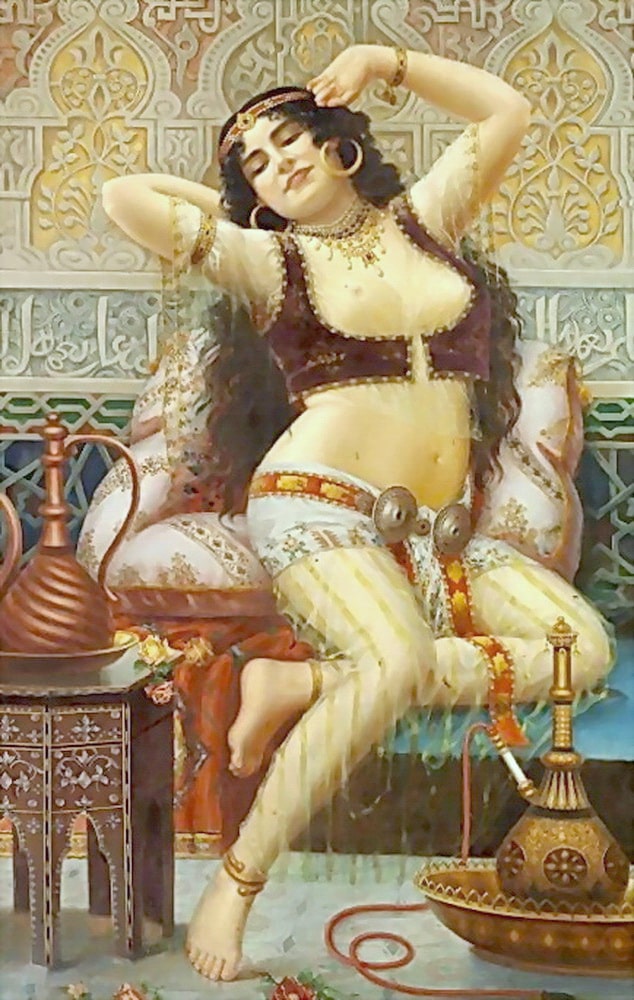
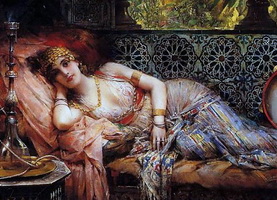
A beautiful woman in a harem having a stretch on a couch showing her sexy breasts.

A Harem Beauty. Joseph Sedlacek.

She has a nice smile and perky boobs. Notice the bong which would contain a good relaxant for her sexual chores, that maybe why she is happy. The buxom beauty also has beautiful hair flowing down her back. She has lovely eyes and luscious lips, which are all the better to kiss you with. The relaxant would get rid of all her hang-ups and make for a happier time for her having sex with the Sultan. If the relaxant is very good she may even get an orgasm herself. You never know her luck in the big titty. She can make sure it's not just: Wham! Bam, thank you ma'am! Some men do that don't they?

Boost your sexual desires with adult toys for improving your lovemaking.

Sex toys can help boost women's sexual desires and help with improving female sexuality as does the paintings on our pages. Looking at nude art and reading erotica helps a girl remove hang ups and have lots more fun! There are many ways to boost your lovemaking leading to a very happy girl. Have more fun with sex! Women can have bigger orgasms with the help of vibrators, dildos and dongs. They can also help satisfy a horny girls desires and sexual needs. Some ladies need a giant dildo and others need 100% silicon dildos. What ever it takes to get your rocks off this is the place to go. So whether its improving a woman's sexuality or satisfying a very horny girls desires. Look no further! Not only that, adult toys can help land your lover. SEX and LOVE share the same part of the BRAIN. So the more SEX you both have the more you both fall in LOVE. By improving your sexuality you can then take the next step in landing Mr. or Miss Perfect. That's the way to do it! Good luck!


Sexy Art for Women 1 Find pretty paintings of lovely ladies and beautiful naked women 2.
Sensuous paintings of feminine beauty and lovely nude ladies with flowers and roses 2.
Paintings of very famous lesbians and their lovers 2. Gay ladies and famous females
The naughty nymph’s, sirens, fairies (related) all lust for sex. They are always hot and horny. They are very wicked girls and have sex with males, females, and Satyrs. Even all three at once!.

Harems are the home to Odalisques who provide sexual favours to Sultans.
Odelisques are the girls who provide sexual favours to the Sultans.
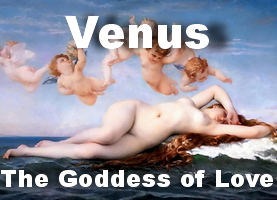
Venus the Goddess of Love. Lust,desire and sexual pleasure are what Venus gives to you.
Sexy Art for Women Page 2 Paintings of nude girls and foxy females Lusty ladies showing off their naked bodies in the name of art.
 
Sexy Art for Women 03 Nude paintings can help to improve a woman's sexuality and love.
Sexy Art for Women 04 Naked paintings of sexy women can help girls with better lovemaking.
Sexy Art for Women 5 Discover naked paintings of foxy females and lusty ladies in portraits.
Sexy Art for Women 6 Find nude portraits of sensuous women and flirty females having sexy fun.


Sexy Art for Women 7 Find vintage portraits of cute girls showing their sexy breasts.
Sexy Art for Women 8 Beautiful paintings of sexy nude girls and lovely females.
Sexy Art for Women 9 Elegant portraits of sensuous women and seductive females.
Sexy Art for Women 10 Pretty paintings of luscious ladies and dainty females.


Sexy Art for Wome Page 2 with saucy paintings of naked women as well as hot nude girls and fleshy females You will also find wicked art of luscious ladies There are many naughty females on here for you to look at for sexy fun!
Sexy art for Women page 4 with sexy paintings of horny nude women and lusty ladies Discover many seductive paintings of arousing naked females for your pleasure Be happy with lovely paintings of hot girls


THE EARLY IMPRESSIONISTS

COURBET was the first painter to turn his attention to naturalism. Manet carried forward Courbet’s standard. Impressionism took the last step, and brought to a close the objectively realistic conception in painting. By this final development of naturalistic means unlimited opportunities for achievement were offered. Impressionistic methods are now employed by a vast army of painters in all parts of the world, and the number of canvases which owe their existence to these discoveries is countless. Specifically Impressionism is ocular realism. It represents 45 that side of actuality which has to do with light expressed by colour; and deals with a manner of approaching natural valuations whereby the painter is permitted to transfer a scene or subject to his canvas in such a way that it will give the spectator the sensation of dazzling light, broad atmosphere and truthful colours. To accomplish this Impressionism confines itself to the play of a light from a given source its reflections and distributions on an object or a landscape. Therefore, it is the restricted study of the disappearance of the local colour in a model, and of the luminosity and divergencies of tones to be found in shadow. It approximates to a nature which becomes, for the moment, a theatre of chromatic light84 sensations. Subject-matter gave the Impressionists no concern. They advanced materially on the spirit in Manet which led him to paint any object at hand because of its susceptibility to artistic treatment. The Impressionists painted anything, not alone for aesthetic reasons, but because all objects make themselves visible by means of light and shadow. This manner of painting was the ultimate divorce of the picture from any convention, whether of arrangement, of drawing or of a fixed palette. Herein it was an elastic process par excellence, with no defined limitations.

Impressionism, though analytic and self-conscious, was not based on science. One may look in vain for parallels between its theories and those of Dove, Thomas Young and Chevreul. It was the imitation, pure and simple, of the disintegrations of colour in nature’s broad planes. And this achievement of diversity in simplicity was brought about by the only method possible: the juxtaposition of myriad tints. In other words, Impressionism was a statement that vision is the result of colour forces coming into contact with the retina. However, the men of the movement did not see nature as an agglomeration of coloured spots, but as a series of planes made vibrant by light. To reproduce this vibration they were necessitated to use nature’s methods: they broke up surfaces into sensitive parts, each one of which was a separate tint. There are no broad planes of unified colour in nature. In each natural atom are absorption and reflection; and the preponderance of either of these two attributes results in a specific colour. Before85 the advent of this new school painters had made warm or cold green by combining green with yellow ochre or raw sienna, or by the admixture of blues and purples. But the Impressionists laid on these colours, pure or modified, side by side, and let the eye do the work of blending. They discovered not only that in green the shadow is tinged with blue, but that blue is the direct result of the yellow-orange of light. Every one nowadays has noticed that, in looking fixedly at a green, it appears now bluish, now yellowish; just as in listening to an orchestra we can, by focusing our attention, hear predominantly the bass or the treble. So the Impressionists observed that in the most luminous colour there is a proportion of absorption, and that in the darkest shadow there exists some reflection. The association of these molecular properties is what produces vibration in nature. By the application of these observations the Impressionists generated a feeling of grouillement; the movement by contrast in the smallest parts.

In attempting to explain their canvases many commentators have credited them with systems of complementaries which resulted in grey, and with other exorbitant theories of oppositions. But one may look in vain in their work for any synthesis of scientific discoveries. Colour, not neutrality, was their aim; and, as they themselves admitted, they painted comme l’oiseau chante. Birds are not conscious of the metallic dissonance of diminished fifths; and the Impressionists were equally unaware of the harshness of red with green, blue with orange, yellow with violet. They only substituted a balance of cold and warm86 colours for the balance of lines which the older painters had used. They copied the tints they found in nature after analysing nature’s processes, in order to arrive closer to its visual effect. In one way they almost achieved colour photography, for their study, in its narrow character, was deep, and their vision was highly realistic. But whereas they depicted nature, they could call it up only in its instantaneous aspects. In this ephemerality alone were they impressionists; indeed, their methods were the most exact and probing of any painters of that time. Each hour of the day raises or lowers the colour values in nature; and he who would copy nature’s form as a permanent interpretation must ignore the exactitude of its reflections and approximate only to its local colours. This latter method is more truly impressionism than the theories of the Impressionists. They repudiated local colours as being too illusory, holding that the most highly coloured object modifies its tint under the influence of the least variation of light. The point is technically true, but it is an observation in objective research, and the word Impressionism must not be accepted as explanatory of the methods of the school it designates.

By decomposing the parts of a surface, in order to represent objects in their atmospheric materiality, the Impressionists were impelled by a force stronger than a mere desire for superficial accuracy: they felt the need for87 complete and minute organisation in a work of art. In landscape, where the many accidentals appeared to lack cohesion, the Impressionists achieved co-ordination by a unity of light which welded all the objects into an interdependent group. Plasticity of form had resulted from the efforts of preceding painters, but here for the first time was a plasticity of method which moulded itself like putty with the slightest change of illumination. Preoccupation in this new compositional element made its users forget, for the time being, the older precepts for obtaining composition. This forgetfulness however was not due entirely to exuberance over a novel procedure. The painters antecedent to Delacroix had used landscape as unimportant backgrounds for figures, and there was no precedent for its adaptation to organisation. Courbet had composed landscape by the linear balance of black and white volumes. The Barbizon artists had brought out-of-door painting into more general notice; but their greys were insufficient to give it more than a factitious and purely conventional unity. The Impressionists, feeling the urgency for a more virile expression in landscape work, saw a solution to their problem in the depiction of light through colour. Thus their conceptions took birth.

Their technique, like Manet’s, was wholly consistent with their objective. To the Impressionists this objective seemed possessed of the merit of finality. Since Corot had carried painting out of doors and Manet had portrayed studio light from every vantage point, what indeed was left for this new group of men? They might have organised Manet or Corot, but even the most competent of such modifications would have presented an appearance like that of a Rubens or a Tiepolo. They were too avid for genuine novelty to content themselves with slight innova88tion; and they were too modern to derive satisfaction from the stereotyped teachings of an antiquity whose tones were unemotional and whose themes were hackneyed. The spirit of servility which is willing to learn second-hand lessons and adopt indoor conceptions spelled decadence to them. Their attitude was a healthy and correct one, for the cup of linear tone-composition had been drained. They were wrong in that they threw aside the cup: they should have filled it with more powerful concepts. Their attitude was indicative of immaturity. The Impressionists in truth were the adolescents of the modern art which was born with Delacroix and Turner, and which only recently has become a concrete engine for the projection of inspiration into an infinity of possibilities.

Impressionism was more important than any preceding departure, for it turned the thoughts of artists from mere results to motivating forces, from the ripples on the surface to the power which causes the tides. It foreshadowed the philosophical idea in art which concerns itself with causes rather than effects, and thereby brought about a fundamental reform which made of painting, not a mere vision, but an idea. The Impressionists, it is true, worked from the surface down, but they had the depths ever in mind; and the posing of their problem set in motion in all serious painters that intellectual process which eventually would begin with foundations and build upward. Impressionism was the undeniable implication that the possibilities of the older art methods had been exhausted, and that a substitution of a new method, however fragmentary, was of greater importance than the sycophantic imitations89 of an unapproachable past. Beneath this attitude we feel the broadness of mind which, when a mistake has been made, does not ignore causes but attaches to them different interpretations in an effort to arrive at the truth. The Impressionists kept their palette intact; but they employed its parts in a way that made new combinations possible. By doing this they unconsciously reacted against the mere dexterity of brushing with which so many painters, like Hals, Velazquez and Raeburn, became obsessed and, as a consequence, failed to heed the deeper demands of aesthetic research. By thus facilitating technique they not only reduced the difficulties attached to the production of a picture, but made the thing expressed of greater relative significance.

Pissarro, Monet, Sisley and Guillaumin who, with Bazille, composed the original group of Impressionists, had all been influenced in youth by the revolutionary doctrines of Corot and Courbet, and to a great extent had adopted the palette of these two men. Landscape painting at that time was almost a new development, and these four readily succumbed to its inspiration. There is little of the strictly picturesque and still less of the grandiose in the French landscape. Consequently a school which worked along the line of old conventions could not have existed in France. But when Rousseau and Diaz, striking out in a new direction, poetised the charm of the hills and forests about Fontainebleau, the painting of the out-of-doors was liberated both as to purpose and to freedom of arrangement. The object of Turner’s work had been to astonish90 and charm the spectator with nature’s vastness and complexity. But, with the men of 1830, landscape art took on softness, introspection, stillness, solemnity. In fine, it became more intimate. Each tree and stone hid a nymph; each stream and hill, a mystery. With the Impressionists all this was changed. They had seen and admired the work of Manet. They applauded his reactions against studio lighting, and later became his personal friends. Manet was then the cynosure of all eyes in the art world of Paris, and it was only natural that he should have been the dominating figure in a sort of cénacle held in the Café Guerbois in the quarter of the Batignolles. Here the revolutionists of the day forgathered, and, by their uncompromising spirit, inspired one another to practical protestations against the routine of the academies. Manet’s eloquence argued away the older idea of lighting as a type; and the younger men, using this negotiation as a starting point, gave birth to the methods which congealed into Impressionism.

Although Monet and Pissarro were the first to profit by Manet’s teachings, there is no definite history to tell who was the first of the group to blossom into colour. However, there is little doubt that Pissarro was the man. He was a Jew with a philosophic turn of mind, and possessed more genuine intelligence than his confrères. Monet was the cleverest and the most enthusiastic, and when the new process was outlined it was he who first developed it to its ultimate consequences. Pissarro, compared with Monet, was conservative, and his practicality did not permit him so great an élan. His canvases beside91 those of Monet’s appear almost tentative, and the greys he had adopted from Corot never entirely forsook him. Both these painters went to London during the Franco-Prussian War, and we may take it for granted that the works of Turner had an enormous influence on them. They had already seen Jongkind who, despite his adherence to the sombre greys of the older men, had, five years previous, more than foreshadowed the later divisionistic technique. But in Turner they discovered not only all that Jongkind had to offer, but the additional quality of joyous and dazzling colour. After their return their palettes became rapidly cleaner.

In 1874, in an effort to bestir the public, the Impressionists held an exhibition. The excitement was all they could have desired, but it led rather to obloquy than to sales. Again and again they exposed in the hope of obtaining recognition, but not until 1888 were they successful. The average spectator did not recognise nature in their canvases. The vision was an unusual one, and bore but slight resemblance to what had gone before. But gradually things underwent a change. Friends of the Impressionists launched a campaign of proselytising. Now and then a picture was sold to a collector; formerly restaurant keepers and bricklayers had been the only buyers of their work. The popular press softened its criticisms and in many instances went so far as to defend their pictures. As a result of these numerous indications of a growing approval among connoisseurs, the public, that almost immovable mass of reactionary impulses, began to look with favour on the new works it92 had so recently ridiculed. The great majority of people had cared only for such canvases as those in which the intellect might jump from one familiar object to another, recognising it wholly, comprehending its uses, but without giving thought to its meaning. Being thus interested primarily in a picture’s conventionally painted details, they were opposed to any innovations which tended to obscure the actualities of delineation. Later their attitude, influenced by acts of authoritative sanction, relaxed. Instead of seeing, as formerly, only a series of raucously coloured spots in these new pictures, the public began to sense the deep reverence for nature that emanated from them. Thus has it always been the case with art: appreciation for anything newly vital lags far behind the achievement.

The true significance of Impressionism, however like the true significance of all emotion-provoking art remained undiscovered to the general. When the mean intelligence of mankind brings itself to bear on a work of art, it applies itself through the channels of literature, archaeology, photography, botany, mineralogy and physiology. To be a popular artist a painter must be something of a professor in all these sciences. With all other considerations such as psychology and aesthetics he need not trouble himself. The public, even after centuries of rigorous training and constant association with art, is no nearer a comprehension of rhythmic ensembles perfectly synthesised form in three dimensions than it was during the Renaissance. The two major requisites to an understanding of the formal relations in momentous art are a93 highly developed sensitivity and an active intelligence. An eye and a nervous system are not enough. Society as a whole may, after a long course of training and sedulous study, reach that perceptive point where it can grasp the simple aesthetic hypothesis founded on two dimensions. But such a hypothesis is but a beginning. It embraces only the rudimentary aesthetic organisations that are found in Japanese art, the works of the Byzantine masters, the primitives of France and the pictures of Botticelli, Manet and Gauguin. The form in art of this kind is, strictly speaking, not form at all. It is balance, harmonious rhythm, linear adjustment, parallelism, co-ordinated silhouette, sensitive arrangement, outline melody in fact, whatever is possible in two dimensions. Significant form must move in depth backward and forward, as well as from side to side. Furthermore it must imply an infinity of depth. This third (and sometimes fourth) dimension informs all truly great art.

While the Impressionists did not attain to depth in the aesthetic connotation of the word, they nevertheless went beyond mere linear balance, for by the means of a higher emotional element light they organised, in a superficial manner, all the objects in their canvases. There were no dissevered objects, unrelated backgrounds, no concessions to the hagiographa or other literature. What chance, therefore, had they of being understood? Their subject-matter was too abstract; their effects were too general. No line was accentuated above another. There were no modifications to achieve vastness or splendour.94 Impressionism was the unadulterated reproduction of atmosphere, the smile or frown of a mood in nature. It is small wonder that the unaesthetic found it obscure: in it there was too much rapture, too much frankness, too much exultation in mere living, and too little restraint. It was the false dawn in the great modern Renaissance of colour the most ecstatically joyful style of painting the world has ever seen. It was feminine in that it was a reflection, and its hysteria may also be attributed to this fact. The Impressionists seated themselves, free from all trammels, before the face of nature. Nature dictated: they transcribed. Nature smiled; and they, completely blent with it, smiled also. This very enthusiasm is what kept them young and held them to their initial path. To paint as they did was an intoxication, subtler and stronger than a drug and more elating than young love.

The vital history of the individual men who formed this group reduces itself to a record of their temperamental tastes in subject selection and to a statement of the degree to which each developed the new method. The individualities of the units of an experimental school are always unimportant. Temperament can dictate to the artist only two phases of variation: what he is to use in his composition, and those transcendental qualities, such as joy and sorrow, drama and comedy, which reflect the timbre of his predispositions. Rhythm, form, balance, organisation, drawing all these aesthetic considerations spring from deeper matrices in a man’s nature than do his temperamental predilections. Whether one man is intrigued95 by sunlight or another by mist, mankind is, after all, so similar in externals, that one individual’s slight departure from a predecessor, or his trifling deviation from a contemporary, is of little moment. The true key to a man’s genius lies in his ability to organise as well as, or better than, others. The compositional figure on which he builds will alone give us the substance of his character. We are all capable of receiving sensations: we have our personal likes and dislikes for subjects, even for actions and smells. But these choices are the outgrowths of our instincts, mere habits of association. In nowise are they fundamental. They are the physiological recognition of pleasant or unpleasant impressions. Their importance is limited to the individual who experiences them. Being the results of receptivity, they have no more to do basically with the aesthetic expression of an artist whose work is pure creation, than phonograph disks with the sounds they receive. By the intelligence alone can a man be judged. Here there is order, extensive in artists like Michelangelo, partially restricted in such painters as El Greco and Giorgione, and severely limited as in the case of the Impressionists. However, it must not be implied that the intelligence alone can create. Such a contention would be preposterous; but it is true that impressions must first be consciously organised before they can be given concrete expression.

The intelligence of Pissarro was synthetic to a small extent, but not once did it exhibit signs of extended apperception. He thought clearly up to a certain point beyond which his art never went. His temperament was not an uncommon96 one among Hebrews. He viewed life as a social reformer who regards the world as a sad place, but one susceptible of improvement. From this psychological standpoint he painted. His pictures depict ubiquitous greys, occasionally brightened by a stream of lurid light; sombre scenes in which the impression is one of late afternoon; peasants who seem wearied of their unceasing and thankless labours; gaunt trees which epitomise the decay of the year. His technique is not dissimilar to that of Jongkind, and his drawing is allied to the construction found in the Dutch landscapists of the early nineteenth century rather than in those of his own group. That he was the transition from Jongkind to Monet is a plausible contention; in him are found qualities of both these other painters. But he was too conscientious ever to attain to the technical heights Monet reached. If one aspires to innovation of means, graphic traits have to be sacrificed: steps must be taken in the dark. Those who cling with one hand to the old while groping toward the new can never reach their desires. Pissarro’s lack of constructive genius was too evident, his timidity too great, his intelligence too literal for him ever to effectuate new plastic forms. His instincts were those of a teacher, and he displayed indubitable traits of an exalted doctrinaire. But his art, with these limitations, was able and complete. Cézanne says he learned all he knew of colour from him. This is not 97 wholly true; but it is certain that Guillaumin and Sisley are greatly indebted to his clarity of reason.

Although Pissarro is the greater artist, Monet is the finer craftsman. He is widely credited with the invention of divisionistic methods; but in this conclusion an inaccurate syllogism has played havoc with the facts. None of the Impressionists invented the procédé de la tâche; and not having invented it detracts nothing from their achievement. Liszt did not invent the pianoforte, yet he was its greatest master. The practice of crediting Frenchmen with the invention and development of methods has scant authority with which to justify itself. Poussin was an offshoot, and a weak one, of the great Titian. Watteau and Boucher come to us direct out of the corners of Rubens’s pictures. Daumier and Courbet, temperamentally unrelated to the French tradition, stem from the Dutch and the Spaniards. Cézanne emanated from the Dutch and the Italians via Impressionism. Matisse’s procedure is little more than a modification of that of the Persians and the early Italians. Cubism was imported from Spain by a Spaniard. Futurism is strictly Italian: there is not a French name among its originators. Synchromism was brought into the world by Americans. And Impressionism, which, like all these other departures, has come to be looked upon as French, is incontrovertibly of English parentage. True, there is small credit due the inventor. The man capable of employing new discoveries (as Marconi employed the principles of wireless telegraphy) is the truly important figure. But we should not confuse discovery with employment. Since Monet was French, France has a 98 perfect right to claim the results of colour division. The honours attaching to its discovery are Turner’s and Constable’s.

Monet, like many great men, had little schooling. He went direct to nature, impelled by the new impetus toward landscape. His first pictures in the Impressionist manner resemble Manet’s except for trivial innovations in the differentiation of shadows; but in this difference we divine the later Monet. Viewed cursorily these paintings appear to be conventional figure pieces. But they are more than that. The figures have no other significance than that which attaches to a vase or a landscape. “Facial expression,” “sympathetic gestures,” the “appeal” all are absent from them. In these pictures the costume plays the hero’s part. La Japonaise is representative of that treatment of subject wherein the figure is only an excuse for a pattern of colour. The modern attitude toward theme which Manet handed down is again in evidence in Monet. Its reductio ad absurdum was the late epidemic of illustrative pictures by such men as Whistler, Shannon, Sargent, Zuloaga and Alexander, the titles of which were derived from the flowers held in the hands of the principals, a bowl of goldfish in the background, or the colour of a lace shawl.

Monet, however, soon tired of figure pieces. His true penchant lay toward landscape. In this field he found an infinity of colour possibilities, innumerable subtleties of light gradation, and ready-to-paint arrangements as appealing as the ones he had formerly had to pose in his interiors. At first his technique was broad and radiant, much like a dispersed Manet. The large flat planes of unified colour which later were to disintegrate into a thousand touches, were laid on silhouetted forms. His boat pieces in the Cail99lebotte collection in the Luxembourg gallery, appear, in their simplicity and breadth of treatment, like the unfinished underpainting of a Turner or a Rembrandt. Much of the bare canvas is visible; and in them one feels the presence of the experimenter. At this time the war drove Monet to London, and his exile proved a salutary one. On his return his pictures bloomed with a new brilliance, and his flat surfaces became fragmentised. Racial characteristics no doubt establish a bond between Sisley and the English landscapists, but nothing less than an active influence could have made so typical a Frenchman as Monet paint a canvas like L’Église à Varengeville in which Turner is so much in evidence. Turner is also unmistakably present in Pissarro at times, as witness Sydenham Road, but never to any great extent.

WATERLOO BRIDGE

MONET


Despite his great debt to Turner, Manet and Pissarro, Monet owed even more to the Japanese. They influenced his style and his selection of subjects. From them he lifted the idea of painting a single object many times in its varied atmospheric manifestations. But where the Japanese shifted their vantage-ground with each successive picture, Monet’s observation point remained stationary. His composition too, superficial as it is, is frankly Japanese. It is generally represented by a straight line which runs near the lower frame from one side to the other of the canvas, and which supports the principal objects of the work. This line slants, now up to the left, now up to the right; but seldom is it curved as in the more advanced drawings of Hiroshige or Hokusai. His kinship100 to the Japanese is, after all, a natural one, for the temperaments of France and Japan are as similar as is possible between east and west. The Japanese artists presented atmospheric conditions by means of gradating large colour planes into white or dark. The consequent effects of rain, snow, wind and sun are as vivid as Monet’s, but they differ from the Frenchman’s in that they are concerned principally with nature’s decorative possibilities. Monet adheres to graphic transcription for the purpose of presenting the dynamics of a mood-producing phase of nature. But though differing as to aims, they both reach very similar visual results. Compare, for instance, Monet’s suite of Les Peupliers with Hiroshige’s series of the Tokaido or with Hokusai’s Views of Fuji. Many of the pictures are alike in composition and choice of subject; but the European has achieved a living light, while the Oriental has presented a more lucid and intensive vision. These differences of purposes and similarities of appearance are again discernible in Monet’s Coins de Rivière and Shiubun’s Setting Sun. A further proof of this Impressionist’s affinities with the Japanese will be found by collating Monet’s figure pieces with those of Utamaro.

There is one important point of divergence, however, between the arts of Japan and Monet’s canvases. Whereas the Japanese ignored texture, Monet at all times devoted himself more or less sedulously to its portrayal. The Falaise à Étretat and The Houses of Parliament London are examples of his freedom from a rigid system of scientific application. In both pictures the 101 sky is drawn with broad intersecting strokes in order to achieve transparency and vastness. The water, in the former, is painted with long curved strippings to give the wave effect, as in Courbet’s La Vague; and, in the latter, ripples are formed by minute touches. Monet’s architecture is often built up with colour-spots as a man lays bricks; and the cliffs in the Falaise à Étretat are corrugated in exactly the same way the strata lie in nature. Later this preciosity of style disappeared, except in his treatment of slightly ruffled water. His brushing became irregular and elongated, and he applied his stroke so that it would merge into the other innumerable touches of diverse colour. His eyesight was highly trained, and after years of labour in the conscious analysis of colour planes, he was able to divide these planes unconsciously.

Monet was artistic in that he felt deeply what was before him. Henri Martin, on the other hand, who painted with independent touches in the hope of obtaining flickering sunlight, and who knew his palette fully as well as Monet, laboured mechanically. His work is more optical than emotional. He is a realist in the same sense that Roll is a realist; but both these men present only the husk of reality. Monet, to the contrary, experienced and expressed nature’s ecstasy. He is like a string which vibrates to any harmony: Martin is little more than an eye. Both finished their work in the open; and both stippled. But here the parallelism ends, for where Monet completed the effects of the Japanese, Martin only took light into the academies. Perhaps this is why Martin was at once acclaimed by the public, and why Monet, during those first darkyears of struggle and poverty, was compelled to sell his canvases for practically nothing. Duret confesses102 to having obtained one for eighty francs. Martin was early accorded academic honours, and received numerous government orders.

Monet found himself at home wherever there was light and water. His canvases describe scenes from all over Europe. But his most famous pictures are his two series, Les Meules and Les Nymphéas. In the first, a single haystack is set forth in a diversity of illuminations and seasons; and the second repeats a small pond of water-lilies, in shade and in sun, ruffled and calm. His La Cathédrale, Venice and London series are also widely known. These represent acute observation and an implacable inspiration to work, for they had to be finished simultaneously. Their accomplishment was a stupendous tour de force. At sunrise Monet would go forth with twenty blank canvases so that the changes of sunlight and mist might be caught from hour to hour. They seem infantile to us today these imitations of the subtleties of light, these meteorological histories of haystacks and lilies, these atmospheric personalities of cathedrals and canals. Yet it is by just such self-burials in data that one exhausts the aesthetic possibilities of nature’s actualities. And not until this probing to the bottom has been accomplished does the artist possess that complete knowledge which impels him to push forward to something newer and more vital.

Sisley was the last of the original five to adopt Impressionistic methods. He had long had an admiration for the exploits of the more revolu103tionary painters, but a comfortable income had acted as a sedative on his ambitions. He did not feel the necessity for difficult endeavour. But when, at the death of his father, he found himself penniless and with a family to care for, he joined the ranks of Pissarro, Monet, Guillaumin and Bazille. He had talent and an accurate eye, and his earlier academic work, done in the sixties, served as a practical foundation. After he had adopted the more modern technique of Pissarro and Monet, he was prepared for the achievement of new art. If we had no other proof that Impressionism at its inception was a shallow craft, Sisley’s immediate mastery of it would be conclusive, for his appropriation of its means was not an aesthetic impulse but a financial expedient. But more extensive corroboration can be found in a score of academies where Impressionism is taught and taught conclusively.

There is no more or less actual composition in Sisley than in other of the Impressionists. He supplied no innovations, and he differed from his fellows only in so far as his temperament indicated variation. In Monet and Guillaumin there is a concentration and precision which the Englishman fell short of. His nature was less akin to these Impressionists than to the Turner of wide and open skies, of the softness and dreaminess of summer, of that104 perfect satisfaction which is content with inaction. Sisley’s very colour preference for which the public reproached him light lilac indicates his penchant for prettiness and repose. His choice of theme was invariably dictated by a poetical and sentimental need for the intimate.

In Guillaumin we have a man who gave promise of good work but who, up to the last, failed in its fulfilment. Indubitably talented, he never succeeded in reaching that point where talent is only a means to an end. But nevertheless there was in him a solidity of modelling, a real feeling for the ponderous hardness of hills and plains. He was a friend of Cézanne, and undoubtedly learned much from that master of form. At first he had painted in sombre tones, but later, after meeting Cézanne and Pissarro in the Académie Suisse, he adopted their lighter and more joyous colour schemes. There is a canvas in the Caillebotte Collection in the Luxembourg which, in its broadness of treatment and extensive planes, suggests Gauguin both as to gamut and conception. Guillaumin was the most masculine talent of the early Impressionist group. He cared less for the transient views of nature than for its eternal aspect. His colour, by its liberality of application, counts more forcibly than that of Pissarro, Monet or Sisley. His contributions to the new idea, however, were comparatively small. He was not an explorer, but followed diligently in the path others had marked out. Only after he had won a fortune in a lottery did he break away from his environment. But this release came to him too late. His formative period of development had passed, and his work, from that time on, did not alter in technique. Only in his picturesque and bizarre subject-matter is noticeable any deviation from his habitual routine.


PAYSAGE

GUILLAUMIN


The individual achievements of the Impressionists, however, no matter how competent, are of minor importance. Impressionism was a new weapon in105 the hands of art’s anarchists. It has come to be regarded as a faultless faith whose devotees can do no wrong. There has been little or no adequate literature devoted to its exposition, its causes and influence; and the exaggeration of its attainments are as grotesque as the calumny with which it was at first received. It was not an ultimate and isolated movement, but a simple and wholly natural offshoot in the evolution of new means. The artists who fathered it were, except in one instance, men whose enthusiasm outstripped their abilities as composers. Their greatest good lay in that they turned the thoughts of painters toward colour, and outlined, summarily to be sure, the uses to which this new and highly intense element might be put. They expressed just what their desires permitted them: nature in all its visible changes. Those exquisite moments of full sunlight on land and water, of cloud shadows over the hills, of the warm brilliancy of a blue sky on the upturned faces of flowers; the stillness of summer amid the woods; the cold serenity of snow-clad fields all were seen and captured and immortalised by these men. They were the greatest painters of effects the world has ever known. They never strove to evoke the sensation of weight in the objects they painted; and that organisation of parts, which is a replica of the cosmos, they were too busy to attempt. Their very deficiencies were what permitted them so complete a vision of the only side of realism which still remained for painting to investigate.

The Impressionists did not embody concretely the teachings of their forerunners, but used them106 all in the abstract. Delacroix had sacrificed photographic truth in drawing in order to present a more intense impression of truth. Daumier had built form as nature builds it, colour aside. Courbet had turned painters from the poetic contemplation of a great past to the life about them. Manet had made images of whatever was at hand for the pure love of painting. The Impressionists turned to the things nearest them, paid scant heed to scholastic drawing, translated Daumier’s doctrine of form into light, and like Manet painted for the joy of the work. As experimenters they were valuable; but their pictures, to those unsentimental persons whose appreciations of art are wholly aesthetic, mean little more than records of how a cabbage patch appears at sunrise, a lily pond at midday, or a country lane at twilight. The Impressionists did not amalgamate and express the dreams of their forerunners. They were one of those transitional generations whose vitality is spent in a stupendous endeavour to conceive before the time is ripe. The need for a great birth had not yet made itself felt; for only when the period of107 embryo is complete can great art be born. Renoir brought forth that issue; and with him evolution seems to halt a moment before plunging onward. The meagre aesthetics of the early Impressionists could not lead to the highest artistic results. Indeed, their animating aims had to be abandoned before Renoir could attain to true significance.


Lite Erotic Art Page 02 Discover lusty ladies and naughty naked girls There are paintings of hot nude women and raunchy females Fun and good times are being had by all as women love sex too
Lite Erotic Art Page 04 Has nude paintings of risque women and portraits of hot girls and sexy females There are paintings of luscivious ladles having fun and good timesIf you love naughty art this is the place


Foxy Females and Foxy Ladies. Sexy Art for Women. Female Erotica and Feminine Beauty.