Sexy Art for Women.

Delphin Enjolras 1.

Female Erotica and Feminine Beauty.
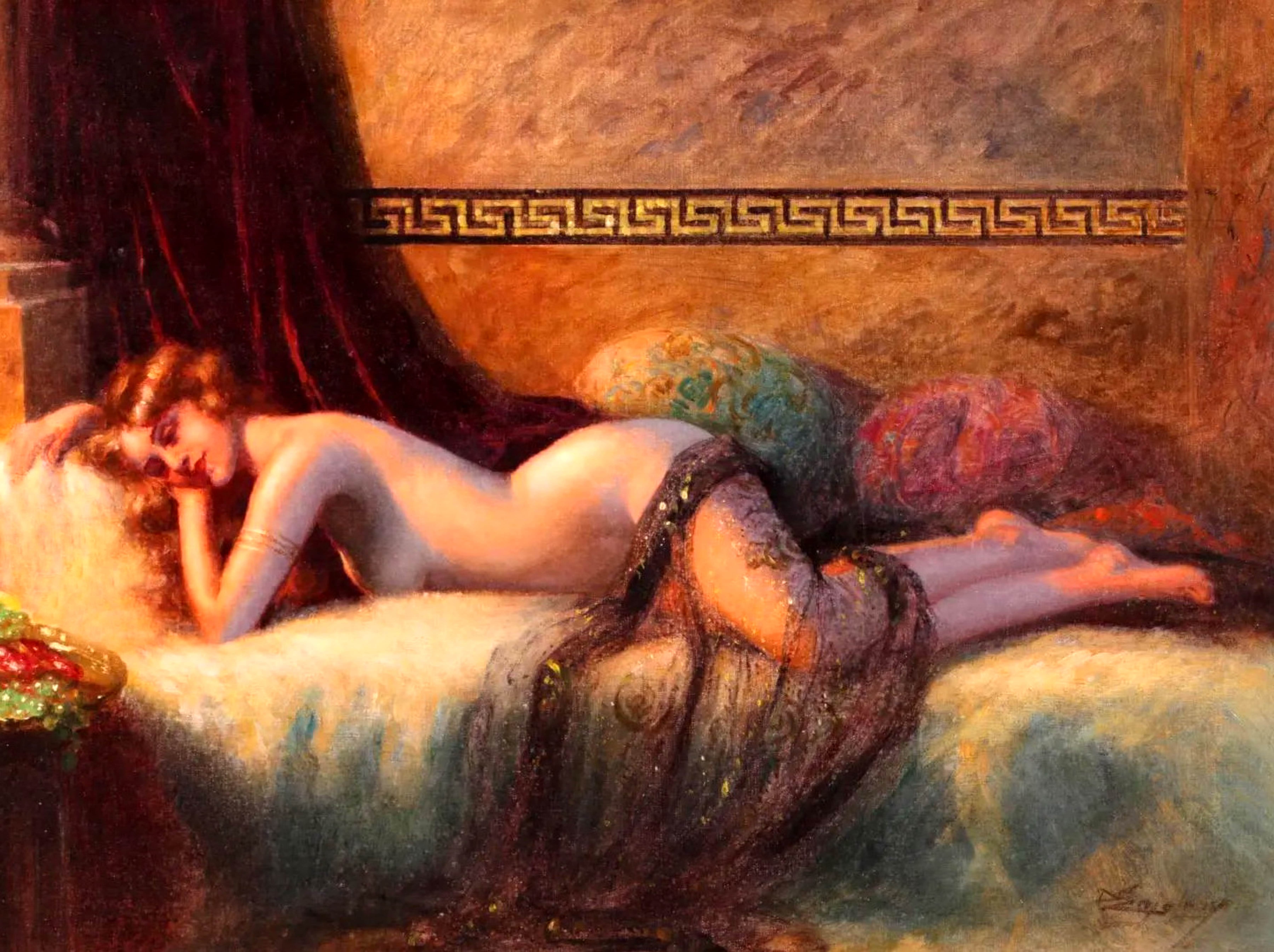
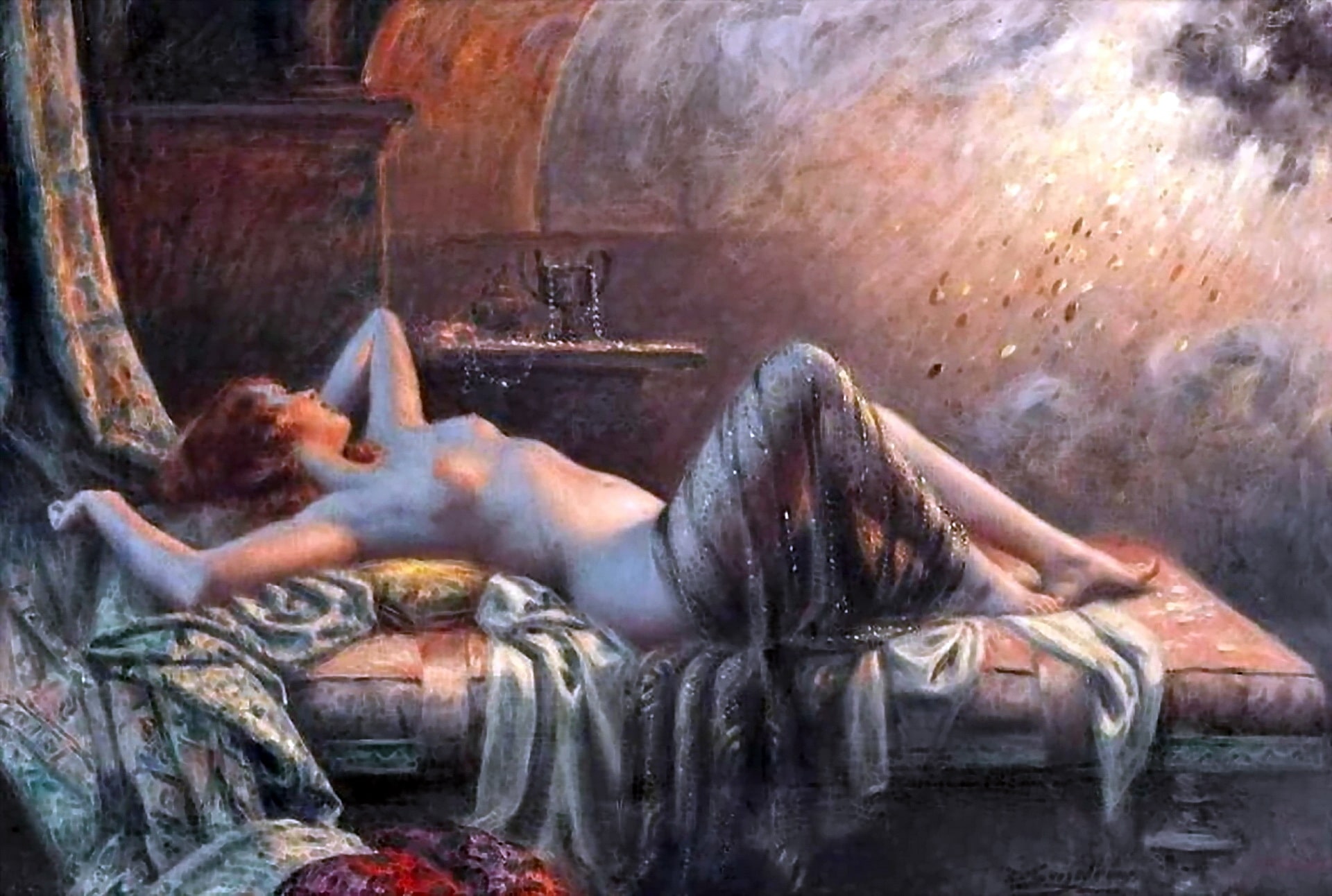
Danae is lying half nude on her bed as gold coins pour over her body. Very sexy.


Danae. Delphin Enjolras.

A semi-naked lady gets a shower of gold as she lays on her bed. A very sheer black garment covers her sexy legs. That certainly looks like a golden shower to me!

Sexy Art for Women Page 10 with saucy paintings of naked women as well as hot nude girls and fleshy females You will also find wicked art of luscious ladies There are many naughty females on here for you to look at for sexy fun!
Delphin Enjolras Page 2 Sensuous paintings of pretty women and girls.


Lite Erotic Art 1 Find pretty paintings of lovely ladies and beautiful naked women. That's right! Horny artwork for boosting a girls desires for sexual pleasure. That's right! Horny artwork for boosting a girls desires for sexual pleasure.
Sensuous paintings of feminine beauty and lovely nude ladies with flowers and roses.
Paintings of very famous lesbians and their lovers.
Venus the Goddess of Love along with lust, desire, and sensual pleasures.

This post contains affiliate links, we may receive a commission if you make a purchase using these links.


Contents.


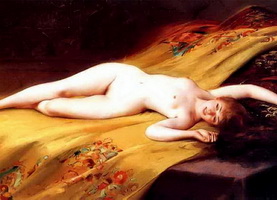
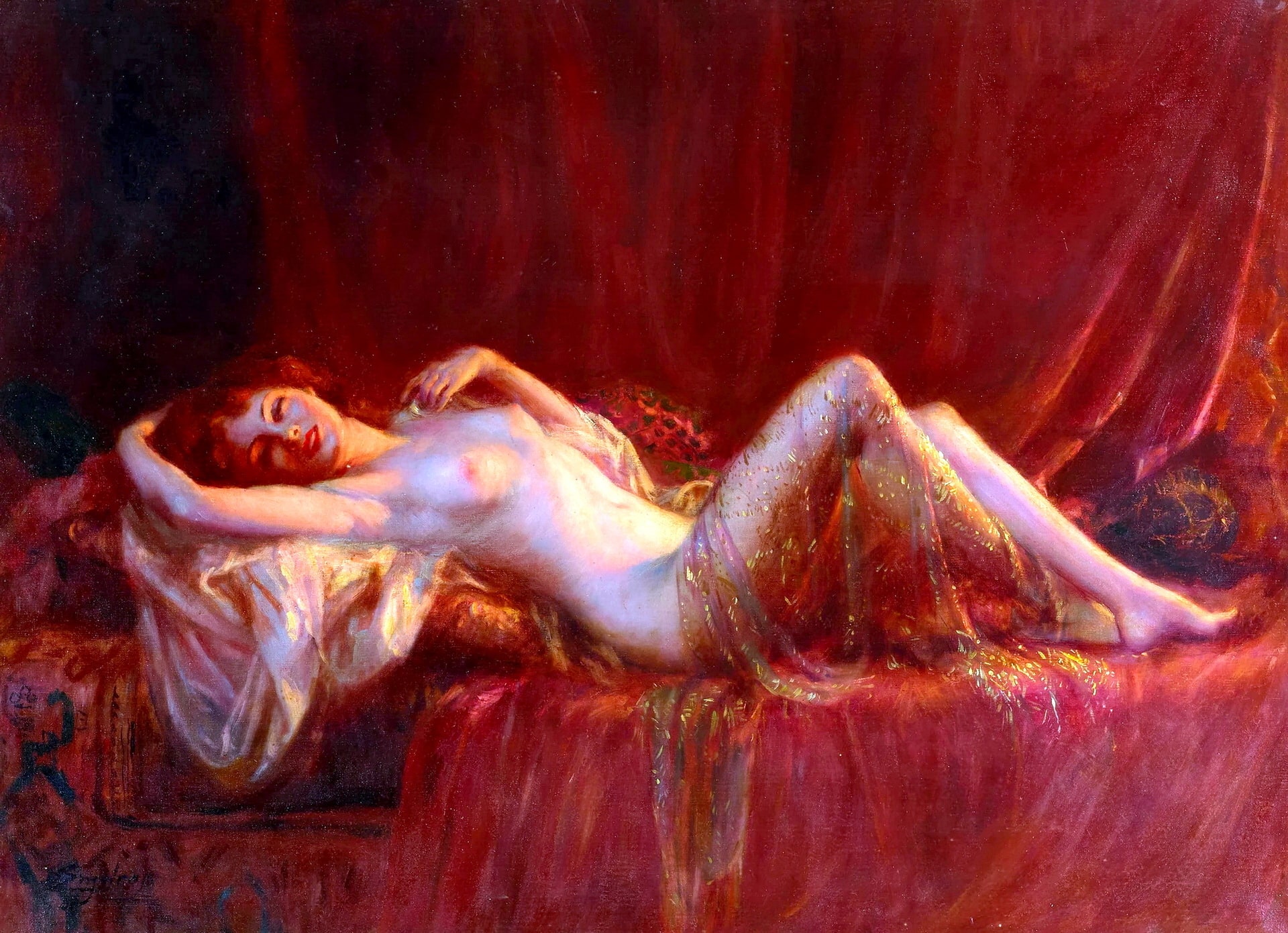
A woman showing her erotic breasts and see-through garment over her legs.

A Reclining Exotic Beauty. Delphin Enjolras.

A voluptuous young lady with a very sheer garment over her legs. She has beautiful eyes and lovely lips.

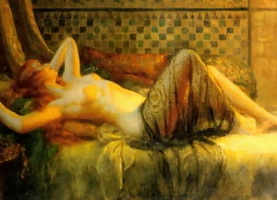
A sexy lady with long red hair and voluptuous bosoms under sheer garment.

A Fairest Rose. Delphin Enjolras.

A luscious lady lying on a rug waiting to be ravished.

The lady is exhausted after the ball with pretty pink roses Resting head


After the Ball. Delphin Enjolras.

Recovering after the dancing all night and she has pretty pink roses from her lover. One of the flowers is lying on the floor.


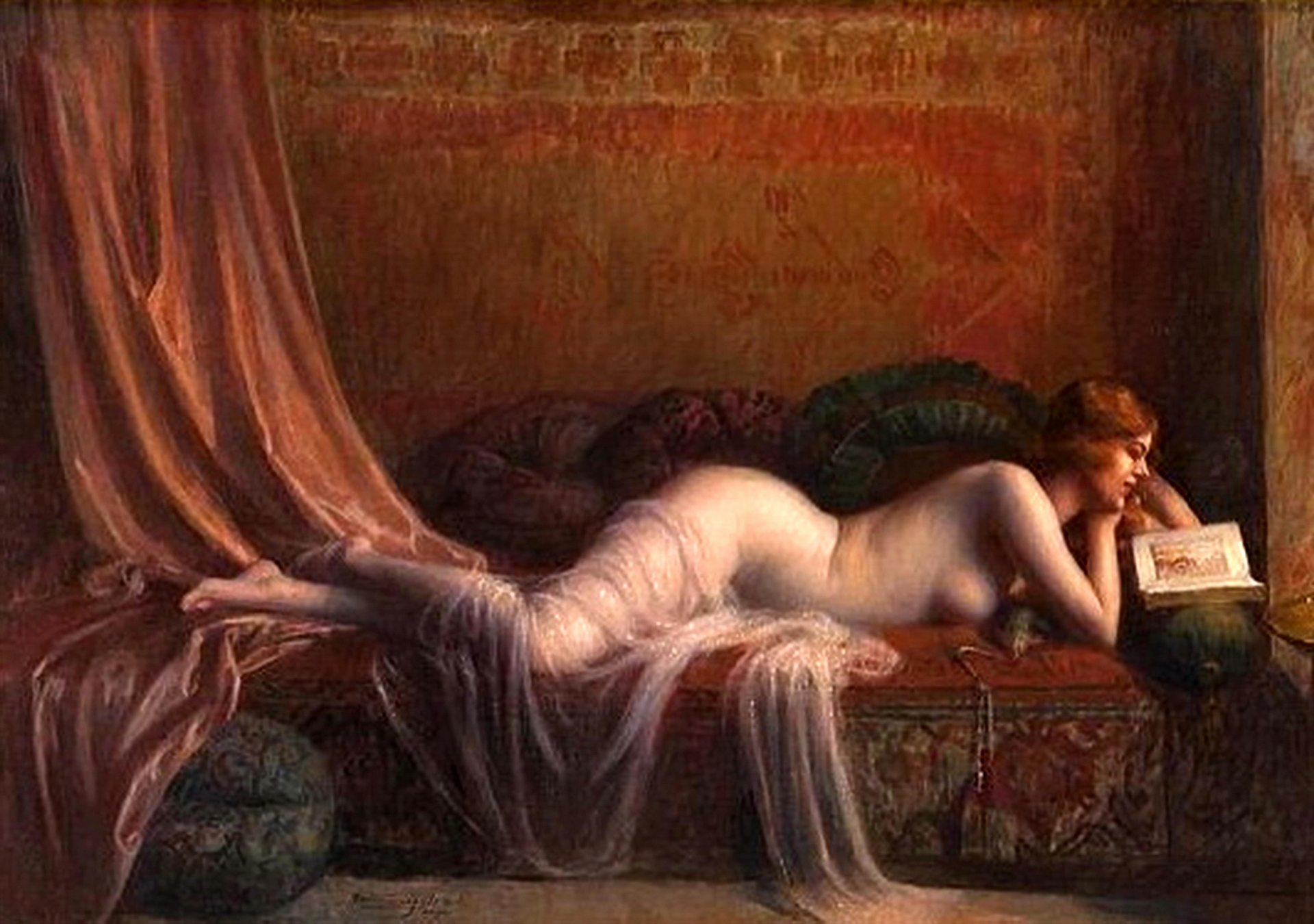
A naked woman on a couch reading a book, with very see-through garment.

A Good Book. Delphin Enjolras.
A woman lying naked on the couch reading a good book. The beautiful woman is totally engrossed in her book.

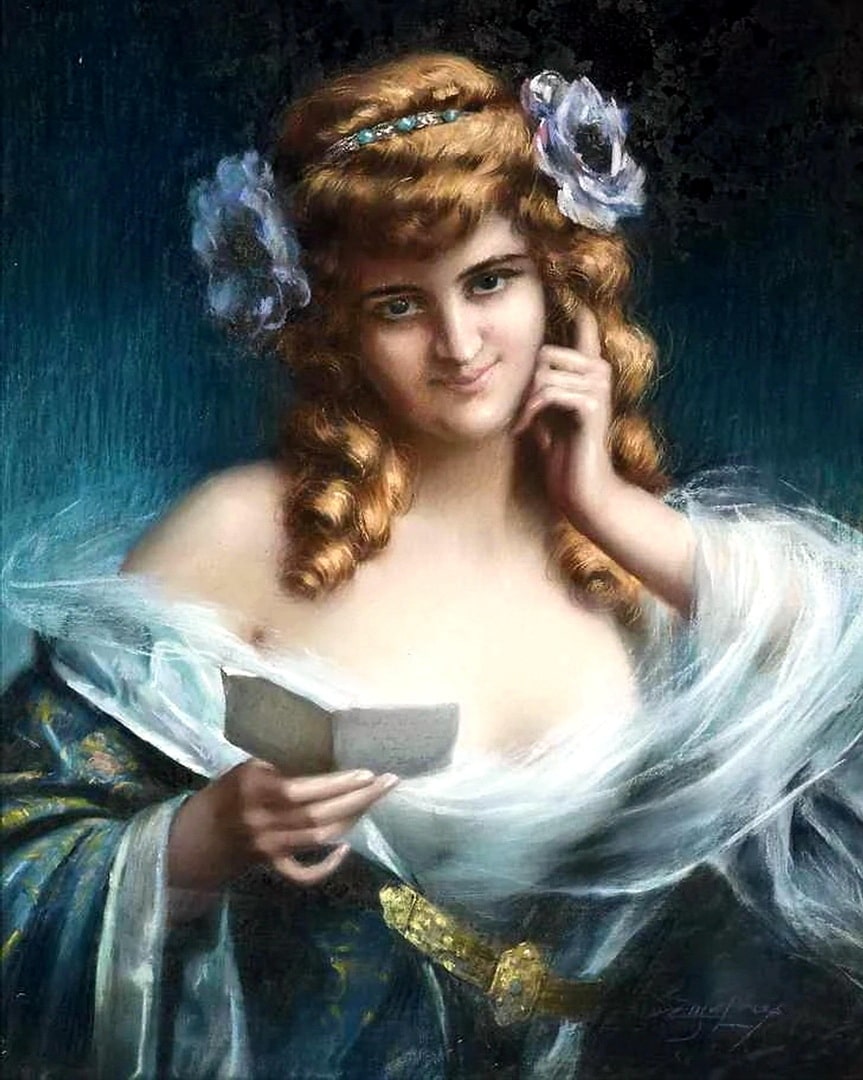
A pretty girl reading a love letter flowers in her hair and beautiful eyes.

A Letter of Love. Delphin Enjolras.
A pretty woman (Delphins wife) with flowers in her hair and beautiful eyes and long golden curly hair, reading a love letter.


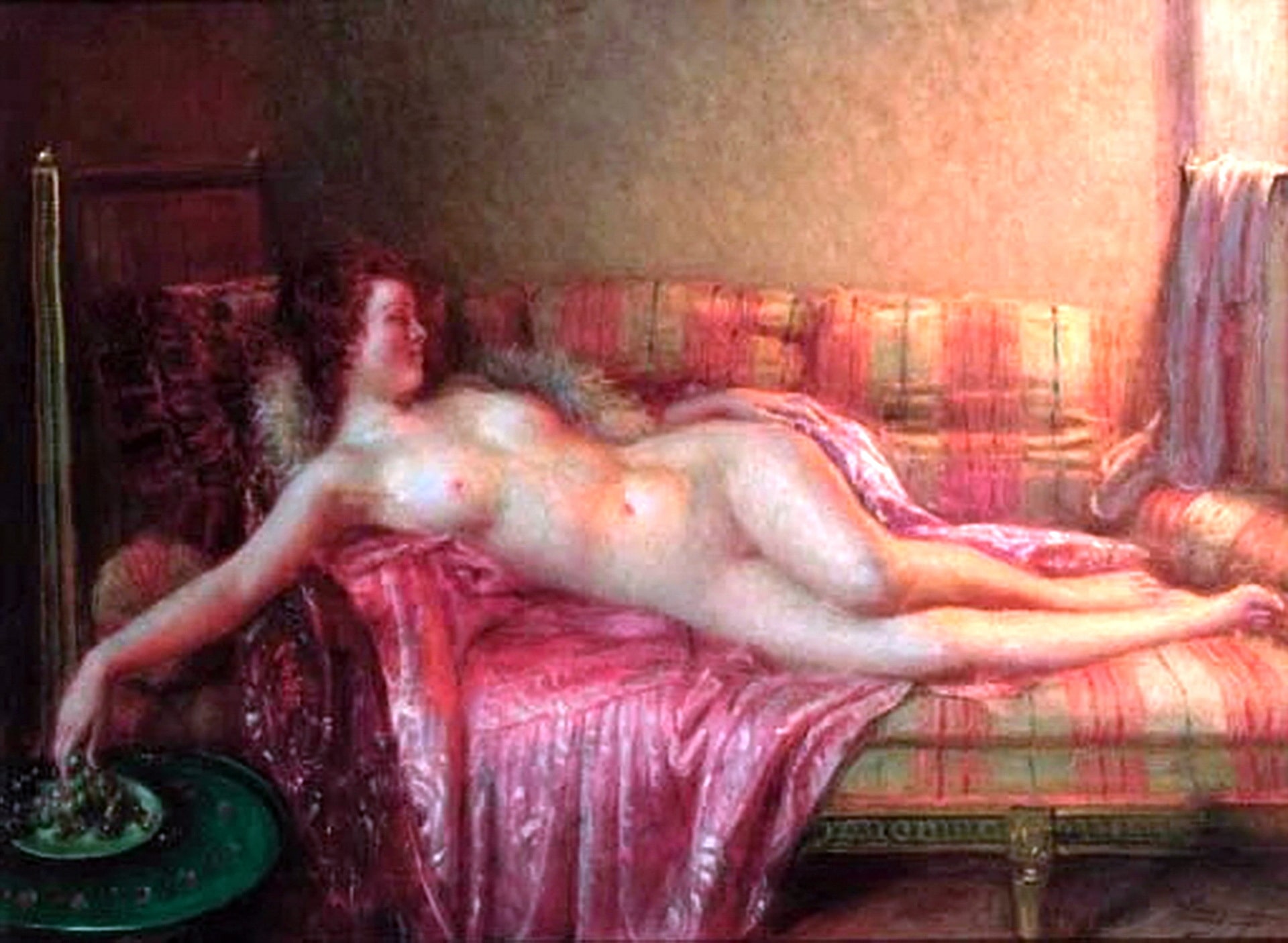
A young lady nude on a couch enjoying some grapes on a pink covering.

A Reclining Female Nude. Delphin Enjolras.

A naked lady is lying on a pink covering on the couch and eating some grapes as she enjoys her relaxation time.


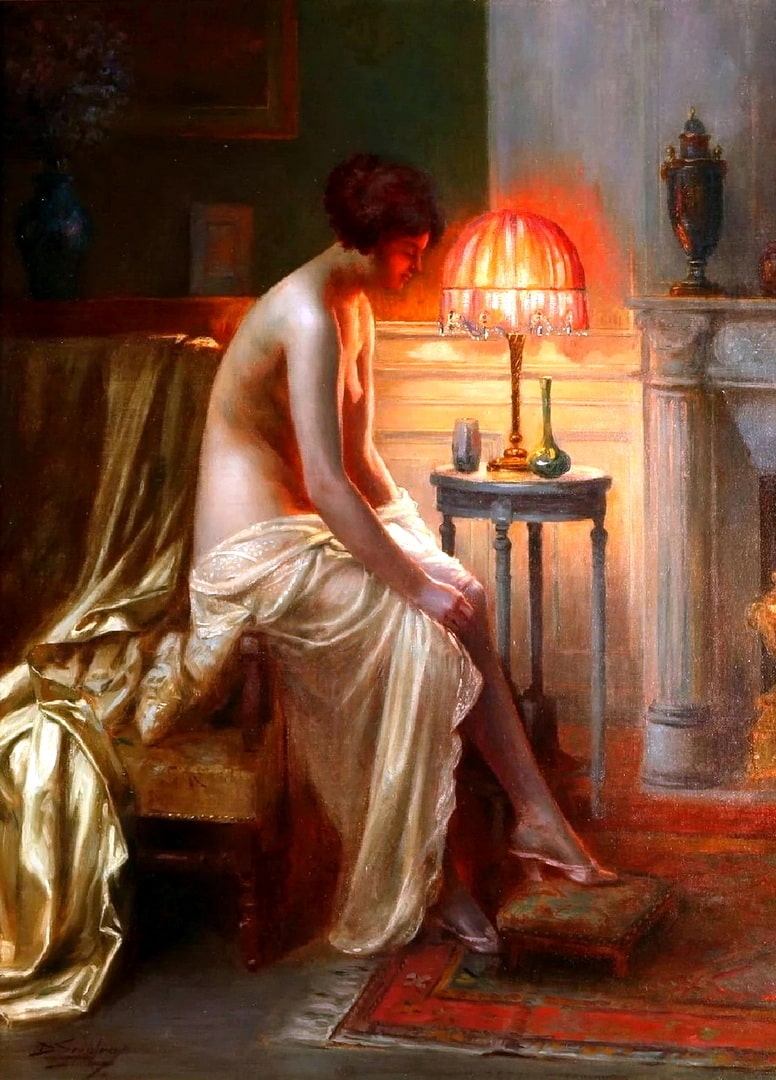
A half-naked woman sitting on the arm of a chair beside a lamp in bedroom.

A Semi Nude Lady Seated Beside A Lamp In A Boudoir. Delphin Enjolras.

The woman's foot is resting on a stool while she is in deep thought. You get a glimpse of one sexy breast on the foxy female.

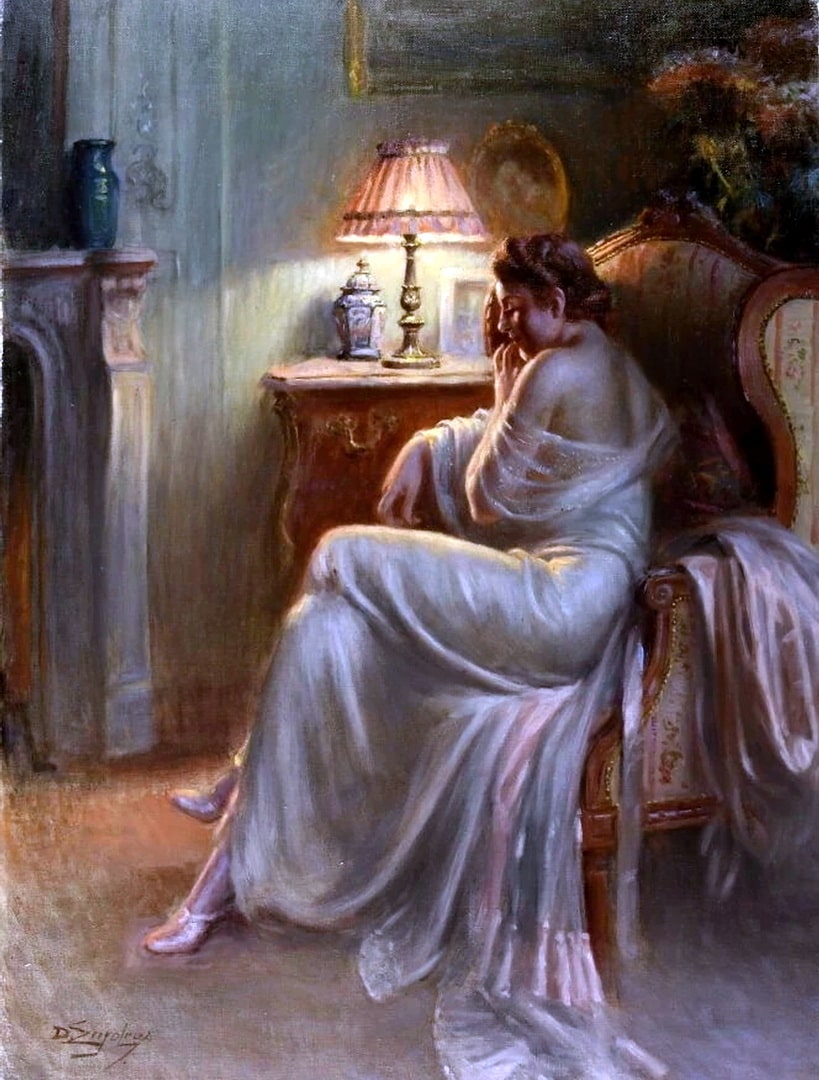
A woman in an off the shoulder pink night dress having fond thoughts.

A Sweet Memory. Delphin Enjolras.
A lady in a long sensuous pink night gown in front of a fireplace showing a sexy shoulder while thinking pleasant thoughts.

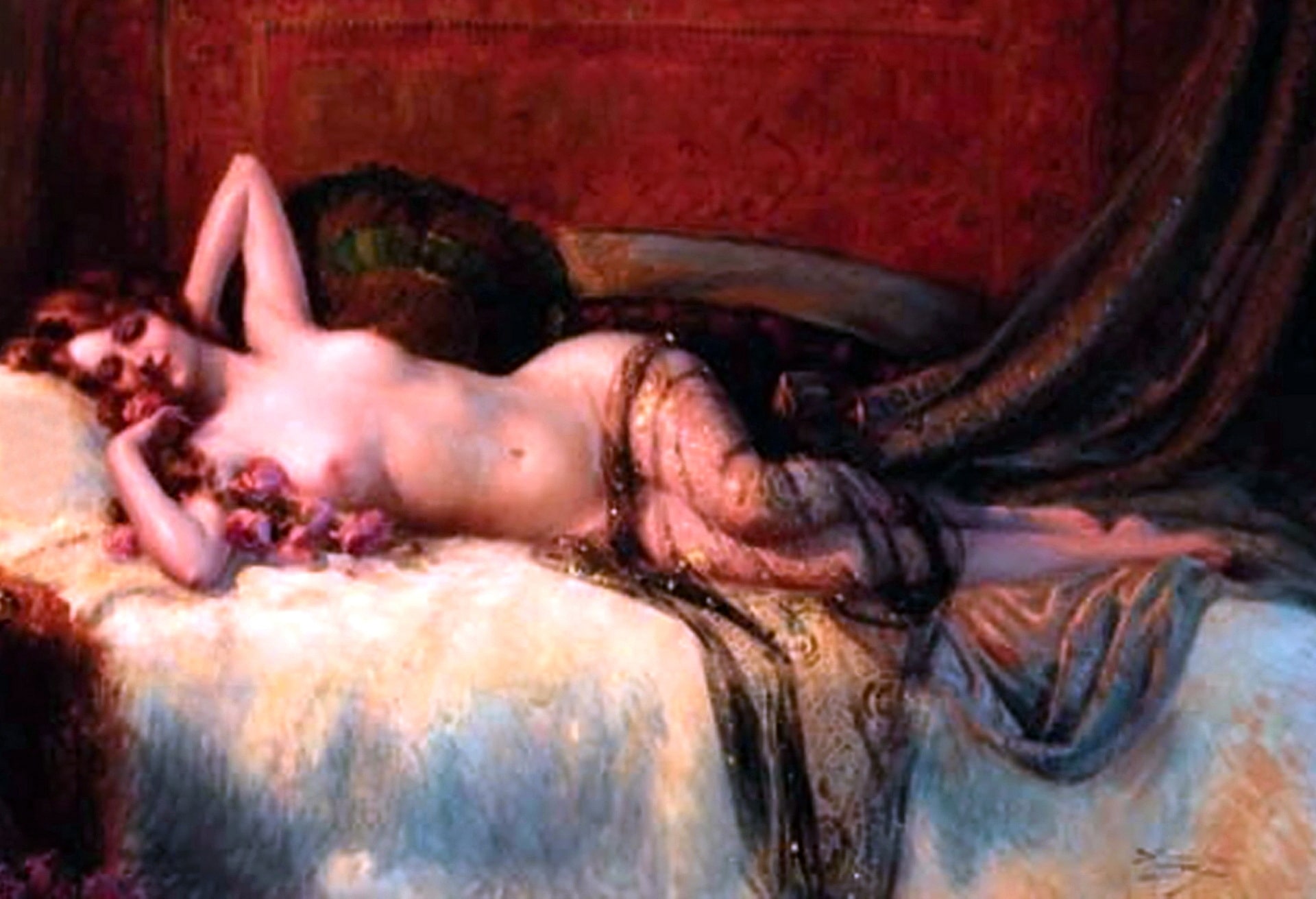
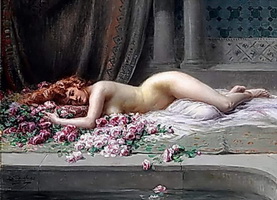
The pretty woman is lying on pink roses showing off her sexy breasts.

A Young Beauty Reclining On A Bed. Delphin Enjolras.

There are pink roses around her head and a very sheer covering over her beautiful legs. As well as lying in the flowers the luscious lady is showing off her buxom bosoms and naughty nipples.

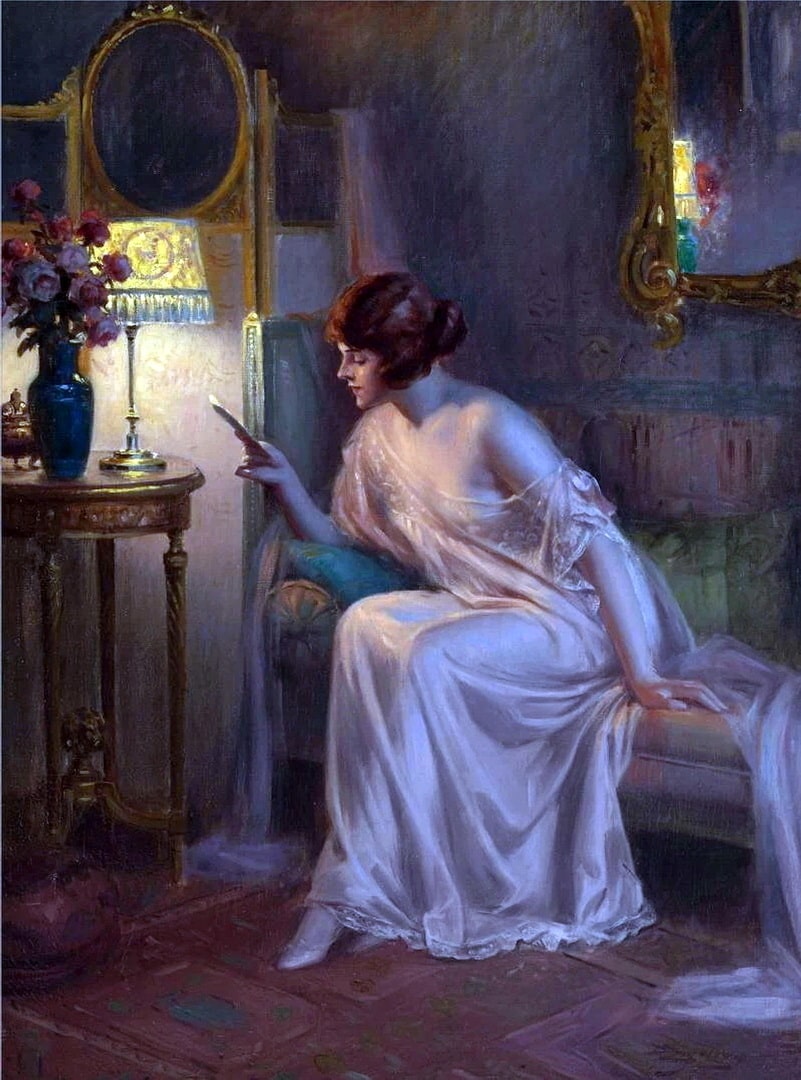
A female in an off the shoulder long pink nighty sitting on a couch reading.

Before Bedtime. Delphin Enjolras.

A woman reading a note under a lamp that is beside some flowers on a small table. The lady is sitting on a couch in an off the shoulder long pink nightie.

Hot sexy lingerie for horny women

Buy sexy lingerie to fire up your love life. That's right lure your lover to lovemaking with lingerie!

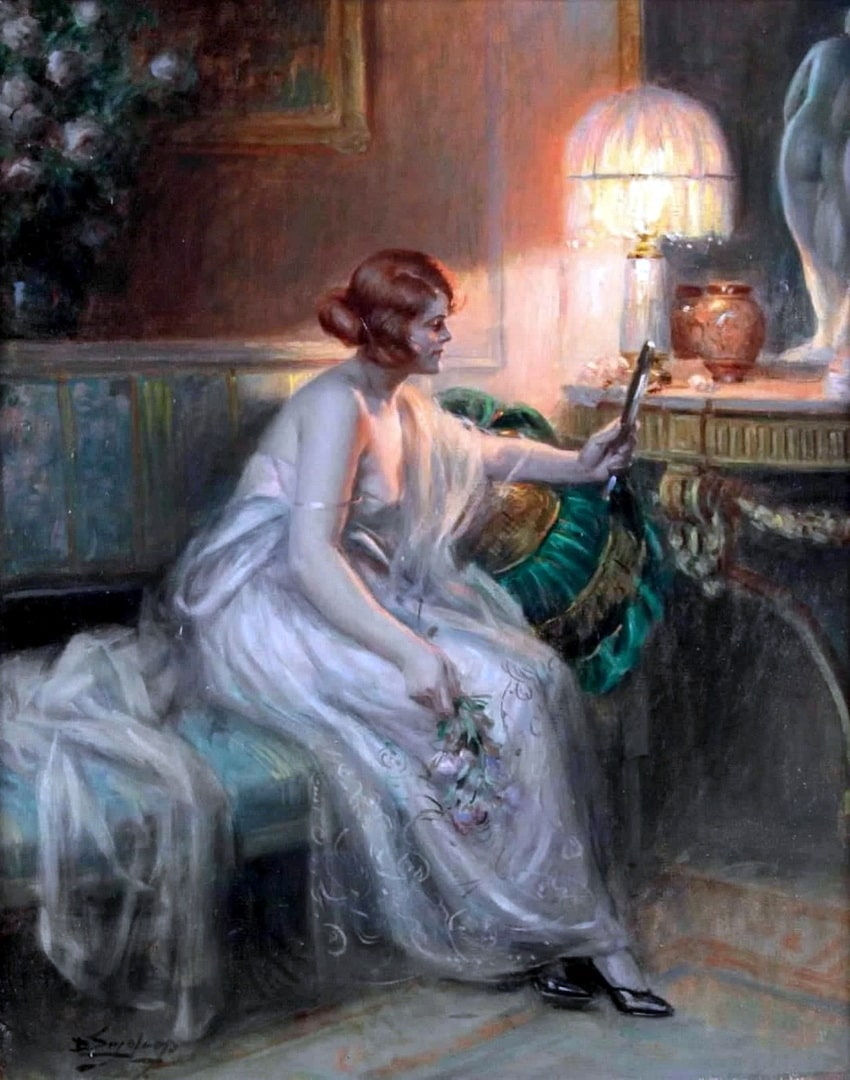
Red haired woman admiring herself in the mirror she holds and pink flowers

Coquetry. Delphin Enjolras.

A lady flirting with herself in the mirror that she holds. While she holds some pretty pink flowers in the other hand.

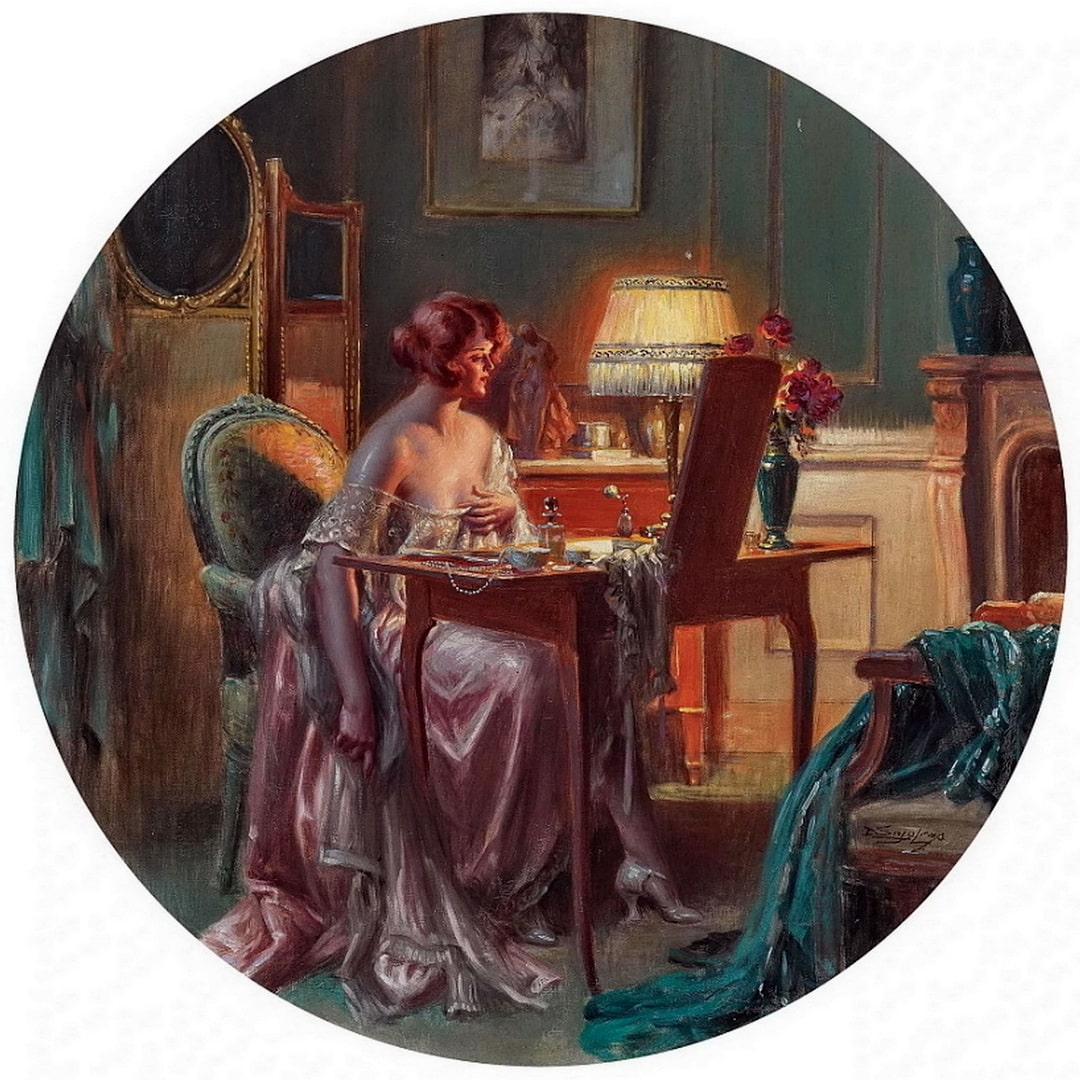
A woman sitting at her dressing table with pearls and flowers on each side.


Lady at the Dressing Table. Delphin Enjolras.

There are perfumes on the table as well as red flowers and a mirror along with a string of pearls. Everythings ready to go!


A lady making herself look beautiful by dressing up for the evening.

Elegante Up its Low. Delphin Enjolras.

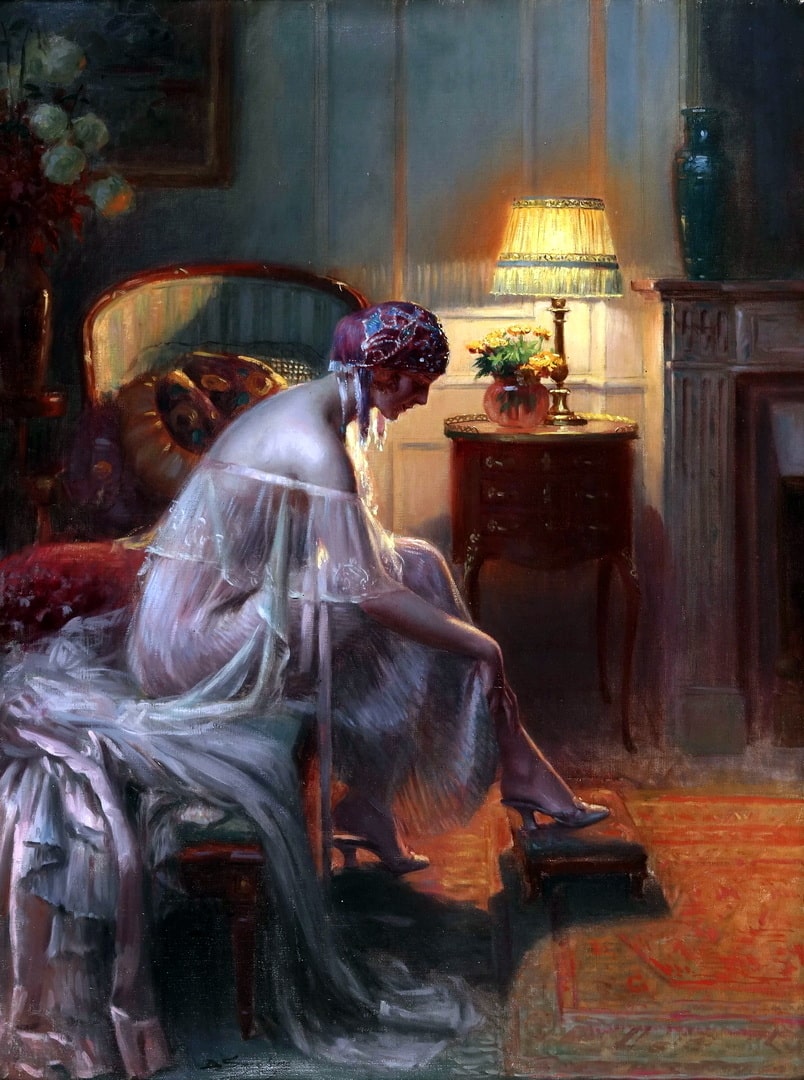
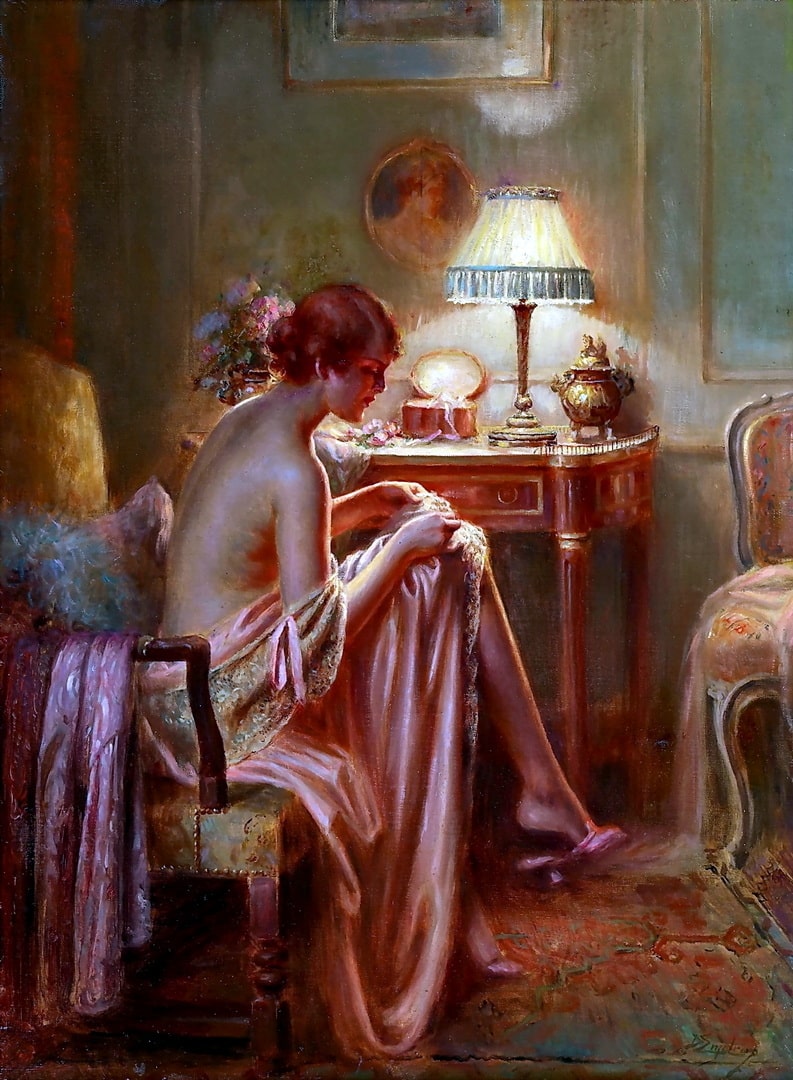
A woman in a sensuous pink nightie that's off the shoulder. On the table with the lamp are some yellow flowers along with some other flowers in a vase.

A pretty lady mending a pink nighty under a lamp next to the lovely flowers.

Young Woman Under The Lamp. A painting by Delphin Enjolras.

A semi-naked lady fixing her nightie who has some pretty flowers in a vase on her table. I will look very alluring for him when he comes to bed.

Sexy Art for Women 1 Find pretty paintings of lovely ladies and beautiful naked women 2.
Sensuous paintings of feminine beauty and lovely nude ladies with flowers and roses 2.
Paintings of very famous lesbians and their lovers 2. Gay ladies and famous females
The naughty nymph’s, sirens, fairies (related) all lust for sex. They are always hot and horny. They are very wicked girls and have sex with males, females, and Satyrs. Even all three at once!.
Harems are the home to Odalisques who provide sexual favours to Sultans.
Odelisques are the girls who provide sexual favours to the Sultans.
Venus the Goddess of Love. Lust,desire and sexual pleasure are what Venus gives to you.
Sexy Art for Women Page 2 Paintings of nude girls and foxy females Lusty ladies showing off their naked bodies in the name of art.
     
Sexy Art for Women 03 Nude paintings can help to improve a woman's sexuality and love.
Sexy Art for Women 04 Naked paintings of sexy women can help girls with better lovemaking.
Sexy Art for Women 5 Discover naked paintings of foxy females and lusty ladies in portraits.
Sexy Art for Women 6 Find nude portraits of sensuous women and flirty females having sexy fun.
     
Sexy Art for Women 7 Find vintage portraits of cute girls showing their sexy breasts.
Sexy Art for Women 8 Beautiful paintings of sexy nude girls and lovely females.
Sexy Art for Women 9 Elegant portraits of sensuous women and seductive females.
Sexy Art for Women 10 Pretty paintings of luscious ladies and dainty females.
Lite Erotic Art Page 10 with saucy paintings of naked women as well as hot nude girls and fleshy females You will also find wicked art of luscious ladies There are many naughty females on here for you to look at for sexy fun!
Delphin Enjolras Page 2 Sensuous paintings of lovely ladies.


THE LESSER MODERNS.

DECADENCE is simply the inability to create new tissue. In painting it manifests itself in two ways: either in the endeavour of an artist to turn the attention from new and precise procedures to antiquated and irrelevant ones; or in the artist’s desire to base his inspiration on the great work of an immediate forerunner rather than on the foundation of all vitality, nature. In neither case is new material being added to the sum of art. Decadence usually takes the form of a facile imitation of the surface aspect of a master, not infrequently making that master’s results prettier, more fluent and more attractive. This is a natural and inevitable consequence of copying the objective side of a great work which originally was the outgrowth of a profound aesthetic philosophy. Decadents, as a general rule, are sufficiently analytic to sense their own paucity of constructive genius. In recognising that nature can never inspire them to significant co-ordinations, they are content to accept, with slight modifications, the artistic standards of their predecessors. They vary the art that has gone before to meet the needs of their own temperaments. In many306 cases highly meritorious work results.

The word decadent is not wholly deprecatory. Often the decadent is a competent composer in the abstract. By presenting in an attractive way his own personal tastes, he sometimes makes his art both interesting and beautiful. His decadence lies in his retrogression from the point to which the art of his day has arrived and in his inability to introduce a new element to compensate for this retrogression. No amount of individuality can bridge this gap. Many painters, like Gauguin, have reacted against achievement but have possessed a tangential vitality which in itself has been a new contribution to aesthetic endeavour. Other painters, like Renoir, while introducing no innovations, have, by talented and comprehensive efforts, duplicated and improved upon the art of the latest creative masters and thereby pushed forward the highest standards. They are not decadents, for their work exhibits no deterioration. Even decadents may be excellent artists. Gaspar de Crayer was undoubtedly a great artist though an offshoot of Rubens; and Giampietrino and Cesare da Sesto were both solid and intelligent painters, though they did not rival their master, Leonardo da Vinci. There has undoubtedly been great sculpture since the Renaissance; but Michelangelo closed up for all time the plastic possibilities of clay and marble, and consequently, there being no new functioning element to be introduced into it, all sculpture since his day has been in the broad sense decadent.

Modern painting has had its decadents also men who have attempted to revert to a sterile past or307 who have followed in the paths blazed by others without approaching the achievements of the painters imitated. This latter class has its usages, for it tends to lend impetus to the movement it follows. The men composing it are popularly called exponents, and the appellation is just. There are painters in all countries today who adhere to Impressionist methods, and thereby keep ever before us one of the great steps in the development of modern painting. Cézanne has undoubtedly been given greater consideration because of the many artists who follow his precepts. And the numerous imitators of Cubism have done much to focus on that movement the consideration it deserves. In a general way all the lesser modern painters, by their feverish activities, expositions and pamphleteering, have, despite their inherent lack of genuine importance, kept the world conscious of the fact that it is in the midst of a great aesthetic upheaval, that new forces are at work, that the older order is being supplanted.

Today nearly every country has a group of men striving toward the new vision. They cannot all be innovators of new methods. They cannot all carry forward the evolution of modern painting. But they can at least give momentum to the current ideals and turn out work which bears so much personal merit that it becomes deserving of more or less serious consideration. Degas and his circle are of this class, as are the Futurists who, though at bottom decadent, inasmuch as they turn their art back to illustration, are a force which cannot be308 ignored. In Dresden, Munich and Berlin are groups of modern men who have repudiated the academies and struck out into new fields. Russia has contributed many young artists to the present ideal. England has not been altogether impervious to the modern doctrines. America is represented by fully a score of artists animated by the new vitality. And in France there are a hundred painters at work tearing down the older idols. While few of these men can lay claim to introducing any intrinsically new and significant methods or forms into modern painting, their work in many instances, while being decadent in the strict sense, is nevertheless commendable. They are not great artists even in the sense that Monet, Manet, Gauguin, Matisse and Picasso are great; but many of them are at least genuine artists.

One of the most conspicuous figures among the decadents is Wassily Kandinsky. In an age when all art was being arraigned before the tribunal of biology, physiology, and psychology, he came forward and attempted to drag it back into the murky medium of metaphysics. The generating forces of modern painting, however, rest on no metaphysical hypothesis. To attempt to define form by transcendental terms, or even to credit form with esoteric significance, reveals an ignorance of the principles of aesthetic emotion. Form in the art sense is a demonstrable proposition; it is answerable to physical laws. Michelangelo, El Greco, Giotto, Rubens, Cézanne and Renoir based composition on natural causes, and as each successive artist has approached intensity in organisation, he has come nearer and nearer to the rhythm which animates and309 controls corporeal existence. aesthetic form, in order to become emotion-producing, must reflect the form which is most intimately associated with our sensitivities. It must primarily be physical. There is nothing mysterious about aesthetic rhythm, and any attempt to “spiritualise” the harmonies of art carries art so much further from the truth. The modern tendency to make objects abstract and to divest subject-matter of all its mimetic qualities, has led some critics and painters to the false conclusion that form itself is unrelated to recognisable phenomena. But even in the most abstract of the great painters, the form is concrete. In a broad sense it is susceptible of geometrical demonstration; and its intensity is in direct ratio to its proximation to human organisms. In fact, there are no moving forms in an aesthetic organisation which do not have their prototypes in the human body in action. Were this not true empathy would be impossible, and without empathy an artistic emotion is purely intellectual and associative. The greatest painters, past and present, have recognised this principle; and art which does not adhere to it is decadent both in the aesthetic and the intellectual sense.

Kandinsky exemplifies this kind of decadence. While the innovators up to Matisse had tried to discover in nature secrets which would aid them in plastic expression, Kandinsky has tried, by numerous articles and at least one complete book, to turn back the minds of painters to the supposedly mystical elements of form and colour. But although this artist is to be commended on his effort to make colour significant in a310 day when angular forms of brown and black were the keynote, his study of colour should have begun where Cézanne left off and not with the writings of Maeterlinck and the symbolist poets. Kandinsky recognises that colour has possibilities, but he ignores the fact that colour is one of the physical sciences, as definite as those of the quadrivium, that its inductive qualities have become classified and that its functioning is precise and answerable to natural laws. Consequently he cannot co-ordinate its governing principles, and, in an attempt to rationalise it he has sought refuge in music, an art which presents to him the same mystical difficulties. So long as he was under the healthy influence of Matisse his symbology was less evident; but when he adopted a metaphysical programme it all came to the surface.

Kandinsky’s early “impressions” are heavy and insensitive “Fauve” pictures. His “compositions” for the most part are general statements of some rural scene in Matisse’s manner; and his “improvisations” represent semi-abstract lines delimiting scientifically meaningless colours. In his book, The Art of Spiritual Harmony, he presents an elaborate explanation of the metaphysical basis for colour, but he fails to contribute any ideas not to be found in Delacroix and Seurat. And the pictures with which he complements the text have been surpassed, in their own manner, by the Chinese. There are isolated comments on colour theories which are separately sound, and there are explanatory generalisations; but a diligent search fails to reveal any statement which is precise and at the same time new. The book refers constantly to311 music, and there are undeniable evidences of literary thought; but nowhere is there an explanation of the plastic significance of colour. Kandinsky is a painter of moods, and as such encroaches upon the domain of music. He is a painter of the vision of an action without its objective integument, and as such he enters the realm of poetry. He is essentially pretty, and despite his idealistic nomenclature, he is at bottom illustrative and decorative. What he designates the “soul” is only associative memory, and his conception of composition is the breaking up of a flat surface into irregular compartments by lines and more or less pure colour. Like Scriabine he has overlooked the formal possibilities of colour and consequently has failed in any aesthetically emotional expression.


KANDINSKY.


Kandinsky’s attempts to create moods are largely failures because of the inherent limitations of his art medium. The arts may be synthesised when a profounder understanding of them has come about, but their functionality can never be interchanged. The art of literature will always be able to tell a story better than the greatest sculpture; and even a primitive song is more capable of producing a mood than the most highly organised painting. Kandinsky, for instance, fails to achieve what the Marseillaise achieves in music, namely: the dramatic presentation of an exhortation to action. Separate, for instance, the phrases of the original version. The first verse opens with a rousing appeal which culminates on “patrie,” a word always welcome to the ear and heart of a Frenchman. Then the song acclaims the glory of the occasion and repeats dramatically the cause of the312 struggle “Contre nous de la tyrannie l’étendard sanglant est levé.” Then it recounts the tragedies which are befalling relatives and friends at the hands of the growling soldiers of the enemy; and suddenly, in an unexpected voice it calls, “Aux armes, citoyens!” ending in a patriotic and decisive flourish. The music throughout is subtly harmonised with the words: lively during the opening call; abated during the first statement of the cause; animated with its repetition; minor when the tragic words occur; vibrant and imitative of bugles during the call to arms; and highest in pitch at the end. This is the expression of the mood intensified.

Could painting extend itself into time and present singly and in sequence the visions of objective nature, dramatically synthesised with colour and line, it could perhaps influence people to emotion in the way music does. But the musical quality of time-extension is impossible in painting. And since a picture presents a simultaneous vision, which cannot be otherwise except through a subjective process, it is incapable of working from a prelude to a finale like music. Music is abstract, though firmly based on the rhythmic movement of all nature, yet it can produce moods by far more distant and far less tangible associations than can painting. But mood in music is no higher a quality than illustration in painting, and the highly creative artists ignore them both. The great composer is the one who, seeing beyond the associative theory in music, feels the deeper plasticity of movement and form: and his plasticity is this only preoccupation, just as the plastic element of313 colour is the great modern painter’s chief concern. Kandinsky has only tried to introduce an unimportant element of one art into another art. While the procedure has a superficial taste of novelty it is no more creditable than if he had declared himself frankly for illustration and joined the ranks of Degas and his school. He has not probed into the pregnant recesses of painting and attempted to discover the meaning of form. He has contented himself with obscuring the delineations of natural objects in such a manner that the beholder feels led to decipher his cryptic realities. The suggestion of actuality is there, but there being no other strong attraction in the picture, aesthetic or otherwise, the spectator sets to work to penetrate its objective meaning. In the majority of cases he succeeds, and gains thereby a satisfaction similar to that of having solved a simple problem in fractions.

In painting moods, which he refers to as “spiritual impressions,” “internal harmonies,” “psychic effects” and “soul vibrations,” Kandinsky does not attempt to depict the dynamic forces which produce moods, but strives to interpret his own emotional impressions by means of semi-symbolic and semi-naturalistic visions and by inspirational methods. Unable to ally the elements of colour and line to a given theme, he contents himself with giving us a chaotic impression by such means as he personally associates with his mood: and since this kind of association is largely individual, his depiction of the mood is incomprehensible to314 anyone not temperamentally and mentally at one with him. Did he understand the inherent psychological dramatic significance of colours and lines he could represent a universally moving vision, and thereby attain in a small degree the end for which he aims. But his feeling for colour especially is so vague and unscientific that it is, after all, a personal thing, and his graphic representation of a mood is little more than an individual and purely otiose expression. Even Carrà, in his colourless Funeral of the Anarchist Galli, approaches nearer the creation of a mood than does Kandinsky in his best canvases, for in Carrà there is exhibited a certain knowledge of the dramatic use of line which, when combined with recognisable subject-matter, augments the thematic drama.

Despite his complete preoccupation with colour Kandinsky is decadent more than Van Gogh to whom artistically he is closely related, because the progress of modern painting is toward purity, toward creation by means of a unique element, toward an art which expresses only the qualities of which that art is the most highly capable. When other considerations enter into it, it is at once drawn back toward illustration, and its final defecation is postponed. Happily Kandinsky, an explorer of the limitless realms of metaphysics, has given us no more specific a postulate than that colour has meaning. Though he formulates many vaguely associative theories (such as “keen yellow looks sour because it recalls the taste of a lemon,” “a shade of red will cause pain or disgust through association with running blood,” and “in the hierarchy of colours green is315 the bourgeoisie self-satisfied, immovable, narrow”); he nevertheless relies largely on instinct for their application. While attempting to turn painters’ minds from the precise discoveries of colourists to a pseudo-philosophical consideration of colour, he is too general and ambiguous to inspire extensive imitation. Already painters since him have gone forward in the great work of research begun by the Impressionists.

If Kandinsky, as a theorist, is cabalistic and illusory, he achieves a certain decorative prettiness in his work. Though his ideas are old, the appearance of his canvases is new: and it is merely this novelty of conception, coupled with his tendency toward abstraction, which makes him of interest, and then only as a theoretical deviation from the work of Gauguin, Matisse and the Orientals. His colour is not without visual charm, and his composition often has the fascination of the delicate patterns found in the Chinese. In fact, Kandinsky’s compositional debt to the Chinese is large. His Improvisation No. 29 is almost identical with a painting by Rin Teikei, and many of his pictures appear like curved-line generalisations of Chinese groupings, or the forms in Chinese backgrounds. Like the Cubists Kandinsky is a step toward arbitrariness in formal composition, but his advance is less significant than theirs. In his desire to illustrate a mood and produce a corresponding psychic emotion in the spectator he is a transcendentalised Futurist. His ontological terminology has given an impetus to his popularity, but it has tended unfortunately to obscure his worth as a maker of arabesques.

Of a different decadent type are Bonnard, Vuillard and K.-X. Roussel who call themselves the316 Intimists. These artists descend in large measure from Matisse, and though other and sometimes stronger influences enter their work, they are in a general way more closely akin to him than any other modern painter. Their appearance is more academic and, in the decorative sense, prettier than that of Matisse. Also, there is in their pictures a greater perpendicularity than in the work of their master. The angular and the perpendicular always represent the second compositional step from symmetricality to order: they are indicative of the earliest stage of aesthetic consciousness. They are found in the Egyptians, Phœnicians, Assyrians, Chaldeans, and in all the primitive Christians, and in Gauguin and Puvis de Chavannes. The artists who use them have awakened to the fact that chaos is not conducive to emotional satisfaction. In perpendicular lines there is a primitive sense of fitness, for one feels they are both well-planted and immovable. Not infrequently they are employed by the decadents of a movement or an epoch because they harmonise so neatly and unostentatiously with pretty colours and delicate themes. The Futurists found in them a ready means to a decorative order.

Bonnard, the most genuine artist of the group, uses perpendicularity of arrangement more consciously than does either of the others. He studied in the same class with Maurice Denis at the Académie Julien, and his association with this painter no doubt explains his compositional predilection. He is strongly influenced by Renoir, although he has never penetrated beyond Renoir’s surface. His greys are always rich and sombre, and317 even his simplest works are as artistically opulent and lovely as the finest tapestry. Indeed his large paintings are more appropriately wall coverings than panels, ornaments rather than decorations. In them are hot sunlight and cold shadow in scintillating succession; and every object is put to genuine ornamental use. They seem to exhibit an unconscious fluency in the employment of bafflingly diverse greys which are saturated with colour and applied so as to reveal highly their attentuated purity. There are also in his work harmoniously horizontal lines and pleasing sequences of curves. In Le Jardin a line starts with the head of a man on the left, continues along his arm and leg and the sofa back, and reaches an apex in the child’s head to the right of the centre, sinks by way of the head of the woman on the right to the man’s arm, is then caught up again by the contour of his legs, is paralleled by the outline of the nearest standing child’s dress and face and the face of the kneeling girl, is continued in the bottom of the skirt of the child seated on the sofa, and then becomes horizontal in a perfect continuation of the table’s surface. The line is beautiful and studiously made, and is pointed out here for the purpose of showing the simple ordonnance often found in the lesser artists. Nor is it the only line in the canvas. There are others as harmonious and as beautiful; but what keeps the picture from being a great composition, although its forms are solid and well adapted to their spaces, is its lack of opposition or solution of warring elements. If we do not try to class Bonnard with the greatest artists, we are forced to praise him. He is unpretentious, highly gifted, has a well-developed sense of the beautiful, and is possessed of a most sensitive eye. He is neither an illustrator of318 nature nor of moods, but an artist who paints to obtain aesthetic expression, without the arrière pensée of a theoretical method. He is one of the most purely pleasing painters of modern times.

Vuillard, a painter of interiors, owes his inspiration as much to Toulouse-Lautrec as to Gauguin. Like Bonnard he uses greys of dry and mat colour, but his harmonies are slighter and of lighter tonality than those of Bonnard. Profiting by the Impressionists’ light discoveries he has done some very admirable interiors; some of his works are more modern and artistic Whistlers. His art is one in which the spotting of masses for the sake of balance supplants any attempt to produce generating lines. As with Bonnard and Roussel there is in him a striving after beautiful surfaces, matières which in themselves will tempt the amateur. In this common pursuit the Intimists show themselves to be the successors of Degas; but they are successors who, having taken to heart the teachings of more significant forerunners, represent a sturdier decadence than that of Degas. K.-X. Roussel is a feminised Poussin. He searches solely for effect, and his canvases have the singular charm of enamel. Were they smaller they would make admirable brooches and vases. He too has made tapestries, but in spirit they are less modern than the corresponding efforts of his contemporaries. His compositions embody reddish satyrs and nymphs, intense blue sky, yellow-green foliage and yellow ground. His drawing never has more than the rudimentary charm of school-room talent, while that319 of Vuillard is subjugated to his colour application, and that of Bonnard is instinctively deformed to the needs of line and decorative necessity.


LE JARDIN. BONNARD.


Maurice Denis is more directly an outcome of the school of Pont-Aven than are the three preceding men. His synthetic figures were first seen in Courbet, then in Puvis de Chavannes, then in Besnard and Gauguin. In Denis they have lost much of their significance and have once more become primarily academic. There was a time about 1890 when Denis’s colour was not aggressively disagreeable. It was subjugated to a certain greyness which was applied in little spots resembling the black-and-white stippling of some of Seurat’s drawings. Now his colour has grown acid and unpleasant. His line is stiff and vitiated and lacks even the quality of a pleasing silhouette. He has written a book of theories, but it has helped him little in his artistic achievements. He is the antithesis of Bonnard, and his colours possess almost no harmonious interrelation. In him there are a few perpendicular lines, but one may seek in vain for evidences of co-ordination. Many of his figures are appropriated from the works of the old masters, but because he fails to adapt them sensitively to his needs, they lose, rather than gain, in beauty by the transfer. He is at times symbolic and allegoric, and while one might overlook this literary phase of his art, provided there were other qualities to compensate for it, he fails to exhibit a complete appreciation of the aesthetic possibilities of his models, and consequently becomes merely an exponent of adopted mannerisms. His popularity has entirely to do with qualities unrelated to painting. Judged by a purely aesthetic standard he is inferior to an Augustus John, a Desvallières, a Bourdelle or320 a Wyndham Lewis.

The highly talented André Derain is another synthetic painter. He is sincerely moved by multiramose tree forms and the sunlight effects of Provence, and his admiration for Cézanne led him into certain mannerisms which have for their object a facilitation of the Aix master’s methods. In his use of soft yellows, hot earth tones, deep warm greens and light blues, he reveals his debt to the modern tendency toward colour. By outlining his objects with heavy contours, he has acquired erroneously a reputation for virility, and though he aspires to composition, he only achieves pattern. He is much like the Scandinavian, Othon Friesz, who, having absorbed the exteriors of Matisse and Cézanne, and having read Cézanne’s letter recommending Poussin remade on nature, has turned his attention to this old Titian offshoot and endeavours to give us a reversion to style. At one time he used colour freely, but he now paints with ochres, blues, blacks, greens and an occasional red a gamut like Derain’s, only yellower. He too has a heavy technique and a reputation for virility. Maurice de Vlaminck is another painter of similar inspiration and palette. He is much prettier and has a finer sense of soft harmonies than either of the other two. He reveals a genuine feeling for his subjects, and always tries to introduce into his works a simple oppositional line. He comes direct from Cézanne, and it is from paintings such as his that Cézanne has acquired a321 reputation as a maker of arabesques. De Vlaminck has a rich and impelling matière and an art sense which is almost coquettish.

Kees van Dongen has studied the sensual drawings of Toulouse-Lautrec and the broad exteriors of Matisse, and in combining his two admirations has made eminently effective posters of nearly harmonious colours in very broad planes. De Segonzac also uses attenuated colours in a broad manner after Matisse. Manguin, another Matisse imitator, is too academic to appeal strongly to those who have acquired the modern vision, despite the primitive order his canvases at times possess. Flandrin is more decorative. His works reveal a classic perpendicularity of composition, and though they are without a sense of form, we feel in them a certain charm of space and air. He brushes in his landscapes broadly by planes of light and dark, somewhat in the very early manner of Matisse. Pierre Laprade has arrived at a style of surface which may best be characterised as bad tapestry. Jean Puy applies his pictures in a broad, somewhat bold, manner, and his light tonality and angularities point to his having lingered over the work of Cézanne. Lebasque is the feminine prototype of Puy. His colour is faded and unemotional, and his exteriors are as flat as the simplest decorations. Madame Marval differs from Lebasque only in theme.

Modern decadence in Zak, Rousseau, Vallotton, Prendergast and Simon Bussy manifests itself in a retrogression to primitive ideals. Though using the modern methods of simplification, these men revert to a static and dead past. Their aim is to revive the most ancient manner of322 painting. Of all the modern decadents they are perhaps the most devitalising for they tacitly repudiate the discoveries of the new men, and strive to turn the minds of the public and of painters alike to the sterilities of antiquity. They even ignore the aesthetic principles of the Renaissance, and by pushing creative expression to its furthest limits of artlessness, turn to naught the entire achievements of the great plastic composers. At best these men are dealers in decorative material. Simple arrangement is absent from their works, and colour, which for nearly a century has fought for its true place in painting, is once more used as an instinctive means for filling in drawings.

Vallotton, though a modern primitive, is not allied to any recent school. In appearance his work is unlike that of the other moderns. He disdains all save the simplest means and the most restricted colours. In him there are no delicate plays of light, but broad and heavy shadings which are not without subtlety. He is a Teutonic Ingres a Flandrin made serious as to precision and reduced colour. At a distance his nude studies are interesting, for there one loses the dryness and hardness of their technical manner a heritage of Vallotton’s days of wood engravings. Other modern painters who elude classification, but who are intimately related in a general way to the new movements are Charles Guérin, Piot, Spiro, Alcide Le Beau, Gustave Jaulmes and d’Espagnat. Though they differ markedly from Vallotton they are all preoccupied with self-expression by means of colour. By making it a dominant element in their work, they have admitted their susceptibility to the modern ideal and thereby have given an impetus to the spirit which tends toward purification. Guérin is a323 professor of the Académie Moderne; and though clinging close to conventional drawing, he attains a slightly novel aspect in all his tapestry-like canvases. He is eminently of the Beaux-Arts tradition, is artificial and monotonous, and paints very large pictures with both idealistic and realistic themes.

Of the modern men who have found in Cubism their strongest aesthetic fascination de la Fresnay is a noteworthy example. So well does he understand the demands of the Picasso tradition that he has come to be looked upon as one of the members of the Cubist group. His arrangements are soft and pretty and his colour is harmonious. He has in fact surpassed in merit several of the original Cubists. Frederick Etchells and W. Roberts are English exponents of Cubism, and the latter has done some work which rivals that of Picabia. Wyndham Lewis, another Englishman, strives for an individual expression, but his angularities reveal his debt to Picasso, although the general impression of his pictures is Futuristic. The hand of the Cubists can be found in many of the canvases of the modern Americans. Arthur B. Davies, the most popular of the new men in the United States, is at bottom a superficial academician, but he superimposes shallow Cubist traits on his two-dimensional drawings, giving them a spuriously modern appearance. Maurice Stern treats Gauguin themes with a pale reflection of the early geometrical Picasso; and similar means are employed by C. R. Sheeler, Jr., though both Matisse and Delaunay have contributed to his art.

To name all324 the modern painters who are conscientiously battling against formalism and the dry-rot of the academies would be impossible. The field is too broad: the activities are too numerous. Few civilised countries have escaped the insistence of the new impetus. By some painters the new methods are adopted tentatively and by degrees. Others fly to the latest phases of art and move forward with the epoch. Today there are numerous representatives of all the movements from Impressionism to Synchromism. Kroll and Childe Hassam, both Americans, are emulators of Monet, though Hassam, who appears less modern than Kroll, is by far the more sensitive painter. Marquet has done more than imitate Impressionism. He has synthesised Monet into a more masculine expression. His planes are broad and luminous, and he achieves a distinct feeling for air and distance by simpler and more direct means than did the Impressionists. W. S. Glackens combines a Renoir technique with a modern purity of colour. J. D. Ferguson, the Scotchman, also reverts to the Impressionists but has learned much from Matisse. Duncan Grant, an Englishman, is much more modern than Ferguson and more competently expressive of the new. Roger Fry has contributed much to the modern impetus. His writings reveal a wide comprehension of present-day paintings and his insight into aesthetics is at times profound. Every year adds to the ranks. Besides the modern artists already named may be mentioned Bechteiev, Bolz, Lhote, Chagall, Chamaillard, Zawadowsky, Hayden325, Ottmann, Lotiron, Utrillo, Hartley, Peckstein, Valensi, Jawlensky, Knauerhase, Münter, Tobeen, Bloch, Dove, de Chirico, Walkowitz, Boussingault, Kanoldt and Granzow.

One of the healthiest movements of the day, though without novelty, is Vorticism whose headquarters are London. The Vorticists are unrestricted as to theories, and have for their aim the final purification of painting as well as of the other arts. Their creed is an intelligent one, and is in direct line with the current tendencies. As yet they have produced no pictures which might be called reflective of their principles, but they have kept before English artists the necessity of eliminating the unessentials. Their main doctrines, so far as painting is concerned, were set forth by the Synchromists long before the Vorticists came into public being; but by their insistence on the basic needs of purification, they have done valuable service. The Synchromists in their manifesto wrote: “An art whose ambition it is to be pure should express itself only in the means inherent in that art..... Painting being the art of colour, any quality of a picture not expressed by colour is not painting.” A year later in Blast, the Vorticists’ publication, we read: “The Vorticist relies on this alone; on the primary pigment of his art, and nothing else..... Every concept, every emotion presents itself to the vivid consciousness in some primary form. It belongs to the art of this form. If sound, to music, if formed words, to literature; colour in position, to painting.....”

All these painters are the leaders of the secondary inspirations in modern art, and out of them grow other painters in Europe and America. They do not as a rule go by the name of any school, but they can be classed together because in326 them all is the same desire to create the novel, to present a strikingly different aspect from the academies, and to differentiate themselves individually from their fellows. They all feel their incompetency to create new forms, the necessity to follow, the timidity which only permits them to modify the surfaces of other greater men. They are the creative exponents and the decadents of vital movements, and they in turn have their own imitators and decadents. They have felt the need for change, but lack the genius for new organisations. That many of them are sound artists it would be folly to deny. But they are in no sense of the word innovators. Some of them in fact are failures, but theirs is the consolation of having failed in attempting something vital and representative of the age in which they live.


CONCLUSION.

IN conclusion there are several points which require accentuation if the significance of modern painting is to be fully grasped. There have been three epochs in the visual arts. The first was the longest, and extended through more than two centuries. The last two epochs have required less than a hundred years for their fulfilment. Each epoch dealt with a specific phase of painting and developed that phase until its possibilities were exhausted. The ultimate aim of all great painting was purification, but before that could come about many theories had to be tested; many consummations had to take place; many problems had to be solved. The laws of formal organisation were first discovered and applied with the limited means at hand. Then came experimentation and research in the mechanics of expression the search for new and vital methods wherewith these principles of composition might be bodied forth more intensely. Later the functioning properties of colour were unearthed and employed. In the course of this evolution many irrelevant factors found their way into painting. The men of the first epoch used primitive and obvious materials to express their forms. When the new means means inherent in painting were ascertained, it was necessary to eliminate the328 former media. The subject-matter of painting that is, the recognisable object, the human obstacle had to be forced out to permit of the introduction of colour which had become an inseparable adjunct of form. To effect the coalition of pure composition and the newer methods was a difficult feat, for so long had the world been accustomed to the pictorial aspect of painting, that it had come to look upon subject-matter as a cardinal requisite to plastic creation.

The first epoch began with the advent of oil painting about 1400, and went forward, building and developing, until it reached realisation early in the seventeenth century. Knowing that organised form is the basis of all aesthetic emotion, the old masters strove to find the psychological principles for co-ordinating volume. Their means were naturally superficial, for their initial concern was to determine what they should do, not how they should do it. In expressing the form they deemed necessary to great art they used the material already at their disposal, namely: objective nature. They organised and made rhythmic the objects about them, more especially the human body which permitted of many variations and groupings and which was in itself a complete ensemble. And furthermore they had discovered that movement an indispensable attribute of the most highly emotional composition was best expressed by the poise of the human figure. Colour to these early men was only an addendum to drawing. They conceived form in black and white, and sought to reinforce their work by329 the realistic use of pigments. That colour was an infixed element of organisation they never suspected. Their preoccupation was along different lines. The greatest exponents of intense composition during this first epoch were Tintoretto, Giorgione, Masaccio, Giotto, Veronese, El Greco and Rubens. These men were primarily interested in discovering absolute laws for formal rhythm. The mimetic quality of their work was a secondary consideration. In Rubens were consummated the aims of the older painters; that is, he attained to the highest degree of compositional plasticity which was possible with the fixed means of his period. In him the first cycle terminated. There was no longer any advance to be made in the art of painting until a new method of expression should be unearthed. However, the principles of form laid down by these old masters were fundamental and unalterable. Upon them all great painting must ever be based. They are intimately connected with the very organisms of human existence, and can never be changed until the nature of mankind shall change.

After Rubens a short period of decadence and deterioration set in. The older methods no longer afforded inspiration. About the beginning of the nineteenth century the second cycle of painting was ushered in by Turner, Constable and Delacroix. These men, realising that until new means were discovered art could be only a variation of what had come before, turned their attention to finding a procedure by which the ambition of the artist could be more profoundly realised. This second cycle was one of research and analysis, of330 scientific experimentation and data gathering. To surpass Rubens in his own medium was impossible: he had reached the ultimate outpost of aesthetic possibilities with what materials he possessed. The new men first made inquiry into colour from the standpoint of its dramatic potentialities. Naturalism was born. While Delacroix was busy applying the rudiments of colour science to thematic romanticism, Courbet was busy tearing down the tenets of conventionalism in subject-matter, and Daumier was experimenting in the simultaneity of form and drawing. Manet liberated the painter from set themes, and thereby broadened the material field of composition. The Impressionists followed, and by labourious investigations into nature’s methods, probed the secrets of colour in relation to light. The Neo-Impressionists went further afield with scientific observations; and finally Renoir, assimilating all the new discoveries, rejected the fallacies and co-ordinated the valuable conclusions. In him was brought to a close the naturalistic conception of painting. He was the consummation of the second cycle. During this period the older laws of composition were for the most part forgotten. The painters were too absorbed in their search for new means. They forgot the foundations of art in their enthusiasm for a fuller and less restricted expression. The essential character of colour and light and the new freedom in subject selection so intoxicated them that they lost sight of all that had preceded them. But their gifts to painting cannot be overestimated. By finding new weapons with which future artists might achieve the highest formal intensity, they opened up illimitable fields of aesthetic endeavour: they made possible the third and last cycle which resulted in the331 final purification of painting.

Of this cycle Cézanne was the primitive. Profiting by the Impressionist teachings, he turned his attention once more to the needs of composition. He realised the limitations of the naturalistic conception, and created light which, though it was as logical as nature’s, was not restricted to the realistic vision. Colour with him became for the first time a functional element capable of producing form. The absolute freedom of subject selection a heritage from the second cycle permitted him extreme distortions, and with these distortions was opened up the road to abstraction. Matisse made form even more arbitrary, and Picasso approached still nearer to the final elimination of natural objectivity, though both men ignored colour as a generator of form. They carried forward the work of Cézanne only on its material side. Then Synchromism, combining the progress of both Cézanne and the Cubists, took the final step in the elimination of the illustrative object, and at the same time put aside the local hues on which the art of Cézanne was dependent. Since the art of painting is the art of colour, the Synchromists depended entirely on primary pigment for the complete expression of formal composition. Thus was brought about the final purification of painting. Form was entirely divorced from any realistic consideration: and colour became an organic function. The methods of painting, being rationalised, reached their highest degree of purity and creative capability.

The evolution of painting from tinted illustration to an abstract art expressed wholly by the one element inherent in it colour, was a natural and332 inevitable progress. Music passed through the same development from the imitation of natural sounds to harmonic abstraction. We no longer consider such compositions as The Battle of Prague or Monastery Bells aesthetically comparable to Korngold’s Symphonietta or Schönberg’s Opus II. And yet in painting the great majority confines its judgment to that phase of a picture which is irrelevant to its aesthetic importance. So long have form and composition expressed themselves through recognisable phenomena that the cognitive object has come to be looked upon as an end, whereas it is only a means to a subjective emotion. The world still demands that a painting shall represent a natural form, that is, that the basis of painting shall be illustration. The illustrative object was employed by the older painters only because their means were limited, because they had no profounder method wherewith to express themselves. And even with them the human body was deliberately disproportioned and altered to meet the needs of composition. When the properties of colour began to be understood, the older methods were no longer required. Colour itself became form. But so deeply rooted was the illustrative precedent that no one painter had the courage to eliminate objectivity at one stroke. Cézanne took the first great step; Matisse, the second; Cubism the next; and Synchromism the final one.

So long as painting deals with objective nature it is an impure art, for recognisability precludes the highest aesthetic emotion. All painting, ancient and modern, moves us aesthetically only in so far as it possesses a force over and333 beyond its mimetic aspect. The average spectator is unable to differentiate his literary and associative emotions from his aesthetic ecstasy. Form and rhythm alone are the bases of aesthetic enjoyment: all else in a picture is superfluity. Therefore a picture in order to represent its intensest emotive power must be an abstract presentation expressed entirely in the medium of painting: and that medium is colour. There are no longer any experiments to be made in methods. Form and colour the two permanent and inalienable qualities of painting have become synonymous. Ancient painting sounded the depths of composition. Modern painting has sounded the depths of colour. Research is at an end. It now remains only for artists to create. The means have been perfected: the laws of organisation have been laid down. No more innovatory “movements” are possible. Any school of the future must necessarily be compositional. It can be only a variation or a modification of the past. The methods of painting may be complicated. New forms may be found. But it is no longer possible to add anything to the means at hand. The era of pure creation begins with the present day.

Those who go to painting for anecdote, drama, archaeology, illustration or any other quality which is not strictly aesthetic, would do well to confine their attention and their comments to the academicians of whom there is and always has been an abundant supply. Let them keep their hands off those artists who strive for higher and more eternal manifestations. The greatest artists of every age have never sought to appeal to the lovers of reality and sentiment. Nor have they wished to334 be judged by standards which considered only verisimilitude and technical proficiency. It is the misfortune of painting that literary impurities should have accompanied its development, and it is the irony of serious endeavour that on account of these impurities there has been an indefinite deferment of any genuine appreciation of painting. It is difficult to convince a man who has not experienced the great aesthetic emotions which art is capable of producing, that there is an intoxication to be derived from the contemplation of art keener than that of association, sentiment or drama. Not knowing that greater delights await him once he has penetrated beneath the surface, he has doggedly combated every effort to eliminate the irrelevant accretions. But if painting was to reach its highest point of artistic creation, its realistic aspect had to go. When colour became profoundly understood, no longer could the artist apply it according to the dictates of nature. It lost its properties as decoration and as an enhancement of the naturalistic vision. Its demands freed the artist from the tyranny of nature. In becoming pure, painting drew further and further away from mimicry; and the superficial lover of painting, enslaved by the ignorant and rigid standards of the past, protested with greater and greater vehemence.

The misunderstanding which has attached to modern painting has been colossal. The newer men, because they have dared search for means of expression superior to those of335 the past, have met with ridicule and abuse. From Delacroix to Synchromism the critics and public have fought every advance. Immured in tradition, their minds have been unable to grasp the meaning of the new activities or to sense the artist’s need for pure creation. No school has escaped the obloquy of the professional critic who, judging art from its superficial and unimportant side, has failed to penetrate to its fundamentals. Delacroix was declared crazy by the leading critics. The Journal des Artistes said of him, “We do not say this man is a charlatan, but we do say this man is the equivalent of a charlatan.” The Observateur des Beaux-Arts, commenting on this artist’s failure to procure an award, remarked, “Delacroix, the leader of the new school, received no honours, but in order to recompense him, he was accorded a two hours’ séance each day in the morgue.” Gros, Delécluze and Alfred Nettement are conspicuous among the academicians and critics who bitterly opposed Delacroix’s innovations. Courbet met with a similar reception. Gautier, after studying one of his pictures, wrote, “One does not know whether to weep or laugh. There are heads which recall the ensigns of tobacconists and of the menagerie.” Clément de Ris said of Courbet’s work, “It is the glorification of vulgar ugliness;” and de Chennevières called one of his finest pictures “an ignoble and impious caricature.” Even Manet, whose radicalism was slight, brought down upon himself the abuse of the critics for daring to paint modern themes. Claretie drew the following conclusion from the Olympia: “One cannot reproach Manet for idealising vierges folles, for he makes of them vierges sales.” The remark was characteristic. Manet revolted against classic subjects, and336 for his modernity was excoriated by the moral traditionalists.

The early Impressionists, as pretty as they were, did not escape critical abuse. Benjamin Constant called them “the school of snobs, the conscious or unconscious enemies of art,” and added, “Their days are numbered.” Albert Wolff was more venomous. “These soi-disant artists,” he wrote, “call themselves the intransigents. They take canvases, colours and brushes, fling at hazard several tones, and then sign the work. It is thus that the wandering spirits at Ville-Évrard pick up pebbles on the highway and think they have found diamonds. Hideous spectacle of human vanity straying toward dementia!” Paul Mantz’s remarks were similar. His criticism in part read: “Before the works of certain members of the group one is tempted to ascribe to them a defect of the eyes, singularities of vision which would be the joy of ophthalmologists, and the terror of families.” (How like the recent criticisms of the very modern men does all this sound these accusations of insanity, these hints of defective vision! Such comments would seem to have been lifted almost bodily by the detractors of Cubism, Futurism and Synchromism.) Renoir shared a similar fate. One leading critic said it was futile to “try to explain to Renoir that the female torso is not a mass of decomposing flesh with spots of green and violet which denote the state of complete putrefaction in a cadaver.” Roger Ballu explained the appearance of Renoir’s work thus: “At first view it337 seemed that his canvases, during their trip from the studio to the exhibition, had undergone an accident.” With the exception of Manet two years prior to his death and Renoir at the age of sixty-eight, not one of the Impressionists was decorated by the French government. They were banished from official Salons, and compelled to expose in private galleries.

To quote from the critics who denounced Cézanne would be an endless task. When he exposed at the Impressionist exhibition in the Rue Peletier in 1877 he was universally regarded with disgust and horror and considered a barbarian. The venom of the critics was appalling. They attacked him from every standpoint, though on one point they seemed in agreement, namely: that he was a communard. Nor did the abuse cease with his early works. His greatness has consistently evaded critics and painters alike. Recently the American painter, William M. Chase, offered the suggestion that Cézanne did not know how to paint. Chase’s opinion is not an isolated one: it is typical of the minor academic painters and the critics who view art through the eyes of the past. Henri-Matisse is another painter who has received short shrift from the reviewers. One need not have a long memory to recall the adverse criticisms he provoked. His distortions have served as a basis for a display of ignorance which has few parallels in art history. Matisse himself has fed fuel to the fire. In his interview with newspaper men he indulged in much high jesting, and the remarks attributed to him were in many instances blague. Others, judging him by his words, have pinned on him the labels of charlatan and degenerate.338

The Cubists, misunderstood from the first, have been a source of ridicule rather than of contumely. Systematisers have sought to trace them to Dürer, forgetting that Cézanne once wrote: “Treat nature by the cylinder, the sphere and the cone; the whole put in perspective, so that each side of an object and of a plane directs itself toward a central point.” Even today, after the vital contributions of the Cubists have altered the whole trend of modern art, there are few who see in them aught but the material for laughter. The critics who have accepted the Impressionists and Cézanne deny the merits of Cubism, venting their derision in a manner which recalls the detractors of the very schools which these critics now uphold. Synchromism has perhaps called forth the bitterest protests. It was the last step in the evolution of modern means. It had no affinities with the academies. There was no foothold in this new school for the conservatives and reactionaries. The Munich critics were first to attack it. Later in Paris André Salmon wrote, “The public will believe that Synchromism is the final movement of which it has learned. Synchromism is the worst of backward movements, a vulgar art, without nobility, unlikely to live, as it carries the principles of death in itself.” Les Arts et Les Artistes summed up Synchromists with: “The house painter at the corner can, when he wishes, claim that he belongs to this school.” La Plume discovered the fact that “Macdonald-Wright copies with a dirty broom the Slave of Michelangelo.” Charles H. Caffin declared, “The whole tenor of their foreword and introduction is one of egregious self-exploitation339 and self-advertisement. This ... raises the very obvious question: ’Are these men megalomaniacs or charlatans?’ Possibly they are neither the one nor the other. I am not in a position to decide.”

These quotations and comments are set down to reveal the opposition which the genuine modern painters have had to contend with. The criticisms of each movement repeat themselves with the following one, even to a point of verbal similarity. The attacks on Synchromism are strangely like those which companioned Impressionism. The same facetiousness, the same irrelevant denunciation, the same opposition to the new, the same antipathy for progress are manifest in all the critics of the new painting from Delacroix to date. All arise out of ignorance, out of that immobility of mind which cannot judge clearly until a thing is swathed in the perspective of the years. Art has grown faster than the critic’s ability to comprehend. Its problems are a closed book to him, for, not being a painter himself, he requires a longer period in which to assimilate the new ideals. Gradually as the new methods establish themselves, and become accepted (as in the case of Impressionism), the critic at last comes abreast of a movement; but by that time art has gone forward and left him in the rear. Again he attacks the new. All innovations are as poison to his system, until he again becomes adjusted. Thus can we account for the animosity and ridicule with which each modern movement has been met.

Nor are the animadversions of academic critics the only obstacles in the path of aesthetic development. Those who sympathise with the new340 without understanding it do more harm than good. There are those who always accept the latest men irrespective of their individual merit. But modernity in itself is not a merit, and the modern enthusiasts, in defending the newest painters, very often expend their energies on the undeserving. Thus the mediocrities are given prominence over the truly great; and the lesser artists are looked upon as representative of the epoch. Again, those who admire without comprehending are given to emphasising the less important points of departure in the new men, and of ignoring the deeper qualities which represent the primary importance of modern art. The true meaning of the late movements is thereby obscured. Of this class of critic Arthur Jerome Eddy may be mentioned as representative. By crediting the distinctly second-rate moderns with qualities they have only absorbed from greater men, and by misunderstanding the animating ideals of today’s painting, he presents so disproportionate and biased a history that the entire significance of modern art is lost. England, France and Germany possess critics who feel the grandeur but miss the meaning of the new ideals, and their books and articles, while crediting the modern painters with vitality, go little beneath the surface.

However, there are a few men to whom the modernist owes much for intelligent assistance. One may name Meier-Graefe as one of these, despite his being in reality a pioneer. He has shown an eager attitude to do justice, and has succeeded in bringing the modern men to the attention of the world. Guillaume Apollinaire, editor of341 Les Soirées de Paris, has done more intelligent service for the younger heretics in France than any other man. Clive Bell and Roger Fry represent the ablest and most discerning defenders of the modern spirit in England; although Mr. A. R. Orage, by opening up the columns of the New Age, has permitted a healthy discussion and exposition of the radical art theories. In America much credit is due Mr. Alfred Stieglitz for his insistent demands that the later men be given a respectful hearing. By his sympathetic attitude and his ceaseless labours he has brought before the American public the work of many prominent modern artists; and his sincerity and understanding have done much toward ameliorating the conventional scoffs of American critics.

But were there no far-seeing defenders of modern painting, the signs of the awakening are too numerous and too conspicuous to be ignored. On every hand we are conscious of the struggle for new methods and forms. Not all the inertia of the critics and the public has succeeded in suppressing the vital spirit. Nor will it succeed. The modern tendency in painting cannot be dismissed as charlatanism or extremism. The ignorant and reactionary may laugh and hurl philippics. Such opposition, if it has any effect, will only prove a stimulus to those who have experienced the ecstasy of the new work. The old dies hard. Even when the corpse is buried (as it has been) the ghost lingers. But the light will soon grow too strong. The ghost in time will be342 dissolved. For centuries painting has been reared on a false foundation, and the criteria of aesthetic appreciation have been irrelevant. Painting has been a bastard art an agglomeration of literature, religion, photography and decoration. The efforts of painters for the last century have been devoted to the elimination of all extraneous considerations, to making painting as pure an art as music. But so widespread is the general ignorance regarding art’s fundamentals that the modern men have been opposed at every step. Public and critical illiteracy in the arts, however, matters little. The painter’s joy lies in the rapture of creation, in the knowledge that he is carrying forward the banner of a high ideal.


Back to the top.

Lite Erotic Art Page 10 with saucy paintings of naked women as well as hot nude girls and fleshy females You will also find wicked art of luscious ladies There are many naughty females on here for you to look at for sexy fun!
Delphin Enjolras Page 2 Sensuous paintings of lovely ladies.


©7th June 2024 sexyartforwomen.


Women in sexy nightwear and hot nude girls and seductive ladies in slinky outfits for luring their lover into making love.

Sexy Art for Women. Delphin Enjolras 1. Female Erotica and Feminine Beauty.