|
Women who love women and enjoy making Love to other hot sexy girls. |
|
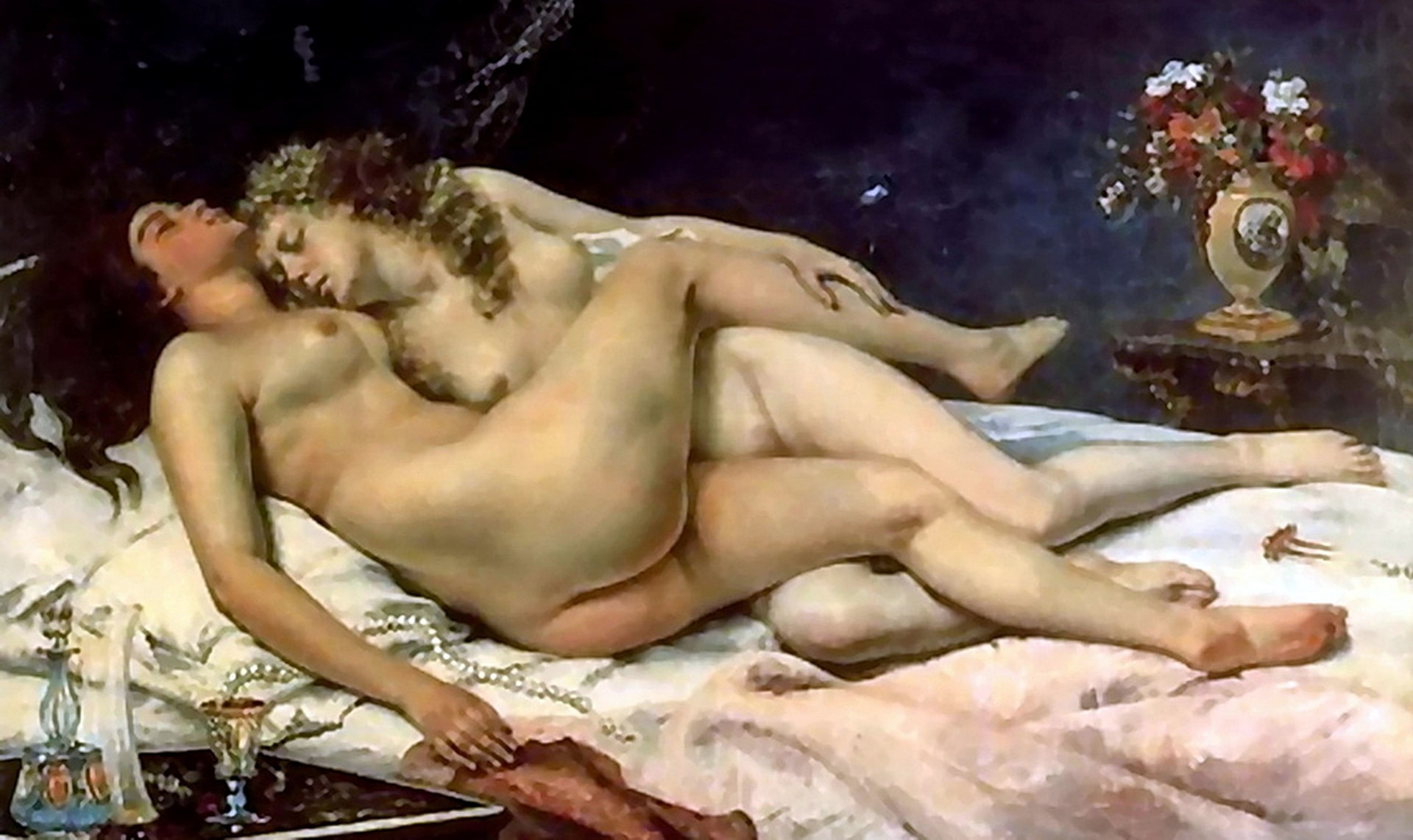
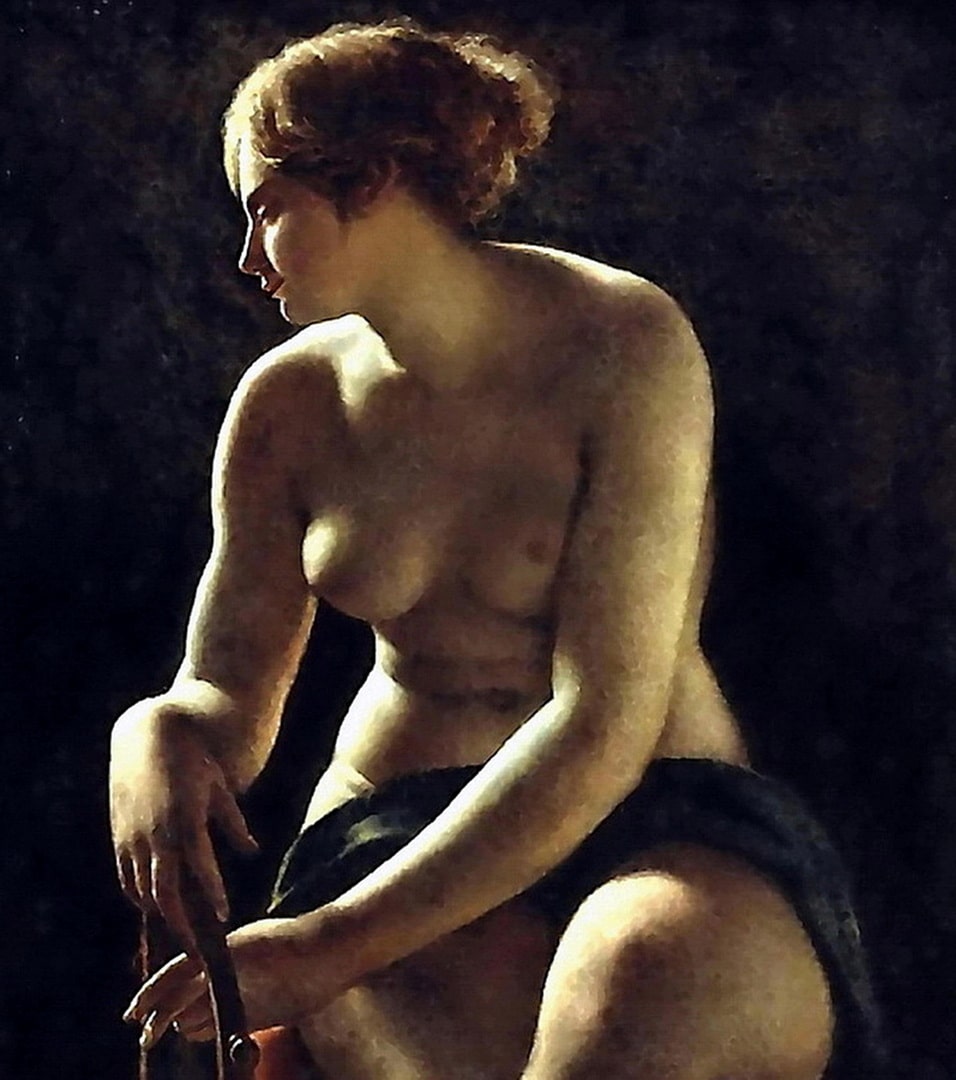
Sleep. Gustave Courbet.
|
 |
 |
||
 |
 |
 |
 |
|
Discover historic paintings of Lesbia and Sappo for your pleasure. If you enjoy Sapphic art then you will find plenty of paintings here for naughty girls. |
|
This post contains affiliate links, we may receive a commission if you make a purchase using these links. |
|
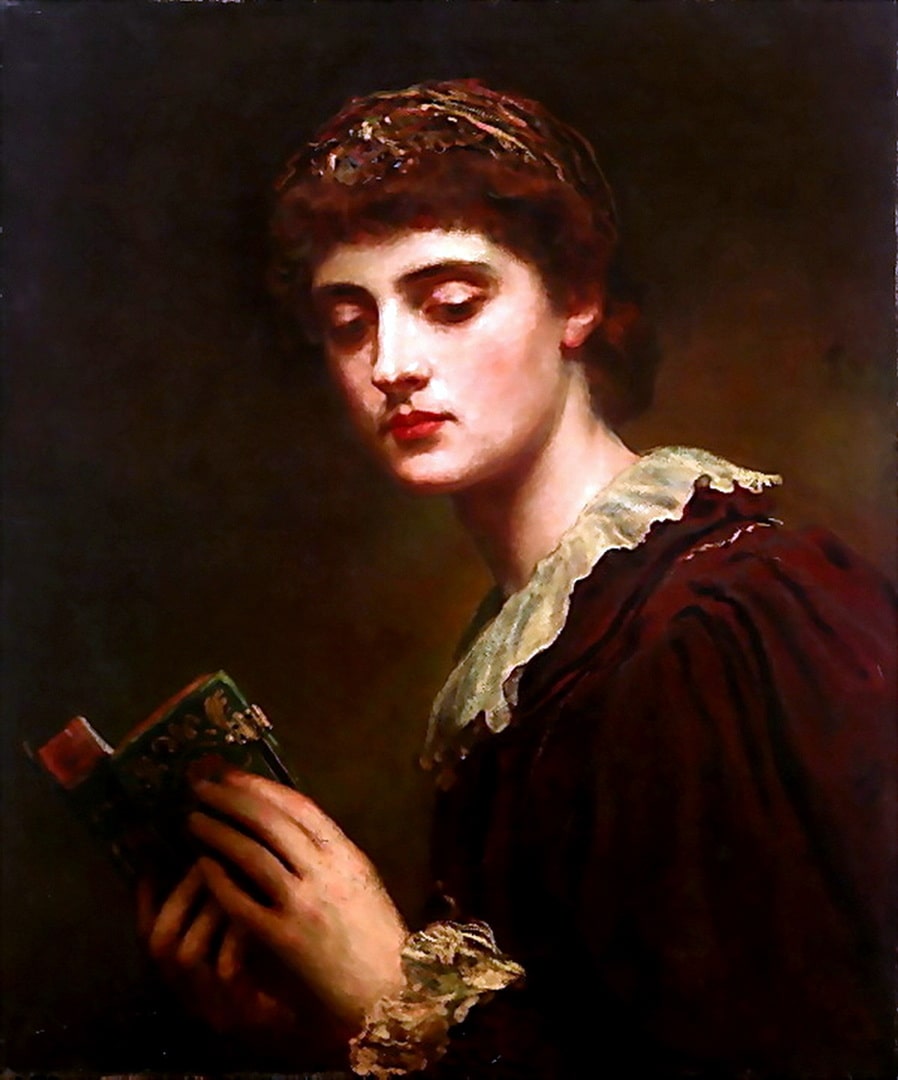
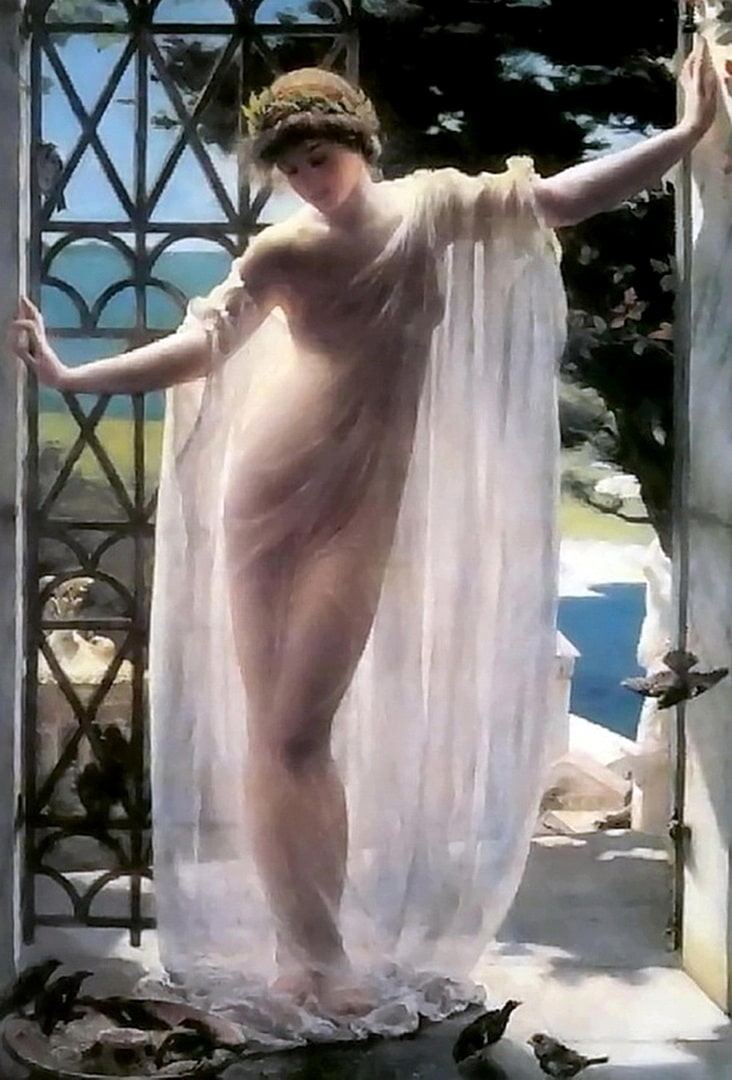
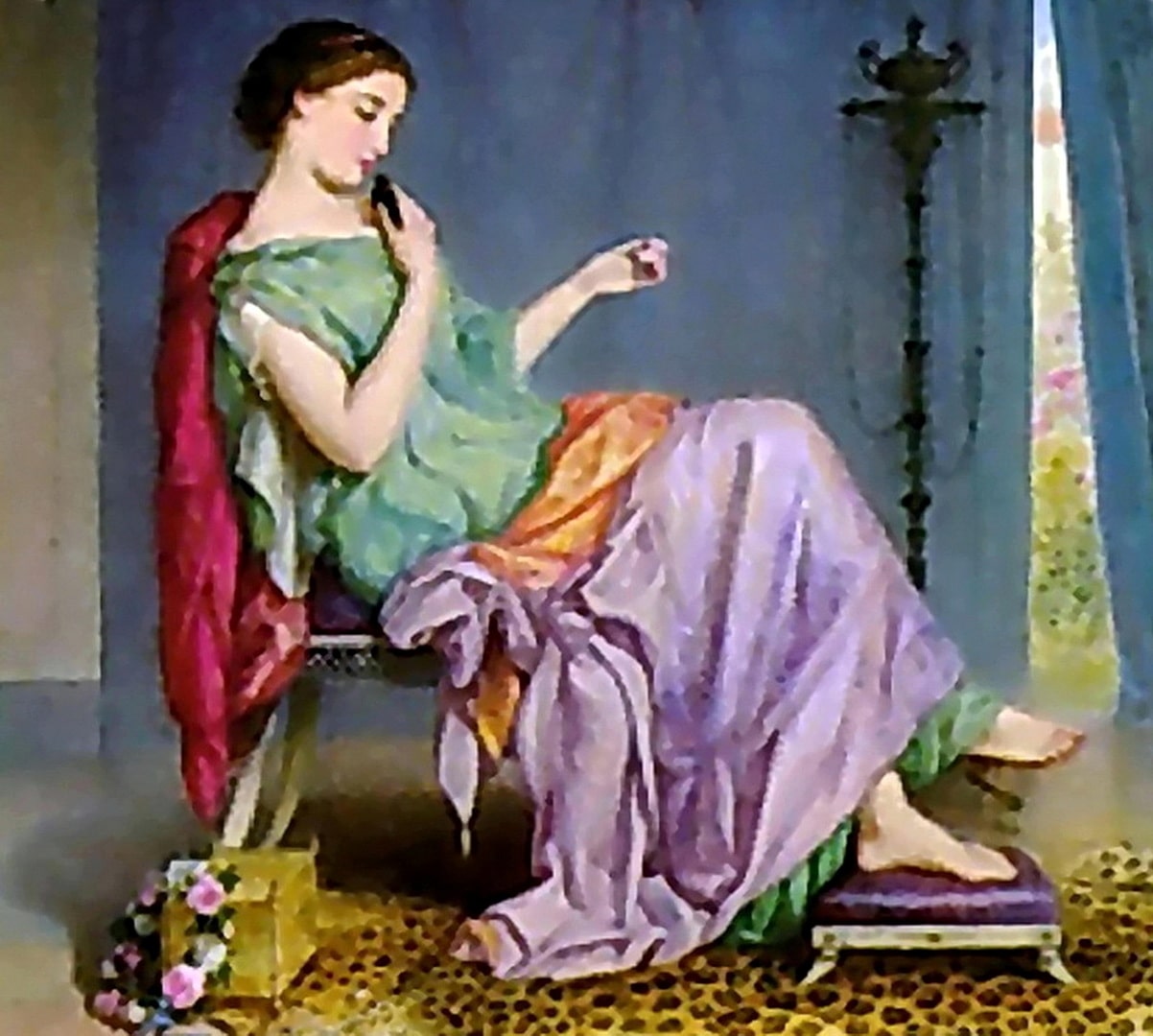
Lesbia. James Sant. This painting is in the Art Gallery N.S.W. Australia. Lesbia is dressed formally for this painting as she poses with a book in her hands. She has very pretty eyes and lovely lips for delicious kissing and a beautiful face. Her hair is tied up in a bun at the back. |
|
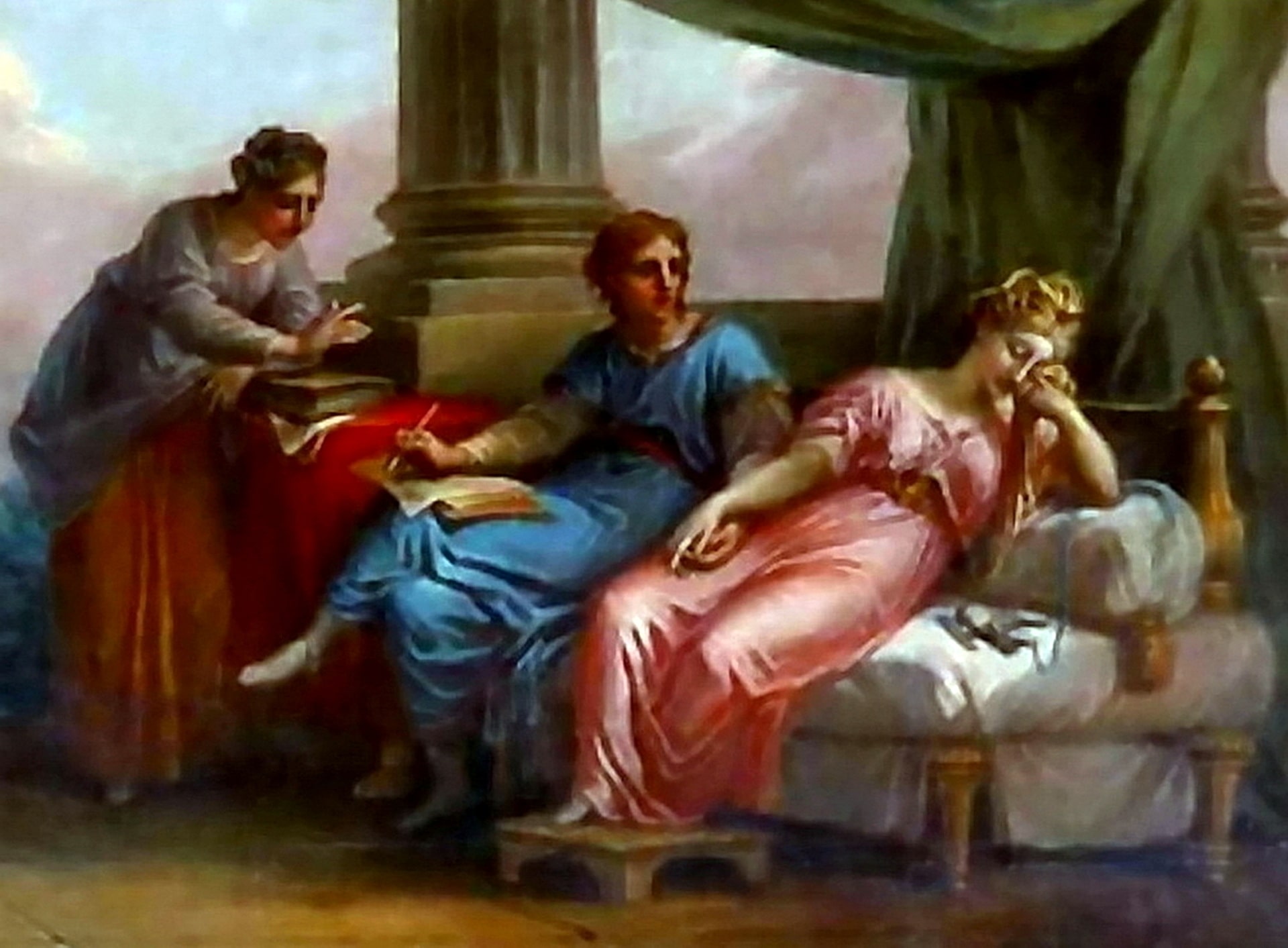
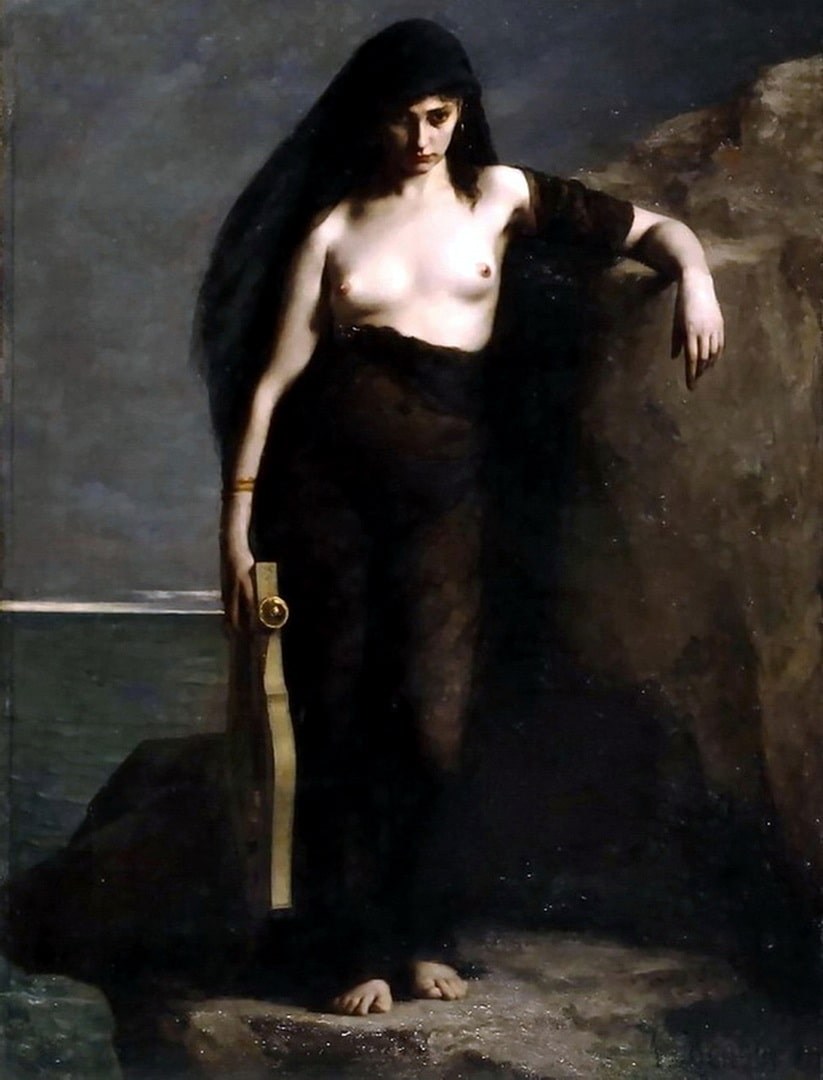
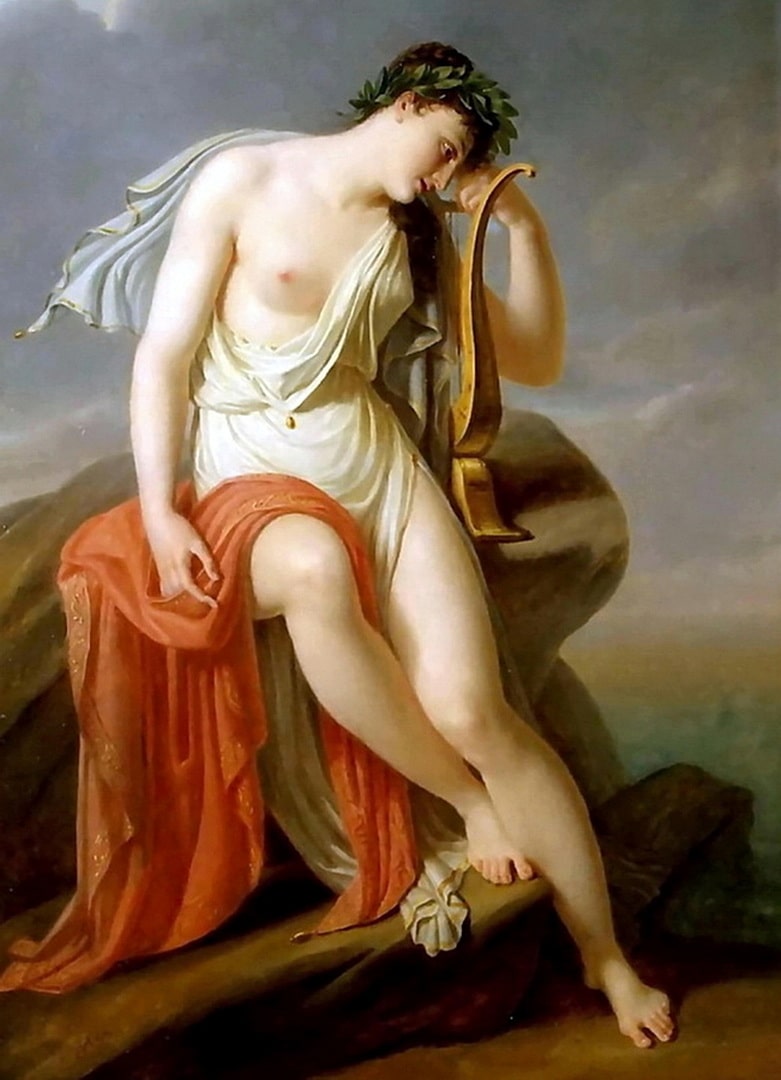
Sappho. Charles Mengin. Sappho stands bare breasted on the edge of a cliff holding her harp in hand and leaning against a rock. |
|
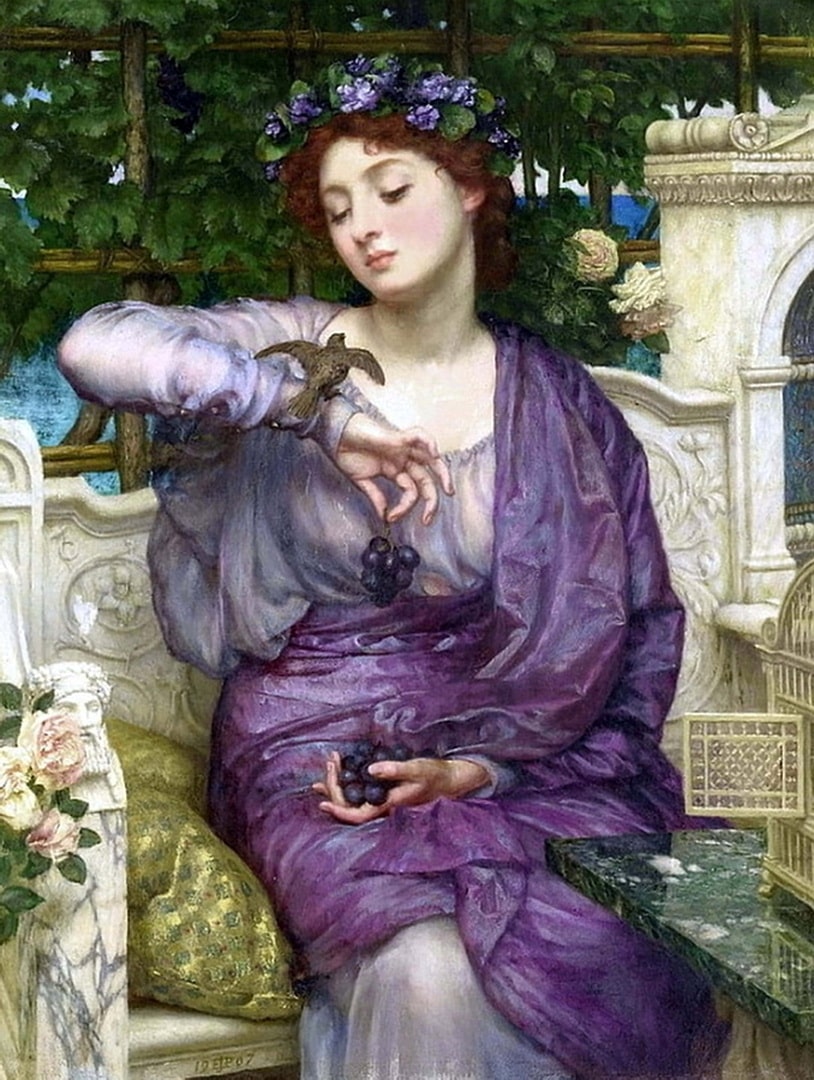
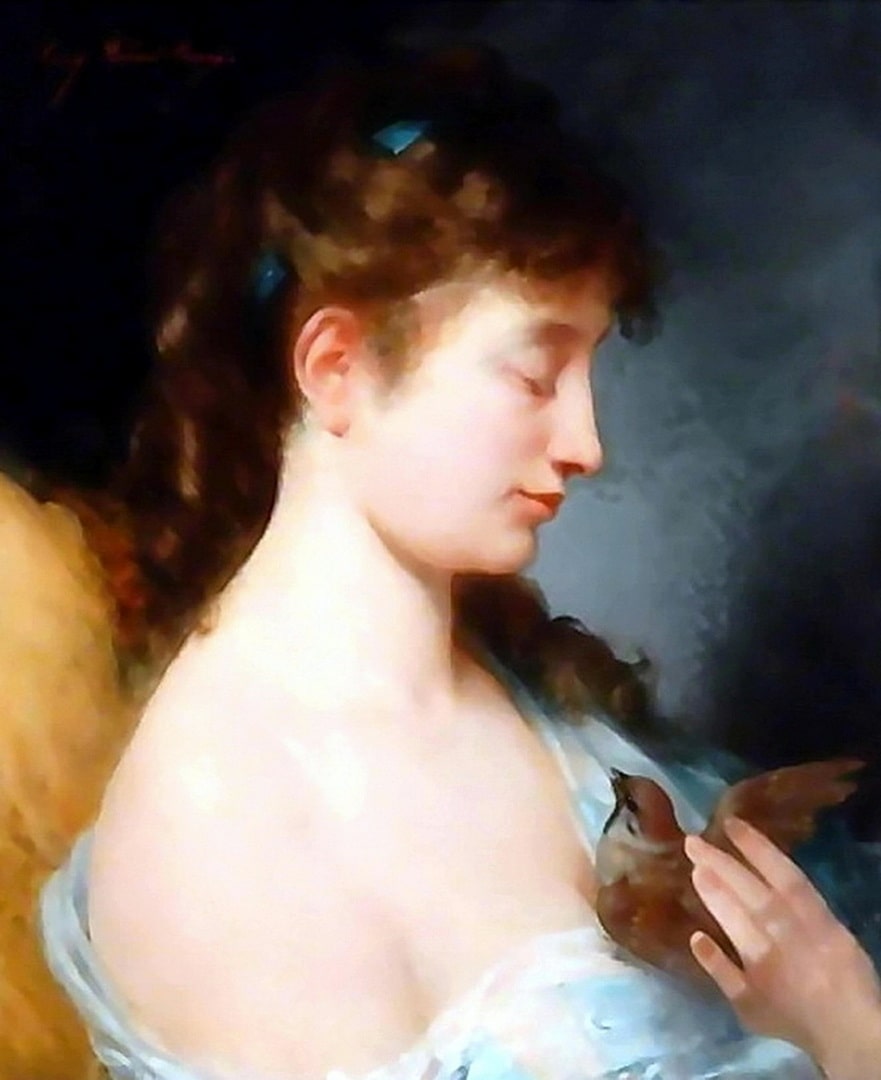
Lesbia and the Sparrow by Tony Robert Fleury. Lesbia is cuddling her sparrow on her chest as she strokes it. Apparently, the sparrow is enjoying it. She has a very pretty face with lovely eyes and luscious lips. All the better to kiss you with! She is displaying a bare shoulder and has black ribbons in her hair. |

|
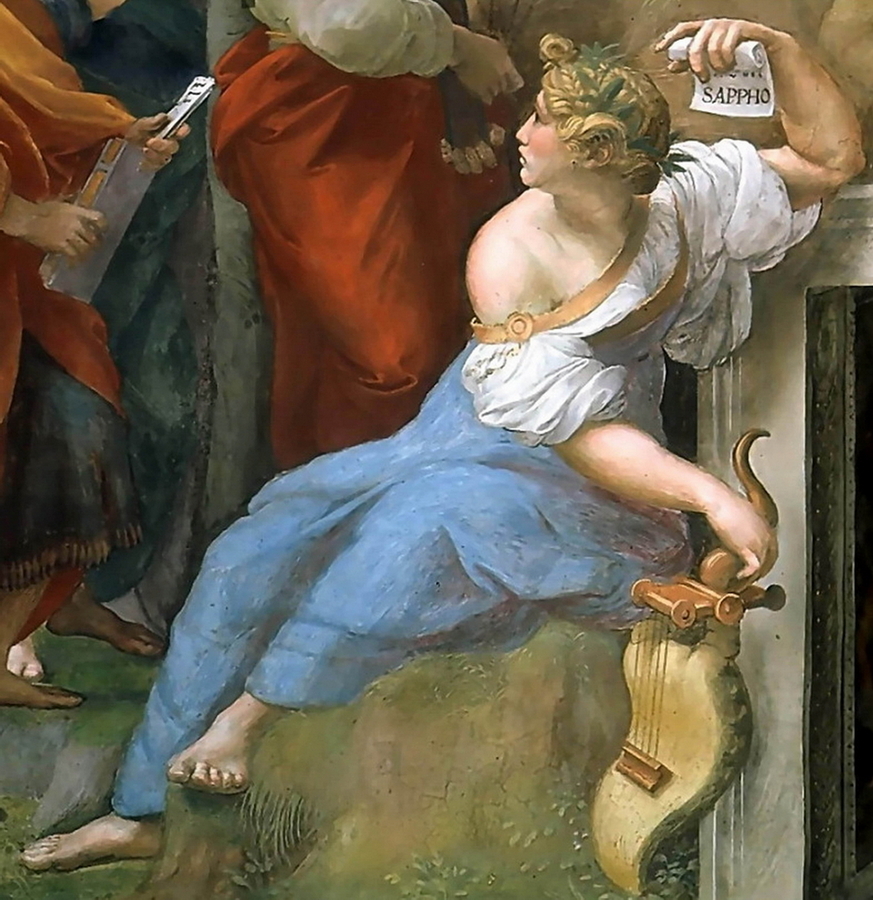
Sappho. A painting by Raphael Parnassus. Sappho is wearing a pale blue dress with white top as she holds her poetry scrolled up in one hand and an instrument in the other hand. |

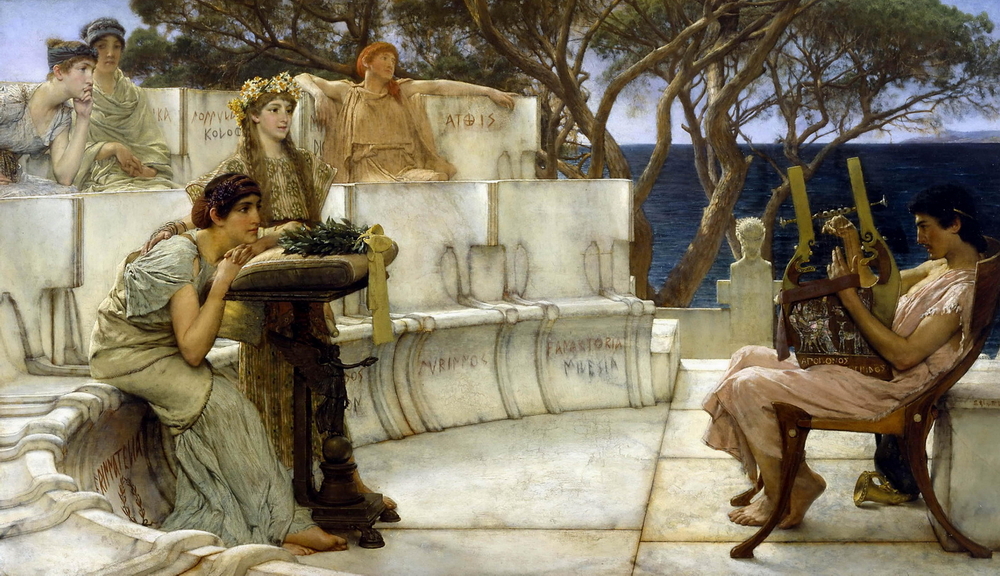
|
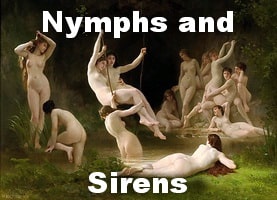
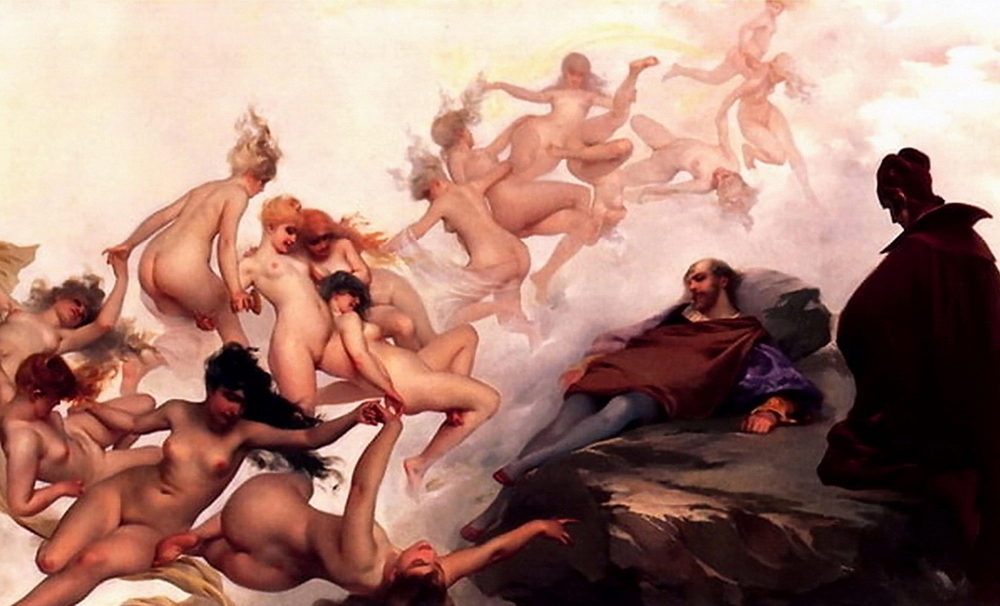
Faust. A Luis Ricardo Falero painting. Nude women galore! There are tits and bums everywhere! There are so many naked ladies for you to feast your eyes on! These girls have beautiful breasts and naughty bottoms. All the better to make love with! Fun and games for all! No Fun Busters are allowed in here! How come religions are such great FUN BUSTERS? |
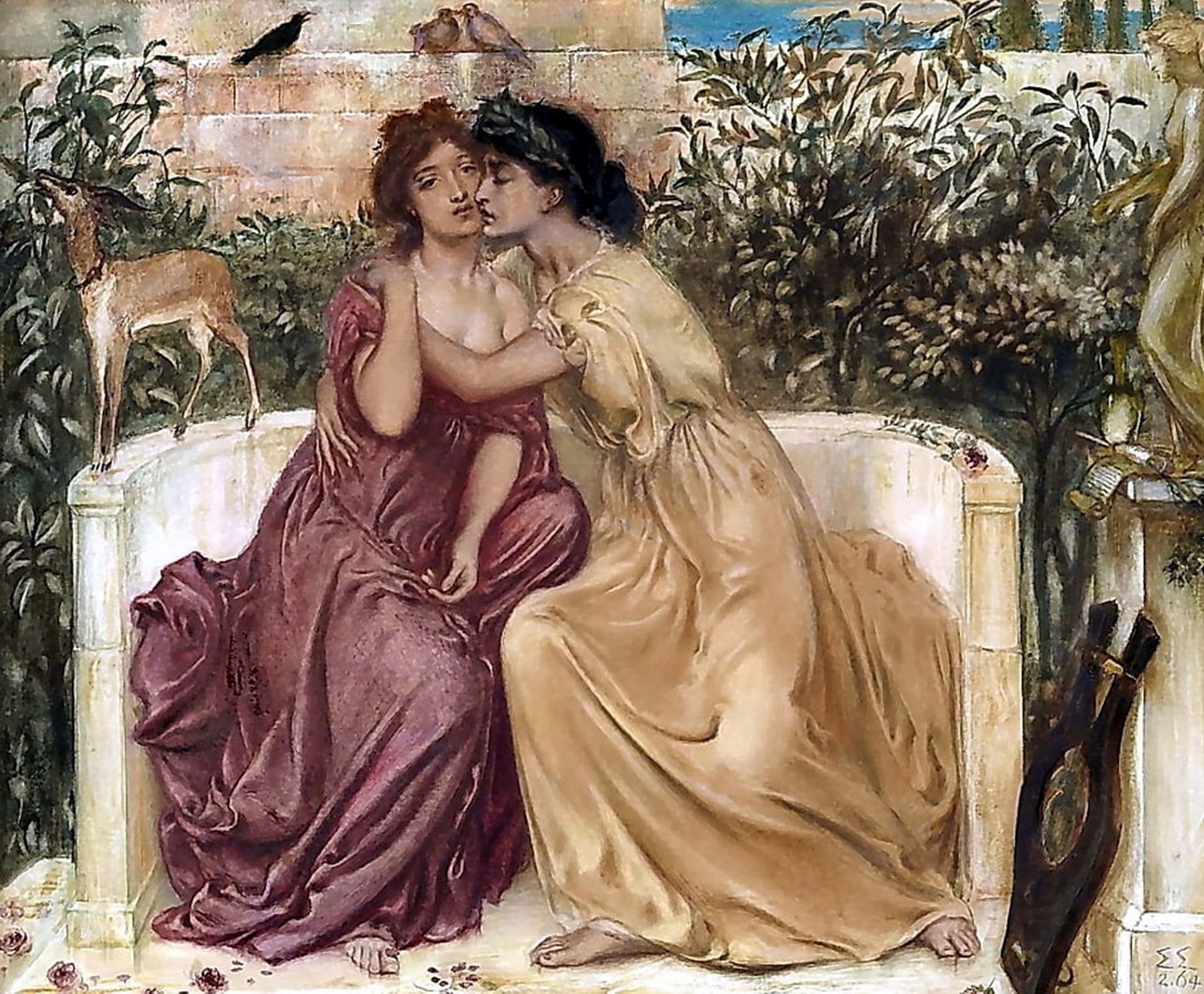
Sappho and Erinna in a Garden at Mytilene.
Simeon Solomon.
Sappho is kissing Erinna as they hide in a garden. Sappho's harp is sitting behind her along with a scroll of poetry.
Three birds are sitting on the wall behind them. There are a few flowers around them lying on the ground and on
the arm of the bench. Erinna has a dark red dress that looks like it is being removed from her shoulder. Imagine
that? The naughty girls!
-Liteeroticart.jpg)
|
Sappho. Edouard Henri Avril (Paul Avril). |

|
|
|
|
|
|
 |
 |
 |
 |
 |
 |
 |
 |
 |
 |
 |
 |
|
|
||
Sex Variant Women (Lesbians)in Literature.CHAPTER I.
|
It is natural to begin a study of Sex Variant Women (Lesbians) with Sappho, Greek lyric poet of the early sixth century B.C., whose name and that of her native island, Lesbos, have supplied our popular vocabulary with its terms for female homosexuality. Plato, who lived only two centuries later and probably knew her work almost completely, pronounced her the Tenth Muse, and, happily, the high quality of her verse led classical writers to quote it freely. For what with the hazards of time and later prejudice, the twelve thousand lines she is believed to have written are now lost save for these quoted excerpts and some fragments on papyri salvaged during modern excavations in Egypt. The few hundred surviving lines consist largely of lyrics addressed to girls, among them the famous “Ode” which has been pronounced the most economical description of passion to be found in literature. These verses will be considered presently.
An amazing quantity has been written about Sappho, translating and re-translating her poetry, eulogizing her poetic genius, and arguing hotly about her emotional life. An exhaustive bibliography would fill yet another volume. The ultimate source upon which all the rest is based may be consulted in the Loeb Classical Library’s Lyra Graeca, where J. M. Edmonds gives (with translations) the text of all that is known of her poems, taking into account the latest archaeological findings, as well as every significant allusion to Sappho in classical literature from Plato to Suidas-some seventy references by more than forty authors. A more popular volume is that from the Peter Pauper Press in which an anonymous compiler has assembled for each of Sappho’s poems and fragments the two or three soundest prose translations along with metrical versions by well-known English poets.
As is universally the case with persons so far removed in time, few details of the poet’s life are established beyond question. The most comprehensive biographical effort to date is Arthur Weigall’s Sappho of Lesbos, Her Life and Times , to which its author brings a wide knowledge of classical languages, history and geography. Although perhaps too conjectural in parts to satisfy the rigid scholar, this can be recommended for its careful documentation and its impartiality with regard to Sappho’s emotional temperament.
The best-authenticated facts seem to be that the poet was a small dark woman sometimes referred to as “ill-favored,” but endowed with sufficient grace and personal charm to inspire in several fellow countrymen and poets a passion which she did not reciprocate. She was of distinguished family and lived in a time of acute political strife. She suffered exile twice during her early years: once from Mitylene to the interior of the island of Lesbos, the second time to Sicily. Weigall believes she was already well-known as a poet before her Sicilian sojourn, and suggests that she may have spent her several years on the island in Sybaris, where she acquired something of that city’s brilliant sophistication. He places in this period also her marriage, probably of short duration, and the birth of her daughter Kleis to whom she was devoted throughout her life. After her return to Mitylene in her middle twenties she seems to have had constantly about her an ever-changing circle of younger women to whom she taught the verse-writing, music, and dancing which constituted a well-born girl’s preparation for marriage. Some of these pupils or protégées may have lived in her house; it is known they came from neighboring islands and mainland to be taught by her.
The incident most often connected with her name is her leap to death from the cliffs of Leucadia for unrequited love of a young ferryman, Phaon. Certain references in her work and that of others, however, indicate that she died peacefully at home at a relatively advanced age. In fact, modern scholars are inclined to pronounce the whole Phaon anecdote legendary; but since it persisted for a couple of millennia, Weigall attempts to demonstrate at least its possible truth. The tenacity with which the story has survived is undoubtedly due to Ovid’s incorporating it in his Heroides or Epistles of Heroines (: “Sappho to Phaon”), since, thanks to his romantic qualities, he was the most popular of all classical authors for several centuries after the Revival of Learning. Ovid’s epistle, though sympathetically written, represents Sappho as an aging and heartbroken woman deserted by her handsome young lover and still consumed by passion for him “as by a grass fire.” Ridiculed by friends, reproached by her brother for such despondency while she still has a living daughter, desperate over her waning charms, she can think only of suicide; and all this plaint she pours out in a letter to the man who has left her without even a farewell. The lament shows less restraint than any of Sappho’s known verse, for fervent though that often is, it never lacks dignity. There is always the chance, of course, that Ovid had access to poems now wholly lost and never mentioned elsewhere; it is certain that during the centuries immediately following her death Sappho was the subject of some dramatic works (possibly satiric) of which we now know only the author’s names, but which Ovid may have known.
Wherever responsibility lies, there was certainly a legend subsequent to Ovid’s day that two Sapphos had flourished in Lesbos, one the great poet and the other a courtesan of undisciplined habits. Weigall believes this tale was motivated by rumors of heterosexual irregularities, and was invented by her well-wishers to clear her name of their shadow. But one must consider also that during the period of this myth’s crystallization homosexuality in either sex was no longer tolerated as it had been (within limits) in the earlier Greek period. In Rome its practice among women was associated only with courtesans; thus it may equally well have been rumors of lesbian irregularity which gave rise to the conviction that she must have been a courtesan.
When one turns from personal conjecture about Sappho to the text of her work, one is left with no possible doubt about her variant tastes. Consider, for instance, the “Ode” mentioned above:
It is to be a god, methinks, to sit before you and listen close by to the sweet accents and winning laughter which have made the heart in my breast beat fast, I warrant you. When I look on you, Brocheo, my speech comes short or fails me quite, I am tongue-tied; in a moment a delicate fire has overrun my flesh, my eyes grow dim and my ears ring, the sweat runs down me and a trembling takes me altogether, till I am as green and pale as grass, and death itself seems not very far away ...
Few of her other poems equal this in intensity, and the textual evidences that its object was a woman (the gender of the name Brocheo being for a time in doubt) are meager enough so that during the years when homosexuality was a heinous offense scholars could translate it as addressed to a man without too great a strain on intellectual integrity. Discovery of the Oxyrinchus papyri, however, (so called from the Egyptian town where they were disinterred), added so much variant material to that already preserved in quotations that it rendered honest doubt of her variance impossible. In the many poems and fragments addressed to girls her ardor is evoked oftenest by maidenhood, its moving aspect not virginity so much as physical grace and delicacy and a certain light freedom of spirit. In one fragment, indeed, she describes herself as “eternally maiden” at heart.
There is no comparable evidence with regard to her feeling for men. Once, to be sure, in attempting to hearten a girl on the eve of her wedding, she says: “That night was sweet enough to me, neither have you, dear maid, anything to fear ...” Again she writes to a man: “But if you love me, choose yourself a younger wife; for I cannot submit to live with one that is younger than I.” And finally: “If my paps could still give suck and my womb were able to bear children, then would I come to another marriage bed with unfaltering feet; but nay, age now maketh a thousand wrinkles to go upon my flesh, and Love is in no haste to fly to me with his gift of pain ...” (The complaint: “Sweet mother, I truly cannot weave my web; for I am overwhelmed through Aphrodite with love of a slender youth,” cannot be counted as significant, for it was rendered by one translator even before the Oxyrinchus discoveries as ending: “a slender maiden.”) These are the total count of verses referring to heterosexual love, and there is nothing in them to match the “delicate fire” of the “Hymn to Aphrodite” imploring the goddess to soften the heart of a girl; or of the “Ode” quoted above; of the verses to Anactoria and Gongyla and the five poems to Atthis; or of the numerous fragments that glow with vivid delight in the beauty and love of girls. Significant too is the poem addressed to these girls in her old age. She laments her fading charms more bitterly even than in Ovid’s fictitious epistle, and ends:
But I, be it known, love soft living, and for me brightness and beauty belong to the desire of the sunlight are as necessary to me as light and therefore I shall not crawl away to my lair till needs must be, but shall continue loved and loving with you. And now it is enough that I have your love, nor would I pray for more.
Thus on internal evidence it appears that despite marriage and motherhood, opportunities for a second match, and much writing of conventional hymeneal verses, her lifelong preference was for women. Nor does the meager quantity of surviving verse disqualify such an assumption. A great part of it consists of quotations chosen by forty classical authorities on poetic style, who can scarcely be suspected of mass preference for variant subject matter. The remainder (barring one seventh century manuscript) comes from papyri which had been used to reinforce mummy-casings. Altogether, no sounder random sampling could well be devised.
We have seen that during the later classical period Sappho was suspected of having been a courtesan, which in those times may also have implied lesbian activity. Just when lesbianism became the main charge against her has not been determined. To be sure, a heavy weight of disrepute fell upon her with the establishment of the Christian church, and led to the burning of her work more than once. This was ordered first about A.D. by Gregory Nazianzen as the result of an earlier church father having pronounced her a gynaion pornikon erotomanes-lewd nymphomaniac (sex maniac) but the phrase does not necessarily imply lesbian excess. Subsequently Scaliger states that her books were burned in at both Rome and Constantinople, without specifying the reason. As this date falls shortly after that on which the church had reimposed strict celibacy upon its clergy, it may be that society had been made sensitive to homosexual activity among celibates and turned its suspicion upon her also. But this last surmise defies proof.
The lesbian controversy became bitter only in the nineteenth century when homosexuality was a heated issue both in the English-speaking countries and on the continent, and Sappho’s champions felt impelled to prove her innocence. The sole outcome of the voluminous quarrel is certainty that the issue can never be finally resolved without the unearthing of fresh evidence. There is no specific mention of active lesbianism in her verse. By way of implication there are two or three references to her girls as her own or each other’s hetaerae, which, since it was the common term for courtesan, might be taken to connote physical intimacy. She also mentions more than once the “pure and beautiful things” they all did together, an emphasis which Weigall feels may imply that in her day rumor ran otherwise. But her defenders judge these and a few more tenuous allusions insufficient to support the charge against her. More definite is Maximus of Tyre’s statement, made without animus, that three girls (whom he names) were to Sappho what Alcibiades and others were to Socrates; then there is the epithet mascula Sappho used by Horace, and last, a reference in Ovid’s “Epistle” to “a hundred others feminine whom I have loved not without evil imputation.” Certain translators of Ovid, however, omit the not, thus completely reversing the sense of the phrase; thus neither reading carries any real weight.
It was not until that so considerable an author as Rainer Maria Rilke ventured to exalt Sappho’s loves (without discussing their nature) as nearer the ‘divine intention’ than heterosexual passion, which he pronounced a ‘temporal interruption’ in the evolution of ideal human relations. Taking Ovid’s “Epistle” as a virtual translation from some vanished poem of Sappho’s, Rilke suggests that the original was a lament not for some actual lover, but for the nonexistent man who could satisfy her after her less sensual experience with girls.
With this century’s increasing tolerance of all sorts of sexual freedom, prejudice has softened to a relatively untroubled acceptance of Sappho’s probable lesbianism, and to an effort to understand, rather than defend, such behavior. Weigall suggests that one description of her “tiny little body” implies underdevelopment and unfitness for easy childbearing, circumstances which psychiatrists consider likely to induce avoidance of heterosexual relations and motherhood. And Freudians might stress her devotion to her eldest brother, Charaxus. In two surviving poems she attacks him so harshly for marrying a beautiful Alexandrian courtesan, whose freedom he had purchased at great cost, that her vitriolic lines to him and the epithet “black she-dog” for his wife suggest acute jealousy as well as contempt.
All this conjecture, like last century’s battles, proves little save the impossibility of objective judgment until new evidence appears. In accordance with the temper of our own time, we may leave it that Sappho was certainly variant, and, quite probably, what modern authorities term bisexual. She experienced marriage and motherhood, and may even have enjoyed other heterosexual relationships, but passion for her own sex inspired most of her poems, to judge from the surviving fragments. Furthermore these poems have been called by some critics the greatest love lyrics ever penned.
- - - -
Though the work of Sappho provides a natural introduction, chronological precedence must be granted to the biblical Book of Ruth, written perhaps a few centuries earlier and describing events that antedated King David by three generations. This great short story, long acclaimed as a masterpiece of narrative art, is the first of a thin line of delicate portrayals, by authors seemingly blind to their full significance, of an attachment which, however innocent, is nevertheless still basically variant.
Certainly as an “anonymous but exact description of love” there are few passages in literature to rival Ruth’s appeal to Naomi beginning “Entreat me not to leave thee ...” To quote it is surely unnecessary, but let anyone who learned it in childhood, who has never subsequently considered it in the light of primitive tribal custom, reread it for the force of Ruth’s willingness to abandon not only her native soil and her own family but even her God and her hope of burial with her ancestors. The emotional significance of this passage is reinforced by three others in the story. Ruth and Orpah had been married “about ten years” at the time of their widowhood and of Naomi’s decision to return to Israel, so that Ruth was then at least in her twenties, and her devotion cannot be counted the clinging of a bereaved adolescent to her bridegroom’s mother. Orpah, moreover, remained in Moab without more than formal protest, and with apparently every prospect of finding a second husband there.
Then when Boaz welcomed Ruth among his gleaners because “it hath fully been shewed me, all that thou hast done unto thy mother-in-law,” the girl replied, “Let me find grace in thy sight, my lord, for that thou ... hast spoken to the heart of thy handmaiden.” And, finally, when by carrying out implicitly Naomi’s clever scheme Ruth was taken as a wife and bore Boaz a son, “The women said to Naomi ... he shall be unto thee a restorer of life and a nourisher of thine old age; for thy daughter-in-law, which loveth thee, which is better to thee than seven sons, hath borne him.”
Viewed without prejudice, this is a masterly portrait of a somewhat passive young woman, twice playing the heterosexual role with success, but dominated by another love at least as compelling as that for the men she successively married. H. M. and Nora K. Chadwick in their Growth of Literature point out that “it gives the impression of being written primarily for feminine circles,” and by comparison with many treatments of the variant theme it might well also have been written by a woman.
- - - -
After Sappho’s poetry and this one Hebrew prose masterpiece, little that is pertinent to our subject remains from the half dozen centuries preceding the Christian era. That male homosexuality was, within limits, an approved pattern in Greek life, and that it occurred in Rome whether approved or not, especially under the later emperors, are now accepted facts. About its prevalence among women less is known. From Plato and Euripides to Ovid, women as individual personalities did not often figure in well-known classical writing, and of women writers, though Mary Beard enumerates references to an impressive number, most traces have vanished. A few fragments, however, and a few allusions to works never recovered, indicate that female variance existed.
Plutarch, for instance, tells us that Spartan girls under Lycurgan law received the same athletic training as boys and were encouraged in the same emotional expression. Havelock Ellis (without citing his source) mentions Miletus along with Lesbos as favorable to female homosexuality. The Greek Anthology includes some variant epigrams of Nossis from the lower Italian town of Locris, an imitator of Sappho, “one dear to the muses and equal to her.” From the same source we have Asclepiades’ epigram on the beautiful Dorcion who wore boy’s garments and “with the chlamys clearly revealing her naked thigh would flash the fire of love from her eyes,” but this may have been merely a device to attract male attention since the costume described here was that of the ephebi-male homosexuals. Elsewhere both Ovid and Appolodorus recount that Caenis of Thessaly, having given herself to Poseidon, begged that in return she be changed into a man. These last two, indicating nothing more specific than transvestism and dissatisfaction with a female role, are not too significant. Equally outside our scope because in the category of erotica, but written and illustrated by women, are lost manuals on erotic techniques of all sorts written respectively by Elephantis and Philaenis. The illustrations from the latter’s work are said to have been widely copied in the bedroom art of contemporary sophisticates.
Weigall suggests that two of Sappho’s protégées, like her, celebrated love for women in their verses. One is the Gyrinno to whom she was particularly attached, who died at nineteen. Weigall identifies her fairly plausibly with Erinna, a known poet from the island of Telos near Rhodes, whose work was highly regarded in her day, although only one poem of hers is known by name and all but a few lines are lost. These lines, however, lament the death of a loved girl, Baucis. The other poet, more certainly identified, is Damophyla of Pamphilia, who is known to have stayed with Sappho and to have written love poems and hymns to Artemis in imitation of her great model’s verse.
Secondary evidence that interest in female variance continued through the period is found in the myths as recounted by Greek and Latin writers at the beginning of the Christian era, though details of these stories are probably more characteristic of the writers’ own times than of earlier centuries. One finds as much variety in different authors’ treatment as is found between Malory’s and Tennyson’s versions of the Arthurian legends. From any great compilation such as the Mythology of All Nations or Fraser’s Golden Bough one learns that in all the interrelated Mediterranean mythologies there was at least one goddess among whose attributes were one or more of the following: virginity, aversion to male sexual approach, some masculinity in dress or interests (such as warfare or the hunt), intense fondness for maiden devotees, and a strict requirement of maidenhood in the latter. One finds also persistent legends of Amazons, exclusively female groups who suffered men only for procreative ends and made active war against the other sex (cf. a random news note, April , of a precisely similar legend from an island off the coast of Japan). It is impossible to date the origin of these myths or to secure historical substantiation of the mores they reflect. But anthropologists assure us that female homosexuality is known in most primitive societies (e.g., there is a North American Indian legend of physical intimacy between two women which resulted in an amorphous birth), and it seems likely that variant detail was current in early oral tradition but was omitted by writers to whom such phenomena was antipathetic, or eliminated by later censorship.
A comparison of the later classical writers supports this view. In Book XI of Vergil’s Aeneid one of the vivid personalities is Camilla, leader of a cavalry troop which figures brilliantly in the military action and of whose members many, if not at all, were women. Of her favorite comrade-in-arms, Camilla says only that she was like a sister to her. The goddess Diana is described as loving Camilla long and intensely, and, when the latter is slain by a sly and unheroic man, Diana lends her own bow and arrows to another protégé, Opis, so that this demigoddess may avenge the favorite’s death. But there is no mention of intimacy between the goddess and either Opis or Camilla.
Similarly the conscientious chronicler Apollodorus reports between Artemis and her nymph, Callisto, a great fondness terminated by the girl’s lapse from virginity; and Iphigenia, whom Artemis rescued from the altar upon which her father was about to sacrifice her, was equally cherished. Of Athene and her boon companion, Pallas, he tells us that in their girlhood they were so equally matched in the practice of arms that Zeus felt obliged one day to interpose his aegis between them lest his daughter be slain. As a result, Athene’s thrust killed Pallas, whereupon, overcome by grief, Athene herself fashioned a wooden statue of her friend, wrapped it in the aegis, set it up beside that of Zeus, and honored it as she did his image. Hence her later epithet, Pallas-Athene. Apollodorus later illustrates Athene’s antipathy to the male by the Hephaestus story. But with all these suggestive incidents he never mentions active variance in the goddess.
Ovid, on the other hand, offers two reports of variance. That it was not a personal obsession with him is proved by his treatment of those devotees of Diana, Atalanta and Daphne. Though the latter was so averse to the male that she prayed to be free of the beauty which made gods and men pursue her and was transmuted into a laurel tree, no woman enters her story. The same is true of Atalanta, “maidenly for a boy, boyish for a maiden,” her plainly dressed hair “caught up in one knot,” and a bow and quiver part of her usual costume. The story is well-known of her evading marriage by challenging all suitors to a footrace in which defeat meant death, but in the end she finally succumbed to the youth who secured Venus’s aid against her.
Concerning Callisto, however, of whom Apollodorus’s account is so bare, Ovid is much more specific. Jove, smitten with the charms of the young huntress, knows that the sure means of approaching her is to assume his daughter Diana’s form. Thus disguised he says, “Dear maid, best loved of all my followers, where hast thou been hunting today?” and then “he kissed her lips, not modestly nor as a maiden kisses.” With neither protest nor surprise Callisto begins to recount her doings, and not until “he broke in upon her story with an embrace and by this outrage betrayed himself” does she recognize that her lover is not the goddess. When the results of Jove’s attentions become evident-amusingly enough Diana, the virgin, is the last to recognize the signs-the girl, though blameless, is expelled forever from the goddess’s train.
Then there is Ovid’s idyl of Iphis and Ianthe. Iphis’s mother, while carrying her child, is warned by the father that if she bears a girl it will be subjected to death by exposure. Consequently she manages to conceal the child’s sex and raise it as a boy, giving it the name Iphis “which was of common gender.” From infancy, Iphis is the inseparable companion of a neighbor’s child, Ianthe, and by the time the two reach marriageable age, a little over thirteen, they are passionately in love. The two fathers have long since arranged a marriage. Iphis and her mother exhaust every pretext for delaying the ceremony, to the sorrow and anger of everyone else, for even Ianthe does not know her beloved’s true sex. Iphis spends long days lamenting the cruelty of Nature, which “surely never before has cursed a living creature with a love so monstrous.” Conscience bids her “do only what is lawful” and confine her love strictly “within a woman’s right.” She and her mother pray frantically to Isis for aid, to the end that when the wedding day can finally no longer be postponed Iphis is transformed at the altar into a boy, her voice deepening, her color darkening, and her body growing in muscular firmness. (As treated later by Antonius Liberalis the heroine of this same plot is the mother, and the suspense centers wholly about her escaping her husband’s wrath, the daughter being of only incidental interest.)
In yet another of the Metamorphoses Ovid describes the birth of Hermaphroditus, thus indicating that he was much interested in all variant phenomena, but from the quoted passage concerning Iphis’s pangs of conscience about expressing her love, it would seem that his approval of overt lesbianism was not unqualified.
All the remaining variant tales in Latin literature deal with courtesans. Probably the best known is Juvenal’s scathing sixth Satire, generally thought to have been directed against the empress Messalina, who figures in the text as Saufeia. It describes orgiastic rites in honor of the Bona Dea during which women of the highest social rank vie with prostitutes in erotic skill and endurance, with Saufeia bearing off the palm. The performance ends with a frantic search for men, since lesbianism alone cannot satisfy the participants.
With a much lighter touch Martial in the course of his Epigrams describes unflatteringly two women who on his evidence would modernly be classed as hermaphrodites. One, Bassa, has gained an irreproachable reputation by admitting no men to her house as either lovers or servants, but the initiated know that with her feminine domestic staff she practices every license. The other, Philaenis, the erotic writer mentioned earlier, exceeds men in her prowess with women, and also takes the active part in sodomy with boys. Although Dioscorides has denied in his epitaph in the Greek Anthology that she wrote the “obscene book” attributed to her, Martial’s repeated references throughout the Epigrams suggest that enough smoke hung over her in his day to justify the suspicion of fire. The specific sexual exercise implied by both Juvenal and Martial is tribadism, and there is mention in Juvenal as elsewhere of the olisbos employed by women less well equipped for a male role than Bassa and Philaenis. Both authors purported to describe actual persons and conditions immediately preceding the Christian era.
A couple of centuries later we find fictional contributions from the minor Greek authors, Lucian and Alciphron, both of whom claimed to be writing about a period nearer that of Plato. Though doubtless they had at hand more literature from the century in question than has been available since, a glance at historical fiction from medieval romance to modern novel will remind us that the life pictured is probably much nearer to that of their own time.
Lucian, in his Dialogues of Hetaerae, presents a tale told to her lover by a flute-girl hired as entertainer by two wealthy lesbians, one a Corinthian. After the banquet the hostesses persuade Leana to stay and share their bed, sleeping between them. The Corinthian removes a feminine wig to display close-cropped hair, and vaunts her ability to give amatory satisfaction. Physically she is entirely feminine, but she protests that “in my feelings and passions I am altogether a man.” Leana admits to have received proof of this, but when pressed for detail by her lover she says, “Now you want to know too much. It was rather nasty business. No, by the Goddess! I won’t tell you any more.” She has already gone far enough, however, to imply tribadism and to hint at cunnilingus.
In a later Dialogue, a lover accuses his mistress of having slept the previous night with another man. He says that stealing to her chamber to surprise her, he hoped the companion he found there was only her maid, but his exploring hand discovered a cropped head. She replies that it was her girl friend whose hair has been cut because of illness and who hides her disfigurement by day with a wig. The gentleman apparently takes no exception to this explanation, though whether the lover was maid or girl friend, the implication is obvious. Lucian’s own attitude may or may not be that of the male lover of women in his Amores. In the course of a long debate with a pederast on the relative merits of the two modes of sexual experience, the champion of heterosexual love says: “If it is becoming for men to have intercourse with men, then for the future let women have it with women ... girding themselves with their infamous instruments of lust ... in a word, let our wanton tribades reign unchecked.”
As to Alciphron, in his Letters from Town and Country (:) he describes a day-long picnic to which a courtesan has invited her friends at her lover’s villa. After a meal of oysters and lettuce, “the sort Aphrodite is said to love,” the guests pair off, a few with their male lovers, the rest with women partners “of random choice,” and drift away into surrounding thickets. Whether the feminine coupling is from preference or faute de mieux is not made exactly clear. The author neither expresses nor implies any judgment on the activity portrayed.
That gleanings should be so comparatively meager from a full millennium is scarcely surprising in the light of later history. After the collapse of Roman power, repeated waves of barbarian invasion, famine, and plague reduced both social organization and literature to only what could be salvaged in the growing Christian monasteries. As the spoken language drifted into dialects of unlettered vernacular, churchmen clung to Latin as the medium of communication, but they withheld classical belles-lettres from laymen for many centuries and undoubtedly winnowed and expurgated it. Deeply ingrained in Christian morality were several factors making for obliteration of anything sympathetic to female variance. One was general asceticism, a natural reaction from Roman excesses during the later Empire. Another was the animus against all homosexuality which Christianity inherited from Hebrew mores. A third was the intolerance toward women in any sexual role, largely chargeable to the strong anti-feminine bias of St. Paul.
From the surviving classical records of variance the policy of later censors is easy to deduce. Ovid’s tales stop short of objectionable detail and in any event include only mythical characters. Juvenal and Martial are vitriolic or contemptuous, Lucian and Alciphron are talking of courtesans. Sappho survives only in such fragments as were embedded in otherwise valued treatises. Any sympathetic treatments of lesbian love have been eradicated.
Even in the few scattering survivals, however, we find a great variety of persons: goddess, empress, great literary artist, wealthy sophisticate, courtesan, and bucolic adolescent. Their experience ranges from depraved exhibitionism through proud assumption of masculinity or unashamed feminine passion, to naïve and troubled innocence (or in the case of Ruth to devotion unconscious of its own deeper significance.) All of these types of personality and experience recur often in later literature, in such guises that it is sometimes difficult to be sure whether they are grounded in observation of universal human behavior, or in admiring imitation of ancient models.
That no variant material remains from the ten centuries following Alciphron is hardly surprising, since so little record of any sort has survived. An oral literature of heroic tales and folk humor must have flourished throughout the Middle Ages; narratives in the earliest vernacular manuscripts bear many marks of such ancestry. But if anything was written down before the eleventh century it doubtless shared the fate of Charlemagne’s collection of Frankish tales, which were destroyed by his son, Louis the Pious, because of their pagan character.
By the twelfth century written literature was increasing rapidly, and early in the thirteenth we find incorporated in a medieval romance the first known variant episode since Alciphron’s light-hearted and bawdy tale. Its appearance did not, however, herald any sustained use of variance as a literary theme, and to appreciate its significance and that of the few subsequent examples prior to the eighteenth century, one needs for background some over-all view of the status of woman in medieval society. To put it briefly, woman was regarded in two antithetical lights: as angel and as devil. We have already noted that from the outset Christian theology saw her as responsible for the fall of man and, therefore, as the root of all sexual evil. This derogatory opinion was reinforced after the third century by infiltrations from the dualistic religion of Persia. Manicheism divided the universe into God’s divine and incorporeal kingdom of light and the souls of men, and a realm of darkness comprising the material world and men’s bodies, the province of the Devil. Since woman’s reproductive function bound her closer to the flesh than man was bound, her burden of original sin was so much the greater. In the later Middle Ages serious philosophical debate arose as to whether she was a complete human being possessed of a soul, or merely a breeder for the superior race of men.
If today such views seem incredible, they gain reality when one remembers the outbreaks of witchcraft from the fourteenth to seventeenth centuries and the dreadful measures taken to suppress witches as followers of Satan. Modern psychologists tend to diagnose those epidemics as hysteria on the part of the bewitched and of the culprits themselves, who frequently confessed to intimacy with the Devil. Certain historians of the occult, however, offer convincing evidence that organized witchcraft was a survival from ancient fertility cults widespread in Europe, of Druidic or even earlier origin; cults which had worshipped a god in the semblance of an animal-most often a goat-and whose rites, as in all known fertility cults, were sexual.
Records of witches’ trials show that leaders of covens and more especially of the great orgiastic sabbaths appeared as “black men,” usually equipped with horns, tails and hooves, and that their followers credited them with supernatural powers and literally worshipped them as legates of a god or as the god himself. The animal disguise so exactly fitted the medieval concepts of Satan that Christian heretic-hunters quite naturally equated witchcraft with devil worship, recorded it as such, and reacted accordingly. No apologia for witchcraft is intended by this suggestion. If one grants “wise women” a knowledge of poisonous herbs and of rudimentary hypnosis, and also, as midwives, the opportunity to procure the bodies of stillborn infants for their horrid magic-working concoctions, the ugliest charges against them become plausible. Then, too, there is little doubt that sexual licence of all sorts was common at the quarterly sabbaths if not at all smaller gatherings. It is particularly noteworthy that the male leaders of these festivals had female partners, supposedly for the benefit of the few attending warlocks; but the record of at least one trial states that the celebrants “usually” consorted with leaders of the opposite sex, an indication that at times they must have consorted with their own. And from secondary sources one learns that witches generally were credited with “masculine” sexual tastes and habits. Thus, homosexual practices, in themselves anathema, were associated also with witchcraft, the blackest of all possible heresies.
In sharp contrast to this negative view of woman there existed at the same time a cult of woman-worship first articulated by the Provençal troubadours and later immortalized by Dante. It celebrated the ennobling and exalting influence of love for a pure woman, who, since she had transcended both common human frailty and the special aptitude of her sex for evil, deserved a twofold reverence. In its religious aspect this worship centered about the Virgin Mary and found expression in the naïvely human legends which grew up about her. As her invariable championship of the underdog, man or woman, innocent or guilty, appears to be merely an apotheosis of the maternal instinct, these legends do not concern us here.
On the secular side, adoration of woman flowered in the convention of courtly love, that concept of passionate devotion without overt reward which seems more often to have been celebrated in the breach than in the observance. From this idealistic code of sexual relations stemmed the copious literature of medieval romance, and indeed of subsequent romantic fiction, in all of which the parallel worship of purity and of overwhelming passion provides the basic conflict. And until the eighteenth century, romantic fiction was the almost exclusive vehicle-at least on the reputable level-for variant incident, which therefore remained technically beyond reproach.
Taken together, then, the two contradictory views of woman just outlined provide, as it were, a philosophical portrait of her as she appeared to the later Middle Ages. There is also a practical picture more difficult to delineate because less was written about it at the time. Its early background in particular is obscure, since so very little is known about women during the Dark Ages. Some anthropologists hold that among Germanic peoples women were highly regarded; monogamy was the universal practice even before the advent of Christianity; women fought beside men in emergency; and certainly the Teutonic Valkyrie are a match for the Amazons of ancient Greece. Other social historians point out that the earliest epics, sagas, and chansons de geste celebrate only the valor of men whose deeds insured the survival of their folk-groups, and in these tales women play negligible roles. It is known, too, that under feudalism in some parts of Europe women were treated as little more than adjuncts to the land holdings they inherited, and were promised in marriage by male relatives, sometimes when scarcely out of the cradle, with the sole end of cementing politically profitable jointures of territory. Whatever the truth may be-and it is certain that no single truth can hold for so heterogeneous a geographic and temporal span as Europe in the Dark Ages-we come to relatively stable ground only with the crusades and the transition from feudalism to chivalry.
For perhaps a dozen generations from the eleventh through the thirteenth centuries many men of all classes were drawn off on ever-widening military campaigns, civil or religious. Thus, the management of affairs at home devolved to some extent upon women. Of the effect on lower-class women we know little that is specific, though the hysteria of witchcraft suggests one result of numerical imbalance between the sexes on that level. On the upper social levels history tells us that many women managed their lords’ estates, dispensed justice, marshalled armed forces when necessary, and sometimes even led those forces against rival lords-a circumstance commoner in Italy and southern France than in regions farther north. Consequently, these women acquired considerable learning. Hitherto even literacy had not been too common among laymen aside from those destined for very high positions, but it is probable that during the twelfth and thirteenth centuries women were better educated than men of the same class, the latter being engaged in more strenuous pursuits. It is known that women were in charge of hospitals during this period, and a few rose to the status of lecturers in Italian universities.
The long period of men’s absences and women’s widening responsibility resulted, as always under such circumstances, in a certain feminization of social outlook, evident in the burgeoning of courtly love. Today statistical reading studies show that sex is a prime factor in determining reading interests and that romantic fiction is predominantly a feminine taste. Historic evidence of these facts can be seen in the rapid spread of chivalric romance between the twelfth and fourteenth centuries.
The earliest romances written down in the twelfth century were comparatively simple and direct, showing close relation to the epics and chansons de geste which preceded them. Subsequently, partly because crusaders brought home oriental tales of intricacy and sophistication exceeding any style current in Europe, plots incorporated magical and fantastic elements and developed greater elaboration. Still later, after the revival of classical learning in the early renaissance, pastorals developed in rough imitation of Latin models, but with plot structure nearer that of their medieval narrative sources.
The first romance mentioned by students of this genre as containing anything relevant to sex variance is Huon of Bordeaux, which appeared in French about . (It has been consulted by the present writer only in the English translation of Lord Berners, first printed in .) The tale was basically a derivative from the Charlemagne cycle or “Matter of France,” and the first part, though incorporating fantasy in the person of Oberon, King of the Fairies, runs fairly true to its source. But like many popular stories it acquired sequels, and when the action reaches the third generation we find Huon’s granddaughter, Ide, serving among the Holy Roman Emperor’s forces in the guise of a knight, a feministic touch alien to the original epic.
In recognition of her prowess Ide is given the Emperor’s daughter in marriage, and cannot refuse the honor without dangerous offense to her overlord. The princess Olive is in love with her fiancé. Ide’s own emotions are not described-one of the author’s subtle devices for exploiting a piquant situation without involving his heroine in moral obliquity. Another is his weaving of an inescapable net of circumstance in preliminary chapters to prevent Ide’s either fleeing as a lone knight errant or returning to her father’s domains in her feminine role-the one course meant disgraceful death, the other involvement in incest. So the reader is free to follow with good conscience Ide’s submission to the marriage ceremony, her pretence of illness as excuse for inadequacy on the bridal night, and the unelaborated account of her attempt to satisfy her bride with “clyppynge and kyssynge” throughout the eight days of the wedding feast. When this technique is pursued for another week, however, the bride’s bitter grief forces Ide to confess her sex, and the confession, carried to the Emperor by an eavesdropping page, results in his decreeing that Ide be burned, “for he sayd he wold not suffre suche boggery to be used.” The fire is actually kindled before Ide’s frantic prayers to God and the Virgin save her (as Ovid’s Iphis was saved at the altar) by miraculous transformation into a man. Beyond a doubt considerable physical intimacy is implied here, though none so specific as in Martial or Lucian. And it appears that death was not an excessive penalty for such intimacy if wilfully indulged in, though again the mores reflected must be taken as a hybrid between those of the tenth century, in which the story was laid, and the thirteenth, in which it was written down.
It is possible that this sequel to Huon owed something to a collection of oriental tales which doubtless entered Europe during the period of the crusades, though they were not published until the sixteenth century and are believed to have been rewritten at that time (as La Fleur Lascive Orientale). One of these, “The Princess Amany,” recounts the adventure of a daughter of the “emperor” of Tartary. Converted to Islam by a highly educated nurse, Amany avoids marriage to a “pagan” by flight in male clothing. During her wanderings, she has a liaison with a “farmer’s” wife, and then rescues the Indian princess, Dorrat, from violation by slaying her abductor. For half a year she supports herself and the lady, who does not know her sex, by her prowess in hunting and marauding. Having arrived in India, the two marry at the emperor’s decree. Up to this point, only Dorrat has been emotionally involved, Amany being still half in love with the Tartar prince from whom she fled on religious grounds. But when Dorrat, disillusioned on her bridal night, attempts suicide, Amany becomes physically excited in the course of the struggle to save her, and the two live in complete marital intimacy for a month. Then the Tartar prince, now converted, appears and marries them both (happy Islam!), whereupon both ladies discover that they prefer the embraces of a man to each other’s. Even an elementary acquaintance with oriental literature will suggest that this tale is a hybrid well cross-fertilized with Christian chivalry, upon which it may have left its reciprocal traces.
- - - -
An Italian renaissance example of female sex variance appears in Ariosto’s Orlando Furioso . Ariosto’s predecessor, Boiardo, in treating the same Roland material, cast as heroine the completely feminine Angelica, but Ariosto gave the lead to Bradamante, a young Amazon in full armor whose exploits equalled and sometimes exceeded those of the male knights. Indeed, Ariosto’s version has been cited as feministic because of her prominence in the plot. We need consider only Canto , which tells how Bradamante while suffering from a head wound is shorn of her hair, and thereafter is universally mistaken for her twin brother. Sleeping one day in the forest she is discovered by “young Flordespine of Spain,” whose instant infatuation is so violent that Bradamante is wakened by a passionate kiss. Since in the chivalric code “cravenhood it were, befitting man of straw” not to respond, she at once confesses her sex. The disclosure has no effect upon the young princess’ ardor. Taking Bradamante home, Flordespine showers her with rich woman’s apparel and gifts, and laments all day-in almost the very words of Ovid’s Iphis-that she should be cursed with a love the like of which she has never met “mid mankind or herd.” Bradamante feels no answering attraction, but nothing indicates that either girl considers this love to be sinful. It is merely “unnatural.”
The ladies had one common bed that night,
Their bed the same but different their repose.
One sleeps, one moans and weeps in piteous plight
Because her wild desire more fiercely glows.
And on her wearied lids should slumber light,
All is deceitful that brief dreaming shows:
To her it seems as if relenting heaven
A better sex to Bradamante has given.
In the morning Bradamante quickly departs, to relieve a misery she cannot assuage.
And now follows an interesting inversion of the theme. When Bradamante recounts her adventure at home, her twin brother, recognizing in Flordespine a beauty whom he has long admired but has had no chance to approach, makes off in secret in his sister’s knightly trappings and seeks the Spanish castle in her place. The princess welcomes him with rapture, again supplies woman’s dress, and only at night discovers his sex, which the boy, still posing as his sister, attributes to a timely bit of magic. The two live together for several weeks before the truth is learned by anyone else.
Comparison of this treatment with that in Huon of Bordeaux points up the literary and social changes which have intervened. Nothing could testify more clearly to the altered role of religion than the absence of moral judgment and the sex change through benevolent magic instead of divine intervention. This and the verbal echo of Ovid throughout Flordespine’s long lament (only partially quoted above) show to what extent the Revival of Learning had bred familiarity with classical word and temper. There is also here a greater psychological subtlety, natural to growing humanism. Though Flordespine’s passion is roused by her mistaking Bradamante for a man and satisfied only by sex-reversal, her initial emotion is unaltered by her enlightenment, and the brother whom she accepts is so feminine in both appearance and action that an entire household is deceived for weeks. Thus the Spanish princess exhibits definite psychological variance. It is interesting that the knightly Bradamante remains unmoved throughout and that Flordespine, the petite, impulsive, eminently feminine member of the pair, takes the initiative in the whole business.
Sir Philip Sidney’s pastoral Arcadia, circulated among friends in though not published till a decade later, shows a similar relation to both medieval and classical sources. Here, as in the second part of Ariosto’s episode, the hero masquerades as an Amazon, in order to gain access to a princess whose family is living in pastoral seclusion for political reasons. The heroine’s father is completely taken in and himself conceives a passion for the handsome stranger. His wife, several decades his junior, is only briefly deceived but holds her peace because she is similarly smitten. Thanks to the separate jealous machinations of these two, all the hero’s efforts to reveal his secret to his love are balked, but within a few weeks his passion has communicated itself to the girl. And now we have the moral scruples which regularly distinguish English from continental literature. They are given vividly in Sidney’s own words:
O me, unfortunate wretch (sayd she) what poysonous heates be these, which thus torment me?... O you Stars judge rightly of me, & if I have with wicked intent made myself a pray to fancie, or if by any idle lustes I framed my harte fit for such an impression, then let this plague dayly increase in me, till my name bee odious to womankind ... No, no, you cannot help me: Sinne must be the mother, and shame the daughter of my affection. And yet these be but childish objections ... it is the impossibilitie that dooth torment me: for, unlawfull desires are punished after the effect of enjoying, but impossible desires are punished by the desire itself ... And yet ... what do I, sillie wench, knowe what Love hath prepared for me? Doo I not see my mother, as well, at least as furiouslie as my selfe, love Zelmane? And should I be wiser than my mother? Either she sees a possibilitie in that which I think impossible, or else impossible loves neede not misbecome me. And doo I not see Zelmane (who dothe not thinke a thought which is not first wayed by wisdom and virtue) doth not she vouchsafe to love me with like ardor? I see it, her eyes depose it to be true; what then? And if she can love poore me, shall I thinke scorne to love such a woman as Zelmane? Away then all vaine examinations of why and how. Thou lovest me, excellent Zelmane, and I love thee: And with that, embrasing the very grounde whereon she lay, she said to her selfe (for even to her selfe she was ashamed to speake it out in words) O my Zelmane, governe and direct me: for I am wholy given over to thee.
There could scarcely be a more economical record of how girls were taught to regard homosexual passion in sixteenth century England; of the heroine’s ignorance that any satisfaction of the desire was possible; and of her blameless rectitude, for she has both her mother and her idol as examples, and the reader knows that she is under the spell of legitimate sex attraction. That Sidney’s own moral attitude was not necessarily his heroine’s is suggested only in his wording of an oracle’s prophecy to her father earlier: “Thy youngest shall with nature’s bliss embrace An uncouth love, which nature hateth most” author’s italics. Still, he was careful that Zelmane’s secret should become known to the princess before the pair had opportunity for so much as a kiss.
The Arcadia is cited in Iwan Bloch’s Sex Life in England as the first instance of lesbian love in English literature, but Bloch bases his claim on a night the princess and her sister spent together. He does not mention that they were sisters; however, it is not the kinship which invalidates his statement. It is true that the text reads: “... there cherishing one another with deere, though chaste embracements, with sweet, though cold kisses; it might seem that Love was come to play him there without darte; or that weerie of his owne fires, he was there to refresh himselfe betweene their sweete-breathing lippes.” But the reason for their embrace was that both were suffering from hopeless loves, and, too shy to share confidences even by candlelight, had agreed that “they might talke better as they lay together.” Bloch, however, makes his point from the statement that “they impoverished their cloathes to inriche their bed, which for that night might well scorne the shrine of Venus,” interpreting this to mean that they made elaborate preparation for a night of love, however cold and chaste Sidney claimed it to be. The proper sense of the elaborate Elizabethan conceit is, of course, simply that they released their own loveliness from their garments and laid themselves on the bed which was thus more “inriched” than a shrine bearing an image of Venus herself.
A French pastoral making use of the same theme is d’Urfé’s Astrée, published serially between and . This vast work, running to some pages, has not been examined, but Maurice Magendie’s L’Astrée d’Honoré D’Urfé gives an adequate notion of its significant points. Laid in Merovingian times, it is bound anachronistically by the strictest rules of courtly love, which made a lady’s lightest word law for her lover. Thus, once banished by his offended lady’s decree, the hero Céladon may not re-enter her presence without specific summons. After a volume of misadventure he contrives to return by impersonating Alexis, daughter of a Druid priest whose casuistry reconciles him to this evasion of Astrée’s orders. Since Astrée has long mourned him as dead she is unlikely to summon him, but until she does, “Alexis” cannot reveal his identity. Her new friend’s phenomenal resemblance to her lost lover provokes in Astrée an infatuation which, however well accounted for, is our first example since classical times of a woman’s passion without scruple for one believed from the outset to be of her own sex.
For a time the Druid manages to prevent too great an intimacy between his “daughter” and Astrée, but when the two are guests at the same castle and share a room, the hero cannot resist taking some advantage of his opportunity, his only concern being dread of his lady’s reaction to these liberties when she is finally enlightened. This eventuality is postponed by enemy attack and a long embroilment during which “Alexis” fights as a heroic Amazon, saves Astrée’s life, is wounded, and is finally spirited away by the Druid to recover without danger of disclosure. When the revelation finally occurs, Astrée is indeed outraged-but note the reason: people will believe she merely pretended to be duped in order to excuse her own complaisances, and ‘in Forez a woman does not trifle thus with her honor.’ She bids Céladon die in expiation for his crime. “‘De quelle mort vous plait-il que je perisse?’ gémit Céladon écrasé. ‘N’importe, pourvu que tu meures!’ Et il s’enfuit pour la satisfaire.” The Druid intervenes by proposing a pilgrimage to a shrine of Diana whose lions and unicorns slay the guilty but spare the pure. These heraldic guardians are transmitted into statues as the pair approach, thus testifying to the young lovers’ technical chastity. As everything short of the ultimate intimacy has pretty clearly occurred, it would appear that in France of the early seventeenth century, as in sixteenth century Italy, such relations between women were not regarded too harshly. Nevertheless, both this pastoral and Sidney’s portray the “far away and long ago,” not the authors’ own period, and d’Urfé’s tale is obviously more than a little satiric. Evidence will appear later that with regard to contemporary phenomena judgment is generally less lenient.
The five examples described above are all from the field of romance, in which no further variant flora have been detected until the early nineteenth century. Indeed, the whole field of fiction was largely fallow during the seventeenth and eighteenth centuries. From the renaissance on, thanks to a growing classical influence and the weakening of churchly prejudice, drama of actable length gradually supplanted long formless narrative. But the drama, too, yields a thin harvest during these centuries. In romantic plays sex disguise was fairly common, but it produced no variant situations comparable to those cited from romance and pastoral. Action on the public stage, of course, cannot go as far as in the printed volume; furthermore, theatre audiences included lower class spectators more apt to be shocked by homosexual implication than educated readers with classical literary background.
Let us look, for example, at the two most significant masquerading women in Shakespeare’s plays. Viola in Twelfth Night is an unconvincing man, afraid of the sight of her own sword, and her scenes with Olivia never even skirt the anomalous, their interest centering on her verbal agility. In As You Like It Rosalind is much more boyish in appearance and temperament, and Celia’s devotion to her is marked. Following her cousin headlong into banishment, Celia reminds her harsh parent that:
... we still have slept together,
Rose at an instant, learn’d, play’d, sat together,
And wheresoe’er we went, like Juno’s swans,
Still we went coupled and inseparable.
Also LeBeau tells Orlando that Rosalind has been “detained by her usurping uncle To keep his daughter company; whose loves Are dearer than the natural bond of sisters.” These passages suggest an intensity in Celia’s attachment which the effeminate Frenchman is quick to notice, but no further word or action in the play reinforces them. Celia’s infatuation at sight for Oliver, though it does not, like Rosalind’s for Orlando, blossom before the spectator’s eyes, is no less whole-hearted, and if passion is implied at all between the girls it is that early adolescent sort readily supplanted by the first heterosexual attraction. The other women of Shakespeare frequently cited as unfeminine, Beatrice and Katherine, express antipathy to men, marriage, and male domination but exhibit no interest whatever in women.
Two realistic plays of the early seventeenth century which have as their heroines real persons, one a known lesbian and the other suspected, are of special interest because no hint of variance appears in either drama. Middleton and Dekker’s Roaring Girl was built around Mary Frith, a transvestist of the London underworld commonly called “Moll Cutpurse,” who was about twenty-five when the play was written. She is portrayed as hearty, fearless and clever, a walking lexicon of thieves’ cant and free tavern songs, but of blameless character-the sworn enemy of injustice, oppression and double-dealing in underworld and gentry alike. She befriends honest lovers of any class but makes short work of men who approach her; she would like to see all women “manned but never pandered,” and she burns to right women’s wrongs in general. Asked when she will marry, her impudent rhymed answer adds up to “Never!” In short, she is a kind of sexless and feministic Robin Hood.
In their epilogue the authors say that some will:
Wonder that a creature of her being
Should be the subject of a poet, seeing
In the world’s eye none weighs so light: others look
For all those base tricks published in a book
Foul as the brains they flowed from, of cutpurses,
Of nips and foists, nasty obscene discourses
As full of lies as empty of worth and wit,
For any honest ear and eye unfit.
Their reference is undoubtedly to A Booke called the Madde Prancks of Merry Moll of the Bankside, with her Walks in Man’s Apparel and to what Purpose. Written by John Day, which was entered in the Stationers’ Register for August . All copies of this document were so thoroughly eliminated by her friends that scholars have even questioned whether it was ever printed, and a Life and Death of Mrs. Mary Frith surviving from , the year after her death, is somewhat less harsh. An editorial note to the edition of the play, drawing on this biography and other sources, tells us that she was a shoemaker’s daughter who from childhood would run only with boys, “taking many a bang and blow,” and that she had a lifelong aversion to women’s occupations and to children. Against family opposition she educated herself far above her station, but in the end apparently found no outlet for her capacities except in the underworld, where even her bitterest detractors admit her masculine daring and success as “highwayman,” forger, and fence. Havelock Ellis, in his introduction to another edition of the play and in his Studies in the Psychology of Sex, quotes the biography as saying that “No man can say or affirm that she ever had a sweetheart or any such fond thing to dally with her,” a mastiff being the only living thing she cared for. Ellis adds that though nothing is said of homosexual practices, “we see clearly here what may be termed the homosexual diathesis.”
The second play is La Monja Alférez by Juan Pérez de Montalban, a literary disciple of Lope de Vega, and is included in a volume by Fitz-Maurice Kelly entitled The Nun Ensign. It gives a partial picture of the known life of Catalina de Erauso, a Basque woman who was alive at the time of its publication, and like The Roaring Girl, it was probably written to whitewash the heroine’s reputation. Here also the heroine is a transvestist, but one who actually passes for a military man, the mainspring of the plot being her exposure by her brother, a fellow officer. One Doña Ana is represented as being infatuated to the point of presenting her beloved with her girdle, but the gesture is symbolic only. “Guzlan” evades the issue by pleading a vow of castidad, a term less exclusively feminine than its English equivalent, and the two are never alone together or involved in more than acceptable verbal exchange. The play can scarcely have been a dramatic success, consisting as it does largely of long retrospective speeches by other characters which review Catalina’s past adventures and constitute her apologia. It is not known to have been produced more than once, at a critical period in her fortunes when it must have been badly needed.
Erauso’s full history as given in Kelly’s volume is compiled from an autobiography included in toto, certain “Relaciones” fairly well established as originating with Erauso herself, and references in the De’ Viaggi ... of Pietro della Valle. Relegated by her family to the life of a nun, which she found intolerable, though three of her sisters took their vows, the girl escaped from her convent in at the age of about fifteen by contriving men’s garments from the stuff of her religious habit. Subsequently she shipped to South America, where for some time she lived by her wits and her sword. Later, to escape a prison sentence she joined the army, was promoted for bravery to the rank of ensign, and was entrusted with at least one special mission. For some ten to fifteen years she went unexposed and unrecognized even by her brother, under whom she served for a time in Peru. In , however, he became suspicious, and assigned her to perilous duty, as a result of which wounds brought her so near death that she confessed her sex to a bishop, and her military career was naturally at an end. The alternative life as a nun was now more distasteful to her than ever, and within a year she sailed for Spain to obtain proof that she had never taken the final vows, and, if possible, to secure a pension from Philip III on the strength of her military service.
It was at this time that La Monja Alférez was written and presented, and perhaps partly through its sympathetic influence she had success in both her undertakings and was furthermore granted permission by Pope Urban VIII to continue wearing men’s clothes, though not to practice further deception about her true sex. Her European visit was thus somewhat in the nature of a triumph, though her family still refused to recognize her. Accordingly she returned to South America, became a wealthy owner of horses and mules, and was still thriving in the business of carrier when she died in her late fifties.
Of her love life not too much is given, but it is all significant. At one point she tells of taking refuge, when wounded, with a halfbreed Indian woman, a widow, who wished to keep her on as son-in-law. The daughter, however, “was very black and ugly as the devil, the very opposite of my taste, which has always been for pretty faces.” From this situation she quite simply ran away, as from a number of similar ones; but where the ladies were agreeable to her she postponed flight till the ultimate moment. While serving under her brother she even sometimes accompanied him to his mistress’ house, but when she took to going there on her own he became so jealous-believing her a man, of course-that he had her transferred to a distant post.
Before joining the army she worked for a time as bookkeeper to a wealthy merchant in Lima, in whose house she also boarded, and she was dismissed in less than a year for “sporting and frolicking” with his wife’s two unmarried sisters, “one especially whom I preferred.” One day while she was “in the parlour, combing my hair, lolling my head in her lap and tickling her ankles,” the employer observed the play “through a grating” and sent her packing. The inferred activities are fairly unmistakable, but since she was believed to be a man, we can deduce nothing from the incident about local attitudes towards homosexuality.
A well-documented passage in the “Relaciones” tells us that after her return from Europe she was entrusted, by a couple in Vera Cruz who knew her to be a woman, with the responsibility of escorting their daughter to Mexico where the girl was to be married. Thus it is clear that her earlier emotional adventures had been well concealed. But during the journey “she became jealously attached to her charge, resented her young friend’s subsequent marriage, and in a letter of incomparable arrogance challenged the girl’s husband to a duel” because he forbade her the house. Friends managed to prevent the meeting, and it was after this that she “sheathed her rapier and set about earning an unromantic living as a carrier.” She must have been in her late forties at the time of this episode.
Because so little variant material appears in reputable imaginative writing between and we must turn elsewhere for evidence that variance nevertheless flourished. For reasons mentioned earlier, biography and memoirs are not generally within our scope, but in the sixteenth to eighteenth centuries the chief aim of such writing was narrative interest, and certainly Brantôme, Casanova and the rest are read and enjoyed now in somewhat the same way as is Proust’s autobiographical fiction of the present century. As has been said, even historians grant that a very fair general impression of the writers’ periods can be gained from these spontaneous records.
The wide and colorful canvas of Brantôme testifies that court morals under the later Valois were free in every respect. At several points in the Lives of Gallant Ladies he implies that lesbian attachments were taken for granted in his time, and in Section of his first Discourse he raises the question whether husbands are cuckolded when their wives engage in “the love that is called donna con donna.” He also doubts whether the point has ever been raised before, living as he did three centuries before divorce was commonplace and lesbian activity actionable as one form of alienation of affection. The cases he cites are almost all bisexual, for though he has heard of women who would have nothing to do with men, these do not seem to have been celebrated for variance either. He says it was useless to seek one young girl in marriage because her “friend” would never let her go; but the friend, who was providing bed and board, was a married woman. Indeed, he maintains that husbands regarded such affairs lightly, since these could not lead to embarrassing questions about the paternity of offspring. With characteristic wit he manages to include among his anecdotes every possible means of satisfaction between women, impermissible of translation today outside a medical treatise. He maintains throughout that women come in the end to acknowledge the inadequacy of all such means, “for after all nothing is the equal of a man.”
Anthony Hamilton in his Memoirs of the Comte de Grammont gives an amusing account of the rivalry between the Earl of Rochester and Miss Hobart, a maid of honor to the Duchess of York, for the affections of the rather stupid young court beauty, Miss Anne Temple. However, at the English court even under Charles II such affairs were not taken so lightly. When, after a long siege, the patient Hobart attempted to embrace her favorite, the girl screamed, other waiting women came running, and “this was sufficient to disgrace Miss Hobart at court and totally ruin her reputation in London.”
These affairs occurred in high society, but Montaigne-or perhaps his secretary, who is said to have written the Voyage in Italy -writing in the same period as Brantôme, describes the case of a young weaver, one of a group of six or seven transvestists engaged in that trade, who courted several women in towns near her own and was finally hanged for effecting a marriage with one of them. The union endured happily for half a year, however, before the offender was recognized and exposed by someone from her own village. This is interesting evidence of contrast in sexual mores at different social levels, for the country in this case was Italy, and Brantôme and others claim that homosexuality was rife there, particularly in the courts of Naples and Sicily.
What may be called a middle-class allusion appears in the memoirs of the Comte de Tilly when he tells of being drawn in as second in a duel by two young men in an inn at Chartres who wished to settle a quarrel at once. The matter involves a girl whom both had known intimately and one had promised by signed agreement to marry within the year, come what might. The prospective bridegroom learned that “the treacherous Julie was acquainted with a lady of this town who was suspected of having habits once much in vogue in Lesbos and which to the shame of our time have made alarming progress even in the provinces,” and accused the other man of having known this when he foisted Julie off on him. Without denying the charge, the accused says to de Tilly: “I confess this sort of rivalry gives me no ill humor, on the contrary it amuses me, and I am so lacking in morals as to laugh at it.” Several other examples of lesbian activity, some of them involving nuns, are to be found passim in Casanova’s memoirs.
- - - -
From the viewpoint of mere numerical count the richest field for the gleaner of variant incident would be that literature-not quite reputable from the English reader’s viewpoint-which is farthest removed from the romantic. In romance, sexual attraction is an experience so personal and subjective that true lovers can be satisfied only with one another, and separation or an extraneous attraction on the part of either constitutes tragedy. Woman’s role often transcends that of man because any lapse on her part entrains personal and social consequences of extreme gravity. That is, the romantic viewpoint is relatively feminine.
In the other type of narrative, sometimes erroneously classed with realism, the sexual act is all-important, enjoyable with any adequate partner since sensual pleasure eclipses all subjective factors. Here a woman may be an enthusiastic and carefree playmate, a coy jade to be taken by trickery, or an aggressive, even sadistic, snarer of the hapless male. Her one requisite is a sexual appetite to equal her partner’s, and she is apparently immune to physical, and indifferent to social, consequences. In short, the outlook here is masculine. If the percentage of women authors is low in all areas of literature, in this one it reaches the vanishing point. Not even Margaret of Navarre nor Aphra Behn, famed as they are for a free approach, go all the way with their brother writers.
The ultimate limit of male-oriented literature is pornography, with which this study will not be concerned beyond defining it as writing of which the primary intent is sexual arousal. The category is difficult of sharp delineation for an English-reading audience, since relatively unseasoned readers may attribute pornographic intent to works which the more “sophisticated” continental takes in his stride and admits to the realm of legitimate belles-lettres. This is particularly true of that early French and Italian material which was written with wit, style, and care to avoid coarse terminology, and which is more properly termed erotic or galant. To account adequately for such racial or national inconsistencies in sexual tolerance is impossible here. Undoubtedly an earlier familiarity with classical literature in Italy and southern France, as well as a readier exposure there to oriental influences, had something to do with continental lenience.
Historians of erotic literature trace the genre ultimately to two hypothetical sources. One is a group of Greek tales called Milesian which originated about the sixth or seventh century B.C., satirizing religion as well as sex. They were particularly scurrilous in their portrayal of women. The other source is oriental literature, since in both Hindu and Islamic philosophy the inferior status of woman tends to depersonalize sexual relations. Whatever its origin, erotic literature has flourished steadily in modern Europe from the earliest renaissance to the present day, and has been produced by authors of literary repute-Boccaccio, Poggio, Aretino in Italy; and, in France, LaSalle, Rabelais, Venette, not to mention a score of lesser names in both countries. In the seventeenth and eighteenth centuries it developed in France into the style called galant, somewhat less lusty and more verbally subtle than earlier works but nonetheless very free. In this class the names most familiar to English readers are probably Restif de la Bretonne and Casanova.
Naturally all erotic works concentrate mainly upon heterosexual activity, but intrasexual episodes, particularly among women, are not uncommon. The women involved are never wholly, or even primarily, homosexual. An innocent girl may be initiated by one more experienced into the mysteries of giving pleasure to men. Ladies of quality may experiment with one another to alleviate boredom, or prostitutes amuse themselves in idle intervals. Nuns may console each other for lack of opportunity with priests, though the latter are usually also available. All these contacts are the fruit of propinquity rather than personal devotion, and the sexual play often involves more than two participants. In short, even these lesbian anecdotes are presented from the male viewpoint.
Erotic works involving religious celibates have been much more a continental than an English product. Such works always had as their secondary and sometimes as their primary aim, the discrediting of the Roman church, and may have begun in the Middle Ages after Gregory VII (-) first stringently imposed celibacy on the clergy. (It will be recalled that Sappho’s works were burned by the Church in .) With the growth of rationalism in the seventeenth and eighteenth centuries anti-clerical erotic writing increased in volume, and once the French Revolution had broken the hold of Catholicism in France, tales about the cloistered orders degenerated there into almost unalloyed pornography. In England, where Roman church and monasticism had been crushed by Henry VIII, the anti-clerical category of erotica did not flourish; in the Puritan-influenced American colonies it seems never to have taken root at all. Perhaps as a corollary of this religious conservatism, homosexual works were equally rare. Of the continental writers named above only Boccaccio and Rabelais are generally acceptable to English readers, possibly because of the absence of homosexuality from their works.
Even after the Restoration in England the natural anti-Puritan outburst of risqué drama and picaresque novel went no farther than heterosexual freedom. The only variant literary traces of the court’s sojourn in France are Anthony Hamilton’s lesbian anecdote cited above, and a vicious poetic satire written anonymously in . It was actually penned by Sir William King, principal of St. Mary’s Hall at Oxford, and was directed against a female relative who had done him out of a fortune. He describes the lady as one endowed with some of the attributes of a witch and addicted to indecencies with a titled woman friend who figured as her “familiar.” The occult details Sir William seems to have incorporated not only to render his picture more repulsive, but to supply etiology for his subject’s homosexual bent, which apparently he did not care to import gratuitously. England has little else to contribute to the early variant record save an incident or two included in stereotyped histories of prostitutes, and some rather juvenile whipping stories laid in boarding schools or in households dominated by sadistic step-mothers or governesses, and even in these lesbian activity is infrequent.
French literature, meanwhile, moved in quite the other direction, undoubtedly following tendencies at court. At the end of the sixteenth century Henry III was widely reputed to be homosexual. A generation later Louis XIII, ailing and neurotic, vacillated between a few feminine and several masculine favorites, and is said, by some French biographers, to have made little distinction among them. The house of Orléans was also generally credited with homosexual proclivities in both the male and the female lines. On the feminine side, too, we have Christina of Sweden’s lengthy visit in France during the emotionally disturbed period of her life (-) following her abdication. It has been suggested that she brought about Monaldeschi’s murder at Versailles because the “thick packet of letters” in his possession contained damning evidence of her now almost unquestioned lesbian habits. A century later Marie Antoinette’s relations with Lamballe, Polignac and others of her court ladies were the subject of numerous scurrilous pamphlets, and although the details must be largely discounted as political mudslinging, any wide reading of serious biographical studies shows the underlying charges to be quite plausible.
For whatever reason, as the Bourbon dynasty grew in power and extravagance and under Louis XV the great courtesans enjoyed high social standing, freedom among women even loosely connected with court circles became quite fashionable. By the middle of the eighteenth century several houses of pleasure were elite institutions. Private theatres were maintained by certain noblemen for the presentation of highly censorable drama, and the best-known actresses and courtesans-often synonymous-were credited with constant lesbian activity in memoirs of the gossip-column type. From better authenticated sources we know that numerous frivolous private societies sprang up, and at least one of them was composed of “Anandrynes” or lesbian women. The galant narratives, of which the eighteenth century produced a rich crop, included frequent lesbian episodes, and for the first time in many decades the variant interest sometimes predominated over the heterosexual.
As one example of such writing, let us glance at a comparatively inoffensive survival from the period just before the Revolution. It is taken from L’Espion Anglais (-), eleven rambling volumes probably from several pens. In imitation of the more reputable journalistic correspondence of the time, this work is cast in the form of letters from “Milord All’eye” in Paris to his friend “Milord All’ear” in London. Mayeur de Saint-Paul is credited with the authorship of three very long letters recording the career of a young girl from the provinces who runs away to Paris, finds a place in the most elite maison of the day, and is there groomed for the service of a prominent lesbian actress. The latter’s luxurious maisonette, which is secluded in a wooded park, is described in detail, as are the stages of the girl’s initiation into the erotic services of her mistress and into a large lesbian cult whose temple is located within the grounds. Action and setting are portrayed with some art and the narrative seldom becomes indelicately specific. Unhappily for the lesbian, the girl’s personal maid, who lives outside the grounds, gives her male lover an eloquent account of her young mistress’s charms. By masquerading as a delivery girl from a modiste’s shop the boy insinuates himself into the actress’s paradise, converts the lavishly-kept prisoner to the superior delights of jouissance with him, and brings about her expulsion by her outraged lesbian lover. This rococo gem was said to be based upon actual persons and circumstances of the decade in which it was written.
As a kind of last gasp of the galant school’s attempt to conform to later standards of acceptability one may cite the work of Felicité de Choiseul-Meuse, an author of uncertain identity who produced a number of racy novels just after . Her Julie, ou J’ai Sauvé ma Rose is a lushly romantic tale in which, as its title suggests, a professional flirt contrives to be all but seduced by every type of lover from timorous stripling to middle-aged man-about-town, and in every sort of setting from her own boudoir to a Gothic cavern where she is held by a kidnaper. Throughout the story she is attracted by lovely women, but she becomes involved with one only in the final chapter. A woman of boyish type seems to have captivated the man Julie really loves, and, by way of revenge on both, Julie seduces her rival, who proves to be an already active lesbian. She finds this dalliance pleasanter than anything thus far experienced with men, and as it does not constitute defloration, she ends by marrying happily the original lover who advised her in adolescence that women’s power over men consists in never sacrificing their technical virginity.
Erotic writing did not, of course, cease with the end of the eighteenth century. But what may be called the galant way of life suffered a sharp check with the French Revolution. Not only the divine right of kings but the allied privilege of court circles to be a law unto themselves was eclipsed for a number of decades. In all countries and at all times the possessors of enormous wealth have enjoyed considerable independence of public opinion, but literature celebrating such independence in the sexual sphere tended to bifurcate after into problem novels whose tone was condemnatory, and an underground stream of pornography unacceptable for open publication. However unavailable the latter material may have been to the growing number of middle-class readers, rumors of its existence doubtless filtered into the general consciousness. Bisexual pornography continued to be written throughout the nineteenth century, some of it fairly high in quality and attributed to authors of renown, and the recurrence of lesbian activity in this subterranean stream may well have contributed to the disrepute of variance of all sorts during that century and the first years of the present one.
|
|
©7th June 2024. sexyartforwomen.
Famous paintings of lesbians
such as Lesbia and Sappho as well as other erotic
paintings.
Find lesbian art here. Erotica and Feminine Beauty. Sexy Art for Women.