Sexy Art for Women.

Harems 1.

Female Erotica and Feminine Beauty.

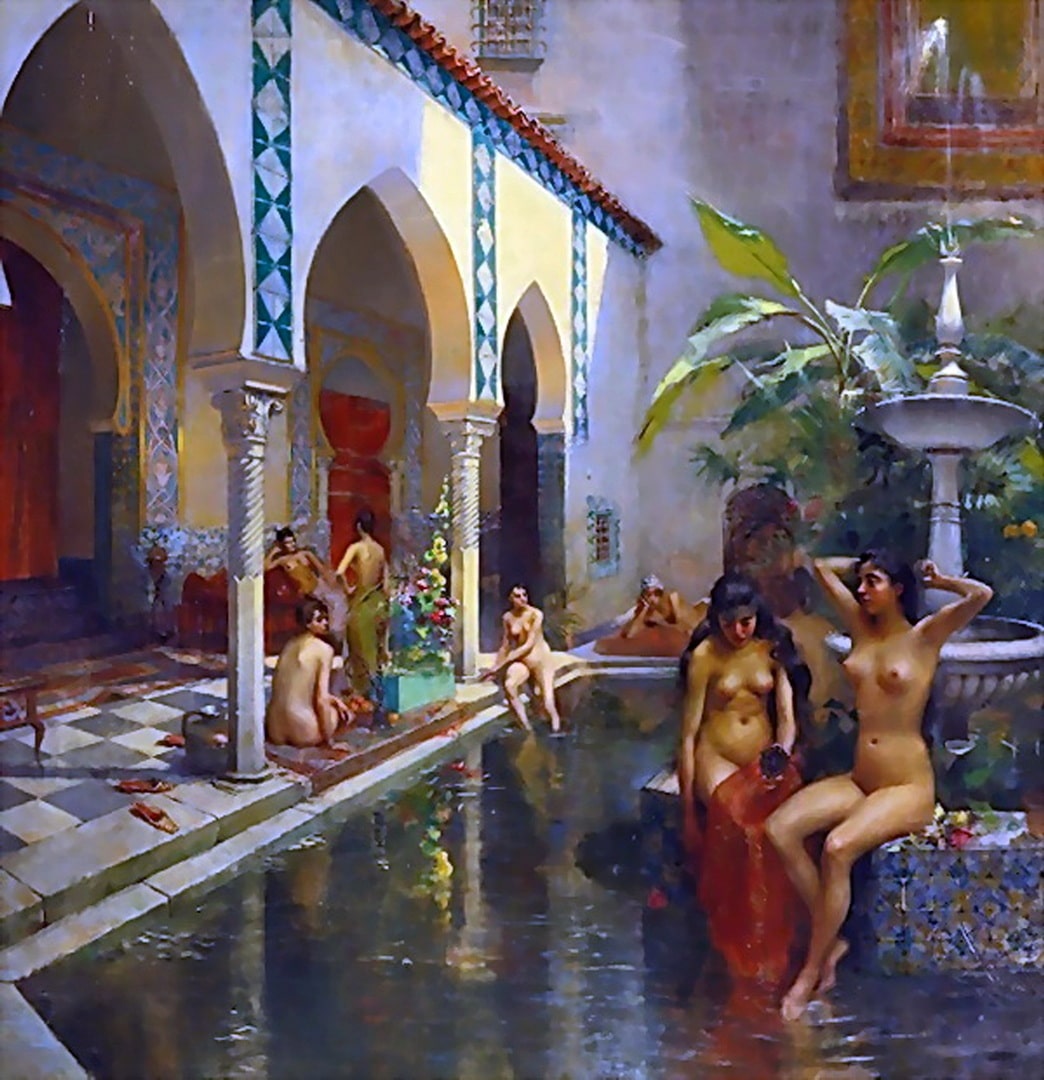
A glamorous area for the harem girls to play. An alluring pool for buxom women to enjoy.


An Exotic Courtyard. Henri Victor.

The voluptuous ladies from the harem are sitting around the pool.

Apparently, these women get looked after really well.

Harems were banned in the 1870's.

Naughty nymphs love luscious sex many times a day.
Harem Girls Page 2 Suacy young women working in Harems.
Lite Erotic Art 1 Find pretty paintings of lovely ladies and beautiful naked women.
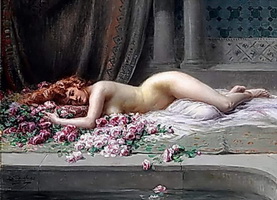
Sensuous paintings of feminine beauty and lovely nude ladies with flowers and roses.
Paintings of very famous lesbians and their lovers.
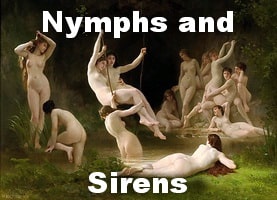
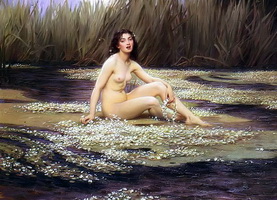
Naughty nymphs lust for sexy. They are always horny. The Sirens are close relatives of them.


This post contains affiliate links, we may receive a commission if you make a purchase using these links.
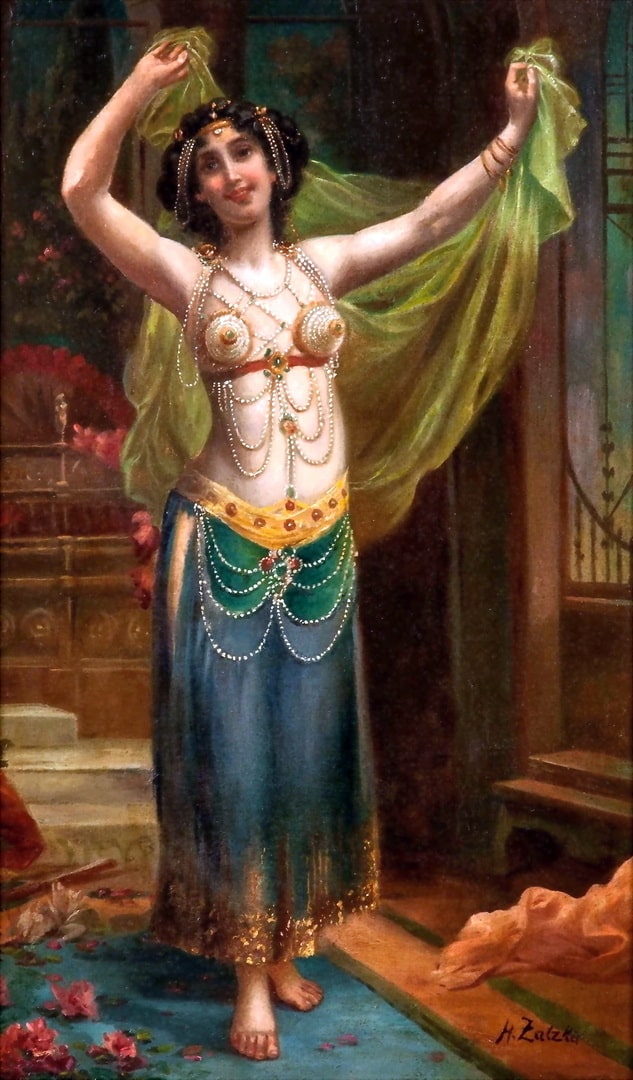
 

A saucy harem girl walking through pretty flowers. The woman has beautiful eyes.


The Harem Girl. A Hans Zatzka painting.

A cute harem girl with lovely eyes and sheer pants is walking through some pretty flowers on the ground.


A painting of girls in a harem doing some bathing.


The Harem Bathing. Jean Leon Gerome.

A couples of girls in the harem are having relaxants. It looks like it might be their turn next.


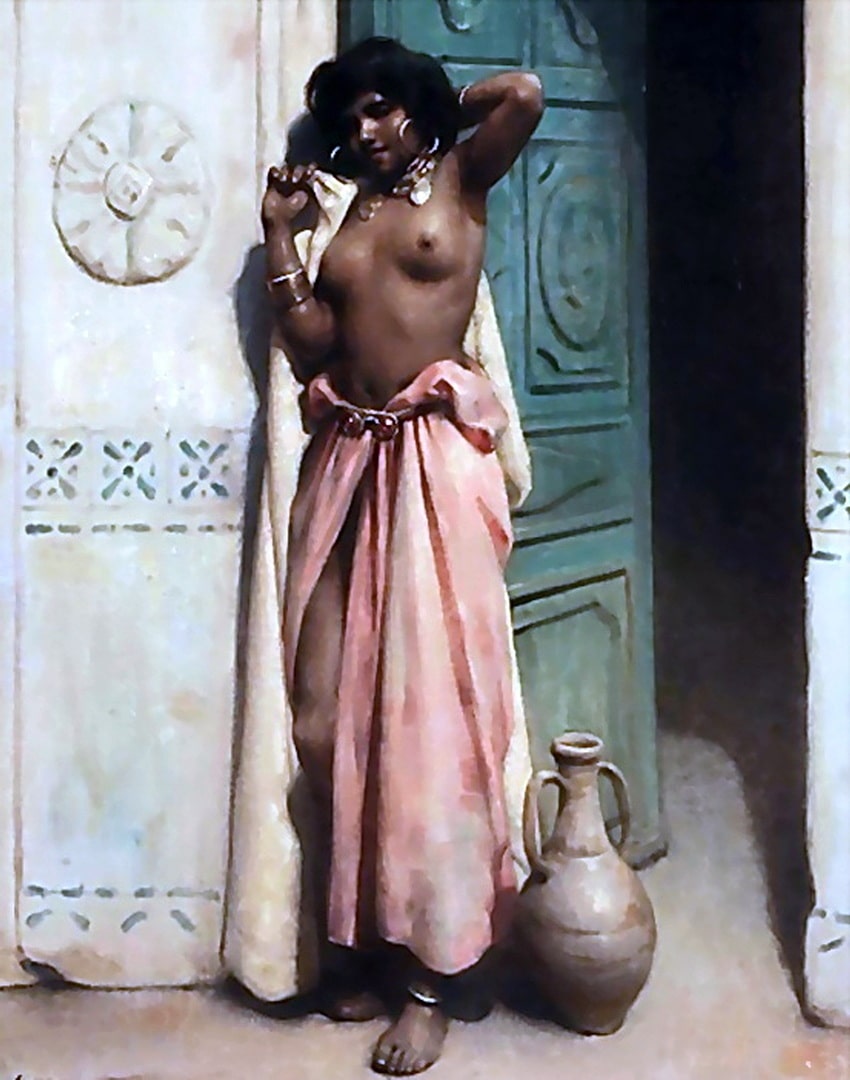
A beautiful woman from a harem standing in a doorway.


A Harem Beauty. Henri Adrien Tanoux.

A pretty lady standing in a doorway showing her erotic breasts and naughty nipples.


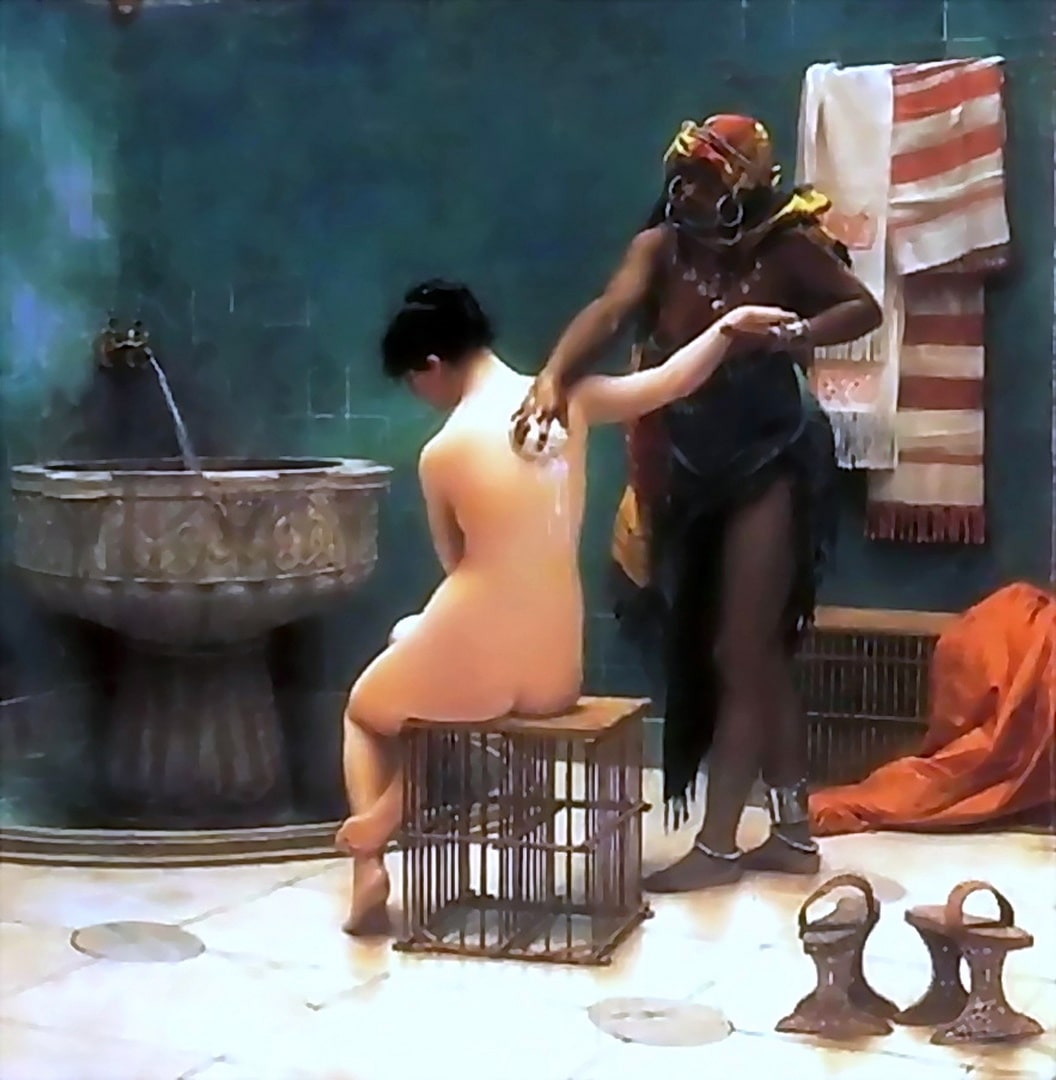
One of the harem girls is being bathed by another woman.


Bath. Jean Leon Gerome.
One of the women from the harem is being bathed. Looks like it might be her turn soon.


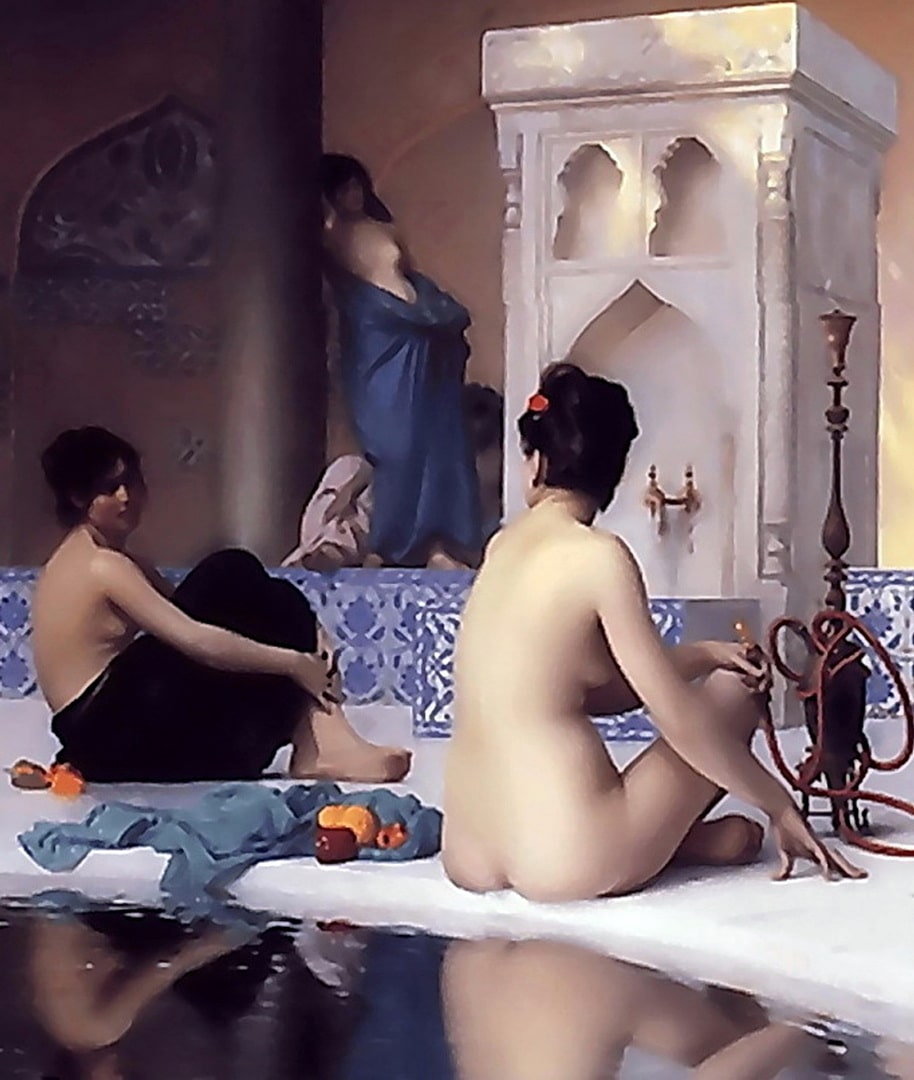
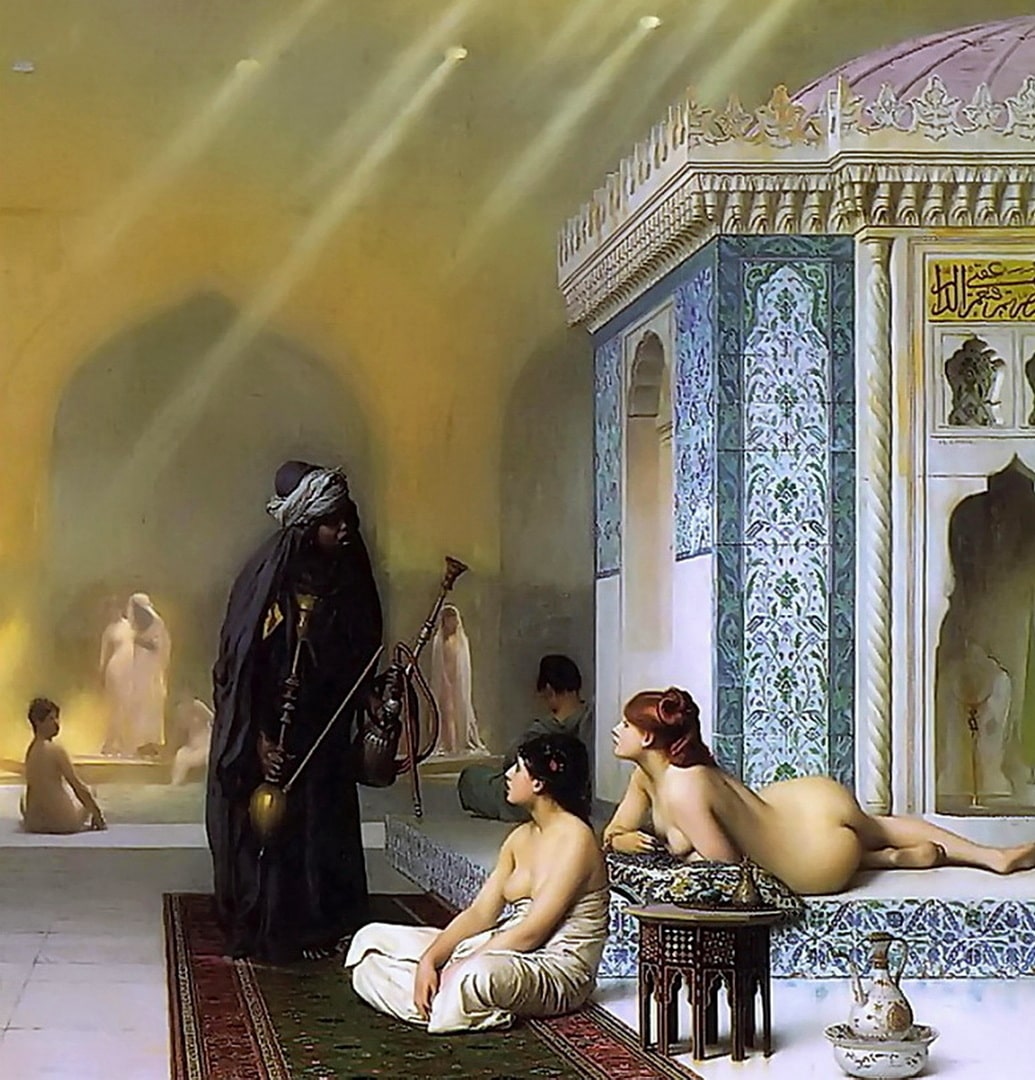
Two harem girls are being given a bong. Their turn next.


Harem Pool. Jean Leon Gerome.

Two girls are being handed a bong each. A girl at the poolside is turning around to see who's next. Time for your relaxant! It looks like it's going to be a threesome to me! The Sultan wants some fun!


Computers


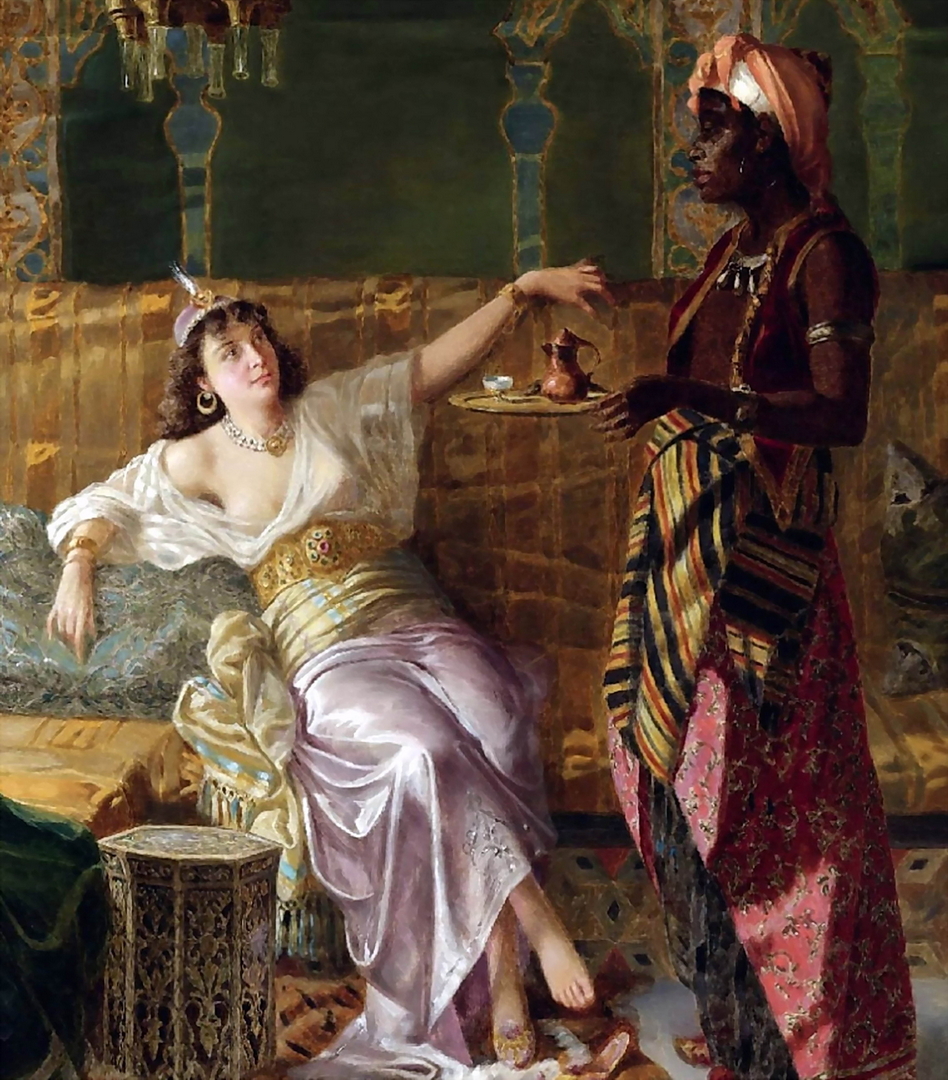
Tea in the Harem. Vincent Stiepevick.


Tea in the Harem. Vincent Stiepevich.


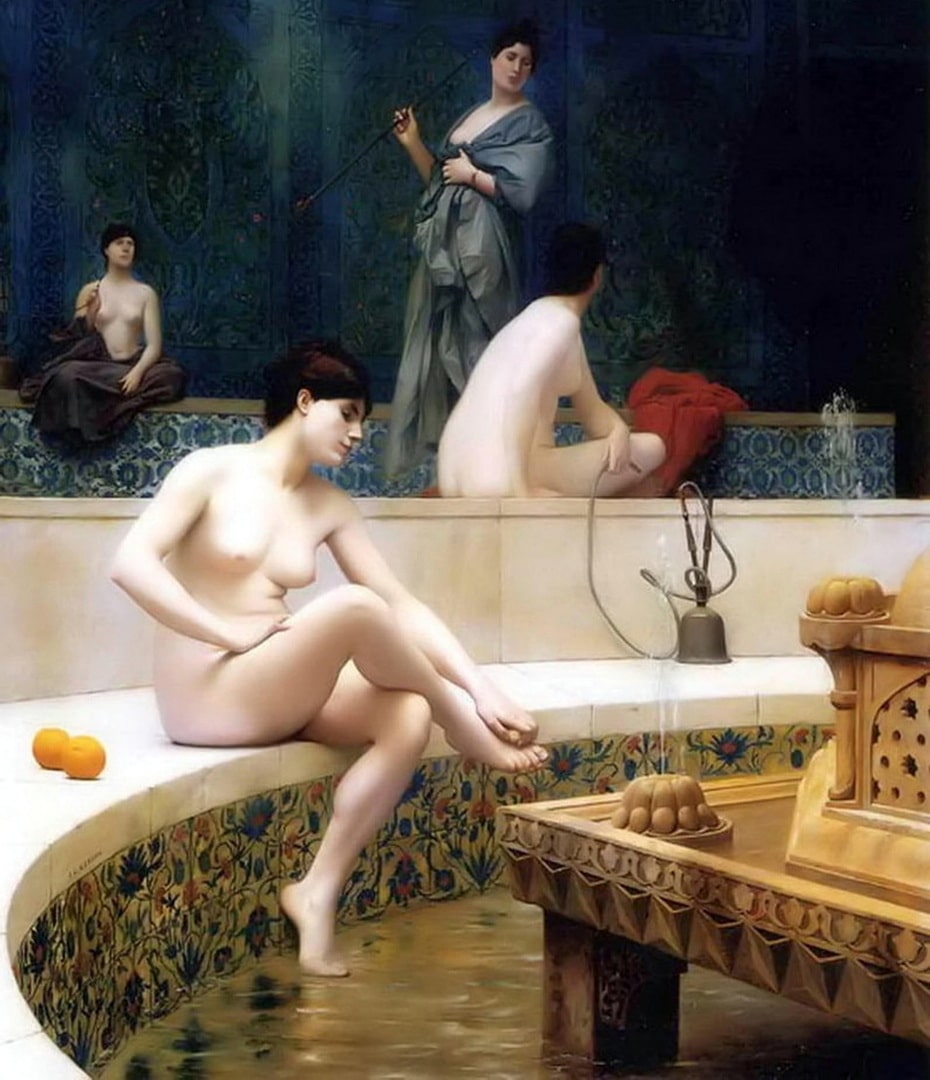
Naked girls sitting around a pool bathing and using a bong.


The Harem Bathing. Jean Leon Gerome.
One of the girls is using a bong. Looks like it is her turn next.


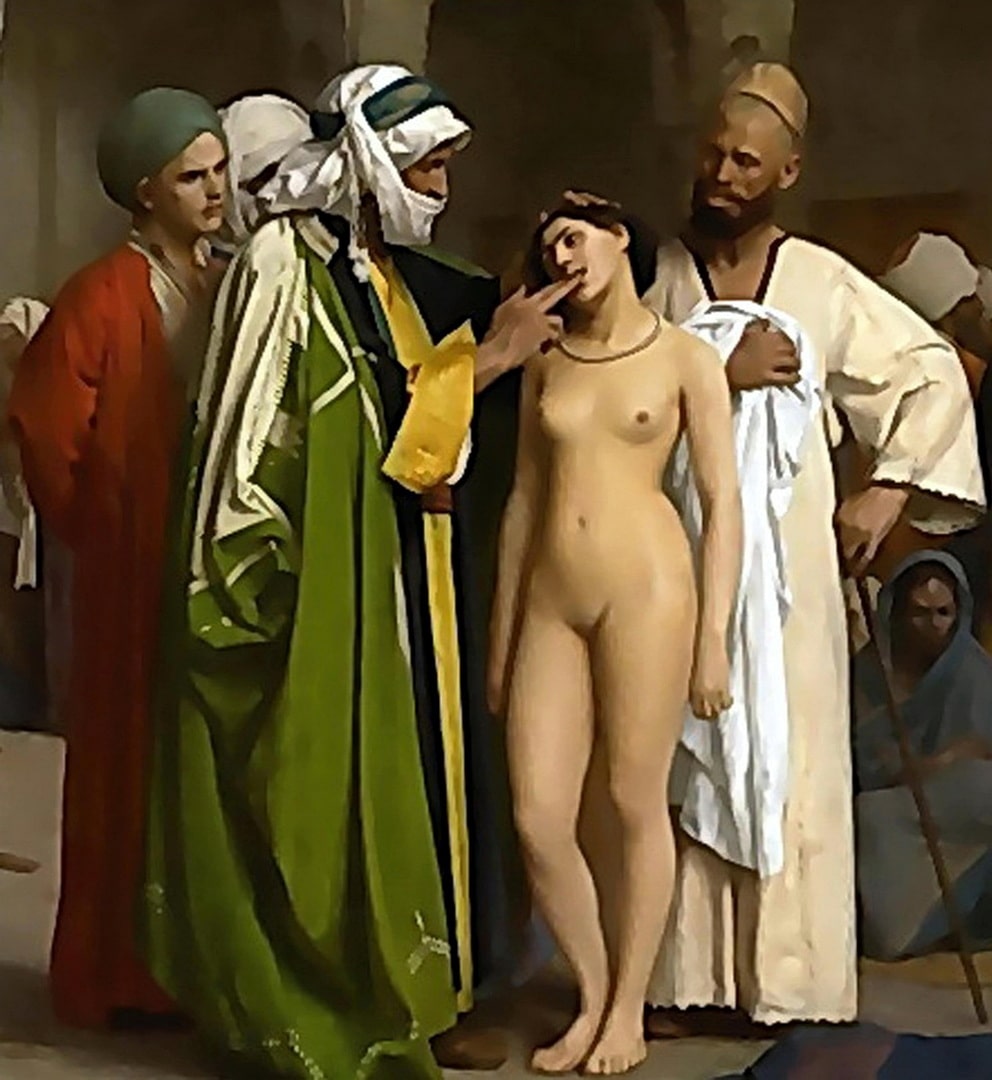
Looking at a young woman to see if she meets the standard for a harem girl.


The Slave Market. Jean Leon Gerome.
They are looking for new additions for the harem at the slave market.


Buy yout perfume here!

Sexy Art for Women 1 Find pretty paintings of lovely ladies and beautiful naked women 2.
Sensuous paintings of feminine beauty and lovely nude ladies with flowers and roses 2.
Paintings of very famous lesbians and their lovers 2. Gay ladies and famous females
The naughty nymph’s, sirens, fairies (related) all lust for sex. They are always hot and horny. They are very wicked girls and have sex with males, females, and Satyrs. Even all three at once!.
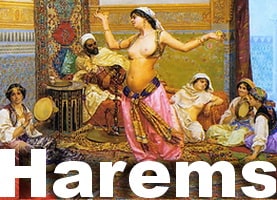
Harems are the home to Odalisques who provide sexual favours to Sultans.
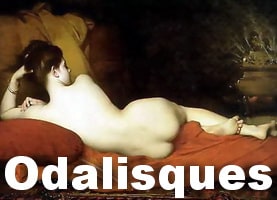
Odelisques are the girls who provide sexual favours to the Sultans.
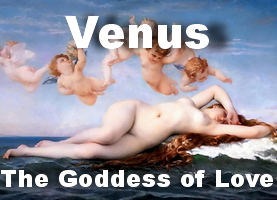
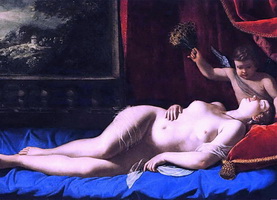
Venus the Goddess of Love. Lust,desire and sexual pleasure are what Venus gives to you.
Sexy Art for Women Page 2 Paintings of nude girls and foxy females Lusty ladies showing off their naked bodies in the name of art.
 
Sexy Art for Women 03 Nude paintings can help to improve a woman's sexuality and love.
Sexy Art for Women 04 Naked paintings of sexy women can help girls with better lovemaking.
Sexy Art for Women 5 Discover naked paintings of foxy females and lusty ladies in portraits.
Sexy Art for Women 6 Find nude portraits of sensuous women and flirty females having sexy fun.
   
Sexy Art for Women 7 Find vintage portraits of cute girls showing their sexy breasts.
Sexy Art for Women 8 Beautiful paintings of sexy nude girls and lovely females.
Sexy Art for Women 9 Elegant portraits of sensuous women and seductive females.
Sexy Art for Women 10 Pretty paintings of luscious ladies and dainty females.
Nymphs are very horny girls who enjoy sex with men women and Satyrs.
Harem girls Page 2 Raunchy girls working in a Harem.


A History of CLAUDE MONET.

Newly translated from French. 11/07/2026


CLAUDE MONET

I

A LIFE LESSON


It is a widely held view that the example set by "superior men" offers the best lesson in life. Yet defining the "superior man" is not as easy as one might think. Various badges of honor have been devised for this purpose, though the mark may not be infallible. Claude Monet would let out a hearty, amused laugh whenever he was asked why he had never received a decoration.

In truth, people classify themselves--rightly or wrongly--by their deeds, and each of us draws a lesson from the encounters we have, whether fortunate or unfortunate, as the occasion arises. We truly learn about human activity through the random play of circumstances. There is no life--{8}be it humble or great--that cannot serve as a lesson to us, even amidst the extreme indulgence with which we view our own lives.

To guide our judgments, moralists have made a habit of presenting us with the biographies of "illustrious men" as examples. I would not disparage this practice, even though, in our daily lives, we rarely find ourselves needing to look to Themistocles or Epaminondas for inspiration. Our Plutarch did not always scrutinize his subjects so closely, and his great men did not always set a good example. If I were to write the life of Plutarch himself, I would reproach him for his weakness for Alcibiades and for his incredible failure to appreciate Aristotle and Phidias--a failure he shared, initially, with his contemporaries.

He is certainly a choice to be made from among the renowned favorites of history. Philosophy and art were the great battlegrounds where Hellenism established its hegemony. The man from Chaeronea gave them only a passing mention, and, as a result, the two figures most truly representative of a humanistic idealism elude us. Despite the praises of Philip--who burdened him with the weight of tutoring his son--Aristotle offers us astonishing distillations of ideas. Phidias--spanning the prestigious evolution of Hellenic sculpture, right up to the stylistic departures of chryselephantine statuary--is perhaps the only master of whom it can be said that he reached the very limits of his art, achieving a level of excellence that would never be surpassed. A word on the Stagirite, in connection with that madman Alexander, who did little more than churn up the East. Another on the Master of Marble, for having walked alongside Pericles--that silver-tongued orator--a proximity that did not save him from dying in prison. We find these two men barely put forward for renown; it was easier to speak of the soldier.

The reader must therefore forgive me if I yield to the temptation--perhaps a futile one--of setting a good example by speaking sincerely of what I have felt, seen, and loved regarding a great figure who is no more.

It may well be that, amidst the infinite diversity of the human race, a careful examination would reveal far more great lives than is generally supposed. The uncertainty lies in the assessment, and the difficulty in establishing a hierarchy of values.

I know of no drama more deeply moving than the spectacle of a human life wholly dedicated to ideal ends through an irrepressible surge of enthusiasm, governed by the steady discipline of a sustained will. Long before a mocking skeptic proclaimed the concept of "man the manifold," we had already observed the shifting impulses of our discordant emotions, held in check by the resistance of rigid, atavistic traits. Yet, the youthful aspirations driving the evolution of relative knowledge toward the Infinite--and the activities that flow from them--have continually shaped, as chance dictates, the sequences and ruptures of the organic processes from which we seek to forge the "unity" of our own character.

To judge a painter, it would seem that merely looking is enough. We might well leave it at that, were there not ample reason to know that sensibilities differ in every individual human being. We seek to live within society while shielding as much of our personality as possible from constraint--an aim that presupposes a combination of conflicting qualities, variously blended. This is the quintessential dilemma where the fortunes and misfortunes of the human race converge. In the realm of accumulated knowledge, we are still grappling with fundamental questions; perhaps our greatest progress lies in the fact that we no longer send people to the Place de Grève simply because a word or phrase they uttered happened to offend the majority.

When it comes to art--where emotion alone seems to be at stake--judgments appear just as likely to lead us astray, depending on each individual's organic makeup. For here, too, we are dealing with the shifting states of unique sensibilities, reacting to our encounters with the outside world. And, within this mental framework, the artist will join or even surpass the scientist, aspiring to rise above a mere knowing machine--at the pinnacle of sensation.

Art, then, would be the ultimate fulfillment of man--in his shifting relationships with the planetary world and the infinite heavens alike. The more art unites and fuses every facet of human sensibility, the closer a man comes--having undertaken the supreme task of personal assimilation that benefits his fellow inhabitants of this planet--to achieving one of the finest realizations of a fleeting being within the eternal universe.{11}

Dear reader, that is why I have ventured to present to you certain aspects of Claude Monet. The artist lived through a sublime moment of art--and, by the same token, of life itself. There will be no shortage of discerning critics to attest to this. Yet it is the human being I seek beyond the artist: the man who, wholly given over to his loftiest impulses, dared to confront the problems of the universe, to grasp them as a whole and fuse them into the aesthetic unity of a refined sensibility--driven by a force of will that nothing could deflect. I call the heavens to witness that such an achievement is no ordinary feat. Hence the idea of ​​adding a few strokes to Monet’s self-portrait, to characterize as best I can the great figure of a man who brings honor to his age, his country, and his planet.

It is not without some hesitation that I venture to offer a few brief observations on the diffusion of light characterizing the *Water Lilies* of the "Water Garden." I am neither a painter nor an art critic--not even a poet. At most, I can claim membership in the anonymous congregation of the public--that French public for whom these paintings were created and to whom Monet himself gifted them.

A formidable honor has thus fallen to us. I would like to try to prove myself worthy of it by accepting the legacy as it is offered: that is, as the depiction of an emotional state enabling us to assimilate new aspects of universal energies and, consequently, to better understand the world--and ourselves along with it. This matters as much for our aesthetic evolution as for our general development, since the expansion of any single faculty inevitably corresponds to the evolution of the entire organism.

It is not for the sake of Monet’s “glory” that I lay siege to those willing to take the risk of reading me. He knew all too well the acrid misery of that smoke. Now dead, he is a stranger to the concerns of his earthly sojourn. Yet, because he lived, he left us something of himself--something we still need to recognize for the sake of--and to the honor of--our own future evolution. That is what I wish to explore. A lesson, as I have said, emerges from every human life. What is the lesson of Monet’s life? It is a question of art. It is, pre-eminently, a question of humanity, since all art--like our knowledge itself--ultimately comes down to expressions of sensibility.

Monet was a supreme lyricist, and that lyricist was a man of action. These two qualities do not necessarily commend one to our contemporaries. Indeed, nothing is more likely to provoke resistance from the modern crowd than innovations that demand tangible realization. Monet proclaimed no doctrine. One might even say he wrapped himself in silence to grant the impetuous strokes of his vigorous brush full freedom. Confident in the unswerving integrity of his vision, he stubbornly persisted in painting what he saw--and exactly as he saw it--casting aside the studio conventions that had previously governed his art.

Assailed by relentless intensity, he sometimes doubted his hand, but never his eye; through a heroic, ever-steadfast application of effort, he expanded his realm beyond his wildest dreams, ultimately dying amidst the brilliant radiance of incomparable success. It was a triumphant defiance of the ordinary course of destiny. As the centuries pass over this remarkable journey, its aura will only grow more luminous. Let us content ourselves with preparations for today.


CLAUDE MONET
I

A LIFE LESSON


It is a widely held view that the example set by "superior men" offers the best lesson in life. Yet defining the "superior man" is not as easy as one might think. Various badges of honor have been devised for this purpose, though the mark may not be infallible. Claude Monet would let out a hearty, amused laugh whenever he was asked why he had never received a decoration.
In truth, people classify themselves--well or poorly--through their deeds, and each of us draws a lesson from the encounters we have, whether fortunate or unfortunate, as the occasion arises. We truly learn about human activity through the random play of circumstances. There is no life--{8}be it humble or great--that cannot serve as a lesson to us, even amidst the extreme indulgence with which we view our own lives.
To guide our judgments, moralists have made a habit of presenting the biographies of "illustrious men" as examples. I would not disparage this practice, even though, in our daily lives, we rarely find ourselves needing to look to Themistocles or Epaminondas for inspiration. Our Plutarch did not always scrutinize his subjects so closely, and his great men did not always set a good example. Were I to write the life of Plutarch himself, I would reproach him for his weakness for Alcibiades and for his incredible failure to appreciate Aristotle and Phidias--a failure he shared, initially, with his contemporaries.

He is certainly a choice to be made from among the renowned favorites. Philosophy and art were the great battlefields where Hellenism secured its hegemony. The man from Chaeronea gave them only a passing mention, and, as a result, the two figures most truly representative of a humanistic idealism elude us. Despite the praises of Philip--who burdened him with the weight of his pupil--Aristotle offers us astonishing condensations of ideas. Phidias--spanning the prestigious evolution of Hellenic sculpture, right up to the deviations of chryselephantine statuary--is perhaps the only master of whom it can be said that he reached the limits of his art, an excellence that would never be surpassed. A word on the Stagirite, regarding that madman Alexander, who did little more than churn up the East. Another on the Master of Marble, for he walked alongside Pericles--that silver-tongued orator--yet that did not save him from dying in prison. We find these two men barely put forward for renown; it was easier to speak of the soldier.
The reader must therefore forgive me if I yield to the temptation--perhaps a vain one--of setting a good example by speaking sincerely of what I felt, saw, and loved regarding a great figure who is no more.
It may well be that, amidst the infinite diversity of the human race, a careful examination would reveal far more great lives than is generally supposed. The uncertainty lies in the assessment, and the difficulty in establishing a hierarchy of values.

I know of no drama more deeply moving than the spectacle of a human life wholly dedicated to ideal ends through an irrepressible surge of enthusiasm, governed by the steady discipline of a sustained will. Long before a mocking skeptic proclaimed the advent of "multifarious man," we had already observed the shifting impulses of our discordant emotions, held in check by the resistance of rigid atavism. Yet, the burgeoning aspirations of an evolution--moving from relative knowledge toward the Infinite--and the activities they entail have ceaselessly shaped the sequences and ruptures of the organic processes from which we delight in forging the "unity" of our character.

To judge a painter, it seems that merely looking is enough. We might even leave it at that, were there not so many reasons to know that sensibilities differ in every individual human being. We seek to live in society while preserving as much of our personality as possible from constraint--an aim that implies a combination of conflicting qualities in varying proportions. This is the quintessential problem where the fortunes and misfortunes of the human species converge. In the realm of accumulated knowledge, we are still grappling with fundamental questions; perhaps the greatest progress we have made is that we no longer send anyone to the Place de Grève simply for a word or phrase that happens to offend the majority opinion.

In matters of art, where emotion alone seems to be at play, our judgments appear just as likely to lead us astray, depending on each individual’s organic makeup. For we are dealing here with the shifting states of particular sensibilities, reacting to our encounters with the outside world. Within this mental framework, the artist may well match or even surpass the scientist, aspiring--at the pinnacle of sensation--to rise above the status of a mere cognitive machine.
Art thus represents the ultimate fulfillment of man in his fluid relationship with both the planetary world and the infinite heavens. The more art succeeds in uniting and fusing the various facets of human sensory response, the closer the individual--having undertaken the supreme task of personal assimilation for the benefit of his fellow planetary inhabitants--comes to achieving one of the finest realizations of a transient being within the eternal universe.{11}

Dear reader, that is why I have ventured to present to you certain aspects of Claude Monet. The artist lived through a sublime moment in art--and, by the same token, in life. There will be no shortage of discerning judges to attest to this. Yet it is the human being I seek beyond the artist: the man who, wholly given over to his loftiest impulses, dared to confront the problems of the universe, to approach them as a whole and fuse them into the aesthetic unity of a refined sensibility, driven by a force of will that nothing could deflect. I call heaven to witness that such an achievement is no ordinary thing. Hence the idea occurred to me to add a few touches to Monet’s self-portrait, in order to characterize as best I could the great figure of a man who brings honor to his time, his country, and his planet.
It is not without hesitation that I venture to offer a few brief remarks on the diffusion of light characterizing the *Water Lilies* of the "Water Garden." I am neither a painter nor an art critic, nor even a poet. At most, I can claim membership in the anonymous congregation of the public--that French public for whom these paintings were created and to whom Monet himself gifted them.
A formidable honor has thus fallen to us.

I would like to try to prove myself worthy of it by accepting the legacy just as it is bestowed upon me--that is, as the expression of an emotional state that enables us to assimilate new aspects of universal energies and, consequently, to better understand the world and ourselves within it. This is important both for our aesthetic evolution and for our general development, since the growth of any single faculty inevitably corresponds to the evolution of the organism as a whole.

It is not for the sake of Monet’s “glory” that I lay siege to those willing to take the risk of reading me. He knew all too well the acrid misery of that smoke. Now dead, he is a stranger to the concerns of his earthly sojourn. Yet, because he lived, he left behind something of himself--something we still need to recognize for the sake, and the honor, of our own future evolution. That is what I wish to explore. A lesson emerges, as I have said, from every human life. What is the lesson of Monet’s life? It is a question of art. It is, pre-eminently, a question of humanity, since all art--like our knowledge itself--ultimately comes down to expressions of sensibility.

Monet was a supreme lyrical artist, and that lyrical artist was a man of action. These two qualities do not necessarily commend one to our contemporaries. Indeed, nothing is more likely to provoke resistance from the modern crowd than innovations that demand tangible realization. Monet proclaimed no doctrine. One might even say he wrapped himself in silence to allow the full freedom of his vigorous brushwork free rein. Confident in the unshakeable integrity of his vision, he stubbornly persisted in painting what he saw--and exactly as he saw it--unconstrained by the studio conventions that had hitherto governed his art.

Assailed by relentless violence, at times he doubted his hand, but never his eye; through a heroic application of ever-more sustained effort, he expanded his domain beyond his wildest dreams, only to die at the dazzling peak of incomparable success. A triumphant defiance of the common lot. As the centuries pass over this saga, its aura will surely grow. For now, let us content ourselves with the preliminaries.{15}{14}


II


CLAUDE MONET, PAINTER


I cannot help but introduce the man to the reader.
Of average height, possessing the fine poise of a robust, well-knit frame, and an eye that holds a smiling assertiveness to match the firmness of a resonant voice--is this not enough to evoke "a sound mind in a sound body," a character of steadfast will? It represents the harmonious development of all energies directed toward the goal the organism itself has spontaneously set! Prometheus, the tortured Titan, stole the divine fire, hiding it within the hollow of a fennel stalk. Monet, a mere specimen of humanity, conceived the plan to conquer the light of the heavens to create an enchanting vision of things for us, forging new interpretations of ever-changing life for us to absorb.
For the demigod, there are the embellishments of legend and the birth of the miraculous. For the simple demonstration of a man engaged in human endeavor, the distortions of miracles will not suffice. We require nothing less than the truth. Look at the powerful modeling of that skull. It calls to mind the work of Vauban--but a Vauban of the offensive, guarding his citadel of energy only to better return fire against the challenges of an outside world that questions us even as it seeks to elude us. Sky, plains, valleys, mountains, waters, forests--life spread everywhere, the entire shifting universe--offers itself to us, yet slips away the moment we attempt to pin it down. These are dazzling milestones along the path of an interpretation that, however brilliant, can only ever be an approximation.

Merely stating that Claude Monet was born in Paris on Rue Laffitte--in the very district of art dealers, perhaps a sign of predestination--does not get us very far. But if I add that he spent his entire youth in Le Havre, where he became captivated by the interplay of light--that light which the tumultuous coastal ocean receives from infinite space--then perhaps we can understand his eye’s familiarity with the luminous gymnastics of a frenzied atmosphere, one that scatters every nuance of every tone across the wild abandon of waves and winds.
From his earliest youth, Monet was drawn to the vast horizons of the sea. To earn a little money, he would prosaically sketch caricatures of those around him. Yet he was not born for caricature. "I had a passion for drawing," he wrote; indeed, by the age of fifteen, his pencil work had enabled him to save enough to fund a trip to Paris.
At Sainte-Adresse, he met Boudin, who took him out to paint in the fields. There, Monet encountered nature’s own palette. A spark ignited deep within him; he discovered his true calling. He did not...


Claude Monet’s House in Giverny
{17}
...all that remained was to define the gap between what he wanted and what was within his reach. Troyon, whom he met, gave him the odd advice to join Couture’s studio. Instead, he preferred an independent academy, where he met Pissarro. In Paris, he naively reproached himself for having spent too much time at the Brasserie des Martyrs. Yet it was there that he met Albert Glatigny; the unforgettable Théodore Pelloquet--who fought a sword duel over the flowers at the Olympia[A]--and Édouard Manet, as well as other figures such as Alph. Duchêne, Castagnary, Delveaux, Daudet, and Courbet, with whom he later formed a close friendship.
In 1860, the military draft sent him to the *Chasseurs d’Afrique* for two years--an experience that, he declared, did him a world of good mentally. Drawing on his artistic skills, he would paint his captain’s portrait to secure leave. Then came a period of convalescence. His father, won over by his son’s dedication to his work, decided to pay for a substitute to take his place. And so, Claude Monet found himself directed to Gleyre’s studio, though he was keen to follow Jongkind and Boudin into the countryside to see things as they truly were. In 1864, Renoir, Bazille, and Sisley answered the rallying cry. "At the Salons of 1865 and 1866, my early attempts met with success," Monet wrote. Then Courbet arrived to see *Le Déjeuner sur l’herbe*--a large *plein-air* painting by a young man "who paints things other than angels." They remained friends, and Monet made a point of{18} mentioning that Courbet "lent me money during difficult times."

Africa is left behind. The artist speaks of that admirable land, yet its palette of colors did not captivate him as it did Eugène Delacroix. Already, however, the divine monster is stirring within him--the force destined to take possession of his flesh, his blood, and his life. The die seems cast: he is fated to endlessly demand an accounting from those soaring flights of light, and never to tire of wresting some revelation of the great secret.
The *Water Lilies* panels will reveal him straining desperately toward the realization of the impossible. From his trembling hand spring forth bursts of luminous transparency, striking new flares of brilliance right out of the thick impasto. His genius lies as much in the brush’s assault upon the canvas as in the swirling of the multicolored palette, from which Monet--with a single resolute gesture--plucks droplets of a luminous dew, bestowing them upon elements that care nothing for holding onto them. Up close, the canvas appears caught in a bacchanal of incongruous colors; yet, from the proper vantage point, they align, arrange, and combine to form a delicate structure of interpretive shapes, all within the precision and certainty of a luminous order. We shall have occasion to speak of this marvel again.

One day, I said to Monet: "It is humiliating for me. We do not see things the same way at all. I open my eyes and see shapes, shades of color, which--until proven otherwise--I take to be the fleeting aspect of things as they are. My eye stops at the reflective surface and goes no further. With you, it is a different matter. The steel of your gaze shatters the shell of appearances; you penetrate the underlying substance to break it down into vehicles of light, which you then recompose with your brush in order to subtly restore--with the utmost vigor--the effect of sensations upon our retinas. And while, looking at a tree, I see nothing but a tree, you--with half-closed eyes--think: 'How many tones of how many colors are there in the luminous transitions of this simple trunk?' Whereupon you proceed to dismantle all values, only to reconstruct and unfold, for our benefit, the final harmony of the whole. You torment yourself in search of that penetrating analysis which will yield the best approximation of an interpretive synthesis. And you doubt yourself, failing to grasp that you have been launched like a projectile toward infinity, and that it must suffice for you to draw near a goal you will never fully reach."

"You cannot know," Monet replied, "how true everything you have just said is. It is the obsession, the joy, and the torment of my days. To such an extent that one day, while standing at the bedside of a dead woman who had been--and still was--very dear to me, I caught myself--my eyes fixed upon that tragic temple--mechanically seeking out the sequence and interplay of color shifts that death had just imposed upon that motionless face. Shades of blue, yellow, gray--who knows what else? That is the state I had reached. It was only natural to want to capture the final image of someone who was about to leave us forever. Yet, even before the thought of preserving features to which I was so deeply attached could arise, my organic instincts would first react to the impact of color; reflexes would draw me, despite myself, into an unconscious process--a resumption of my life’s daily routine. Like a beast turning a millstone. Pity me, my friend."

Monet’s eye was nothing less than the man himself. A remarkable capacity for the most delicate retinal sensitivity governed every sensory response, creating a play of supreme harmony in which we find an interpretation of universal correspondences. This phenomenon appears to be the defining quality of all the great masters of painting. What strikes us about Monet is that every aspect of life became subordinate to this vision.
Deeply devoted to his family--whose circle he delighted in expanding to share the bounty of his generous friendship--he found in the loving care of his sons and his daughter-in-law, Mme Blanche Monet (herself an occasional painter), all the attentiveness required by the rhythm of a life consumed by art. The moment he put down his brush, the painter would hasten to his flowers or settle comfortably into his armchair to contemplate his paintings.

With eyes closed, arms slack, and motionless, he sought the movements of light that had eluded him; and upon that lapse--perhaps merely imagined--a harsh meditation on themes of toil took hold. A sudden jest would signal contentment, or at the very least, a glimmer of hope. The bluntness of a remark betrayed anxiety about the morrow. And so life unfolded, with every faculty of his being straining desperately toward the boundless anticipation of those caresses of light for which his entire sensibility yearned. For the eye was but the triumphal arch opening the way to every tremor--commanded from without by all the exaltations of a self that dreams carry far beyond the mere reactions of its faculties.

I do not see that Monet ever set his mind to explaining his painting. Nothing could have seemed less necessary to him. He was born with a palette in hand and could not conceive of life otherwise than before a canvas, there to capture the shifts of luminous energy through which the protean universe resolves itself--mirroring its own image--into appearances of stillness. To feel, to think, and to will as a painter. Nothing could halt him on the painter’s path. The bow drawn taut, the right arrow nocked, ready for the release of will. He saw as a man must see who needs to render and express as much of his sensation as possible--a man who would never reach the limits of his own emotional depth.

Nothing, I have said, is more beautiful than the perfect convergence of all human diversities toward the ideal of a higher realization, wherein all the faculties of the self unfold in shared harmony. This is, undoubtedly, what is termed genius. The entire mystery lies in the total convergence of our synergies toward the complete flowering of greatness and beauty. We cherish the names of those who have dazzled us with this spectacle. Yet, the debate often remains open regarding the ultimate value of a stroke of fortune whose outcome eludes us.

The number of talented painters is immense. Many could even lay claim to the most coveted credentials. What distinguishes Monet is that, having established his own style, he developed it through continuous progress--culminating in the marvel of the *Water Lilies*--thereby transcending even what his series on haystacks, poplars, cathedrals, and the Thames had foreshadowed.
The danger in such an undertaking is that, amidst this effort of evolving interpretation, the artist’s heightened nervous intensity may far outstrip the corresponding sensibilities of an ill-prepared public. This is what Monet meant when he repeatedly said: "People may get used to it, perhaps, but I have come too soon." Yet even as he spoke, his eyes--hard as black steel and firmly set within their sockets--were already scanning the vastness of space, intent on revealing to human vision a spectacle of shimmering light, steadily bridging the gap between reality and appearance within the unity of sensation.
In every aspect of his artistic work, this is precisely what Claude Monet consistently demonstrated.

How should we picture Monet at this stage of his life, as he battled to conquer the light? We are witnessing only the earliest signs of recognition, for Durand-Ruel--that expert and dealer--has not yet arrived on the scene. What did this young fighter look like, gripped by a burning ambition that was all too often scorned? The only surviving image from this period is a portrait of the eighteen-year-old Monet by Déodat de Séverac. His face radiates a dramatic energy. The brow--which would later appear so firmly modeled in his all-too-rare portraits--here conveys a commanding presence. The painter begins by conceptualizing his work, breaking it down only to reconstruct it through his own vision, imbuing it with a solidity born of seamless transitions. His entire countenance is subordinate to the imposing boldness of a gaze that confronts the world directly, without fear and almost beyond the realm of hope--so powerfully does his vision sustain him, lifting him far above the mundane. In short, we sense the emergence of a formidable power. That is the true event here.

The “Claude Monet Painting” (1875) that Renoir has left us is no less significant. The body is not rigidly constructed; the facial expression is softened. Yet, the posture while at work reveals an effortless ease, underscored by a virility that already bespeaks determination. The mouth is no longer tense; the nostrils breathe the air freely. And the eyes--flaring with an overflowing, inquisitive intensity--fix with irresistible, penetrating focus upon passages of light that guard their secrets. Here, the battle truly begins: the initial, unstoppable impulse of the offensive.

In 1884, we have a self-portrait of Monet (at age forty), in which the man reveals himself with the striking power of his own simplicity. Nothing could be less conventional, less contrived, or less "stylized" than this image of the workman at his task, wholly absorbed in developing the personal sensations he seeks to express. Since he looks solely to the ultimate activity of light waves for a true interpretation of the world, he cannot help but possess a supreme awareness of efficacy when he places himself at the heart of the interpretive drama. With an ingenuousness underscored by the firm determination of his gaze, the true "seer" presents himself--calm and assured--ready for a vision that transcends the ordinary. It sweeps his whole being, imbued with a sacred flame, toward the conquest of a world intoxicated by light. The furrows of his brow speak of the irresistible momentum of a life lived with unwavering purpose. There is no hint of a gesture; the man is in full possession of himself, poised on the threshold of action. He has seen, understood, and resolved; he is advancing toward a supreme goal. Here is our Monet--simpler and more balanced than ever, ready for the surge of action. Confident in his friendly palette, gathered within himself for a masterful leap, standing at the very brink of a determined start, he appears in all the intensity and ingenuous ardor of a master of vision--engaged in the struggle to conquer the light that draws him irresistibly and which he has resolved to tame.

By this stage, the initial formative years of youth are complete. All the powers of a harmonious humanity have definitively coalesced and combined to yield their established results. The victor of the coming day does not yet hold the full measure of his triumph in his grasp, but his eye--confident in its power--has already sized up the battlefield where the genius of a consummate achievement is destined to unfold and reach its crowning glory. It took the approach of death for Augustus to realize that "the comedy" was over. Monet, free of all theatricality yet forever doubting himself (a luxury reserved for the fully realized man), was able to witness the definitive success of his life’s drama, even while refusing to release his *Water Lilies* to the public before his death. It was the final gesture of a brilliant self-doubt--one that, in its noble candor, rounded off the splendor of a truly selfless energy.
Before the *Water Lilies*, he had painted three other self-portraits (in 1917); he spoke of them only hesitantly, perhaps because he saw in them the ultimate expression of his final vision and did not believe he could surpass them in the time he had left. Two of these canvases depicted his face in full light, emerging from beneath a large straw hat. When he showed them to me, he took a mischievous pleasure in speaking of them disparagingly:

"I could do something other than this," he would exclaim disdainfully. "But I shall not be given the time."
I foresaw all too well what came to pass. He had long since acquired the dreadful habit of slashing with a scraper or kicking to shreds any pieces that failed to satisfy him. Sketches of panels in his studio still bear the wounds inflicted during fits of fury in which he heaped abuse upon himself.
I cannot speak of the final portrait (the one in the Louvre) with composure; it captures so miraculously the ultimate state of Monet’s soul--radiant in the anticipation of a triumph he could already glimpse, before the terrifying threat of blindness tragically descended upon him. For anyone who knew the depths of Monet’s life--the full intensity of his dread regarding ultimate failure and his bursts of joy when he felt he had conquered a difficulty--there can be no doubt. It represents the inner consecration of that artistic surge which would culminate in the soaring achievement of the *Water Lilies*. The two destroyed portraits should be viewed primarily as highly developed preparatory studies for that triumphant masterpiece. Here, victory is secured before the battle has even begun--an anticipatory fanfare from a soldier who has already mastered the day.
The solid structure of that brow--which the catapults of the "Philistines" could not breach--speaks volumes about the tragedy of this glorious life. Between broad, high-set temples, the energies of the mind have left their mark, shaped by great struggles for an ideal. It is a foundation of command, the imperious seat of ideas and authority. The eyes are half-closed, savoring an inner dream. With quivering nostrils and a throat convulsed by an irrepressible surge of emotion, the master craftsman has just discovered, deep within himself, the clear realization of an ultimate fulfillment--heralded even in the halo of spring-like reflections playing upon the "flowered beard," that *labarum* of Charlemagne, emperor of a new world.{27}

As everyone has noted, at the distance from which Monet necessarily had to paint, the viewer sees nothing on the canvas but a storm of wildly churned colors. Yet, step back a few paces, and--miraculously--nature reassembles and organizes itself upon that very panel, emerging from the inextricable tangle of multicolored dabs that had initially baffled us. A magnificent symphony of tones takes the place of that thicket of intermingled colors.
How could Monet, without moving from his spot, capture--from a single vantage point--the breakdown and reconstitution of tones required to achieve the effect he sought? This surely implies a state of infinitely delicate sensibility, quick to respond with the corresponding reactions that cause a succession of snapshots to flash across the retina through agile, appropriate adjustments. It is the painter’s gift to engage in a direct, physical struggle with light--and to possess the strength to sustain that battle.
Needless to say, Monet gave no thought to theory in this regard. Nature had endowed him with an eye equal to the task, and he accepted no arbiter other than his own retina when it came to the judgments that guided him. Is that not the essential prerequisite for a successful day’s work?

He would settle silently before the subject, his eyes piercing it with questions, while slight facial twitches accompanied the movement of his pupils from the object to the palette and the swift leap of the brush to the canvas. At this dramatic juncture, he did not speak idly. Occasionally, he would address a question to his daughter-in-law, Mme Jean Monet, who never left his side. Yet he was questioning himself far more than awaiting an answer, to which he rarely paid heed. Like an airplane taking off, the artist required a certain coordination of effort to "take to the air" and plunge magnificently into the action. Then came the sudden release of the brush--like a sword thrusting straight at the body the moment the duel begins.
Free from the pitfalls of reflections, the Louvre portrait must, in my view, be considered Monet’s final statement. A flash of triumphant joy crossed his face when his ultimate attempts revealed that, having conceived a vision at the very height of his creative powers, he was capable of executing it. It is this flash of superhuman ambition that the admirable final portrait has captured.
The historical significance of this canvas lies in how it reveals--amidst a whirlwind of joyful passion--the man who has achieved his dream. The full radiance of triumphant labor is etched upon that face, transfigured by the dazzling inner vision from which the terror of falling short of his ambition has finally been banished. And destiny decreed that this triumphant radiance of his finest hour be handed down to us in the most exalted light that ever shone from Monet’s brush.

The idea of ​​the *Water Lilies* had long occupied Monet’s mind. Each morning, in silence by the edge of his pond, he would spend hours watching clouds and patches of blue sky drift by in magical processions across his "garden of water and fire." With fervent intensity, he examined the contours, the intersections, and the varying degrees of interpenetration amidst the tumult of light-bursts. He sought to capture moments of the personal insight he had gained--aiming for a more profound interpretation--by defining the subtle aspects of the light radiating from objects into the infinite universe.
From this magnificent endeavor, evidenced by moving studies, the *Water Lilies* of the Tuileries emerged. It was only after long periods of observing, critiquing, and comparing them in a thousand ways within his "water garden" that Monet resolved to embark on the definitive adventure of the large panels, beginning with the construction of his spacious studio (1916). The order to build was given only once the decision was made; and for that decision to be reached, the painter had to pass not only the test of his own rigorous self-criticism but also the ultimate touchstone of actual execution.
Numerous canvases capturing the initial Water Lilies inaugurated the "Water Mirrors" series, which would reach its full flowering in the unbridled creative outpouring of the Tuileries project. In truth, the final panels demonstrate a level of accomplishment far superior to the early attempts created in the large studio. There were some truly beautiful and highly distinctive works among those early efforts--works that were, unfortunately, destroyed during the trials and errors of the initial phase. Inevitably, there were times when a sought-after effect did not seem fully realized. Since friendship permits such things, I would sometimes--perhaps presumptuously--venture to offer an opinion. Sometimes I would get a grunt in reply, implying: "That remains to be seen." At other times, silence. Yet, from one visit to the next, I noticed that labored passages--where the brush had stubbornly struggled--had miraculously "opened up."

For a long time, my unspoken criticism concerned his clouds, some parts of which seemed heavy to me. I dared not say a word. Then, one day--what a surprise!--a sudden appearance of clouds made entirely of light vapors. No words were spoken. Gradually, I watched as capricious, wispy clouds dissolved, shredded by the wind. Monet observed with such intensity that he was reluctant to accept criticism from others. Yet, he never ceased to rethink, correct, and refine his work based on his own inner judgment. Driven by a scrupulous desire for perfection, he even introduced vaguely sketched animal shapes into his clouds--reminiscent of the forms Hamlet pointed out to the bewildered Polonius. Conscientiousness could go no further.
Far from yielding to the allure of the initial draft, Monet constantly revisited his original inspirations, always finding some way to berate himself for perceived shortcomings. He never hesitated to lash out at himself--at any hour--swearing his life was a failure and that the only thing left to do was slash all his canvases before he died. First-rate studies were lost in these fits of rage. Many works that later won great public acclaim were fortunately saved thanks to the efforts of Mme Monet. I have already mentioned how two magnificent self-portraits, painted in full sunlight, perished in this way on a single unfortunate day. By a stroke of luck, the one now in the Louvre was saved. One day, after he had spoken disparagingly of this incomparable work, he fetched the canvas just as I was leaving and tossed it into my carriage: "Take it away," he said gruffly, "and let me hear no more about it."

It was as if he were trying to guard against the folly of another summary destruction. And when I told him that on the day the panels were unveiled we would go--arm in arm--to see that canvas at the Louvre, he replied:
"If I have to wait until then, I’ll say goodbye to it forever."
Alas! We had to give up on that happy visit, for he refused to part with the *Water Lilies* before his death. Thus, we are left with two portraits from his hand, dating from the two moments that mark the painter’s great leaps toward the pinnacle of his vision: the *Haystacks* and the *Water Lilies*.
Then came the dreadful catastrophe of double cataracts. An unspeakable tragedy! Thanks to surgery followed by skillful medical care, the horrific fate of total blindness was temporarily averted. I would have preferred a radical treatment, but Monet would not accept the risk of losing the light. He therefore remained in a state of partial vision that allowed him to complete the *Water Lilies*.
It was little short of a miracle, for the relationships of light registered on a profoundly altered retina differed from those that existed when the work was first begun. I had but one fear: that a canvas might be completely lost. For reasons unexplained, the work concluded most happily; the transition from one retinal state to the other caused no flaws. It was as if Fortune--which incurs debts to all great lives--had inadvertently settled its account. In this instance, Monet seems to me to have been the beneficiary of a "providential" oversight.

Yet another supreme feat was to be accomplished. Everyone around Monet implored him to consider the work on the panels finished, for there was every reason to fear a clumsy brushstroke that might ruin everything. But he let us talk, shaking his head without replying.
Time passed, and then one day he took me by the hand and led me before one of the canvases, where the infinite spectacle of light played out across the expanse of still water, broken by bluish reflections lost in fields of rosy hues.
"Well, what do you say to this?" he exclaimed teasingly. "You didn't dare criticize me. But I knew full well that the water looked pasty--as if it had been cut with a knife. The whole treatment of the light needed redoing. I hadn't dared. Then I made up my mind. This will be my final statement. You were afraid I might ruin my canvas. So was I. But somehow, a sense of confidence came to me in my distress, and I could see so clearly--despite the veils over my eyes--what had to be done to maintain the continuity of the..."

Claude MONET.--Poplars on the Banks of the Epte (1890)
{33}
...connections, that confidence sustained me... Now, look. Is it better or worse?
--I was wrong. You are so quintessentially a painter that, even with eyes out of tune, you complete the harmonies of vision to which your eyes--once open to the supreme chords of color--had led you.
--It is an accident.
--An accident that the unfortunate Turner never experienced.
--It is over. I am blind. I have no reason left to live. Yet--mark my words--as long as I am alive, I will not allow these panels to leave this place. I have reached a point where I dread my own criticisms more than those of the most expert eyes. It is highly likely that my attempt is beyond my strength. Well, I accept dying without knowing what fate may have in store for me. I have given my canvases to my country. I leave the judgment to it.{35}{34}

III

THE WORLD, MAN, LIGHT


The subject of art, no less than that of human knowledge, is necessarily the universe in its manifestations--man included--to be expressed through reactions of sensibility comparable to those of the anvil beneath the hammer. For a long time, we were offered the distortions of religious imagery--of varying degrees of refinement--to satisfy the simultaneous demands of our need to know and our emotional joys. Consider the incredible poverty of the subjects in the paintings where the Renaissance stagnated. Polytheism and Christianity brought their legends, which would eventually become "history." Nature was ignored. Only portraiture asserted itself, because it is impossible to escape the human presence. Raphael’s *Balthasar* and Leonardo’s *Isabella d’Este* stand as testaments to humanity. Later, lacking princely friendships, Rembrandt had no recourse but to array himself in various guises in order to seek out the human being in his own mirror.

However, we have reached a stage of knowledge today where science and art--though deeply differentiated--share a common starting point:{36} the intensive cultivation of sensory reactions. The scientist organizes the sensations derived from experience to earn the right to generalize. The artist holds fast to the emotions evoked by harmonies in order to realize, to the very limits of possibility, the insights of his own sensibility.
Within man--the vessel of this organic sensibility--a reaction of emotional vibrations arises in response to external stimuli. I am referring here only to "luminous" activities--that is, those carried out by the organism within a realm of specifically defined sensations. Everyone knows that the art of painting seeks to represent the visible world through tonal harmonies, just as we create a musical symphony through harmonic combinations of sounds. It was under these very conditions--and before any theory had been formulated--that cave dwellers traced their first images, and that herdsmen of primitive ages entrusted their songs to the passing wind to gather their flocks.


What we call light is merely the transmission of a vibrational state of elements, propagating at a fixed speed. The universe thus appears to us as a storm of waves--opposing or intensifying one another to produce fleeting results, all watched over by the benevolent Lethe as lost hopes and irreversible disappointments flow perpetually away. Yet, since anything can happen--from profound discord to the arrangement of harmony--it may also come to pass that fortunate organic alignments temporarily ready the individual for higher forms of activity, where all the values ​​of the personality converge. This is seen in legends, where imagination holds sway over events; in the ancient songs of early humanity, where poetry dictated the tenor of the times; and even--in what is perhaps the greatest marvel of all--in human reality itself. Take, for instance, the example of Claude Monet.
Why, then, single out Claude Monet here? Why not Leonardo da Vinci, Michelangelo, or Rembrandt--figures who are perhaps more familiar due to their antiquity, and whose supreme mastery is beyond dispute? It is because I knew Claude Monet; because I was able to gauge his true stature--time and again--through the incomparable intensity of his simplicity; because I loved him and love him still; and because I wish to bring him back to life amidst the shimmering light in which he evolved--a master who willed and achieved.

Leonardo saw, knew, and understood everything; he achieved almost everything. Yet it does not appear that light moved him to the point of sheer visual enchantment. Following the common practice, he chose the moment when daylight was fading to caress the exquisite contours of the Mona Lisa’s face with his finest brush. Add to this that the patina of time has darkened the areas of brightness; the face--an outdoor subject--is cast in semi-darkness. One day, as we were looking at Corot’s *Woman with a Mandolin*--one of the most beautiful things in existence--Monet, having made sure no one was listening, whispered in my ear:
"I prefer this to the *Mona Lisa*."
The fact is that all the Italian’s genius did not sufficiently free him from the conventions of studio lighting, whereas the rustic Frenchman--without theory or precepts (though I dare not say without experimentation)--stuck to the natural distribution of light from the sky, faithfully rendered. Leonardo did, however, achieve a rather fine vindication in the *Isabella d’Este*--a prodigious drawing where, somehow, light seems to be an integral part of the work, even though it is not explicitly present.
It is doubtless presumptuous to speak of such masters with such freedom. I hope to be forgiven for citing nothing but my own status as a spectator to support my opinion. After all, I am one of the public. It was for me--as for all of us--that Phidias, Michelangelo, Raphael, Leonardo, Rembrandt, Velázquez, Frans Hals, Goya, and the greatest masters labored. Everyone is subject to the judgment of the world at large. All the great men of every age placed their trust in us by submitting their works to our view. What greater tribute could we offer them than our sincerity?

Michelangelo was an engineer, poet, sculptor, and painter. A genius without equal, he sought the limits of exertion--limits he sometimes came close to transcending. His Moses owes nothing to Hellenism. The shock of the "Monster" could never be forgotten. And what judgment could one pass on the work in the Sistine Chapel--other than to acknowledge one’s own inadequacy and wretchedness--when faced with that soaring array of superhuman figures, swept up by an irrepressible breath toward the sublimity of prophecy! The man magnificently poured himself into every field of endeavor. He reigned supreme on all fronts. More than a king. Almost divine. Rembrandt, too--wearing the halo of the unrecognized God--spontaneously gathered the most vivid elements of an impassioned vision, along with the interpretive choices best suited to express them. The Kassel museum offers us a series of sketches in which one seeks--and sometimes finds--the spark destined to ignite the dazzling flashes of lightning to come. The portrait of Burgomaster Six and *The Syndics* mark the milestones of a giant--a master of the astral prism--who sows sunlight both within and without objects, creating bursts of lightning-like brilliance.
Lacking other models, the painter would soon turn to his own image in the nearest mirror, experimenting--whether with brush or burin--with every conceivable lighting arrangement. The Dutchman’s "astonished genius" did not tremble before the inexhaustible wonder of infinity. Just as Monet would later do, he responded directly to the call of light, and in a magnificent struggle, he succeeded in taming the untamable. Yet it does not appear that he has thereby reached the end of his dream; instead, he kneads the shadow with his titanic hand, pitting it against the dazzling brilliance of the solar blaze--the secret of which he discovered through the contrasts of his brush--to melt the very tremors of an awestruck retina. And since the full ardor of the furnace has sprung from the most violent contrast, all the transparencies of light--whether distinct or blended--will surge forth in subtle waves of illumination, culminating in sensory experiences hitherto unknown to painting.{40}

It is a miracle--like the miracle of Monet’s *Water Lilies* reflected in the Water Garden, lulling them into a voluptuous slumber amidst the clouds. It is the encounter with an inverted world that, through contrasting relationships, compels the eye to refine its perception of color waves blended in symphonic harmony. A new kind of visual exercise offers us a delicate web of luminous sensations; through the effort of perceiving them, the depth of our insight is enriched.
Rembrandt poured more of his own personality into the dramatic clash of his contrasts. For the marvel of the *Water Lilies*, Monet dared to follow the direct path of the most rigorous observation--a journey leading from the shifting light on haystacks to poplars, cathedrals, and Westminster, until the day his meditations at Giverny revealed, in the tranquil waters of the Epte, transpositions of light that enabled his supreme interpretive achievement.
In his final days--mortally ill, yet finding a last consolation in those lingering rays of chiaroscuro where his imagination still infused color--did he reflect on his life’s work? Did he, at last, dare to judge himself? I do not know. He was too sincere to have the audacity to cast aside the anguish of doubt. He was too great an artist ever to be satisfied. At most, he was occasionally bewildered by the inconsistencies of the public.
One day, I told him how, while passing through Vitré, I had stopped an elegantly dressed young man on the sidewalk to ask the way to Les Rochers--the château of Madame de Sévigné.{41}
"You must be mistaken, sir; we have nothing of the sort here," came the unexpected reply.
"Forgive me, sir, but I am inclined to think *you* are the one who is mistaken, for I know that Madame de Sévigné has a statue in Vitré."
"Ah!" "Are you talking about that bronze woman in the Jardin des Plantes? Well, to get to the Jardin des Plantes, you have to turn right..."
"So that’s what fame is, eh?" exclaimed Monet.


--Yes, that’s right. Do you need any rewards?
He burst out laughing, and the Chinese porcelain cat, asleep on its cushion, understood there was no need to wake up for such a trifle. The brushes were soon taken up again, and the ascent toward distant peaks resumed its course.
After evoking the immense body of work that slowly shaped the education of our modern eye, how can we not turn our thoughts to the master craftsman? The man poured perhaps the best of himself into expressing himself through images. It is up to these images to return to us--and to reveal of him--what they have preserved. For if we can leave our mark, for a time, amidst the planetary upheavals in which we are both spectators and participants, nothing could be more precious to our own self-definition than those trials of action and thought where our fellow beings have marked the milestones of our shared emotional lives.
Of the world, we know only the resonances{42} of waves upon the tentacles of our sensibility. As for our attempts to capture shifting light, they date back, as everyone knows, to the primal drawings of prehistory. It was one of our first ways of claiming the outside world as our own, and ever since, we have ceaselessly expanded and developed our conquests amidst the endless invitations of space and time.
Since the images that constantly pass before our eyes are the living source of our sensations of the world--and, in turn, of ourselves--we continually draw from them the subtle emotions of a universal harmony that crowns our knowledge with an aura of beauty.
Yet, varying states of light will continue to succeed one another all around us, thanks to the breaking down and reassembling of the color spectrum. And the painter’s sensory interpretation will embrace a direct encounter with the spectacles of the world to express forms through lines that do not exist in nature, and states of light through juxtapositions or superpositions of colors that will be nothing more than fleeting compositions.


From whatever angle one views it, man’s relative nature will forever be grappling with that monster--the Absolute--which our highest achievement is to articulate, if not to assimilate. For such a claim to be justified, we would indeed need to realize it through something other than a mere indicative verb--a verb that too often misleads us, causing us to accept an interpretation of relativity{43} as a dogmatic representation of the Absolute. What sum of realities, known and unknown, is required to construct such an appearance?
I ask the reader to excuse these passing remarks--points Monet was under no obligation to consider, as they lay outside his domain, yet which nonetheless fall to anyone attempting to place the labors of art in their proper context within humanity’s idealistic output.{45}{44}


Nymphs are very horny girls who enjoy sex with men women and Satyrs.
Harem girls Page 2 Raunchy girls working in a Harem.


©7th June 2024 sexyartforwomen.

Sexy paintings of nude girls and naked women. Discover foxy ladies and hot females.

Sexy Art for Women. Harems 1. Female Erotica and Feminine Beauty.