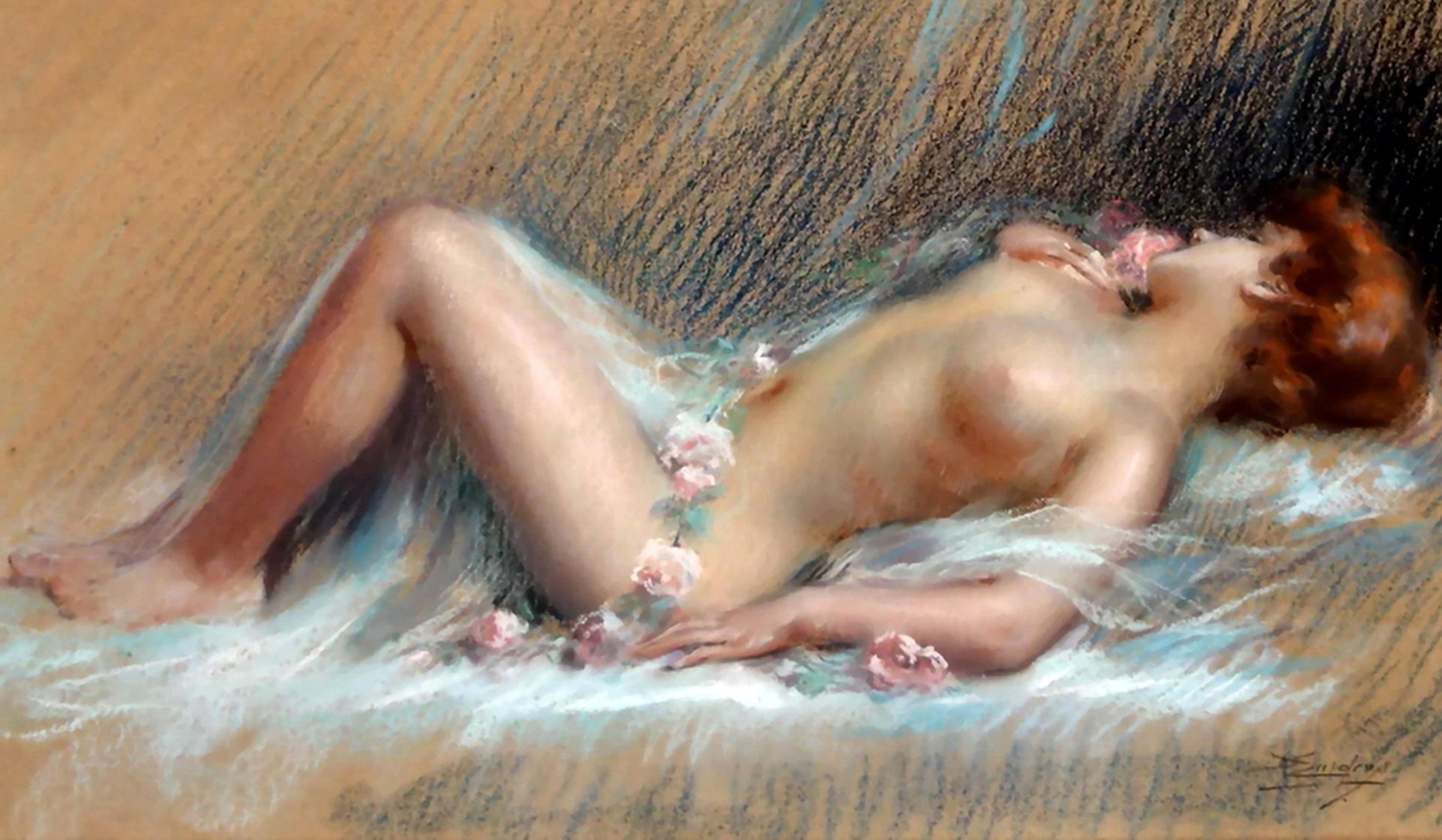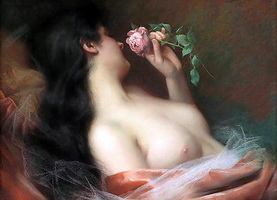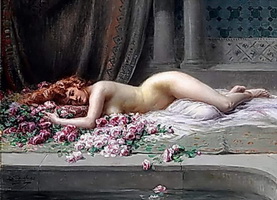

A Girl Lying. Delphin Enjolras. The pretty flowers over covering her erotic nude body. The young woman has pink roses over her naked body! This is another sensuous painting by Delphin who has painted many of the best paintings presented on this site. This foxy female certainly looks very ready for romance. Once her partner comes through the door, watch out. Fun and games will be had by all. A lusty lady waiting for her lover! Artists and their models often make love together a lot. Before, during and after their sessions. That's right! Artists make love with their models. They are hot! |

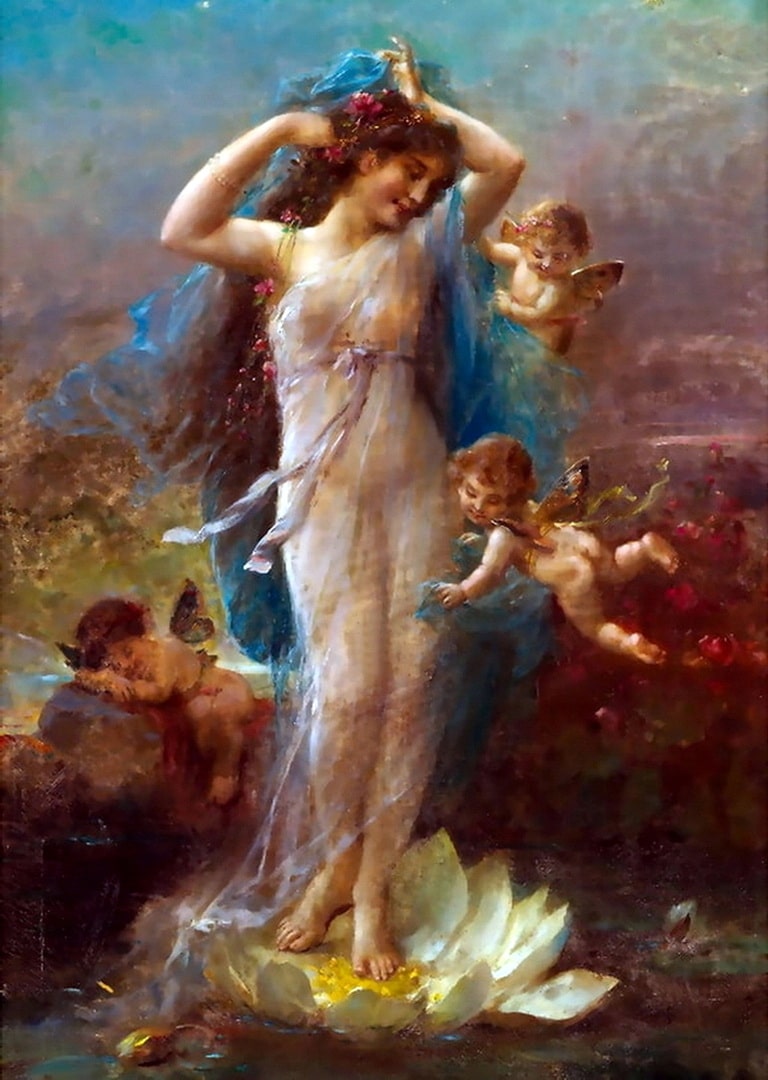
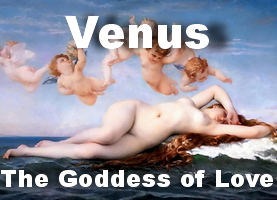
The Birth of Venus. Hans Zatzka. The Goddess of Love has pink flowers in her hair and Cupid is there to help with her very sexy see-though dress. Already, Venus looks like she is up for lots of hanky panky. After all that is the Goddess's of Love's job. Who would have thought it? Three Cupids are fussing over her as she steps out of the water lily. That very sheer dress is very hot and horny as you would expect. Nobody will say no to her! You will receive plenty of pleasure will be yours when making love to her. Guilt free! Fun and games will be had by all. Her beautiful long hair flows down passed her bottom and she has some pretty pink flowers in her hair. Because that's the way she likes it. A beautiful lady has just entered the world. |

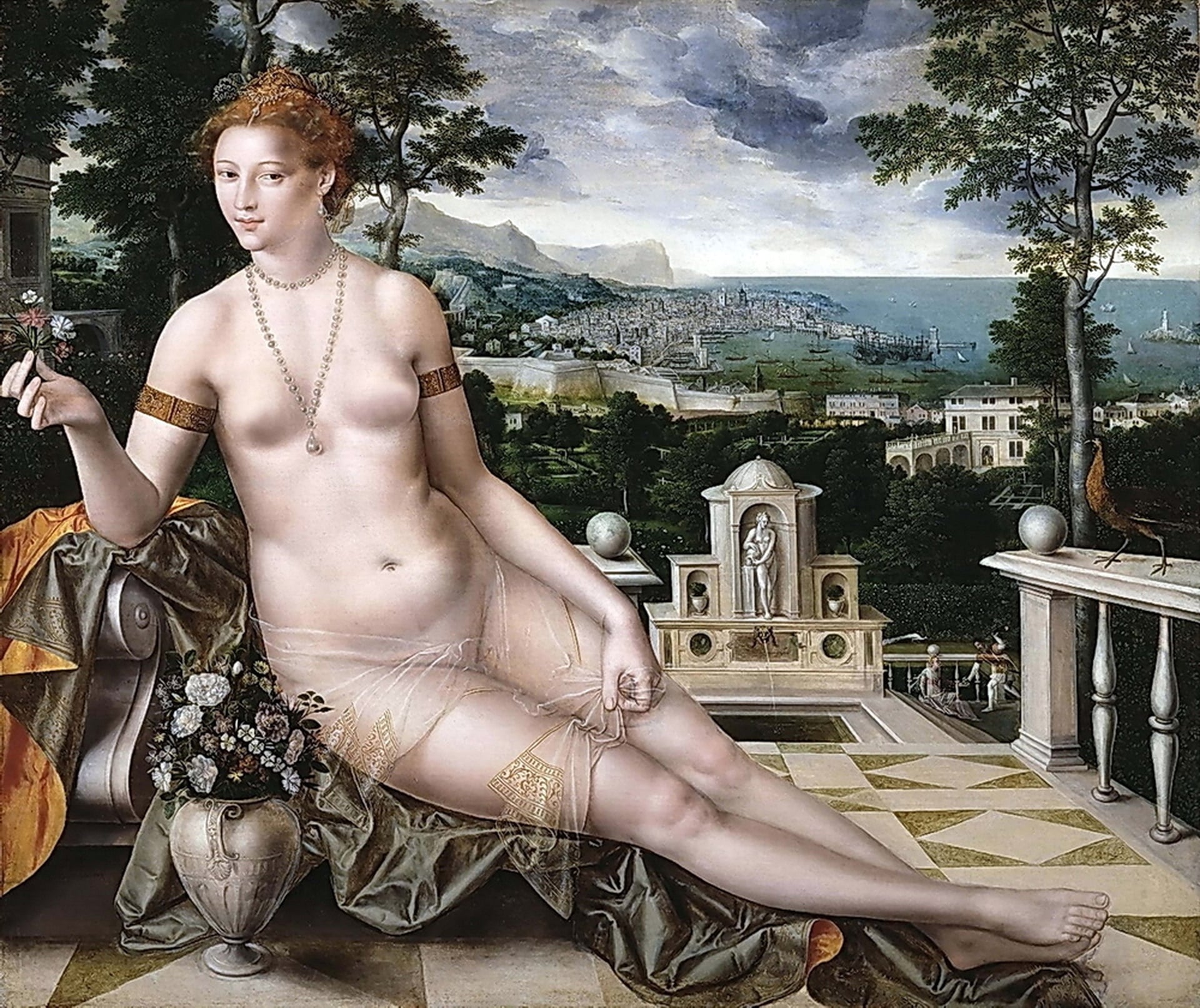
Venus Van Cythera. Jan Massys. The Goddess of Love is holding some pretty flowers in her fingers. Venus is in Cythera. Her elegant body leans back in a seat where she can enjoy the view. Next to Venus is a vase of flowers. She has lovely red hair and beautiful breasts along with two sexy legs. Venus has a very sheer garment over her lap and a bird has come to join her on the fence in front of Venus. The sheer wrap over her lap looks quiet pretty. |
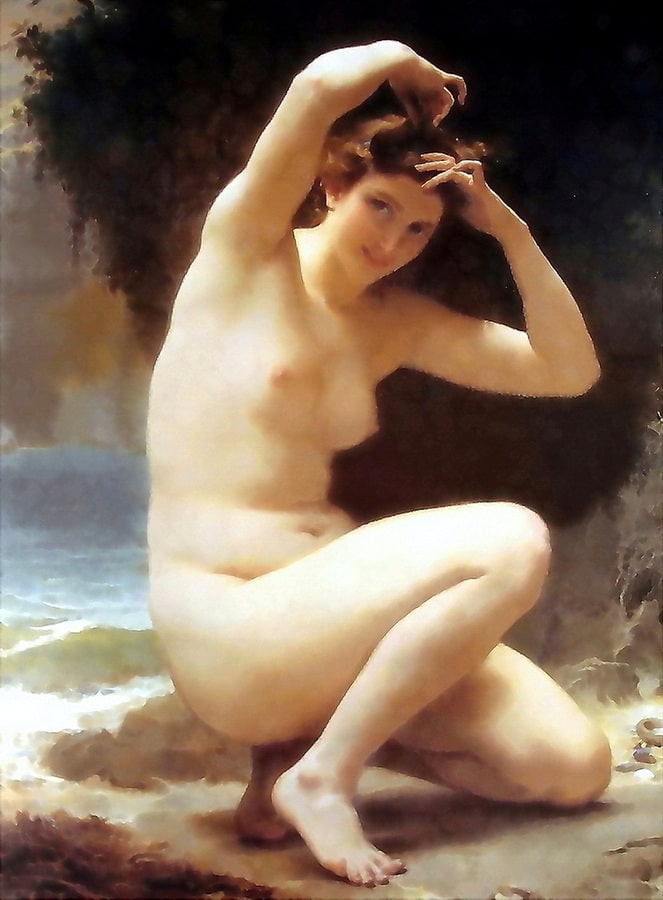
The Toilet of Venus William Adolphe Bouguereau. A voluptuous Venus attending to her daily duties with her sexy nude body and erotic breasts. Just what you expect a Love Goddess to have. Venus is kneeling beside the sea and doing up her hair. Her delightful naked body is on show, not that Venus minds that, she is very out going. Venus has pretty eyes and lovely lips, all the better to love you with. Imagine having a sexual romp with this beautiful Goddess. Maybe you could invite two or three of your friends to join in. Venus would love that. |

Buy spicy lingerie for cute women & hot girls here. Lingerie to lure your Lover to Love Making. Find hot sexy lingerie for horny girls and steamy women. Boost your feminine sexuality with erotic lingerie. Your lover will worship you for that. Sexy see-through garments along with naughty bras and wicked panties, all the right stuff for a horny romp with you partner. For sexual seduction at it's best. Wear sheer lingerie and see how fast you are rushed to the bedroom. Hot sexy lingerie for horny ladies. You can turn on your partner with hot sexy see-through lingerie and hot sexy girls and horny ladies love erotic lingerie. |
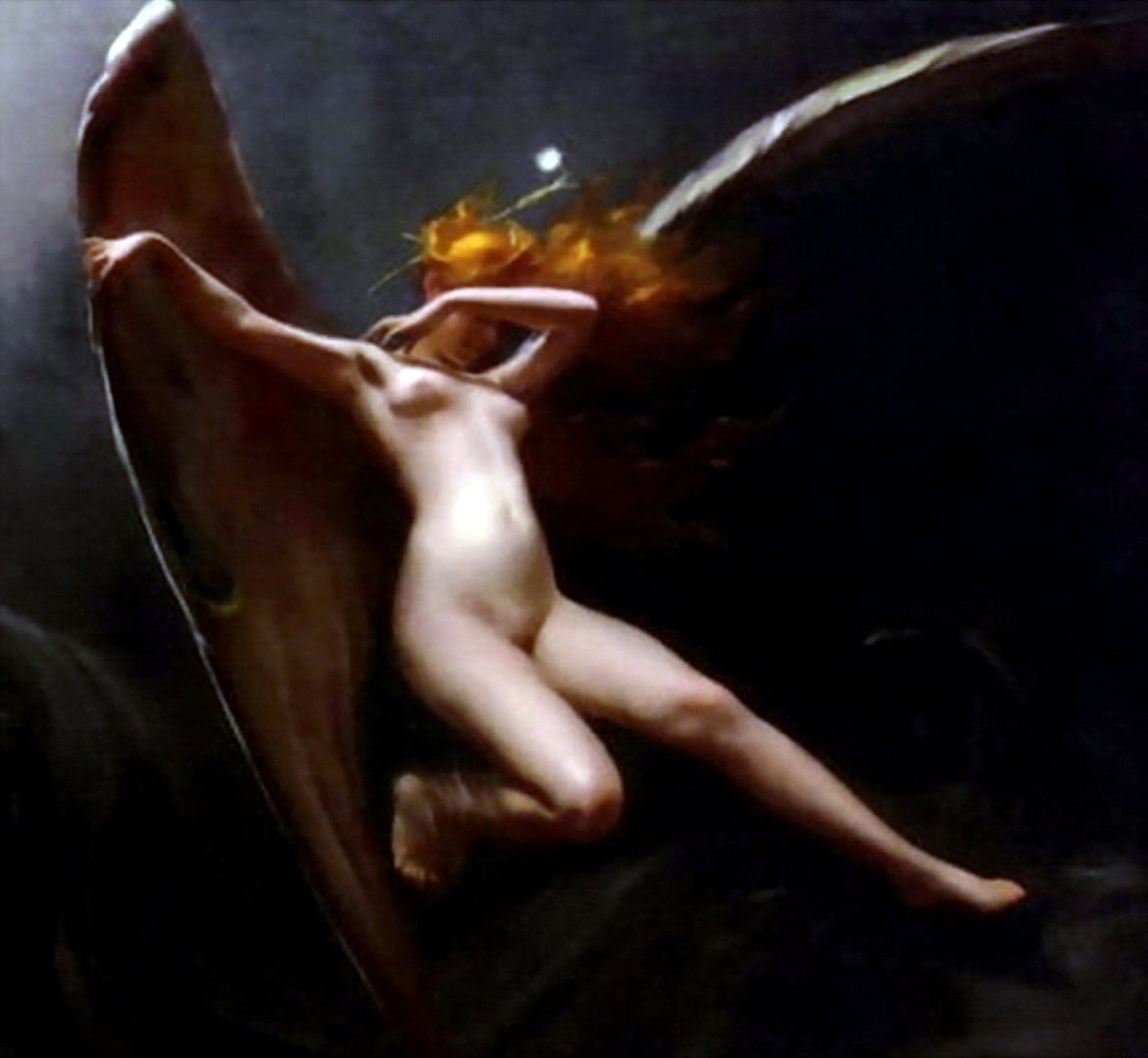
A Fairy Under Starry Skies. Luis Ricardo Falero. A hot sexy fairy flying through the air showing off her naked body. Another horny female that loves lots of sexual activity. Maybe she is in the hunt for some action for her pussy right now? I did say hunt! With that fiery red hair and those nice little titties you never know what she might get up too! Fun and games for all. You certainly can't miss her long elegant legs of hers. Watch out ladies and gentlemen!
|

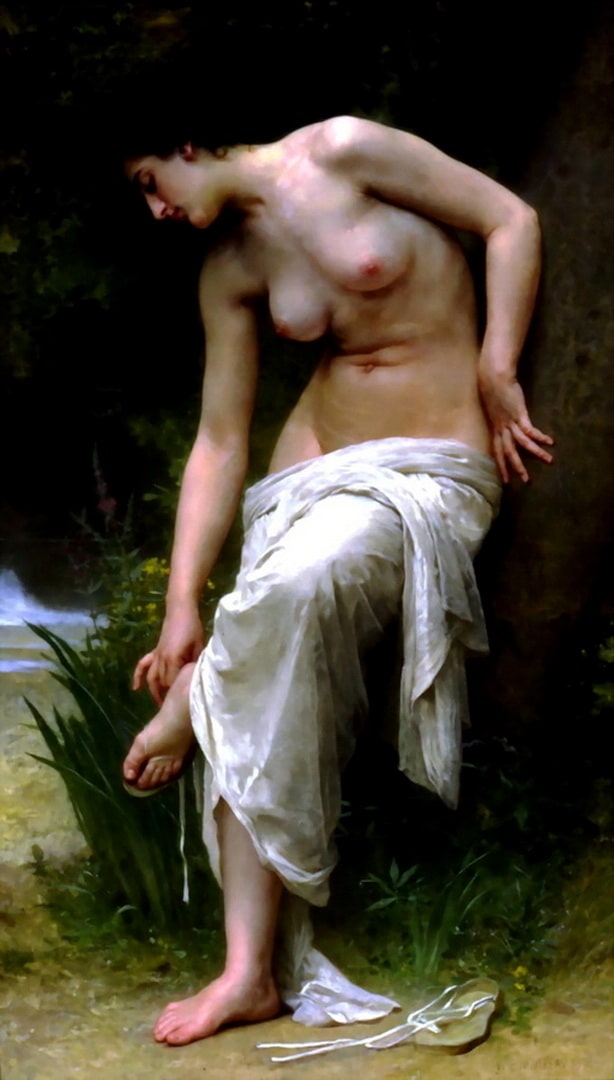
After the Bath. A sensuous painting by WilliamAdolphe Bouguereau. The pretty lady has very nice bosoms. Looking at nude art can help make a girl hornier and lose her hang-ups! You can become a better lover simply by enjoying nude art. Who would have thought it? This erotic painting with a hot sexy girl with big breasts and two outstanding nipples is just the place to start. Feast your eyes on her large bosoms for a start. She also has beautiful eyes and luscious lips. Just the sort to make passionate love with! They could eat you all up! This pretty lady also has lovely long arms and cute feet.
|

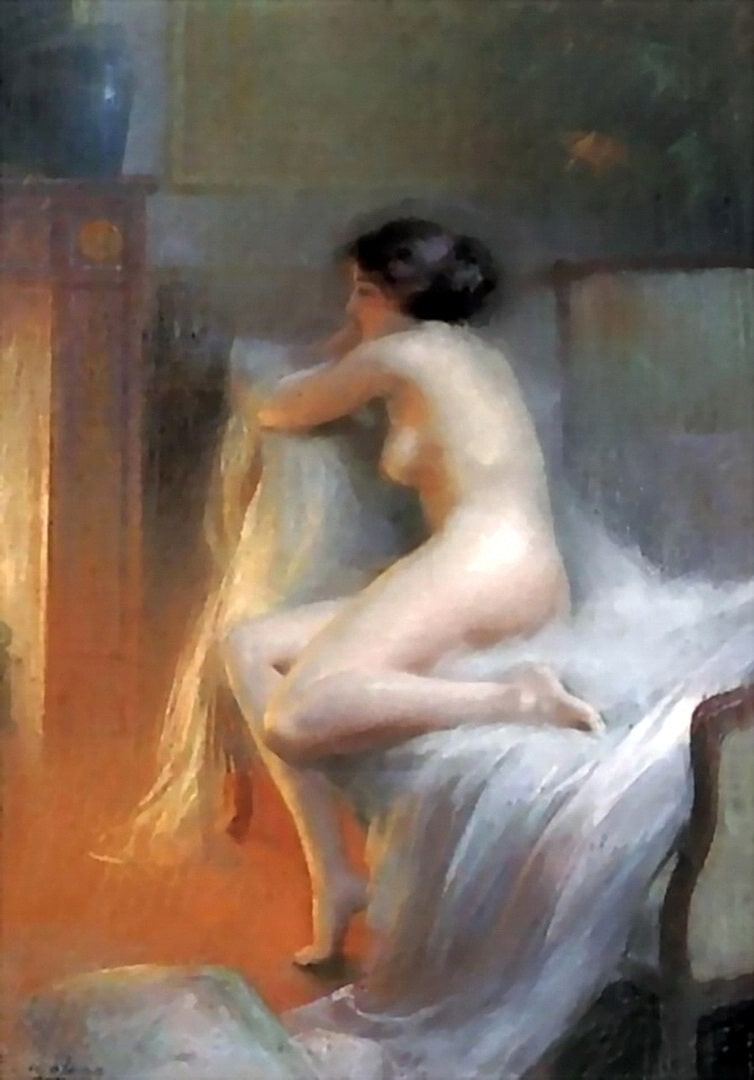
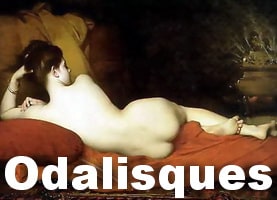
A Nude Reclining by the Fire. Delphin Enjolras. She has a very nice bottom and a big beautiful breast with an erect nipple. Her black hair is done up in a bun at the back as the naked lady enjoys the warmth of the open fire on her body. She is sitting on a couch with a white garment draped over it. |
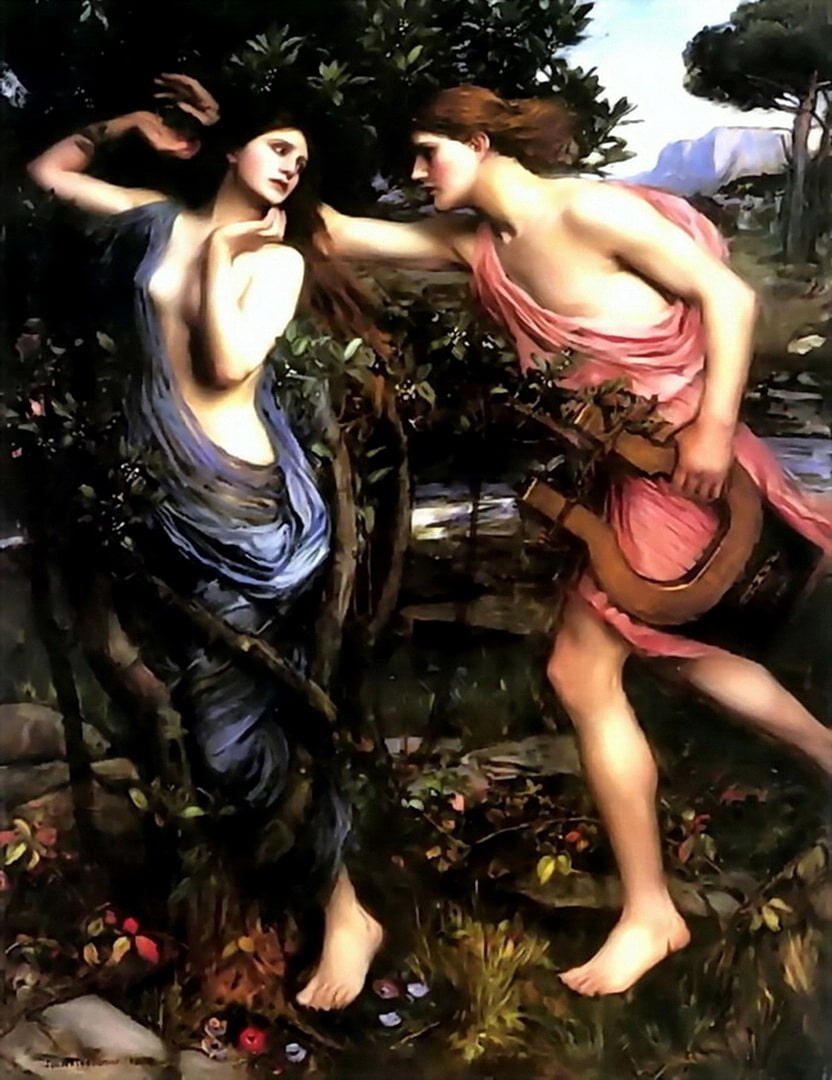
Apollo and Daphne. A painting by John William Waterhouse. They are out by the stream with pretty flowers on the ground. Daphne is playing hard to get. She is semi nude and she is wearing a sexy sheer dress (what a tease). Apollo is having the time of his life with her fun & games. Although, it must be hard running with bare feet. Daphne is almost naked with the way her dress is draped over her shoulder exposing her erotic bosoms to Apollo. She is such a tease! |
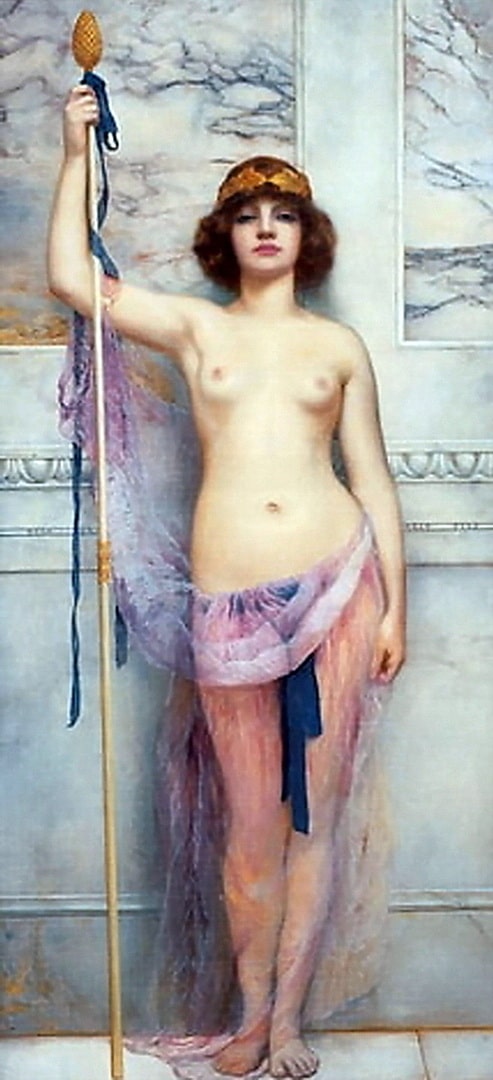
A Priestess. A painting by John William Godward. She is showing off her breasts in a sexy see-through dress for all to see. With her lovely breasts and nipples on show. She must be quite distracting for those who have come to see her. You can even see her pussy through the sheer dress. Anyway, if they step out of line they are sure to get the point. This beautiful lady has pretty eyes and lovely lips as well. |
![]() |
Pierre Auguste Renoir THE entire past progress of painting is condensed and expressed in each of its great men. The creation of new art cannot be accomplished overnight, any more than that of a new organism; it must stem from first impulses and be formed on the differentiations of the past. Those men who declare themselves primitives10 and seek to acquire the eyes and minds of the Phoenicians or Aztecs are as conscious of their inability to create new art forms as are those visionaries who live in a mythical future and try to prophesy the forms that are to come. No man is born too soon or too late. There are those who strive toward classic intellectual ideals, toward Utopian economic states, toward new orders of society: but such reformers are only the malcontents. The truly great and practical men quickly assimilate the impulses of their own epochs and push the frontiers of the mind’s possibilities further into the unknown. These latter comprise the maligned vanguard of heroic thinkers who fight the battles for their weaker followers. Often, however, these followers rise to great heights, for in the world of endeavour two conspicuous types exist the man who experiments and the man who achieves. Delacroix, Manet and the Impressionists belong to the first; Courbet and Renoir are of the second.108 In Renoir’s life story, as in that of Titian, Rubens and Rembrandt, we see in miniature the evolution of all the painting that preceded him the bitter struggles with the chimeras of convention, and each slow change that came over drawing, style, colour and composition. In the end, after a life full of near defeats, strife, yearning and anxiety, we behold the great man emerge triumphantly from his broken fetters and take his place beside the masters of the past. Some painters have more arduous fights than others, for the odds against them are 11greater. Rubens and Delacroix seemed the pampered favourites of a high destiny: Courbet and Renoir had to cleave and chisel each step of the way through the adamant of public suspicion. The world appears incapable of recognising either an intensification or a modification of an old and accepted formula. Hence Courtois and Puget were preferred to Delacroix; Ribera and Rembrandt to Courbet; the Avignon painters to Manet; Corot, Diaz and Rousseau to the Impressionists; and Rubens and Ingres to Renoir. In all of these parallelisms, the latter had their roots in the former. They were complications and variations of their forerunners dissimilar only in method and manner. Renoir began to paint at an early age. The poverty of his family necessitated him to make his own living, and at the age of thirteen he was in a factory painting porcelains. Five years later he applied for work at a place given over to the decoration of transparent screens. Here his unusual facility permitted him to paint ten times as fast as his fellow decorators, and since he was paid by the piece, he soon saved enough money to give himself an education in the art which had now become with him a conscious instinct painting. From his earliest youth he had evinced a discontent with the slow-moving minds about him, and it was natural that he should first look upon art through the eyes of his great revolutionary contemporary, Courbet. His earliest work, of which 12 Le Cabaret de la Mère Anthony and Diane Chasseresse are the best-known examples, reflected Courbet in both palette and conception. Even later, when Manet claimed him, he clung to his first influence. For while his work now reached out toward the substance of light to be found in La Musique aux Tuileries, it revealed at the same time all the form of the Ornans master. Le Ménage Sisley and Lise strikingly combine these two early influences. Since humanity has emerged from the darkness of unconsciousness and the individual from the darkness of the womb, it is consistent with nature that in a man’s creative development the route of which lies between dark and dark the use of black should be his first instinct. Renoir, like all painters of great promise, started with this negation of colour. But wherein his intellectual distinction manifested itself was his innate proclivity for the rhythm of surface lines which he alone of all his contemporaries recognised in Courbet. In Lise, painted in 1867, a year after his Diane Chasseresse, both of these early penchants are evident. Black is the keynote of his sunlight; and while in conception the canvas is akin to Manet, it is a Manet made dexterous and masterly. It contains a balance 13 and a linear rhythm of which that painter was ignorant. Lise is one of the few Renoirs into which the influence of Velazquez and Goya can be imagined. Even in its pyramidal form, which when used by most painters becomes a static figure, there is a movement at its apex which opens into a shape like a lily. This is brought about by the tilt of the sunshade and the continuation of the line of the sash outward in the tree trunk. By just such obvious and simple signs as these in early works, can we foretell an artist’s later developments. The next year, 1868, Renoir’s work is more net, more able in its balance, more sure in its effect. Le Ménage Sisley is one of his finest early examples of how this rhythmic continuity of line obsesses a mind avid for form, colour, vitality. At first glance we see only an irregular pyramid formed by the outline of the two figures; but after a minute’s study we notice that on the right the line of the skirt curves gracefully inward to the waist-line, sweeps up to the woman’s neck, then begins an outward flexure, and finally disperses itself amid the tree’s slanting branches in the right-hand upper corner. On the left, the outline of the man’s right leg and arm and hair forms another curve which bends back the line of the opposing curve of the woman’s dress, and completes the figure of the pyramid. But 14 the first curve, the force of which is seemingly ended at the woman’s waist, is continued in the outline of the light tonality which begins at the man’s right elbow, curves outward to the frame, then inward, and ends on the upper frame a little to the left of the man’s head. Furthermore, the volume made by the light tonality in the upper left-hand corner serves as a balance to the form of the woman’s tunic. This composition is, in all essentials, the same as in Lise, and embraces that rhythm in two dimensions which Manet did not know, and that balance of tonal form of which Manet was never capable. Manet’s mind was that of the lesser Dutch and Spaniards. Renoir’s was the plastic and flowing mind of the Latin races, never satisfied with angularity and immobility, but needful of the smooth progression of sequence and movement. The recognition of the artistic necessity for linear rhythm led Renoir to search for it in others than Courbet. Among the painters by whom he might profit, Delacroix stood nearest his own time. To him Renoir turned; and it was out of him that Renoir’s greatness was to grow. Delacroix’s organisations appealed to him especially the triangular one which opens at the top. His admiration for this artist’s talent led him to paint in 1872 a canvas called Parisiennes Habillées en Algériennes, an ambitious essay to compete with Les Femmes d’Alger dans Leur Appartement. Intrinsically the picture was a failure, but it taught its creator more than he had heretofore learned concerning colour and drawing. In it are discernible indications of the formal unconventionalities and the chromatic brilliancies15 which later were to be such dominant qualities in Renoir’s work. Although for two years he had used Impressionistic methods, it was through this picture that Delacroix introduced him to the Impressionists’ colour. Manet had already introduced him to Ingres: and these two incidents went far toward laying the foundation for his greatness. On neither the Impressionists nor Ingres did he build a style; but from both he learned something of far more value: freedom from the dictates of style. Here again Delacroix had a hand, for by studying this artist’s uses of Ingres’s simplifications, Renoir was able to make these simplifications plastic. Renoir’s colour up to this time had been restrained by the dictates of his epoch. But with the inspiration and encouragement given him by Les Femmes d’Alger dans Leur Appartement, it burst forth with all the force of long-imprisoned energy, and drove him out of doors. In this picture16 he found excuse to carry colour to any extreme he desired. At once the instincts of the porcelain painter, ever latent in him, came uppermost. Delacroix, in giving him the Impressionists’ freedom of colour, had brought him back to those rich and full little designs he had painted on china between the ages of thirteen and eighteen. In this early training alone lies the explanation of his later matière which has for so long puzzled the critics. Many attribute his colour effects to Watteau. But Renoir had developed his technique before he knew the older master. Years previous he had been intensely interested in the very material of his models. In Le Ménage Sisley, La Baigneuse au Griffon and La Femme à la Perruche is evinced the love of the connoisseur for rare and rich stuffs. Furthermore he had begun to turn his eyes toward Impressionist methods two years before he painted Les Parisiennes Habillées en Algériennes. Up to that time his brushing had been broad like Manet’s or Courbet’s; immediately afterward it tended toward spotting, and Monet took the upper hand. Watteau’s manner of application served only to substantiate Renoir in his choice of method. The years from 1865 to 1876 constitute a period of Renoir’s life rich in its promise of splendid things. His keen admirations and high enthusiasms made of him throughout this time a disciple. But his achievements, small as they were, were more sumptuous and effectual than either Manet’s or Monet’s. Their true significance, though, lay in their assurance of what was to come after he had completed that unlearning process17 through which all great men must pass. Only by sitting at a master’s feet can one acquire the knowledge that informs one which influences should be utilised and which cast aside. One cannot learn from experience the total lessons of many men, each one of whom has given a lifetime to the study of a different side of a subject. If these men are to be surpassed their life work must be used as a starting point. Renoir began thus. He had fallen under the sway of Courbet, Manet, Delacroix and Monet; but after eleven years he had exhausted his creative interest in both their theories and their attainments. These men had expressed all that was in them. For Renoir to cling to them was to stand still. If he was to go down in history as a constructive genius and not merely as an able imitator, it was time for him to strike out alone. He did not hesitate. The portrait of Mlle. Durand-Ruel, done in 1876, marks his transformation. In it he achieved the scintillation of light which is not linked with colour or painting, but which seems to arise, by some mysterious alchemy, from the surface of the canvas. In114 this picture, and also in the Moulin de la Galette, finished in the same year, he consummated the fondest ambition of the Impressionists, namely: to make the spectator feel a picture, not as a depiction of nature’s light, but as a medium from which emanates the very18 force of light itself. But Renoir did not stop here: to this achievement he added form and rhythm two attributes which the Impressionists, preoccupied with objectivity, were too busy to attempt. And in addition he displayed a technique so perfect in its adaptability to any expression, that its mannerisms were completely submerged in the picture’s total effect. These were the qualities which Renoir was to develop to so superlative a degree. He had begun to express form in 1870 in his Portrait de Dame. Two years later in his Delacroix adaptation he had branched out into colour. And in his very first canvases there was rhythmic balance of lines. In 1876 all these tendencies coalesced. In consequence Renoir blossomed forth free from aggressive influences, knowing his own limitations and possibilities. This cannot be said even of those excellent works, La Loge, La Danseuse and La Fillette Attentive, done the two preceding years. It is only by contemplating such pictures as the portrait of Mlle. Durand-Ruel, La Chevelure and La Source that we can perceive the path along which his development was to take place. For these canvases, though far more significant than the works of Pissarro and Monet, are almost negligible beside his later work. He was a man never satisfied with results, no matter how exalted. His every new achievement was only a higher elevation from which his horizon ever receded.
One of Renoir’s important advances in method is his liberation from the circumscribed use of black. Although in some of his work of 1876 there are still traces of that tone used organically, they are so slight that they may be disregarded. Black was the very keynote of the paintings of his day. It was looked upon as a necessity in the creation of volumes. Courbet did little without it, and Manet brightened it only with occasional flashes of colour. Today we know that it is not a technical necessity, that pure colours, in fact, when properly used, can produce the most solid forms. But whereas we have been able to profit by the teachings of Cézanne and the Synchromists, Renoir had19 to learn this fact by bitter experiments in a new element. In La Balançoire, done in the same year as the Moulin de la Galette and now hanging with that picture in the Luxembourg, black is entirely absent. This little canvas was probably an experiment actuated by Monet, for never afterward did he on principle lay black aside. While he realised its unimportance as a fundamental for constructing volume, he nevertheless felt its need as a complement to colour the need of the static and the dead to accentuate the plastic and alive. It is during this period that critics are prone to see Gainsborough in Renoir. But their reasons for such a comparison are superficial, and go no further than the fact that both painters dealt with feminine themes in a similarly intimate manner. No genuinely artistic likeness can be found between Mrs. Siddons, for instance, and the Ingénue. The one is merely a spirited portrait without composition or tactility: the other is an exquisite bit of form and colour, which we feel would be as solid to the touch as it appears to the eye. If we are to compare Renoir to English painters at all, let us designate Hogarth and Romney, although any such comparative method of criticism is apt to lead at once to misunderstanding. However, even these two men are distinctly inadequate as measures for Renoir. In the graphic arts Englishmen exhibit no feeling for rhythm. Indeed, it may correctly be said they possess no20 graphic arts. Rhythm is a factor which has made itself felt only in their poetry, and here it can hardly be called more than a division of interval, or tempo. Rossetti in his paintings is seemingly more conscious of its power than any other Englishman, and occasionally attempted to produce it by the primitive device of curved lines. But, after all, Rossetti was Italian. On the whole Renoir and the English artists are two fundamentally dissimilar to be estimated relatively. The finest qualities of Renoir’s art grew out of his instinct for fluent movement, for intense undulations, for hot gorgeous colour, for freedom from all traditional prescriptions. The evolution of these instincts was by no means a mechanical one. After he had amalgamated the leading qualities of his art, his interest would often reveal itself more strongly in one direction than another. Thus many of his canvases show a retrogression toward emphasis of light; others toward form; still others toward linear rhythm. Yet no matter which one of these qualities predominated, the others also remained intact. More importance, however, attached to his preoccupation with the treatment of light. His experiments and consequent development in this field are of initial significance in judging his later work. In 1878 he had evidently foreseen the cul-de-sac into which the natural distribution of light would lead. The very volatility and translucency of illumination and its matter-dispelling qualities, constituted the greatest drawback to its use in the creation of form. In other words its sheer beauty nullified the deeper aims of painting. In two decorative Panneaux of reclining nudes, done in the same year, Renoir makes his21 first attempt to escape from the naturalism of light. The use of light is here restricted to a colour force which serves only to bring form into relief. From that time on, although he had many struggles with its power over him, he had conquered its insidious influence. It became his servant, whereas before it had been his master. In his earlier canvases, wherein sunlight had played a leading part, he had placed the sun patches, gleaming and vibrant, wherever they naturally fell. After 1878 he began placing them arbitrarily on points where formal projection was needed. The subtle manner in which he constructed and posed these patches precluded any discovery of his reasons for altering their natural location. But Renoir was not fully satisfied, and soon abandoned this phase of pleinairisme. Later the spots of sunlight appeared on cheeks, shoulders, knees, or any other salients which called for powerful relief, thereby losing their flat and detached appearance. This moulding of them into intense aggregations had much to do with Renoir’s fullness of form. His long experience had given him a complete knowledge of their naturalistic effect. He knew it was impossible to make them remain on the same plane with the surrounding shadow, and he understood the reasons for this phenomenon. It was not therefore remarkable that, in his later method of applying them, he was sure of his results. As soon as he realised that sunlight dispersed matter by obscuring some points and accentuating others, he knew that by an intelligent employment of this factor of luminosity he could at will accentuate certain parts of his canvas and obscure others. This knowledge led him naturally to create his own light, irrespective of how it22 actually existed. This was an important step toward its complete abrogation, and brought arbitrary means in painting just so much nearer. He had already distorted volumes for purposes of organisation in the same manner that he now distorted light. Indeed every great painter has taken this liberty with form; but each one has to learn the device anew in its relation to his own separate vision. There are few shadows, as such, in Renoir. We find darks and lights in scintillating succession, but we may search in vain, even in his canvases of 1878 or 1879, for those shadowed outlines which are the result of light. If light there is, it is only the light which springs from our own eyes light which seems to come from the direction of the beholder, like the reflection of a light in water. Move as you will before his pictures, it follows you, for it is the illumination of that part of the picture nearest the eyes of the painter. Where a form is full, there Renoir contrives to have a light fall. This artifice may strike us today as childish, since we have outgrown our concern with light; but let us remember that from the beginning the depiction of lights and shadows had been a fixed practice, and that23 their tones had formed the only basis for chiaroscuro. With the Impressionists light became the atout of painting. Renoir made of it a vital form-creating element. Herein we have its evolution: first, a convention; next, an obsession; last, a utility. So were the aesthetic possibilities of light exhausted, just as the aesthetic possibilities of the human form were exhausted by Michelangelo. In this last step of liberating light from convention, Renoir approached nearer to nature than any antecedent painter. After all, a human being in the sunlight appears to us as a solid moving mass. Only those who look upon nature as a flat pattern of shades and lights are misled by sun patches. So, in Renoir’s adapting the source of light for the purpose of producing solidity of form, we are cognisant of the palpability of his figures whether they are in light or shadow, or both. Thus he created the actual impression of volume we all get before a moving form. This arbitrary disposition of light and shadow also gave fullness and intensity to his form, and accentuated the24 poise, so subtle and unexpected, we feel in even his slightest works. But while this was the secret of his attainment of volume, the compositional use to which he put this volume requires another explanation one120 which has its roots in the very depths of the man’s genius. There had never been such form in the French school as that which Renoir gave it in 1880. The Tête de Jeune Fille and Les Enfants en Rose et Bleu, done about this time, must have been the despair of even the sculptors of his day. And these were but the beginning. Many phases of his art were yet to be emphasised and developed before the Renoir we know today was to be perfected. It was in 1884 that he began to “apprendre le dessin.” For four years he continued this self-training in the precision of draughtsmanship. As a boy he had begun his painting in a manner more competent than the most advanced style of the average artist, as is evidenced by the able use of colour as design in his early porcelains. And although he was driven to this work by necessity, the incident was a salutary one. It turned his thoughts toward those abstract organisations of colour which always afterward haunted him. Later he learned all the tricks25 of the day in the school of the realists, and succeeded in surpassing his masters. Next he studied the Impressionists and went beyond them also. Then he co-ordinated his knowledge and established his individual greatness. This period of his development gave France much of its finest painting, and his Baigneuse done at this time is an undoubted masterpiece. His reversion to the rudiments of drawing was the result of a burning desire to develop rhythm and form. His technical difficulties had been conquered at an early date: he needed only dexterity in drawing to achieve his end. Not only did Renoir attain to his objective, but, by comprehending the principle of the placements and displacements of volumes, he learned the advantages of line accentuation in obtaining movement. We now come to those pictures which show Renoir’s intimate relation to Rubens through Boucher and Watteau: to his alfresco bathing figures. Some one has pointed out that his Baigneuses of 1885, one year after he had devoted himself to drawing, was inspired by Girardon’s lead-reliefs in the gardens at Versailles. The commentary is undoubtedly true; but even so, of what significance is it? Aside from the superficial fact that in the works of both appear bathing women in more or less abandoned poses, Renoir had nothing in common 26with the school of Largillière, Pater, Fragonard, Le Moyne, Santerre and Girardon. In all such observations one senses the restriction of the critic’s viewpoint to illustration. An artist may find inspiration in any visual form, but this form is of no more aesthetic importance to him than a photograph. In Picasso’s paintings of violin fragments we are scarcely permitted to deduce an inspiration from Stradivarius. Grotesque as this analogy may seem, it is applicable to the contention that Renoir stemmed from Girardon. For there is nothing whatever in Renoir’s bathing girls to suggest a psychological parallel between them and the leaden frieze at Versailles. If Renoir saw in that frieze an attractive pose, it was with an eye to its adaptability to composition. In Girardon there is only a pretty and sensual chaos. In Renoir we have a masterly organisation wherein the actual positions of the young women are not even remarked. Compare, for instance, Girardon’s version of the figure of the girl throwing water on her playmates, with the corresponding figure in Renoir’s drawing. The body of the former is without doubt a more faithful replica of its model; in Renoir it has become impossibly elongated and voluminous. Its head is too small; its back too long; its hips are too large and yet withal it is an exquisite bit of rich form which has as concrete a tangibility as that of a real body. One cannot judge it by its contour; one must bury oneself in its very weight. Had Renoir advanced no further than his masterly Baigneuse of 1884, he would nevertheless have gone down in history as a great artist. But compared with the same subject done in 1888, it appears stiff. We feel in it the rigidity of a master whose great qualities are without a directing intelligence. In the later canvas, Renoir is less preoccupied with details. As a result there is a greater plenitude of bulging form, a purer rhythm. And there is also an added movement caused by the linear harmony of the background, by the hair over the shoulder, and above all by the turning of the head so that its weight is shifted over a hollow. An apparently simple thing this turning 27of a head. Yet Michelangelo’s genius, as well as that of all great artists, is dependent on the knowledge of when a head should be turned or a limb advanced. This knowledge is what transforms action into movement, tempo into rhythm, the static into the plastic, the dead into the living. It is the final penetration into composition; on it all aesthetic form is built. Renoir acquired it in his123 period of so-called dry drawing. Its dawn came in La Natte and Mère et Enfant. It was still developing in the Baigneuse; and in La Baigneuse Brune and Nu à l’Étoffe Vert et Jaune, both done after 1900, this knowledge was becoming sure of itself. Between 1884 and 1892, however, Renoir’s new strength was not wholly mastered. There was conscious effort in its employment. This is seen in La Fillette à la Gerbe and Les Filles de Catulle Mendès and in that otherwise miraculous canvas, Au Piano. In Le Croquet, 1892, he begins to exhibit, in his use of new means, the same prodigious adroitness he displayed in his earlier and slighter works. And in Les Deux Sœurs the effects of labour entirely vanish, and he once more paints with magistral unconcern. From that time forward Renoir’s complete genius was but a matter of evolution. And here let it be remembered that his transcendent competency was the result of academic training, for of late we have heard many objections to this kind of discipline. We have been invited to behold the water-colour and crayon works of the untutored, assured that they were as fine as Matisse’s drawings. And we have been asked to accept, as a corollary, the statement that all painters are better off without the pernicious influence of schools. We have had modern paintings pointed out to us as examples of what inspiration and freedom from convention can do. We have 124heard the constantly reiterated assertion that academies cramp genius, restrict vision and force all expression into stipulated moulds. To concede to these extravagant assertions would be to ignore the history of great painting, for during all the significant epochs of art the school was at its zenith. Without it there could be no genuine achievement. No amount of mere inspiration has ever enabled an artist to paint an eminent canvas. No amount of uncontrolled emotionalism has ever permitted one to make an aesthetically moving work of art. No untrained man, no matter how high his natural gifts, has yet been able to record adequately his feelings. All the records of past accomplishment go to show that no person who has not been profoundly educated in the purely objective (not utilitarian) forms, and in the abstract qualities of painting, such as anatomy and technique, has succeeded in conceiving an artistic organisation. The school has never obscured or dwarfed genius, nor is it probable it ever will. To the contrary it assists the truly great man in his self-fulfilment and weeds out the mediocre man. It turns the student’s thoughts to methods rather than to inspiration. It directs the attention of incompetent and merely talented persons, incapable of rising above its teachings, into side issues. Thus it relegates their work to the soupentes of the world: whereas, if they had been permitted to labour at random, they would only have choked the market of genuinely aesthetic production. The school teaches discipline, precision, and the control of wayward impulses, without all of which the greatest artist could only incompletely express himself. These are the things which Renoir felt he lacked; and in the midst of his career he halted long enough to acquire them. It may be argued that his was intelligent training, while that of the schools is unintelligent. But all discipline is beneficial to the artist. Only slavish minds, hopeless from the first, succumb to it. The fact that a man capitulates to academic training attests to an incompetency so great that, under no circumstances, however favorable, could it have arisen to a point capable of producing great art. Giotto, El Greco and Rubens passed through rigid training and rose above it. And the apprenticeship demanded of the old Egyptian, Chinese and Greek artists was longer and more tedious than any of our school courses today. Renoir’s scholastic training was his salvation. With the advent of the twentieth century he struck his pace. All his qualities converged toward the construction of rhythm. In 1900 he painted a large and ambitious canvas of an attired maid combing a nude’s hair, La Toilette de la Baigneuse, which is more extended and conclusive than any of his previous works. The forms lean in opposition and complete each other. In them is a 28perfect poise which subjectively evokes an emotion of movement. Even the lights and darks are separated so as to give the strongest effect. The very hat and tree trunk are integral parts of the whole, and there is not a line in the picture which does not develop logically to a harmonic completion. The luscious plenitude of form is equalled only by the finality of the rhythm. Another picture of the same period is the Baigneuses in the Vollard collection, a duplicate of his Baigneuses of fifteen years before. Now all the hardness is gone from the contours. The differentiation of texture between the flesh and water and foliage is absent. The lines are less angular and true, and both the distant nudes’ attitudes are changed. The first canvas recalled Ingres; but the second brings up Cézanne, for it is pure composition with every nugatory quality eliminated. It demonstrates the possibility of creating abstract unity 29in three dimensions with the objective reality at hand. The picture contains movement in the vital sense, and possesses a tactility as great as a Giorgione done with modern means. In fact, comparison of these two Baigneuses will straightway divulge the advantages that lie in modern methods. The first is extremely able, and has the unfinished foundation of a great composition. The second, because of what Renoir had learned of freedom, is as intense as a Rubens in that painter’s own manner; and in addition it has an emotional element to which the Antwerp master never attained. Two years later this obsession to create form as an impregnable block, no matter in how many integers it might be divided, made him turn his attention to Daumier; and in Le Jardin d’Essoyes and his heads of Coco he surpasses even this master of organisation. Having assimilated this new influence Renoir added it to his own store of knowledge, and four years later painted his greatest picture, Le Petit Peintre. After this there was little more to be done in Renoir’s style unless he extended his vision to greater surfaces. This he has not done. 127But he has added other masterpieces to the ones already mentioned. His Ode aux Fleurs (d’après Anacréon), the two decorative Panneaux of the tambourine player and the dancer, Coco et les Deux Servantes, La Rose dans les Cheveux and La Femme au Miroir are all worthy of a place beside the greatest pictures of all time. In these last paintings nature’s form is transcribed in a purely arbitrary manner. Many of the parts are exaggerated to create greater projection or more perfect proportion in relation to the whole. Texture has developed into a unified surface, and simple linear balance has become poise in depth. The colouring has grown so subtle that it is impossible in many places to tell just what it is, for in it is a whole spectrum that makes it living.
Renoir was a man who fundamentally was not revolutionary, an artist who was shown the way by others, a genius who culminated a great and febrile epoch. His beginnings were imitative of the painters of his day. He climbed the ladder from dark to light, from the stiff to the mobile. His first works under Courbet and Manet were no better than those of Hankwan. Later his pictures began to flow rhythmically in simple lines as in the Head of a Chinese Lady by Ririomin. Then they began to extend into depth, and as early as 1881 they surpassed Titian. From then on they approached steadily to the completeness of a modernised Rubens. That Renoir never reached that master’s greatness is due, not to his lack of acute and complete vision, but to his restriction of it to small works. A composer 28who writes a symphony in which each minute part is an intimate factor of the whole, is greater than he who writes only an overture whose entirety is no greater than one of the symphony’s movements. Renoir, in so far as he went, was as great as the greatest. One cannot think of a Renoir canvas merely as a painting. It is a new and visually complete cosmos. In looking at his work the intelligence enters a world in which every form has interest, every line completion, every space a plasticity: in short, a world in which everything is visibly interrelated. A host of influences have been read into Renoir, and indeed there were many in his development. But they were only the steps by which he mounted to high achievement. So unimportant are the works of most of these other men when compared with Renoir’s personal accomplishments, that one may visualise this artist as a raindrop on a window, which, as it flows downward, 29consumes and embodies all those in its path. Courbet, Monet, Delacroix and Manet, had they no other claim on posterity than as instructors of Renoir, would not have lived in vain. The Chinese, the Greeks, the Renaissance, even that full Indian sculpture in the Chaitya of Karli of the eleventh century B.C. are all within him. That they are temperamental affinities rather than direct influences none can deny; but, strange as it may seem, he has traits which directly recall each one of them. They all have the ineradicable germ of genius in them; and that germ, being changeless and eternal, lies at the root of all aesthetic creation. For this reason a great man belongs to all time. He embraces all the results of the struggles which have gone before. In the possession of Renoir we have no apologies to make to antiquity, any more than in having produced Cézanne must we abase ourselves before the artists who are yet to come.
|
![]() |
©8th June 2024 sexyartforwomen.
Sexy Art for Women and foxy females and also spicy girls & hot ladies. Female Erotica and Feminine Beauty.