Sexy Art for Women.

Odalisques 1. (Harem Girls).


Find Female Erotica Feminine Beauty.

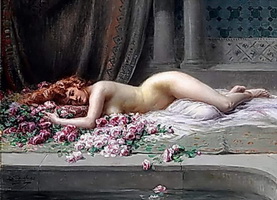
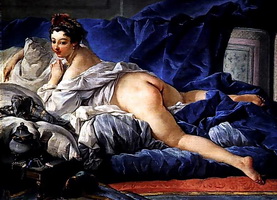
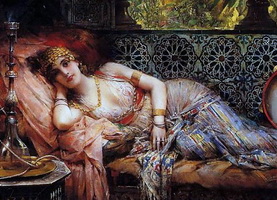
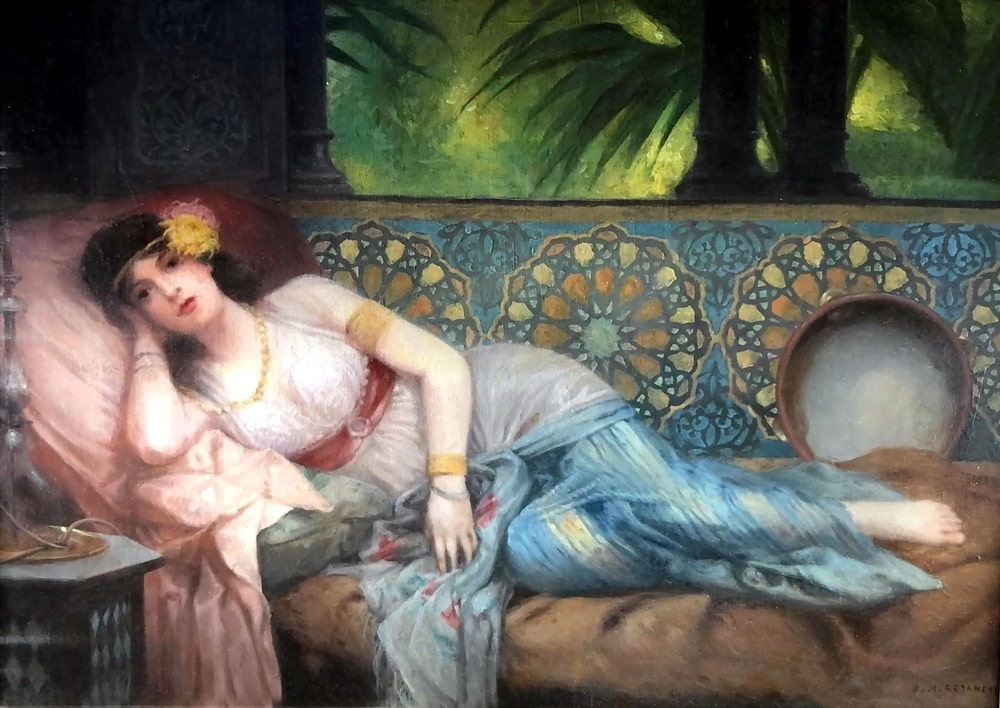
A beautiful woman with a pretty folwer in her hair is streched out on her bed with her tambourine at one end of the bed and her relaxant at the other.

The Odalisque. Francois Maurice Roganeau.

A pretty lady lying on a peach coloured cushion on a bed with a flower in her hair. To the left of the painting is the relaxant she uses while at the other end of the bed is her tambourine.

Famous paintings of Lesbia and Sappho.
Back to the Home Page.
Lite Erotic Art 1 Find pretty paintings of lovely ladies and beautiful naked women.
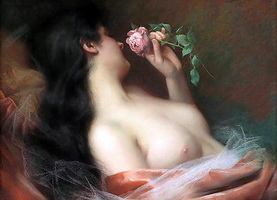
Sensuous paintings of feminine beauty and lovely nude ladies with flowers and roses.
Paintings of very famous lesbians and their lovers.
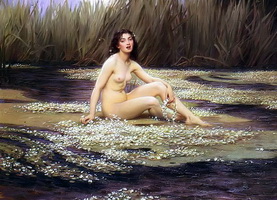
Naughty nymphs lust for sexy. They are always horny. The Sirens are close relatives of them.


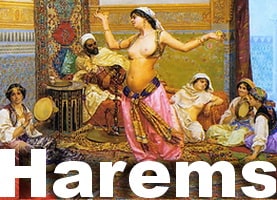
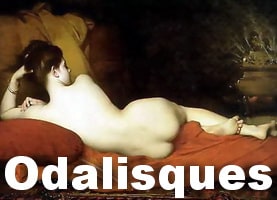
Odalisques were found in Harems. They were the women that worked in the Harems as sex slaves.
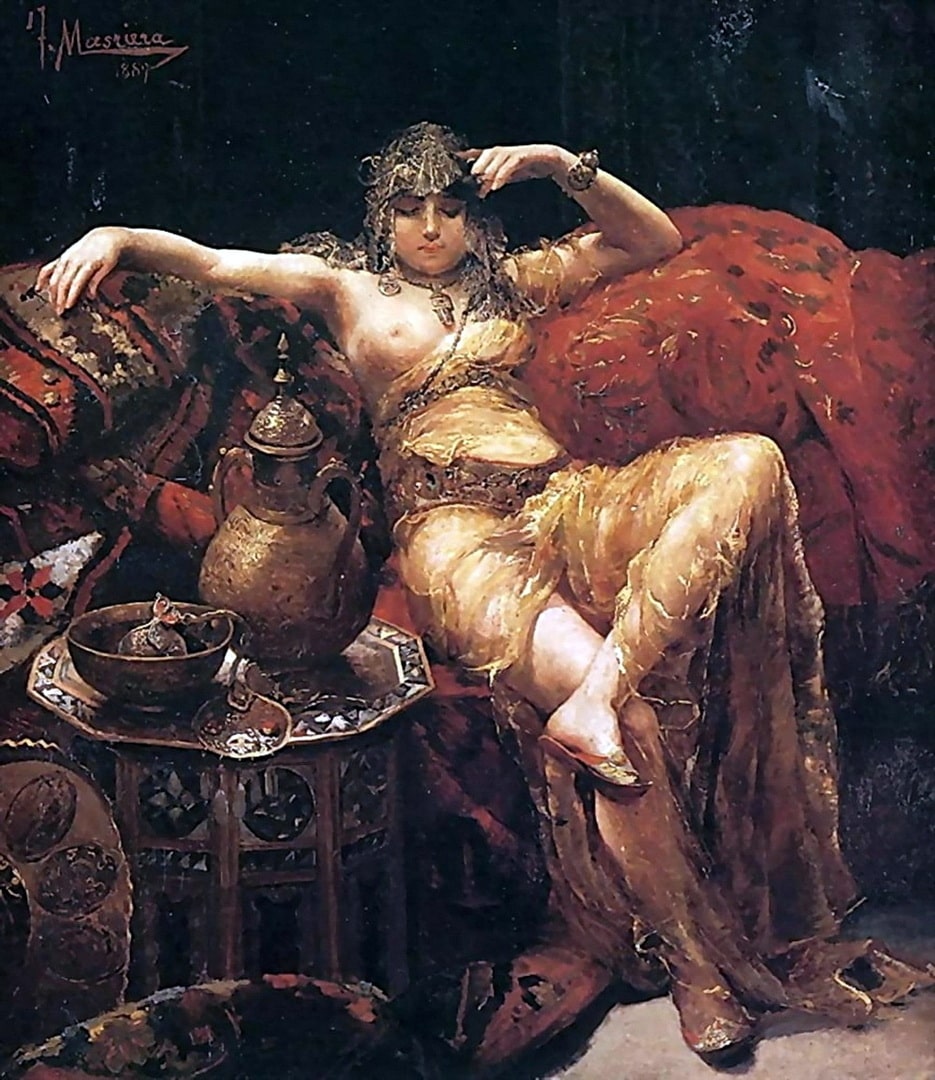
 

A sexy Odalisque with buxom boobs sitting elegantly on a couch with a big jug in front of her.

An Odalisque. Francisco Masriera y Mano.

A beautiful Odalisque displaying a naughty breast as she sits on the couch contemplating. The lovely lady is probably waiting for her call.

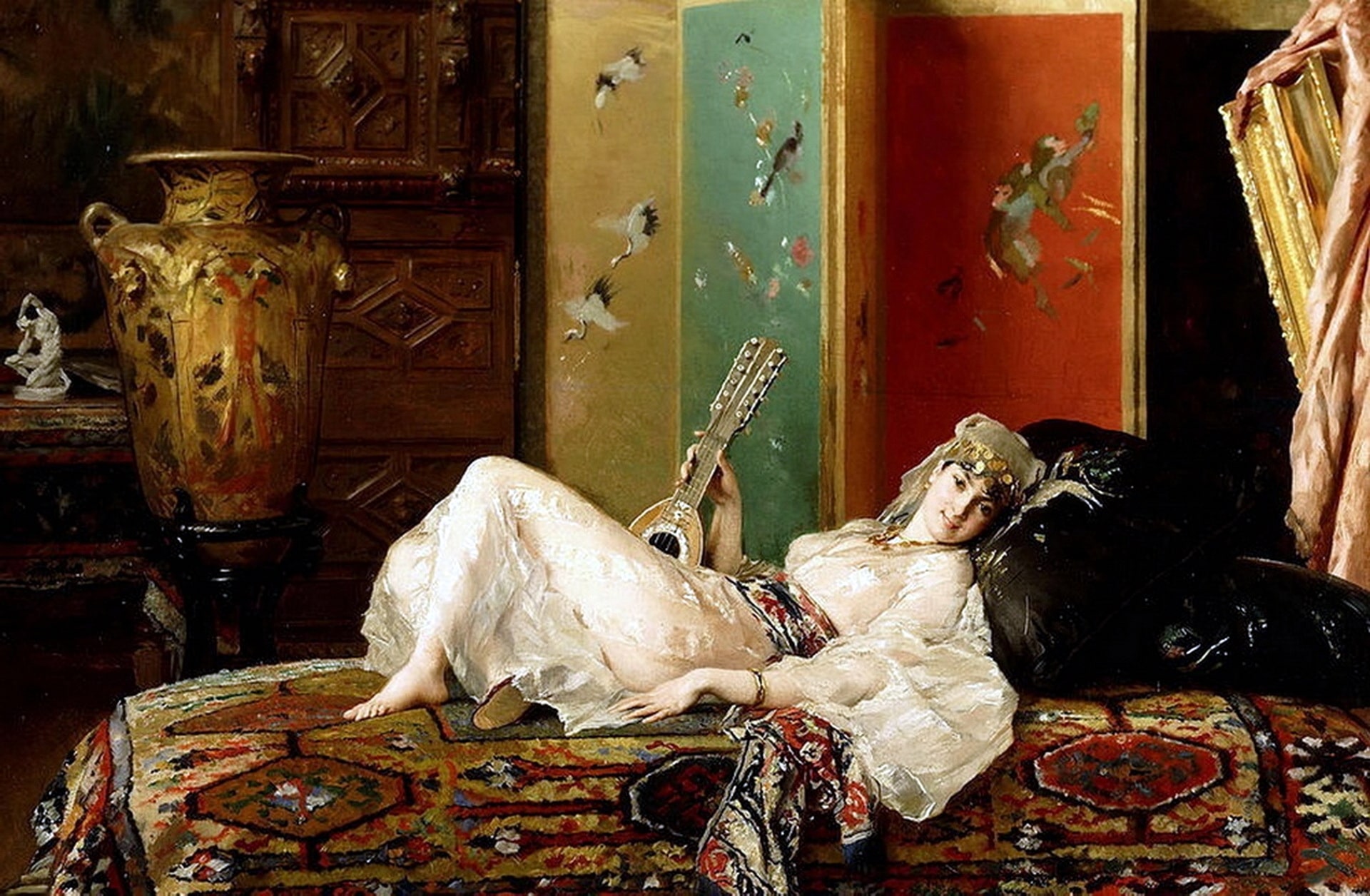
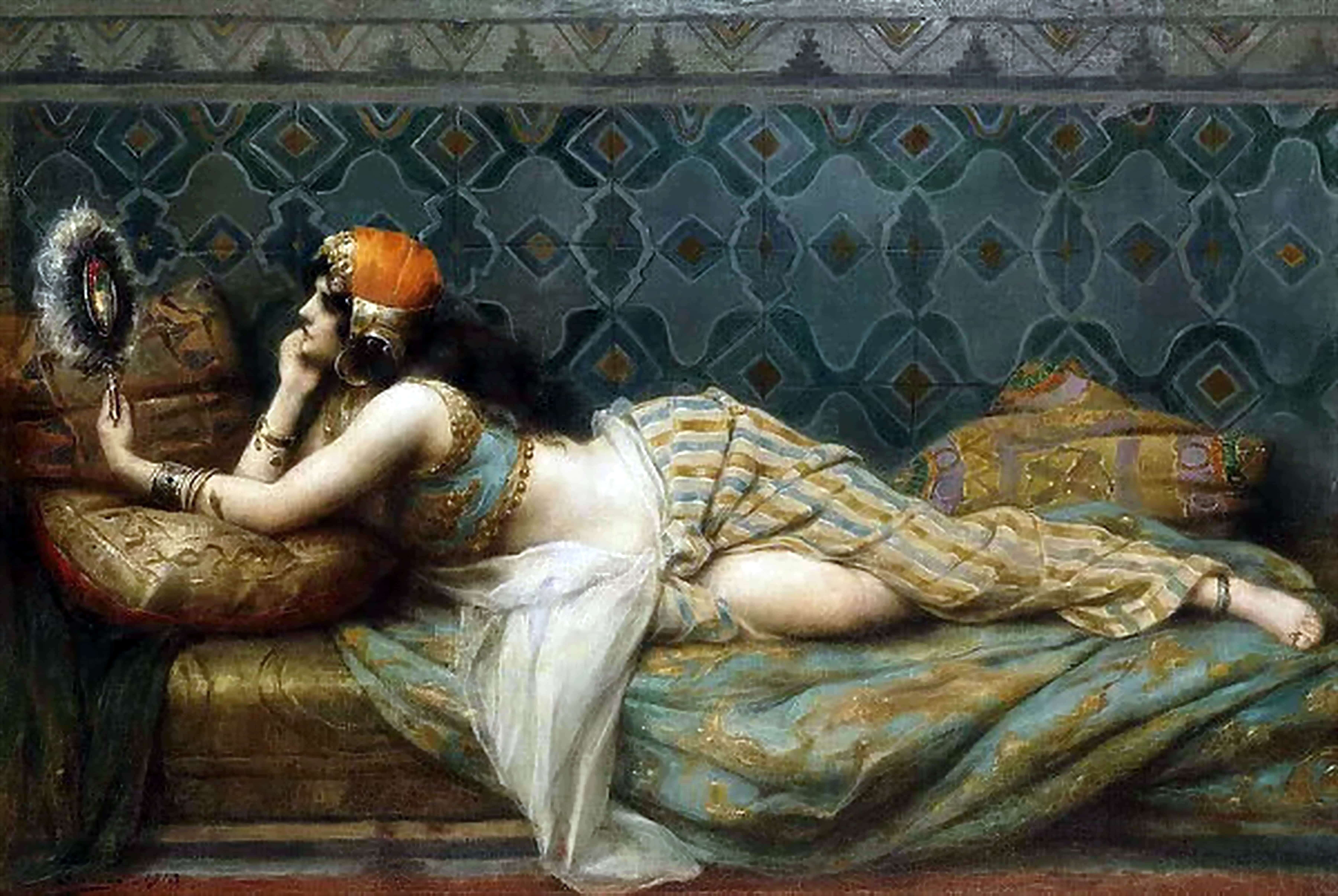
An Odalisque lying streched out on a couch holding a musical instument. She has lovely eyes and kissable lips. Such a pretty face.

A Reclining Odalisque. Gustave Leonard de Jonghe.

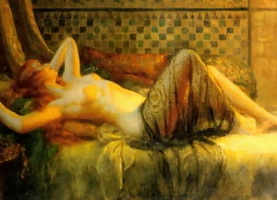
A sexy Odalisque in a sheer outfit. The pretty girl is enjoying her time lying on a small couch. Her cute bottom is not quite covered up.


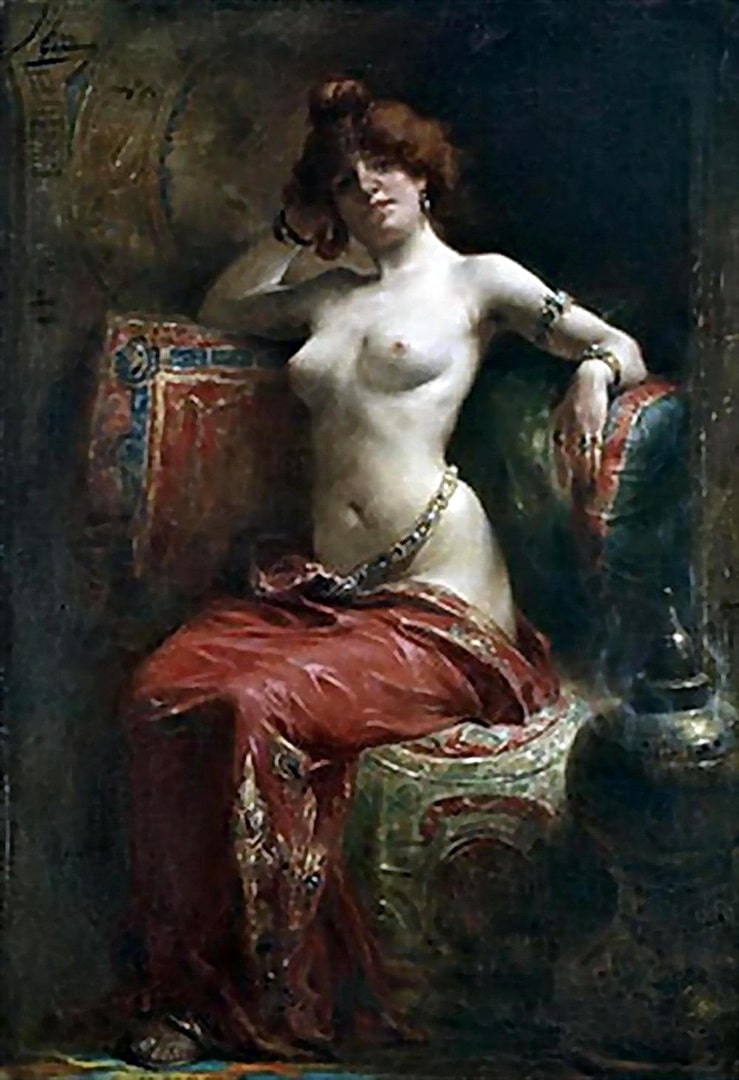
A pretty Odalisque with buxom bosoms. The naked woman also has very naughty nipples. She is sitting on a chair flaunting her raunchy breasts waiting for her call.

l'odalisque. Henri Adrien Tanoux.

The saucy odalisque is sitting on a chair displaying her big boobs as well as her pretty eyes she has luscious lips for sensuous kissing.

A buxom girl with pretty eyes and luscious lips for hot kissies.


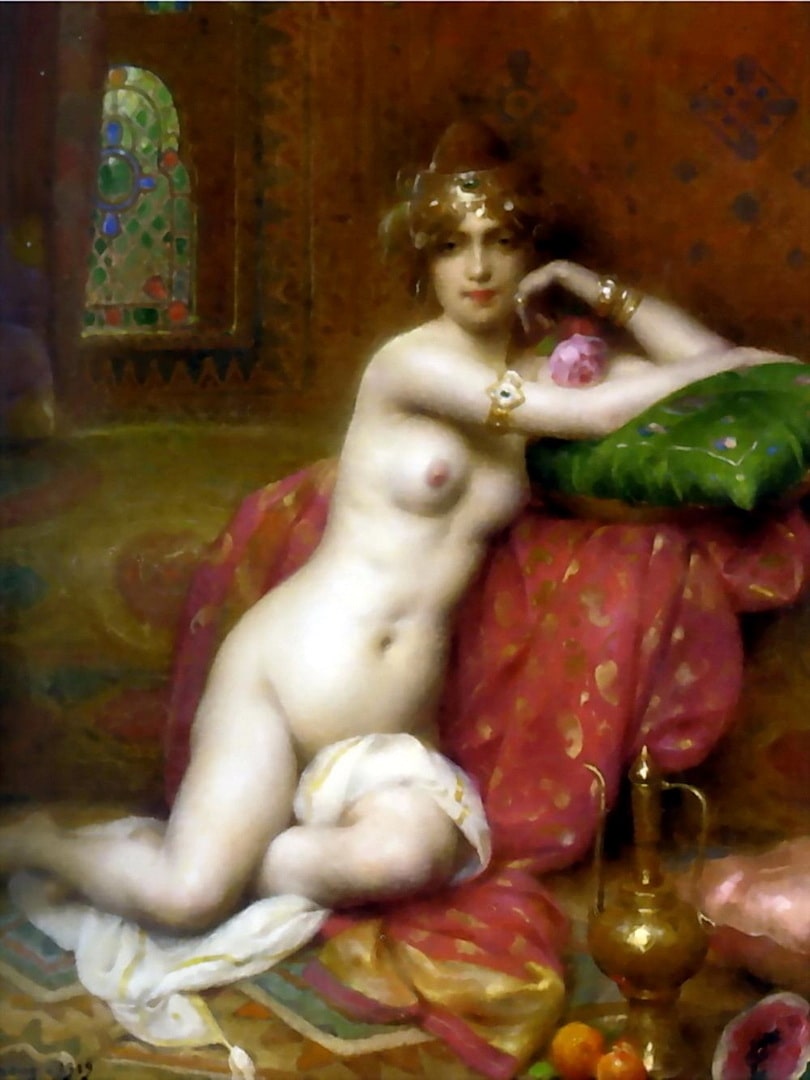
l'odalisque. Henri Adrien Tanoux 2.

A voluptuous young woman with nice eyes and lovely lips. She is holding a pink flower in her arms and has a white cloth over her legs.

A loverly lady sitting in a chair with nice eyes and kissable lips is waiting for her call.

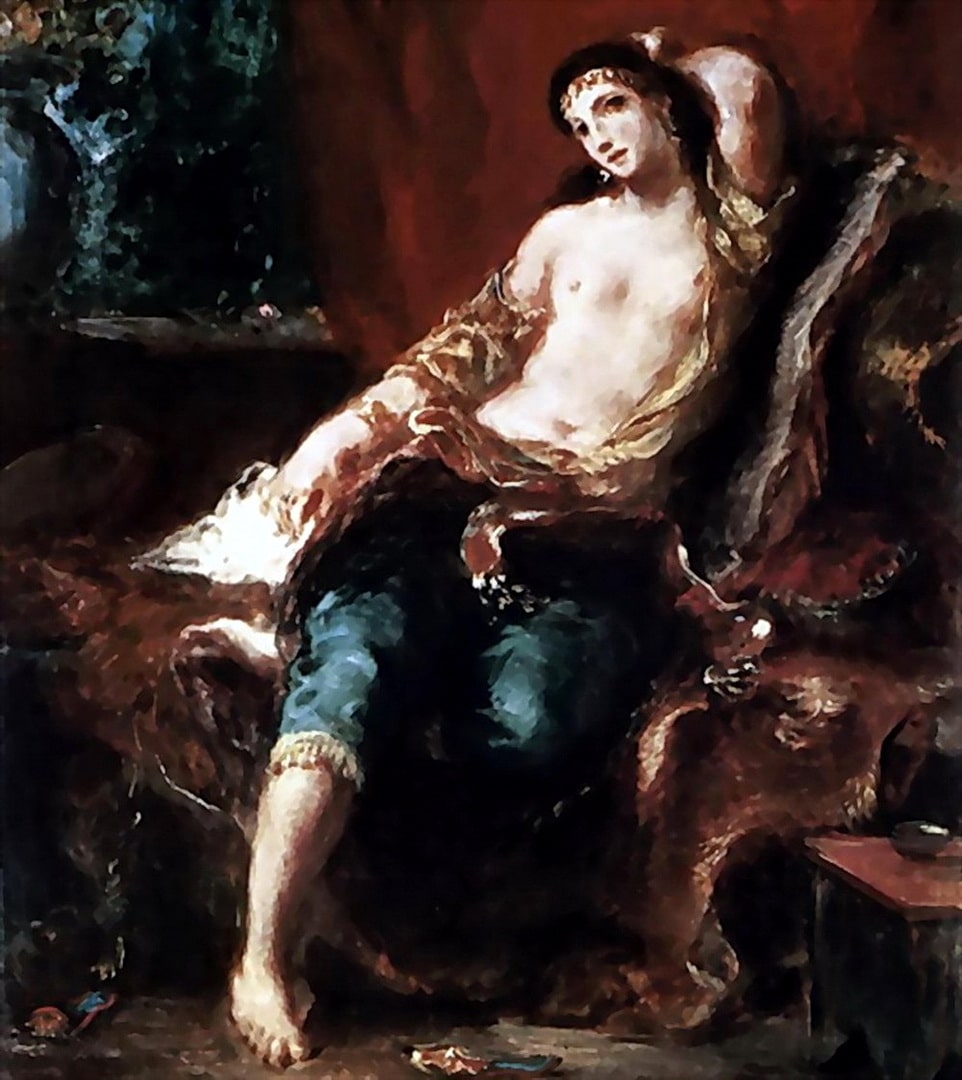
Odalisca. Ferdinand Victor Eugene Delacroix.

A girl with pretty eyes and sexy lips showing off her boobs. She is relaxing on her chair waiting for her call.


Sex toy for horny women

Buy Sex Toys here.


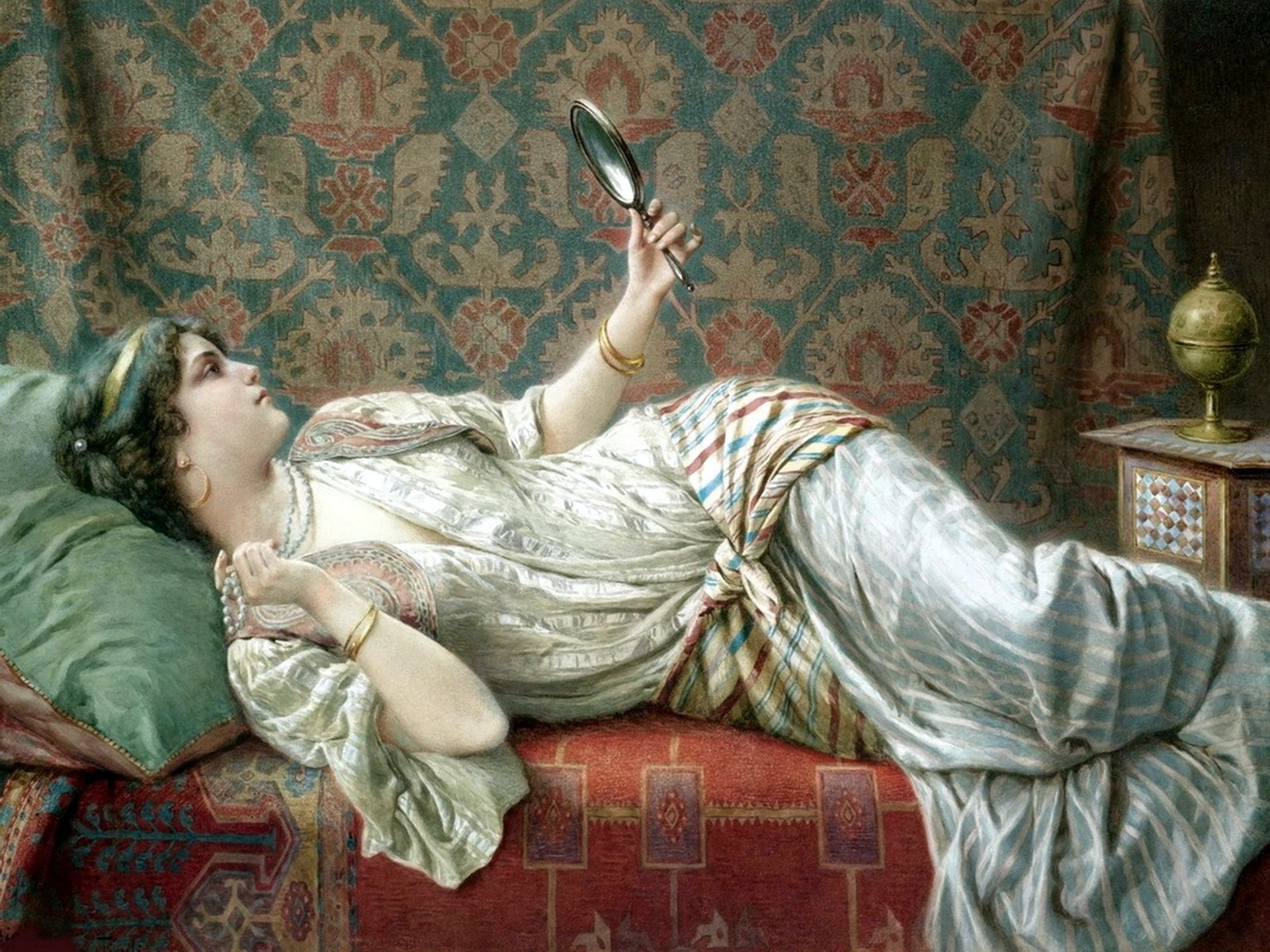
An alluring young lady on a couch with a pretty face and lovely eyes is checking herself out in a mirror.

Odaliscas. Francesco Ballesio.

A beautiful lady checking herself out in a mirror as she lies on a couch. The lovely woman has pretty eyes and is lying on a green pillow.

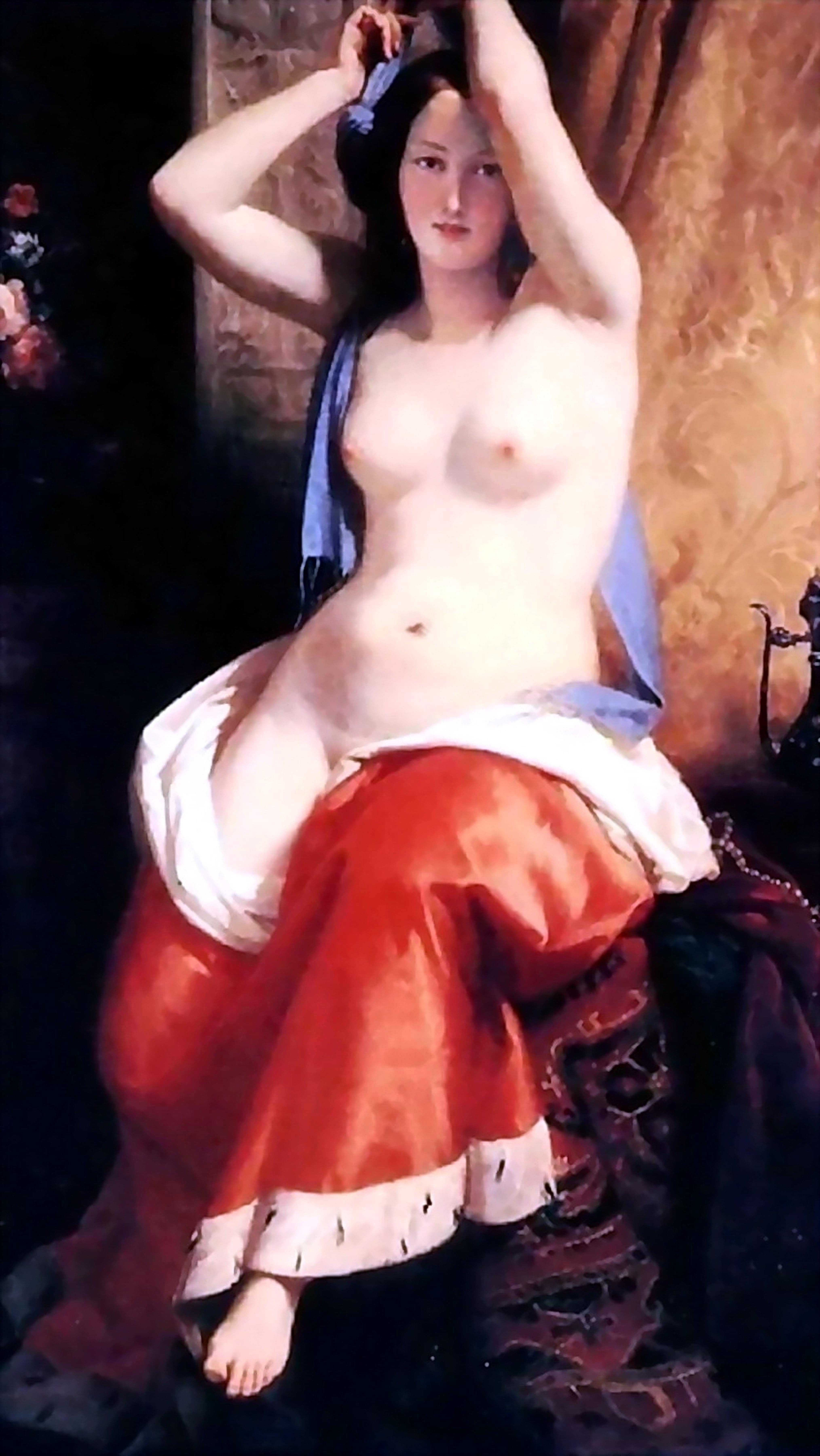
A loverly lady with a red coat over her lap and nice eyes. She has a light blue cloak around her neck.

Odalisque. Henri Decaisne.

A stunning woman with buxom bosoms and a pretty face has a red garment over her lap.

A foxy female with big boobs is taking a relaxant. It must be her turn next with the Sultan.

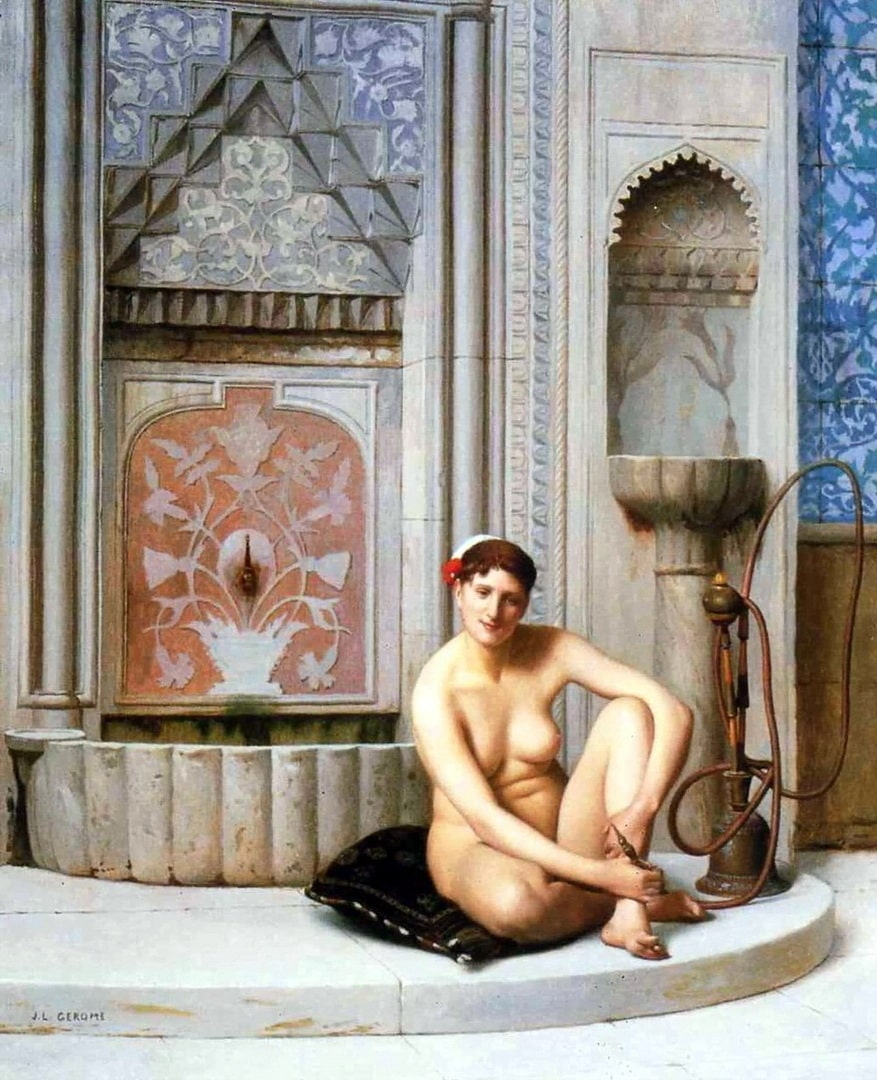
Odalisque. Jean Leon Gerome.

A big breasted lady sitting in a courtyard on a black cushion using a relaxant. She has a red flower in her hair and nice lips.


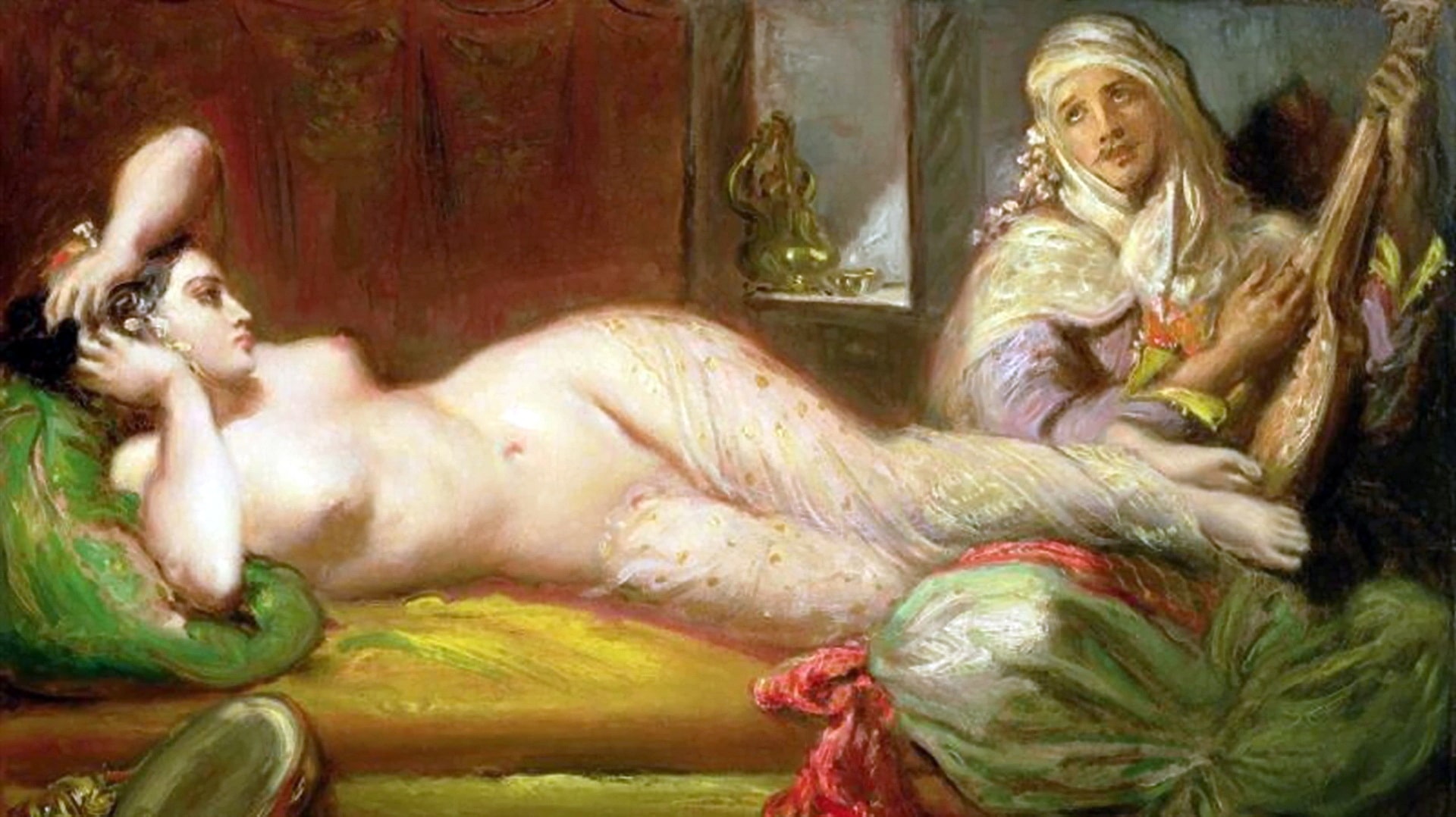
A lady with pretty eyes and volutuous breasts is lyng on a couch with a green cushion listening to music.


Reclining Odalisque. Theodore Chasseriau.

Some relaxing music for the lady who has a very see-though garment over her legs as she is stretched out on a couch.

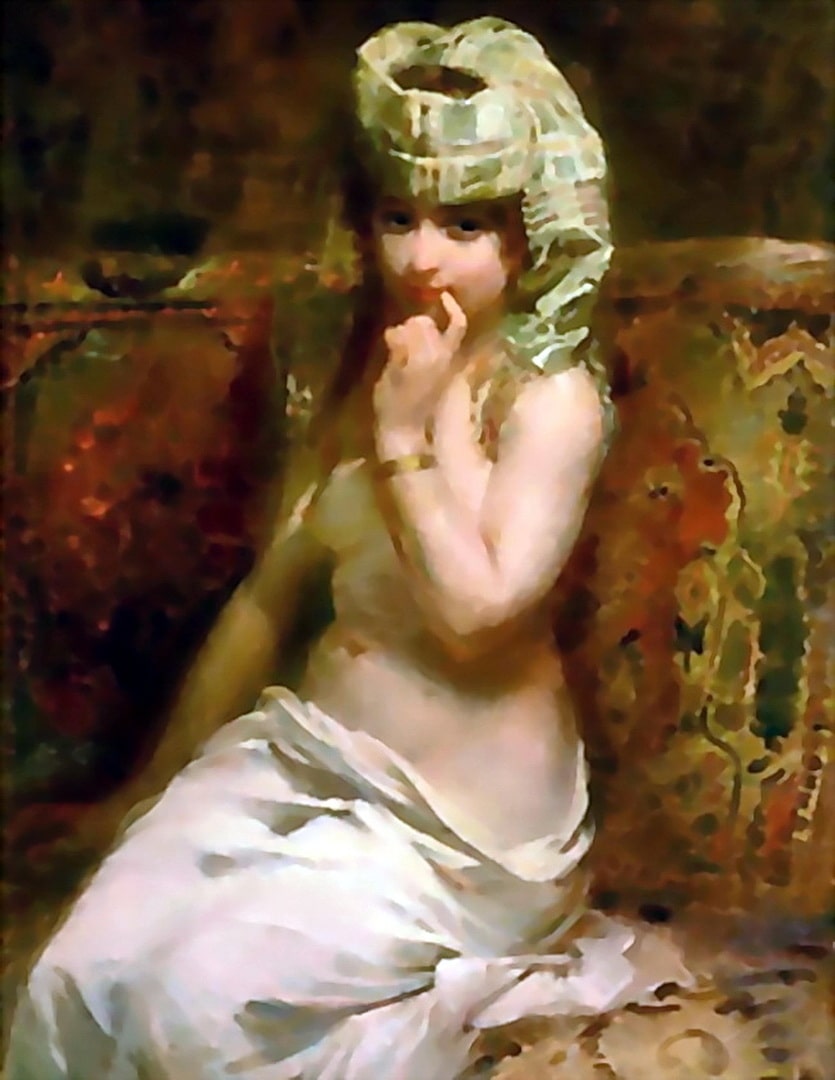
A cute young woman has lovely eyes and luscious lips is sitting on a couch with a white sheet over her lap.


Sitting Odalisque. H Giller.

A girl with pretty eyes and voluptuous bosoms and naughty nipples is sitting on a couch with a white sheet over her lap.

Satisfy you sexual desire.

An attractive lady is stretched out on the couch as she looks at herself in a mirror.

The Odalisque. Henri Adrien Tanoux.

A young woman is lying on a couch admiring herself in a mirror. She has long dark hair flowing down her back and a bare tummy.

The sultans favourite sex slave.


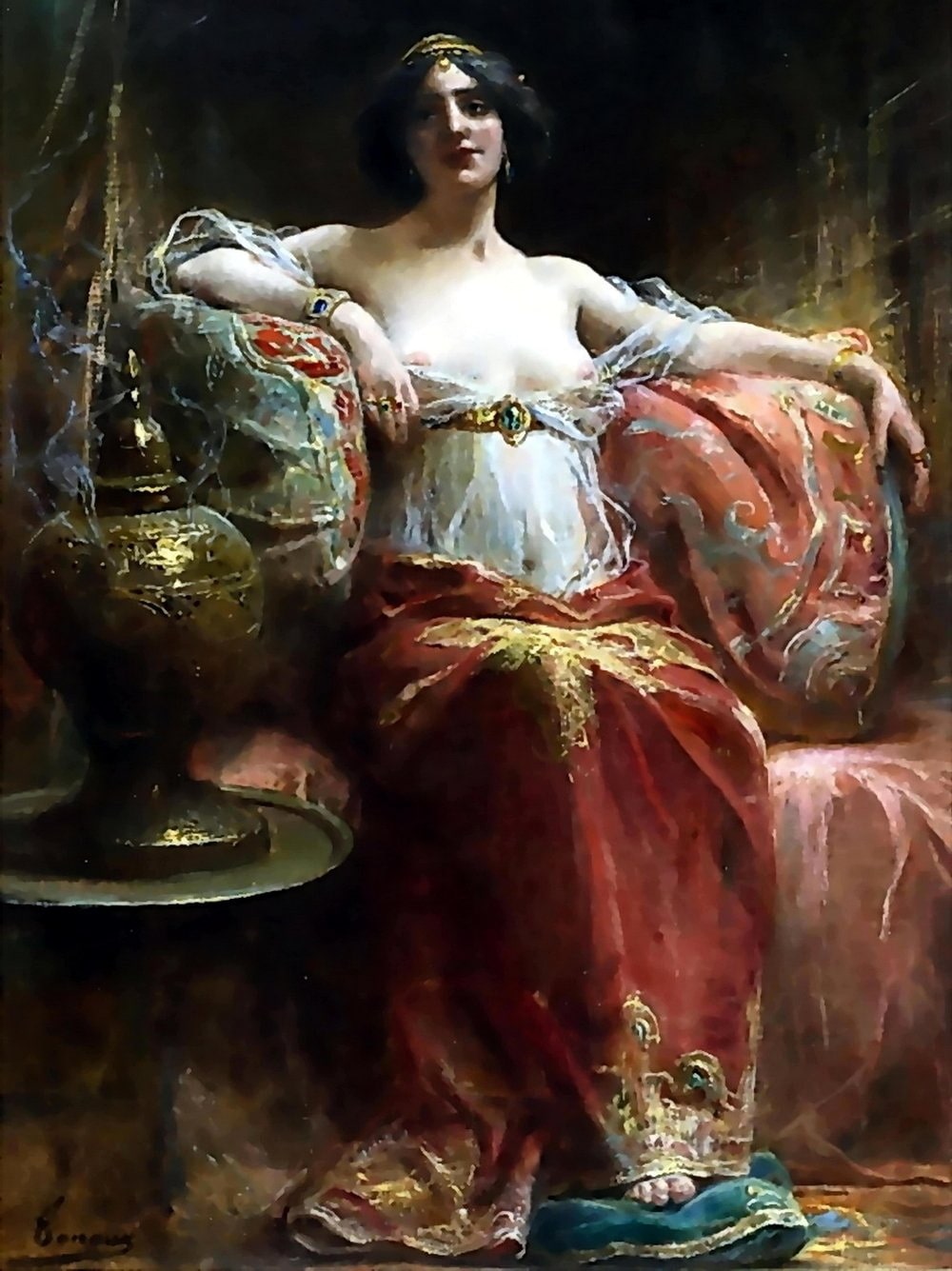
The Sultans Favorite. Henri Adrien Tanoux.
She has pretty eyes and luscious lips that are all the better to kiss him with. She is showing off her perky breasts and her naughty nipples are peeking over the top of her see-through dress. The relaxant is steaming beside her.


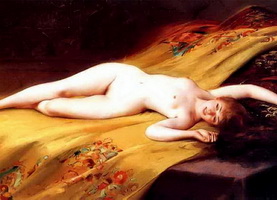
The pretty female is showing off her nude body to potential buyers. She has a nice bum and a cute face.

White Slave (Odalisque). By Ernest Normand.

The woman is showing her naked body to potential owners. She has a cute bottom and a pretty face. The lady to the left has nice tits.


White Slave (Odalisque). By Ernest Normand.


The woman is showing her naked body to potential owners. She has a cute bottom and a pretty face. The lady to the left has nice tits.

A hot sexy bra for a seductive night.

Find hot sexy lingerie for lusty ladies here.


Sexy Art for Women 1 Find pretty paintings of lovely ladies and beautiful naked women 2.
Sensuous paintings of feminine beauty and lovely nude ladies with flowers and roses 2.
Paintings of very famous lesbians and their lovers 2. Gay ladies and famous females
The naughty nymph’s, sirens, fairies (related) all lust for sex. They are always hot and horny. They are very wicked girls and have sex with males, females, and Satyrs. Even all three at once!.


Harems are the home to Odalisques who provide sexual favours to Sultans.
Odelisques are the girls who provide sexual favours to the Sultans.
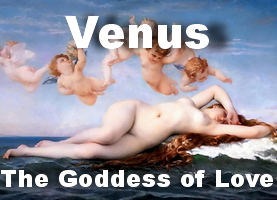
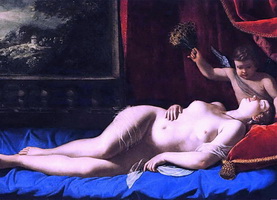
Venus the Goddess of Love. Lust,desire and sexual pleasure are what Venus gives to you.
Sexy Art for Women Page 2 Paintings of nude girls and foxy females Lusty ladies showing off their naked bodies in the name of art.


Sexy Art for Women 03 Nude paintings can help to improve a woman's sexuality and love.
Sexy Art for Women 04 Naked paintings of sexy women can help girls with better lovemaking.
Sexy Art for Women 5 Discover naked paintings of foxy females and lusty ladies in portraits.
Sexy Art for Women 6 Find nude portraits of sensuous women and flirty females having sexy fun.


Sexy Art for Women 7 Find vintage portraits of cute girls showing their sexy breasts.
Sexy Art for Women 8 Beautiful paintings of sexy nude girls and lovely females.
Sexy Art for Women 9 Elegant portraits of sensuous women and seductive females.
Sexy Art for Women 10 Pretty paintings of luscious ladies and dainty females.
Famous paintings of Sappho and Lesbia.
Back to the Home Page 2.


VII

THE CATHEDRAL REVOLUTION
I do not intend to follow Monet from exhibition to exhibition, nor to recount the history of those admirable paintings--several of which I rediscovered in America, notably in the fine Potter Palmer collection. For my purposes, it suffices to note the major milestones: from Vétheuil to the Haystacks, the Poplars, the Cathedrals, the Thames, the Louvre portrait, and the Water Lilies.
I would have liked to trace Monet’s journey through the impetuous activity of his ambitious brush. I would have liked to group his principal canvases according to their intrinsic merit and the evolving interpretations of light they display. Yet I am well aware that such a task would be beyond my powers. Indeed, I do not even aim to produce a monograph on Monet. In the final throes of these heavy times, I feel a need to speak of him. I yield to this perfectly understandable desire--not to preach or prove anything, but simply because our lives, however different, drew very close at the two ends of our careers; and now that the race run by my fellow idealist has reached its triumphant conclusion, I take great pleasure in hailing him for his fierce struggle for truth--a truth I refuse to separate from beauty.
This short work belongs to that genre our forebears loved to attempt under the vague title of *Considerations*. That is why I need only the starting point and the finish line, along with the stages marked by the "series"--haystacks, poplars, cathedrals--which, in all their magnificence, provide every necessary link in the chain. With such waypoints along the road to the wondrous pond--the source of the *Water Lilies*’ apotheosis--we have no need for an "accessory" of isolated masterpieces; they could only stand in a row, like milestones, leading up to the fateful moment when the sublime blaze of that noblest life comes to an end.

What need is there to speak of the many canvases--all so full of life--housed in museums abroad? Is it not enough, first of all, to highlight the most notable features of such a brilliant career in order to evoke its greatness? Should I, for instance, debate why Monet abandoned the human figure for landscape? Admirable canvases demonstrate that the human face held no terrors for him. His portrait in the Louvre--no less dazzling than the *Water Lilies*--was painted just before the Tuileries panels. To this day, there has been no painter whose scope Monet did not surpass. Who would not be happy to lend their support to the celebration of such a resounding triumph--an act that itself confers a mark of honor?
If our artistic sensibilities are thereby irresistibly refined, if our artistic emotional responses rise to a level of assimilation that completes and crowns positive knowledge, and if the meeting of modern art and science sparks new progress in our understanding of the world, it is simply because truth--wrested from areas of ignorance--triggers, through the law of universal interdependence, corresponding evolutions within the growing organism. All of this serves only to deepen our gratitude toward an artist of absolute integrity who, through the brilliant cultivation of his own emotional sensibility--and, by extension, our own--enriches and beautifies the realm of how we perceive the world and ourselves. Finally, what spectacle could be more rewarding than that of a man standing tall--who, through the sheer power of his personal emotion and the strength of his character, silences the baying packs of ignorance to take his place, after a lifetime of trials, in the triumph of a selfless will that never knew compromise?


I have often recounted how, one day, I found Monet before a field of poppies, with four easels upon which he would rapidly ply his brush, shifting from one to the next as the lighting changed with the sun’s progress. From our early days, we had known the white walls of Vétheuil--reflected through the fog in the river’s mists, blending air, earth, and water into a spectrum of reflections that we would see again forty years later, more sophisticated if not more brilliant, in the spectacle of the *Water Lilies*. This marked the advent of those developments and refinements of light that would be successively revealed in the *Haystacks*, the *Poplars*, the *Cathedrals*, and the *Thames*--captured at shifting hours as the diverse dramas of light played out beneath the sun’s blazing glow. Observe the man in pursuit of those distillations of light--light that constantly alters the appearance of things, creating a ceaseless process of transformation wherein the perpetual life of Nature is revealed to us.
It was under the sway of this vision that the *Haystacks* series was begun. Wheelbarrows--and occasionally a small country cart--would be loaded with a heap of equipment to set up a succession of open-air studios; easels were lined up on the grass, ready for the battle between Monet and the sun. It was a remarkably simple idea, yet one that none of the greatest painters had previously attempted. Monet can claim the honor for it. Across these series of canvases, the artist’s loftiest ambitions poured forth--vibrant and alive--in his quest to capture the luminous atmosphere that brings such dazzling splendor to our humble lives. Were we, then, forever destined to seek the charm of form in the dry precision of a line devoid of objective reality, and the joys of light in the somber "studio light"? The line was already faltering under the onslaught of the sun’s rays, and Monet set out to push the subtle refinements of color dispersion and recomposition ever further. It is for the *Water Lilies* to reveal the sensory triumphs that painting was able to derive from this.

In May 1891, Monet exhibited a series of fifteen canvases{79} depicting haystacks at every hour of the day and in every season. It was the dramatic masterstroke that decisively secured the resounding triumph of a revolution in painting. The four easels set up along the banks of the Epte--facing poppy fields lined with poplars--had marked the moment when light, caught in the shifting dishabille of its own metamorphoses, truly entered the fray. After the haystacks--soon followed by the poplars, the cathedrals, the Westminster series, and the *Water Lilies*--there was no longer room for debate. It was an Austerlitz without a Waterloo; the battle ended for lack of combatants. The era of the loud-mouthed "art critic" had passed. Indeed, there was not even anything left to argue about. I am well aware that there is still some grumbling in the corners, but the public has at least reached the point where such grumbling is kept to a low murmur.
To ensure that the commentary served only to glorify Monet, all that was needed was a positive theory of light that aligned with the sensations arising from this new mode of interpretation. Indeed, M. Camille Mauclair, in his excellent study on Impressionism, aptly noted that the Impressionists’ use of light coincided with major modern discoveries revealing the nature of light energy in action. For my part, I see in this a remarkable parallel between our emotional and mental evolutions as they unfold in tandem. Everything is interconnected within our own organisms, just as it is in the universe. Our experience of nature and its artistic interpretation will only truly fulfill their purpose if we manage to conceive and interpret the world in close alignment with a harmony confirmed by the concordance of works born of sensibility.

Whether in the realm of sensibilities shaped by scientific disciplines or that of emotional responses subject to the control of knowledge, ingrained habits do not readily give way to innovations that unsettle minds steeped in obsolete traditions. We should not be surprised, then, that Monet--who can paint nothing but what he sees--scandalizes all those who think and see under the sway of atavistic rigidity, at odds with the emergence of a new sensibility. Since all worldly relationships are in a state of eternal flux, we have for too long accepted a view of eternal stasis. What a profound personal shift is suddenly demanded of us when Monet--with his four canvases painted in broad daylight to track the sun’s path--presents us with the ultimate scandal: that of truth itself!
Here I reach the heart of my subject, for it concerns the pivotal moments in an artistic evolution that seeks to draw us toward increasingly faithful representations of reality. Executing this artistic program requires nothing more--and nothing less--than tracking, as faithfully as possible, the behavior of light that relentless analysis allows us to master.
This raises two questions. Must the modern painter resolve to interpret light differently than he has done until now? And is Monet--placing such faith in his own retina--the right man to achieve this?
This is the subject of an article titled "Cathedral Revolution" (*Révolution de cathédrales*), which I published in *La Justice* on May 20, 1895, and which was reprinted in *Le Grand Pan* in 1896. Indeed, it was the cathedral series (1895)--following the *Haystacks* series and the *Poplars* series--that prompted me to take up my pen. Thirty years having passed--and finding that I have nothing to retract from my words--I yield to the temptation to reproduce it, for it clearly shows that my views today are not improvised. Here, then, is the greater part of it:


I beg the professionals’ pardon, but I cannot resist the urge to set myself up, for a day, as an “art critic.” Claude Monet is to blame. I went into Durand-Ruel’s gallery to revisit at my leisure the studies of Rouen Cathedral--works I had previously had the joy of seeing in his Giverny studio--and I found that I carried this multifaceted cathedral away with me, without quite knowing how. I cannot shake it off. It haunts me. I must speak of it, and--well or ill--I shall.
I present myself simply as one of those two-legged creatures whose chief merit is to wander the earth with a pair of eyes ready to delight in all the feasts offered to us by the divine light. And on this point, to begin with, I have a few observations to make. How does it happen that so many people pay a fortune for so many canvases--good or bad, though more often bad than good--and likely end up “enjoying” them, when they would be incapable of pausing sincerely for five minutes before the actual landscape or figure whose depiction delights them so? I am well aware that we are told the painter infuses the work with something of himself. But nothing prevents the viewer from doing the same; indeed, even *The Embarkation for Cythera* captivates us only because it evokes emotions rooted in reality.
In this multifaceted world, what ought to charm us above all is the unstable vibration of life that animates sky, earth, and sea--all of nature, whether teeming with movement or seemingly “inert.” Indeed, the earth tirelessly lavishes upon us that ever-shifting marvel--revealed in the myriad spectacles of this radiant planet--that changing miracle which ceases only to give birth to new miracles, that intensity of life flowing not only from man or beast but also from grass, wood, and stone. There is, then, no need whatsoever to be a millionaire to experience artistic delights far superior to those of the wretched connoisseur condemned to wear out, over twenty years, the same sterile epithets on the same stubbornly mummified canvases.


While the unfortunate man narrows his horizons, shrivels his capacity to see and feel, and paralyzes or petrifies his emotional power, I roam the world; I question things; I strive to grasp their fleeting aspects, to attune myself to their harmony, to penetrate their inexpressible mystery, and to revel in ever-changing spectacles with an intensity of joy that I leave to the shifting world to renew endlessly.
...Yes, humanity lives within a miracle--a true miracle--from which it can ceaselessly draw incredible joys; yet it fails to perceive this, or, to be more precise, is only just beginning to formulate the very idea of ??it. For thousands upon thousands of years, the human eye has confronted the planet, which reflects back--pulsing with vitality--the waves of life that sprang from the solar inferno. Everything that has come down to us in the way of artistic monuments--from the primitive axe, with its pleasing proportions and bold coloring, and the profiles of bears and mammoths sketched by some Stone Age Leonardo on the bones housed in the Saint-Germain museum, to Monet’s cathedral--allows us to trace, in broad strokes, the phases of vision our race has traversed.
We know that what first struck our ancestors was life in its most turbulent manifestations: the overall shape, the rough outline, and a generalized coloration--vaguely perceived, without precision of tone or value. Is this not precisely how a child sees the world today--whether drawing or coloring? We know that the ancients--Asians, Egyptians, and Greeks--though their mythology bears witness to a vivid impression of the world’s phenomena and its shifting aspects, did not feel the same need as we do to express the sensations derived from the spectacle of things.

Examine Greek vases--many of which reproduce some of antiquity’s most famous paintings--and look for a landscape, a tree, a rock, a sea, or water, whether flowing or still. Poets had long since demonstrated a keen perception of certain aspects of what we now encompass within the all-embracing word "Nature," yet that sensation was not defined precisely enough to prevent Zeuxis from devoting himself to still-life painting. At the very least, that is the subject chosen to commemorate his greatness. At the Lesche of Delphi, Polygnotus depicted scenes from the Trojan War without venturing any further into landscape. If Pausanias is to be believed, he worked with limited means and even had to rely on explanatory placards to clarify the subjects of his paintings. Need one mention the Primitives--their trees, their rocks, their meadows? Consider the strange landscape that the great Leonardo, at the height of the Renaissance, chose as the background for his *Mona Lisa*.
"The countryside at present is not much in bloom."
That, as Théophile Gautier noted, is the only impression of his rural contemplations that Molière’s genius ever conveyed to us. It took the likes of La Fontaine and Rousseau to truly fall in love with the land. How, then, are we to appreciate the labored landscapes of Poussin today?
It is not my place here to recount the history of landscape painting. Suffice it to note, with Gustave Geffroy, that the sun--which shines for everyone--shone but little on the art of painting for a long time: "In the works of Ruisdael or Hobbema--to name but two great landscape painters--the foliage, with its metallic, speckled quality, is the color of ink; the sun has gone out, and everything appears illuminated by the somber light of the studio." Corot, however, experienced the true emotion of light. The eye was gradually being educated. As Geffroy aptly puts it in his fine study of Impressionism--a work that made such a vivid impression on us all--: "A sense of light could not exist in art when it was absent from human understanding... Painting, like all other forms of human expression, had to reflect that slow discovery of the world and of the self which lies at the heart of human destiny."
With the Impressionist school, the sovereignty of light finally asserts itself. It bursts forth, permeates one’s very being, and imposes itself like a conqueror; it dominates the world--the medium of its glory and the instrument of its triumph.


Who does not now understand that the human eye sees differently today than it did in the past? After long effort, it has discovered nature--once obscure, now illuminated. That is not all. Who can say what joys await
 
Claude MONET--Haystacks, End of Summer (1891)
{85}
the refinement of our vision through the future evolution of our faculty of perception?
When I saw Monet--with his four canvases set up before a field of poppies, changing his palette as the sun pursued its course--I felt I was witnessing a study of light made all the more precise because the subject, ostensibly immutable, so strongly revealed the shifting nature of the light. It was an evolution asserting itself, a new way of seeing, feeling, and expressing: a revolution. That field of poppies, bordered by its three poplar trees, marks the beginning of a new era in our history--both in the sensation and the expression of things.
The haystacks and the poplars followed. The same haystacks, the same poplars--at sunset, at sunrise, at midday; in mist and in sunshine; in rain, wind, and snow. And then came Vernon, blazing with light or dissolving into fog.
The artist had realized that he could not escape the analysis of the phenomenon; he understood that while morning merges into evening over the course of a single day through a series of infinite transitions, every new moment of every changing day--under the onslaught of light--creates a new state of the object, one that has never existed before and never will again. The perfect eye must be capable of grasping this state, just as the hand must be capable of rendering it.
Is this not, in truth, a new conception of both perception and expression?


The object, obscure in itself, derives all life and all power of visual impression from the sun. Yet the light waves that envelop and penetrate it--causing it to radiate outward into the world--are in a state of perpetual turbulence: dazzling flashes of lightning, sprays of light, storms of brilliance. What becomes of the subject amidst this frenzy of living atoms--through which it shows itself, by which it becomes visible to us, and by which, for us, it truly *exists*? This is what must now be understood, what must be expressed through painting, and what must be deconstructed by the eye and reconstructed by the hand.
Indeed, this is precisely what the daring Monet set out to do with his twenty canvases of Rouen Cathedral, arranged into four series that I would term: the grey series, the white series, the iridescent series, and the blue series. Through twenty canvases capturing a carefully chosen variety of effects, the painter conveys the sense that he could--and should--have painted fifty, a hundred, or a thousand of them; as many as there are seconds in a lifetime--were his life to span as long as the stone monument itself--and as many moments of the subject as he could capture on canvas with every beat of his pulse. As long as the sun shines upon it, Rouen Cathedral will possess as many modes of being as there are divisions of time that man can conceive. A perfect eye would distinguish them all, for they ultimately resolve into vibrations perceptible even to our current retinas. Monet’s eye--a visionary one--leads the way, guiding us through the visual evolution that renders our perception of the universe ever more penetrating and subtle.
Thus, by striving to express nature with increasingly refined precision, art teaches us how to look, to perceive, and to feel. And from this ever-closer expression springs an ever-sharper sensation. The marvel of Monet’s sensation lies in seeing the stone vibrate and in his rendering of it as vibrant--bathed in waves of light that collide and shatter into a spray of sparks. Gone is the static, lifeless canvas. Now the stone itself lives; one senses it transforming from the life that came before into the life that is to follow. It no longer appears frozen to the viewer. It is in flux. We see it in transition.

I say nothing of the technicalities of color; that is not my concern. Legend has it that an ancient painter, unable to render the foam of a galloping horse, flung his brush down in frustration; it struck the panel and achieved by chance what art had failed to do. This story merely bears witness, in the annals of antiquity, to the despair born of unresolved difficulties. Looking closely at these cathedrals of Monet’s, they seem fashioned from some multicolored mortar ground onto the canvas in a fit of fury. All this wild intensity is born of passion, certainly, but of science too. How can the artist, standing mere centimeters from his canvas, perceive an effect that is at once precise and subtle--one that can only be fully appreciated from a distance? It is the baffling mystery of his retinal vision.
What matters to me is seeing the monolith emerge in its powerful unity, its sovereign authority. The drawing--tight, crisp, and mathematically precise--defines, alongside the geometric conception of the whole, both the ordered masses and the sharp edges of the sculptural tangle in which the statues are set. The stone, lightened by the glow, remains hard and enduring beneath the weight of centuries. The mass holds firm--solid amidst the hazy mist, softened under shifting skies, and bursting into a powdery stone blossom in the sun’s blaze. A vibrant stone blossom, alive and offering its intoxicating swirls of joy to the sun’s kisses, while the caress of a golden ray upon a speck of dust sparks the sheer ecstasy of living. Skillfully chosen, the twenty states of light--drawn from the twenty canvases--arrange, classify, and complement one another into a consummate evolution. The monument, a mighty witness to the sun, thrusts the soaring impulse of its commanding mass toward the sky, offering it up to the interplay of contending lights.


Into its depths, its projections, its mighty folds, and its sharp ridges, the flood of the immense solar tide rushes from infinite space, breaking into luminous waves that strike the stone with every fire of the prism, or subsiding into clear darknesses. From this encounter, day is born--ever-changing, living day; day that is black, gray, white, blue, or purple--spanning the full gamut of light. For all colors are consumed by brightness--"reduced," to use Duranty’s phrase, "to that luminous unity which melts its seven prismatic rays into a single, colorless brilliance: light itself."
Hung as they are, the twenty canvases offer us twenty marvelous revelations, yet the intimate bond connecting them likely eludes the casual observer. Arranged according to their function, they would reveal the perfect equivalence of art and phenomenon: a miracle. Imagine them lined up along the four walls in a sequence of light transitions: the great black mass at the start of the gray series, which grows steadily lighter; the white series, ranging from diffused light to dazzling precision, leading into and concluding with the fires of the iridescent series; these, in turn, subside into the calm of the blue series and vanish into a divine mist that fades away in radiance.
Then, in one sweeping, circular glance, you would perceive the monster--and the marvel--in a moment of dazzling revelation. And those gray cathedrals--which are purple or azure, violated by gold--and those white cathedrals with fiery portals, streaming with green, red, or blue flames, and those iridescent cathedrals that seem viewed through a rotating prism, and those blue cathedrals that are pink--would suddenly grant you the enduring vision not merely of twenty, but of a hundred, a thousand, a billion states of the eternal cathedral within the endless cycle of suns. It would be life itself, as sensation can reveal it in its most vivid reality. The ultimate perfection of art, hitherto unattained.
{89}

That is why, in a postscript, I lamented that no collector had stepped forward to purchase the entire series of *Haystacks*, for instance--thereby illuminating the problem as a whole for the benefit of viewers who, upon passing a single example, fail to grasp the profound lesson that vainly seeks to catch their eye. In truth, the very essence of Impressionism lies in the evolution of how we perceive light. Gustave Geoffroy explains this admirably in his study of Claude Monet.
"Not only," he writes, "did man long believe he inhabited a special, unique world--illuminated solely by a revelation from above and awaiting the solution to the riddle from a will superior to his own--but he even considered himself a being apart within that unique world. He had no inkling of the universe, nor did he link the planet of his birth to anything else; nor did he see himself as connected to the environment from which he had emerged. For a long time, this was the embryonic mindset of all humanity, and it remains the mindset of many people today. Yet others--a group that is constantly growing--have come to see that their lives are linked, first and foremost, to the life immediately surrounding them, given that the life of the Earth is part of the life of the Sun; and having sensed this, they feel a spark of universal life pulsing within them, and henceforth devote all their fervor to expressing that continuous life--a life that lifts them up and carries them forward through the endless ages."

"Painting, like all other forms of human expression, was destined to reflect the slow discovery of things and of the self--the very essence of human destiny. Impressionism, for its part, marks a more vivid realization--and consequently a closer understanding--of the poetry of light. Space becomes illuminated, distances are traversed by thought, and the contact between earth and sun appears more permanent and visible than ever before. Man feels himself to be a product of the sun... it is the sun--its luminous, life-giving emanation--that has bestowed its distant caresses upon painters’ works since the dawn of painting. It is this poetry of the sun that reverberates; it is the universal vibrations that come to rest, with heightened intensity, upon the confined space of a canvas."
In his famous pamphlet *La Nouvelle Peinture* (1876), Duranty had already said of the Impressionists:
"In the realm of color, they made a genuine discovery--one whose origins cannot be traced to the Dutch masters, nor to the light tones of frescoes, nor to the delicate hues of the eighteenth century. They were not merely concerned with the subtle, fluid interplay of colors arising from the observation of the most delicate tonal values, or with how colors contrast or interpenetrate. Their discovery lies, strictly speaking, in the realization that intense light washes out colors--that the sun, reflected by objects, tends through sheer brightness to reduce them to that luminous unity which fuses its seven prismatic rays into the single, colorless brilliance that constitutes light itself. Through a series of intuitive leaps, they gradually came to decompose the sun’s glow into its constituent rays and elements, and to recompose its unity through the overall harmony of the iridescent hues they spread across their canvases." In terms of the eye’s sensitivity and the subtle rendering of color, the result is truly extraordinary. Even the most expert physicist could find no fault with their analyses of light.”
It is evident that everything that needed to be said had been said. All that remained was the execution. That was the task that fell to Monet.{93}{92}

VIII

THE WATER LILIES OF THE WATER GARDEN
To speak my mind right away: the *Water Lilies* at the Tuileries remain unknown to the general Parisian public. I am not naive enough to be surprised by this. The crowd naturally seeks out what is within easy reach. It took a long time to draw people to the masterpieces in our museums; even today, if you tell a taxi driver to take you "to the Louvre," he will invariably drive you to the department store of that name. Admittedly, the Orangerie Museum is not designed for the casual, unrefined eye. Yet I fail to see why the eye of some two-bit Croesus can somehow accustom itself to the paintings found at major auctions, while the average Frenchman is supposedly incapable of responding to Monet’s appeal.

The truth is that a passive conspiracy of silence has quietly taken hold, unwittingly abetted by administrative indifference. At the angled corner of the Tuileries terrace, a small grey sign--scarcely larger than the crown of my hat--makes a feeble attempt to inform the public that something is there. A few paces away, just last month, a gigantic placard grandly announced a gathering of dogs. The public did not hesitate. Is this any way to do justice to an art exhibition the likes of which the civilized world has never seen--and will not see again for a long time?
The Fine Arts administration and the excellent architect, M. Camille Lefèvre, have given us a masterpiece of design, worthy of the artwork itself and of the nation that takes pride in it. All that remains is to let the public--creatures of habit that they are--know that here they can find ample cause for wonder. My strolls have taught me that visitors, once they have come, do not hesitate to return. Parisians need to learn that, in the heart of Paris, they will find something far greater than the solution to a mere problem of painting--for here lies the world itself, waiting to be observed, analyzed, and understood. A guide for the public is needed for this purpose; I am told one is currently in preparation.
But we have crossed the threshold, and from the very first steps, it is a scene of enchantment. How should we proceed? In what order should we approach these walls, which serve as gateways to a realm of wonder?

And first, the spectacle? A field of water, laden with flowers and foliage amidst the swirling heat of the blazing sun, where the interplay between the celestial screen and the watery mirror diffuses subtle sensations--sensations through which man seems to draw ever closer to objectivity. All the radiant energies of sky and earth are thus summoned to appear before us simultaneously, evoking an ineffable sense of wonder--a spectacle where the joys of dreams merge with the freshness of primal sensation. A yearning for the Infinite, sustained by the subtlest sensations of tangible reality and radiating--from reflection to reflection--out to the supreme nuances of the imperceptible: this is the subject of the panels.
It requires the miracle of a retina adapted by evolution--provided, of course, that there is a painter capable of orchestrating these compositions of light and tonal transitions. What matter the bold strokes of a brush--vibrant yet purposeful--when the painter reveals to us, as if under the illumination of an ultramicroscope, elemental depths we would otherwise never have known? Are we not, in this instance, very close to a visual interpretation of Brownian motion? The gap between science and art is vast, to be sure. Yet, at the same time, there is a profound unity in cosmic phenomena; here, the painter offers us an interpretation--not through direct vision, but one crowned by an overwhelming emotion of beauty--where pure understanding is reached only after long, tentative observation.
When the *Water Lilies* of the Water Garden sweep us away from the liquid expanse to the drifting clouds of infinite space, we leave the earth--and even its sky--behind. We rise to fully savor the supreme harmony of things, far beyond our small planetary world, borne aloft on the wings of our own deep emotions. The man of science has revealed to us the eternal elemental movement and enabled us to assimilate, enact, and live it within Nature, leaving it to us to complete it through art--should a paintbrush be found to evoke our emotions. We need not choose between the scientist and the artist; we require both to be fully ourselves.


On the water’s surface, the Water Lilies--borne by the broad, powerful pads of their foliage--wait motionless for their destiny to unfold. A subject worthy of meditation. Since there is neither frame, nor beginning, nor end, we need only take in the spectacle as it presents itself, tracing its progression from one canvas to the next.
Let us first note that the sequence of the paintings was determined and intended by Monet himself. He never revealed the thought process that guided him. I shall therefore simply follow the natural path a visitor takes when viewing the works. I would not be surprised if Monet’s idea--a simple one--was to create a gradual visual education for the eye, suddenly plunged into an outpouring of direct and reflected light.
The Water Garden we have come to see reveals itself precisely in the panel Monet positioned to catch the visitor’s first glance. It is the touchstone painting, a purely classic exposition of the subject that demands no special effort from the viewer--requiring only an average eye accustomed to museum visits. No boundaries, no sky, no clouds. A peaceful interplay of direct light and minimal reflection. Clear, heavy water bathed in classic lighting (always five o’clock in the evening), where a benevolent Providence has scattered a masterfully arranged array of clusters--large leaves joyfully framing beautiful, vivid blossoms that glow like soft flames of white and pink. Monet has infused the scene with a serene, moderate radiance that envelops this earthly bloom like an offering to the heavens. No spectacle could be easier to grasp. Its poetry is so simple and clear--yet so sublime--that even the average viewer is quickly captivated.


A benchmark painting, I called it. It represents the standard vision of museum lighting--the yardstick against which we inevitably measure all other optical sensations, simply because it is what we are accustomed to.
But the sky is darkening. Two heavy masses of shadow--one still retaining traces of chiaroscuro--are encroaching upon the scene; they may soon merge and unleash a storm. Yet the sun, still holding sway, casts thick, cloud-laden drifts through a rift of azure toward the restless waters--drifts in which some indefinable, combative flash of light triumphs--while the wounded water lily, quivering beneath these looming threats, foreshadows the disasters of the impending catastrophe.
And yet, these are merely contrasts born of inevitable opposition. Beyond the intimations of the storm, the canvases that follow reveal the splendors of a festival of light, a magnificent display of solar radiance. There are as many as four works exploring this same theme of dazzling brilliance, each a unique composition--a symphony of light. Rows of Water Lilies sit amidst the tranquil clarity of the friendly willow’s trailing boughs, which allow the passage of fiery shafts; their heat spreads between sky and water, creating reflections--and reflections of reflections--to the ineffable ecstasy of our dazzled humanity. As the clouds seem to encircle the Water Lilies, the flowers and foliage appear borne aloft in space by the irresistible surge of waters--waters trembling with the backwash where the fluid elements of earth and sky mingle, responding to the call of the bloom in the intoxication of life’s supreme delights.


Thus, art brings to life before our eyes the joyful shimmer of the liquid lawn, the blue vault, the cloud, the flower--all of which have something to tell us, but would not tell us without Monet. Ethereal aspects of the eternal drama that the world plays out within itself, with humankind as both partner and spectator.
I have sometimes sat on the bench from which Monet saw so much in the reflections of his Water Garden. My inexperienced eye needed perseverance to follow the Master's brush from afar to the very edges of his revelations. Unlike the monkey in the fable, he profusely cast torrents of light onto the screen of his magic lantern. Almost too much, one might say, if one could complain of an excess of luminous vibrations beneath the transparencies of the Milky Way's expanses, which tempt us with the dazzling brilliance of the Infinite.

Whatever its plan, the Water Lily is there only as a witness to the universe, in the atmosphere of soaring colors whose wings carry us beyond the flights of imagination. And so, to complete everything, here, in leafy retreats, is revealed the tranquil ardor of a still pond, sharpening.


Claude MONET--*Water Lilies, Waterscape* (1905){99}
A contrast of the Water Garden set ablaze by storms of light--from the dazzling sky to the burning earth, and from the burning earth to the dazzling sky.
In the struggle between sun and flower--a battle for life or death--the delicate nature of the vegetation is destined to yield to the irresistible power of the universal blaze. Sheltered by willows, the clusters of Water Lilies hold fast, for a time, to the brilliance of their triumphant blooms. Yet the fine down of the clouds, pierced by the full fire of the atmosphere, envelops leaves and blossoms in its reflected image, sweeping them up victoriously as supreme spoils into the heights of the burning air; meanwhile, patches of dark vegetation--seen through symphonies of mauve, blue, and rose-tinted mists--tell of the clash between the gentle earth of a single day and the eternal inferno.
And the action playing out across this battlefield is life itself, luminously transposed--an elemental rivalry for successive, fleeting moments of dominance. Here, the drama of the Water Lilies unfolds upon the stage of an infinite world--a world made conscious through man, whose shifting states of mastery and submission form the plot of this eternal libretto. In the vast ocean of space and time, where torrents of light rush to storm the human retina, storms of rainbows collide, interpenetrate, and shatter into a spray of sparks, only to soften, merge, scatter, and reunite, intensifying the universal tumult that stirs our deepest emotions. This ineffable hurricane--in which, through the painter’s magic, our bewildered eye receives the shock of the universe--represents the problem of the inexpressible world revealing itself to our sensibility. Even those who have not yet grasped it are on the path to doing so. Due note will be taken of this as time goes on.


That is not all. A new spectacle unfolds. The supreme surge of solar triumph sweeps us into a state of ineffable emotion amidst the iridescent transparencies of a soft, tonally indeterminate light--a realm where sky and earth, amidst scattered blossoms and joyful clouds, lie in a languid embrace. It is a masterpiece--fragile yet irresistible--of the world in full ecstasy, a meeting point of heightened sensations. It represents the supreme culmination of an artistic vision where Monet, with a smile, allowed the voluptuous languor of his final brushstroke to take hold. And since we have recently learned that cosmic waves possess a voice, we can now conceive of concerts where hearing and sight unite in the chords of a universal symphony.
Yet, turn around, and behold the somber spectacles of the bluish night, where ghostly vegetation succeeds the triumphant blooms of that apotheosis. Finally, as we leave, a supreme apparition greets us: the specters of fallen Water Lilies--seen through the wreckage of reeds beneath the blazing sunset--herald the provisional conclusion of so many interlocking cycles.
Thus, Monet brings us, in all its fullness, a novel vision of things--one that engages the natural evolution of our visual apparatus, allowing us to grasp the painter’s adaptation to the energies of universal sensibilities. A succession of subtle transitions leads us from the direct image to the reflected and re-reflected image, through a diffusion of transposed light where tonal values ??merge and emerge in perfect harmony. It is an incomparable field of luminous exchange between sky and earth, crowned by a worldly emotion that exalts us to the very heights of the infinite communion of all things--the supreme fulfillment of our own sensibilities.


How I wish I could hear once more the gently authoritative tone of that friendly voice, as we stood before the displays of nature in his Water Garden: "While you philosophically seek the world-in-itself," he would say with his kindly smile, "I simply focus my efforts on the realm of appearances--on the greatest possible range of them--in close correlation with unknown realities. When one dwells within the plane of harmonious appearances, one cannot be very far from reality--or at least, from what we can know of it. I have done nothing but observe what the universe revealed to me, and bear witness to it with my brush. Is that nothing, then? Your mistake lies in wanting to reduce the world to your own scale; whereas, as your knowledge of things grows, so too will your knowledge of yourselves. Let us join hands and help one another to see ever more clearly."
IX

THE CRITIC CRITICIZED
Before concluding, allow me to introduce into the conversation a distinguished art critic--a great admirer of Monet, yet a ruthless metaphysician--who insists that the painter of the *Water Lilies* leads us, along paths of flowers, toward the bottomless abyss of Nothingness.
That modern painting, in its rendering of light, stems from Corot is a point I readily concede to M. Louis Gillet--author of a charming little book titled *Trois variations sur Claude Monet* (Three Variations on Claude Monet), in which he praises the artist’s "finest perceptions regarding nuances" alongside his "sumptuous genius as a colorist." Where will this lead us?


To begin with, M. Louis Gillet traces the origins of Monet’s technique back to the well-known theory of the "division of colors." "A pure color is more intense than a mixed hue. The implication is that to obtain a vivid violet--composed of red and blue--without any loss of radiance, one should not mix the elements on the palette or the canvas; instead, place a stroke of blue and a stroke of red side by side in their pure state: the result will be a sensation of violet. The mixing takes place on the retina. This is optical mixing."
That said, our author readily acknowledges that this so-called secret is the ABCs for any colorist, while crediting Monet with having revived its use. Above all, he believes that Monet found in it the inspiration for a distinctive "poetics"--one that led him to "decompose light and tone, to resolve shadow itself into colored reflections, and to view all things as if bathed or swimming in an airy fluid--causing us to perceive the spectacle of the universe as an atmospheric enchantment. Outlines dissolve into thin air; edges begin to shimmer within a halo of pale light. Everything is transformed in a dazzling radiance. Nothing remains of the visible world but that impalpable dust--that dance and swirl of atoms weaving a veil of illusion in the void. Never has a painter more resolutely denied the reality of matter." Is there not a great deal contained in a single brushstroke?


From my layman’s perspective, M. Louis Gillet will allow me to view matters more simply. First of all, anyone who knew Monet could tell him that our painter never possessed a "poetics" or any theory whatsoever that might have constrained or guided his brush. He held as true whatever his vision revealed to him, and strove tirelessly to reproduce it exactly as he saw it. Nothing less. Nothing more. That is enough. He would not have understood a suggestion--made in the name of some doctrine--that he do anything other than what he saw. That was his only rule. I do not believe anyone knew him to have another. To put it in a word, it seems to me that this is the secret shared by all great painters. They do not possess the same retinas; that is what sets them apart. And since we ask them to interpret nature, let us not set a bad example by interpreting them in any way other than through their own terms.
I dwell on this delicate point all the more because that shimmering dust of light is not achieved--as M. Louis Gillet seems to believe--through the "optical mixing" of dabs of color. I have often examined the *Water Lilies* canvases as closely as anyone. I saw strokes of almost pure color applied here and there to achieve certain vivid effects--sometimes with great verve, yet without extravagance. Everything else comes from the palette. If M. Louis Gillet doubts this, let him go and see for himself.
Where, then, does the mystery lie? Simply because no two of us are endowed with identical retinas, and because we ask nothing of a painter worthy of the name other than to offer us an interpretation of the world accessible to the average, suitably functioning retina. What makes Monet’s retina so extraordinary is that, from a distance of less than a meter--amidst a cluster of colors or tones massed together through juxtaposition or layering, in a field of inextricable blends--he perceives the representation of the subject just as accurately up close as from afar. I know of no other explanation for this than the state of the painter’s retina, which......adapts instantly from one point of view to another. I note this fact without offering an explanation. I acknowledge things as they are: the calculated meandering of the colored line--which baffles us when viewed up close--takes on, from a distance, a significance of shifting values ??and forms, wherein the very nuances of the world’s activities are revealed in the most unexpected ways. The evolution of the ages may one day allow our descendants to explain the phenomenon. Can we not, even now, give ourselves over enthusiastically to the pleasure of admiration?Especially since, to admire Monet’s art in its fullness, we need not dwell too long on the miracle of that jumble of tones--where the hand’s bold strokes launch bursts of elusive arabesques to define the relief and outline of luminous figures. For there is a "super-miracle": one that M. Louis Gillet attributes to the emergence of a certain "poetics"--though he tells us nothing about it--consisting in the evocation of enchanting spectacles from a world that is at once more beautiful and more intelligible than the one (with the exception of *The Embarkation for Cythera*) we had been lulled into accepting until now.
It is precisely here that the miracle of miracles arises: the world revealed by the brush proves to be not merely a product of enchanting fantasy, but an emotive interpretation of a world which--according to all the findings of advanced knowledge--represents a superior approximation of inaccessible realities. M. Louis Gillet speaks to us of "atomic dances" weaving "the veil of illusion in the void," and concludes that Monet presents us with "a negation of matter." This is, quite simply, to view matters in reverse. A visit to M. Jean Perrin’s laboratory will allow him to see Brownian motion, as well as the tracks of atoms and their electrons recorded on a glass plate.
Then, perhaps, he will be less astonished by "the hail of nerve impulses that make up the visual image" and "the atomic dances" with which he taunts matter in favor of illusion. Then he will understand that universal shimmering--which he admires in Monet’s canvases, yet which in reality serves only to make him doubt the existence of the very thing that shimmers.

I do not go quite that far. In that "powdering" of forms Monet captured at the tip of his brush, I see nothing but a felicitous transposition of cosmic realities--the very ones modern science has revealed to us. I do not claim that Monet reproduced the dance of atoms. I simply say that he led us to take a great stride toward an emotive representation of the world and its elements through distributions of light that correspond to the vibrational waves science uncovers for us. Even if our current atomic conception were to change, Monet’s genius would still have marked an incomparable advance in how we perceive the world--an advance that must always be reckoned with, whatever the future holds for our understanding.
Having acknowledged this fundamental philosophical divergence, I am eager to pay tribute to the insights found in M. Louis Gillet’s literary analysis. The writer’s pen is worthy of the *Water Lilies* painter’s brush. Indeed, the two go hand in hand through the marvelous diversity of scenes that successively held Monet’s gaze. It is unacceptable to view them merely as "mirages existing only within himself." I fully understand that a mirage is a luminous, subjective phenomenon. But by what right do we apply that term to the realities of the physical world--realities distinguished precisely by their objective nature? The writer tells us, without batting an eye, that Monet "treats himself to artistic revels based on meager realities." Can one speak this way of the biblical masterpiece of Creation? Jehovah, what say You?
As a mere passerby, I am disconcerted by the blasphemy--surely carrying M. Louis Gillet further than he intended--of writing that "one does not sufficiently sense life in Monet’s subject." I would like to stand him for a few minutes before the portrait at the Louvre.

Meanwhile, the art critic ventures to write that "Monet’s hymn is one of the finest hymns to universal nothingness." Here we witness Monet’s supreme adventure: like the biblical "Creator," he fashions something out of nothing. Yet this ingenious man of letters faults Monet for not being Virgilian. I can well believe it. I would praise Virgil just as I would Raphael or Leonardo. But I belong to my own time, and the vision Monet offers me is that of an evolved retina penetrating new depths of retinal contact. I do not rank the great poets against one another; nothing could be more futile. I assign them their rightful place within the glory of their own eras. Monet is no more Homeric than he is Virgilian or Dantesque, and the thought of regretting this would never cross my mind. At most, I might say that certain *Water Lilies* panels evoke for me the Shakespearean landscapes of *A Midsummer Night’s Dream*. Even then, this innocent remark would bring Monet no closer to Shakespeare than it would Shakespeare to Monet. It suggests, at best, an evocation of appearances--a link between dreamlike aspects and a reality pushed to the very limits of sensory perception.
My disagreement with M. Louis Gillet is philosophical, not artistic. I sincerely admire his impressions of the *Water Lilies* and the felicitous literary transposition he offers us; yet how can I subscribe to the tormented simplicity of this proposition: "To admire the enchantment wrought by light and the veil of time, to gaze upon the shroud of illusion, to cast the miracle of appearances over a form--this is what Monet never tires of doing"? There is no reconciling this metaphysics of the unknown with Monet’s spontaneous impulse--which was not to uphold a thesis against which both man and brush would have rebelled, but to sacrifice everything to the expression of what *is*, insofar as he could access it.


Fortunately, I can refer the reader to the brilliant pages where M. Louis Gillet--moved despite himself--describes Monet’s paintings with a virtuosity I admire. A conscientious interpreter, he recounts what he has seen; indeed, he would have seen absolutely everything were he not less a physicist than a metaphysician. Yet the realities of the "beyond-in-becoming"--present at the very tip of the brush in the *Water Lilies* series--serve for him merely as a prelude of appearances veiling an *X* he dares describe only through negations. He takes this out on Monet, who is in no way to blame.
Having made these necessary reservations, I cannot help but be grateful to M. Louis Gillet for his poetic evocations of the Water Lily Pond. He has composed charming sonatas on this theme that will help the public grasp the visual experience. Not only is M. Louis Gillet a sincere and clear-sighted admirer of Monet--writing from a position of genuine knowledge--but he resolutely carries his admiration to the point where it becomes indistinguishable from understanding, as far as that understanding can reach. I do the same myself, without being surprised by the divergent opinions so natural to humanity. His conclusion is, moreover, quite beautiful, as he encapsulates it in the Far Eastern doctrine of the Tao--a concept he may not have fully elucidated, yet one he rightly identifies as the search for the Way: the Chinese conception of evolution. It is, moreover, a source of great pleasure for me to conclude this chapter with the beautiful definition of the *Water Lilies* presentation offered by M. Louis Gillet: "An astonishing painting without drawing or borders, a hymn without words... where art--bereft of the aid of forms, vignettes, anecdotes, fables, allegories, bodies, or faces, and relying solely on the power of tones--becomes nothing but an outpouring, a lyricism in which the heart reveals itself, lays itself bare, and sings of its emotions."


Monet, I dare say, would be pleased with these fine words. Let it be clearly understood, however, that Monet never expressed nor felt the need for a theory regarding his art or his personality. He was as he was, and could not have conceived of being otherwise. Sustained by an unassailable sense of self, he found his vitality solely in the integrity of his vision of the world and the faithfulness of his interpretation. An uprightness of being in action. No deviation was conceivable. "We must all advance upon the enemy; there is no guarantee we shall return," Brutus--the most victorious of history’s vanquished--told his soldiers. Monet had no need to articulate or even hear such a call to total sacrifice. He lived it out through the full impetus of his art and will in the daily round of toil, with no sensation other than that of giving himself entirely.

X

CONCLUSION
Perhaps a conclusion is unnecessary?
Claude Monet’s life stands as a testament to the man himself, beyond all objections. I have said that there is a lesson for us in every existence. The loftier the existence, the less likely it is to find resonance with the masses, who necessarily feel and express themselves in terms of mediocre averages. For cultivated minds, the lesson may be no less difficult to discern, given the resistance posed by one’s own personality. That is why I wish to limit myself to a few reflections based on a simplified philosophy.

I am told that at the mere mention of philosophy, the average reader does not hesitate to turn the page. That may well be. But why shouldn’t the reader--like the art lover--come to understand that to live is to change? Any philosophy worthy of the name must be nothing more than a generalization of verified generalizations. There is nothing in our understanding that cannot and should not find a place within the framework of a general coordination of the world and of the human being who seeks to express it.{114}
What is most remarkable about Claude Monet--who never stepped outside his artistic sphere--is that the natural unfolding of his sensations of the world translated into brushwork that was in marvelous harmony with the modern evolution of our physical knowledge regarding light phenomena. To use a common expression that nonetheless hits the mark: "He was on the right track." His personal vision, and the subsequent evolution of his aesthetic practice, aligned remarkably with the empirical findings upon which modern science has built its experimental foundation.
This coincidence is likely a unique phenomenon. In any case, it represents the most "philosophical" aspect of Claude Monet’s life. It seems his destiny was to pursue art and science simultaneously. This was not a deliberate program on his part, for he had no agenda other than to be himself. It was, without any preconceived notion, the outcome and the disinterested application of his life. He thus became one of the supreme exponents of an art form in which so many rightly celebrated figures have magnificently distinguished themselves. Yet he also blazed new trails--paths validated by the checks of observation--in a realm where it was widely believed there was little left to do but doggedly continue the work of the past. He has thus increased our emotional power--that is, expanded man himself--through a new leap in his journey, at once faltering and wondrous, toward the infinite.

Monet was, therefore, a creator in the sense conveyed by the word "poet." A poet of lyrical simplicity, a poet in action. I acknowledge that these terms--prompted by the shifts of etymology--seem more likely to clash than to blend when summarizing the character of a personality. A lyricist--that is to say, someone of "super-imagination"--does not often achieve the supreme fulfillment of simplicity in personal action. We have very great poets in both prose and verse. Neither Bossuet nor Victor Hugo ever thought to be simple, nor were they. Men of action? No more so. One had his *dragonnades*--in which he stood on the wrong side--and the other his resistance to the events of December 2nd. Acts of combat. Men of constructive activity? They may have believed themselves to be. Yet I do not hesitate to say that this will not be the verdict of posterity.
I once heard Victor Hugo seriously declare that, after his death, he would go to the sun. At Mme Drouet’s request, he even promised to take her along. Monet, without a word, separates the rays of that same sun--reflected in the mirror of his lily pond--and recomposes them to enrich our sensibilities and exalt our entire being, right where we stand--at once humble and sublime--within the universe. And in doing so, this great craftsman--through the conduct of his life, the ceaseless labor of his eye and interpretive intellect, and an unwavering, relentless force of will--fully earned the acclaim of a "poet of action" when he went to his grave, laden with years, his life’s work accomplished.

In the course of human development--at the very origins of the thinking species--the poet of the people could claim a superior dignity in the eyes of his audience. In speaking of man and the world, he could only construct them through misconceptions that verified observation would later rectify. Monet made no attempt to embellish the absolute. He knew that art could never rival the beauty of reality, since it can only reflect aspects of it through a relative lens. Yet, in pursuit of a closer approximation of truth--however slight--and to make the best use of his understanding, his will, and his life, he gave everything of himself, only to die feeling it was not enough.
It is evident that the "philosophical" endeavor to which I invite my readers is within everyone’s reach. A broad perspective is not too much to ask when it comes to harmonizing the various facets of a magnificent specimen of humanity. In truth, these notes--penned spontaneously--serve primarily to let me relive wonderful moments spent in the presence of an inspiration fueled by the noblest efforts of a fully realized human being.
At the same time, I must seek to understand the conditions of the human phenomenon I so admire. I offer no theory here regarding the art of painting. Monet’s practice flowed directly from eye to brush; he never sought to preach or theorize. He was a born painter: it was a higher impulse that irresistibly drove him to peer ever deeper into the inner essence of things, leading him to visual encounters no one else had ever paused to consider.

From start to finish, the life of Claude Monet is nothing but an evolution of rigorous consciousness in the unfolding of the finest drama of human ingenuity. Diogenes sought a man--a consummate man--amidst the all-too-common specimens of diminished humanity offered by the public square. He did not turn his head when Alexander came to parade in his sunlight. Does it not seem to you that we have come very close to finding the man the Cynic sought in vain?
Why should "man"--in the fullest sense of the word--be such a rare phenomenon that, upon encountering such a marvel, we are immediately compelled to go into raptures? The higher an organism stands in the order of existence, the more legitimate our right to expect more from it. What, then, is the result? Alas! We are overwhelmed by the weight of laudatory epithets--words that reach us from others only to be fittingly turned back upon them. Nothing is better suited to make us reflect on the adventure of our own lives, and to reduce their pettiness and grandeur to their true proportions. It may well be that the *Übermensch* is little more than the fever dream of a sick mind, whereas one need only open one’s eyes to discover the *Unter-mensch*. It is also possible that, despite the mediocrity of his cosmic condition, the average man might--through the virtue of hard work--prove capable of evolving specimens of a superior humanity. Why do we not begin by placing our trust in our own efforts? The social order offers us the means for splendid development. Yet, at the same time, it undoubtedly tempts us to exploit that order for our own advantage. And I believe it is fair to say that there is greater temptation in profiting from the ignorance of the masses than from positive knowledge or natural emotions painstakingly guided toward their organic fulfillment. The finest part of life can only come from within ourselves, if we are capable of governing ourselves.

With Claude Monet, the case is self-evident. He possessed enough mental balance to properly order his faculties, converging them toward the highest aims of human endeavor. He possessed enough heightened sensibility to trigger the very imbalances necessary for a man to expend himself to the full extent of his powers.
It is here that we encounter, in Claude Monet, the man of action--in the highest sense of the word--the man who sets out to infuse the lives of his contemporaries with the best of his own, and who plunges, with a burning heart, into a perilous adventure, undeterred by disappointment. Humanity will surely take pride in him. Yet, whence comes this clamor of petty incomprehension directed at a man too sure of his own character not to remain faithful to his vision, despite all resistance? Why must it be that, all too often in the chaotic fray, the most resolute heart is the one most tormented--both by itself and by others? Men are what they choose to be. There are clashes of good times and bad, born of a lack of self-understanding that allows each person to overestimate themselves--at the risk of underestimating others. Much talk ensues, yet the facts remain largely unchanged. The surest path is to put oneself to the test, come what may, and ultimately discern how moments of defeat can pave the way for victory, and vice versa.
Monet, breathing in the salt air on the quays of Le Havre, certainly did not engage in such internal monologues. Yet one need only look at that early image from his youth to see that his direct gaze--piercing as a vibrant arrow--was already striking the bronze of the future, making it ring out; one sees, too, that he would never be content with mere partial success. Over time, the profound figure will rapidly assert itself in the thick of the action. The eye is never satisfied. It seeks out difficulty and finds it--happy in the thought of marshalling all its efforts against the obstacle, even at the risk of shattering against it.


Yet he did not break under the strain; and what was not foreseen--what even Monet himself did not hope for, and what only a minority still grasps--is that in this adventure, no "defeat" occurred that was not also a form of victory. I witnessed the drama of it unfold--in its most magnificent turns--before my very eyes; and those whom it does not interest need only leave me the pleasure of recounting it to myself, while pretending to address them. The beauty of the endeavor is enough for me; I have no need to crow too loudly over the success--for to true idealism, life is a struggle, whereas victory, all too prone to breed vainglory, can in certain circumstances lead to a diminution of the spirit. Monet died doubting himself. Does that not reveal where he placed the value of success?
Take this example of a life at once the simplest and the loftiest--a life I sought to portray in the incomparable grandeur of the simplest truth. The man shunned fanfare. He never cared to know the hollow joys of fame. Intoxicated by light, he gave himself over entirely to the joy of opening his window and gazing out--seeking to translate the quivering life of the world beyond and to cast onto the canvas, if possible, something of the most exquisite, piercing delights of color.


The world moves, regardless of the councils. As mere inhabitants of this planet, we ourselves are driven by our evolution through perpetual shifts in harmony--states of interdependence with the movements of the outside world. This is what Monet’s artistic instinct grasped; he rejected the conventions of the School, which sought to tailor the world to our organic faculties in order to express it--as if the retina were not, in fact, subject to cosmic laws. Art, a cultivation of emotional responsiveness, sets itself the task of developing sensation. Such was Monet’s agenda, leading him to seek an ever-deeper interpretation of light phenomena--and, in doing so, to evolve his own sensibilities, thereby expanding the scope of man as a feeling and thinking being.
From his earliest experiments in Le Havre, haunted by the fluidity of color, he sought to capture the uncapturable--something of which we can secure only a schematic snapshot to represent universal mobility. Even if the goal lay beyond his reach, he remained steadfast in his determination to make the attempt, come what may. And, having resolved never to accept defeat, it is no surprise that during agonizing moments of irrepressible doubt--after having felt the breath of victory--the fear of falling short would wring cries of anger from him, driving him to slash the canvases that bore the magnificent imprint of his labor. Monet knew the bitter anguish that made him doubt himself, yet he would immediately rise to face the obstacle and resume, without respite, his pursuit of the beyond.


Who can measure the sheer expenditure of energy such a man must summon to keep the right to hope inviolate deep within his heart? It is the fluttering of his eyes, the trembling of his heart, that he grinds onto his palette for the life--or death--of his most beautiful dream. Such is the very law of our ideal, whose dignity lifts us above ourselves along the perilous paths into which the race toward the unknown draws us.
Who can truly gauge the aspirations of great visionaries against the discord of reality? It all inevitably culminates in fleeting endeavors, even as we attempt to anchor moments of our lives amidst the cyclones of eternal flux.
At what moments, and in what forms, did these questions present themselves to Monet’s eye? I have noted that it was certainly not theories that set him to work. His destiny decreed that light should strike him to his very core at every stage of the sun’s course. He strove to render what he saw, conceding nothing to academic conventions. Hence the constant renewal of his technique and his inventive breakthroughs--innovations that could have been his undoing but proved to be his salvation. He thus mastered a palette whose experiments naturally aligned with the dazzling potential of color. This triumphant evolution of his vision--culminating in the blissful intensity of the *Water Lilies*--represented a ceaseless struggle with himself, driven by the constant anxiety of not knowing whether he was veering toward madness or genius.{122} "They’ll say I’m mad," he would sometimes remark.

Despite such remarks, he did not abandon the task. Yet, during his lifetime, he dared not venture into the *Water Lilies*. A lesson for him. A lesson for us.
The dazzling conquest of light--manifested as supreme symphonies in the fields of *Water Lilies*--could only emerge as a dramatic revelation, even after the groundwork of long, arduous labor. It required nothing less than the perfect harmony of a dual mastery: that of the eye and the hand. The eye--possessed of brilliant daring, consumed by the blazing radiance of the visible world, and so overwhelmed by the earth’s wonders that it staked all its life’s ambitions on a single brushstroke as death drew near. The hand--fully commanding its artistic agility, ready to obey the impulses of sensation while tempering, ordering, binding, and transposing them into the unfolding rhythms of universal life. Moreover, every stroke--despite its apparent "fixity"--had to draw us along the trajectory leading from the immediate present to the moment yet to come.
There were days of dizzying frenzy, days of calm, and days of unyielding obstinacy. Above all, there was the steadfast wariness of a man obsessed with an idea, fearing nothing so much as a failure to fully realize it. The fear of dreaming too ambitiously. The wariness regarding a public that also sought a dream--yet a dream whose scope could never match his own.
Every one of Monet’s canvases bears brilliant witness to what he sought to achieve--often richly illuminated by the artist’s own vivid commentary. For no criticism found him without a retort, and his gruff tone and blunt remarks clearly showed that this kindly, jovial man had given too much of himself to his art to be able to speak of it with detachment.

His aim was to follow nature as closely as possible in every respect. It was a seemingly modest program, yet one of staggering ambition. This had already been the quest of the earliest cave artists, and it must be said that some of them--using only primitive means--succeeded quite remarkably. Far be it from me to criticize the great masters with whom the centuries have enriched our history. They all applied themselves gloriously to their task, leaving us--at times--testimony to a near-superhuman impulse. Let us be grateful to them! There is no need to belittle anyone in order to exalt Monet; he arrived at the right moment and simply ventured further along the glorious path where so many admirable artists had preceded him.
Fortunately, no such demonstration is required. Greece, wholly focused on the shifting forms of the human body, sought to capture them through sculpture--a field in which it fielded an incomparable school of practitioners that will likely never be surpassed. What we know of Hellenic and even Hellenistic painting--gleaned from Egyptian traditions and the frescoes of Pompeii--does not seem to rise much above the level of ordinary pictorial illustration. The devotional paintings of the early masters, reinforced by the artistic explosion of the Renaissance--which sought out man rather than nature (viewed then as an enemy)--burst the old confines wide open, paving the way for the traditions of both polytheism and Christian mythology. It is one of history’s marvels. The museums are open; one need only walk through them.

I therefore take Monet as he presents himself--of his time and of his country. Far from harboring critical sentiments toward the masters of his art, he is captivated by them; he never tires of expressing his admiration for them. They saw what he sees, yet did so at a specific stage in the evolution of their own sensibilities. They painted the art of their era, incorporating conventional elements from which they could not break free. Monet sought only to follow their example as closely as possible--even at the risk of surpassing them.
Influenced by the preconceived notions that inevitably formed the initial foundation of human understanding, the artist of ages past was slow to discover nature as a source of profound emotional inspiration. Monet seeks to capture our sensibilities because he is no longer master of his own, which demand to be felt. Conquered or conqueror? Fate will decide. And since this valiantly contested victory benefits both victor and vanquished alike, let us celebrate a magnificent struggle in which the conquest serves the greater good of all. Honor to men of good will!

The End

Famous paintings of Sappho and Lesbia.
Back to the Home Page 2.


©7th June 2024 sexyartforwomen.


Odalisques were girls that work in a harem. Sex slaves would be a good word to describe them. Erotica Feminine Beauty.