Sexy Art for Women 2.

Female Erotica and Feminine Beauty.

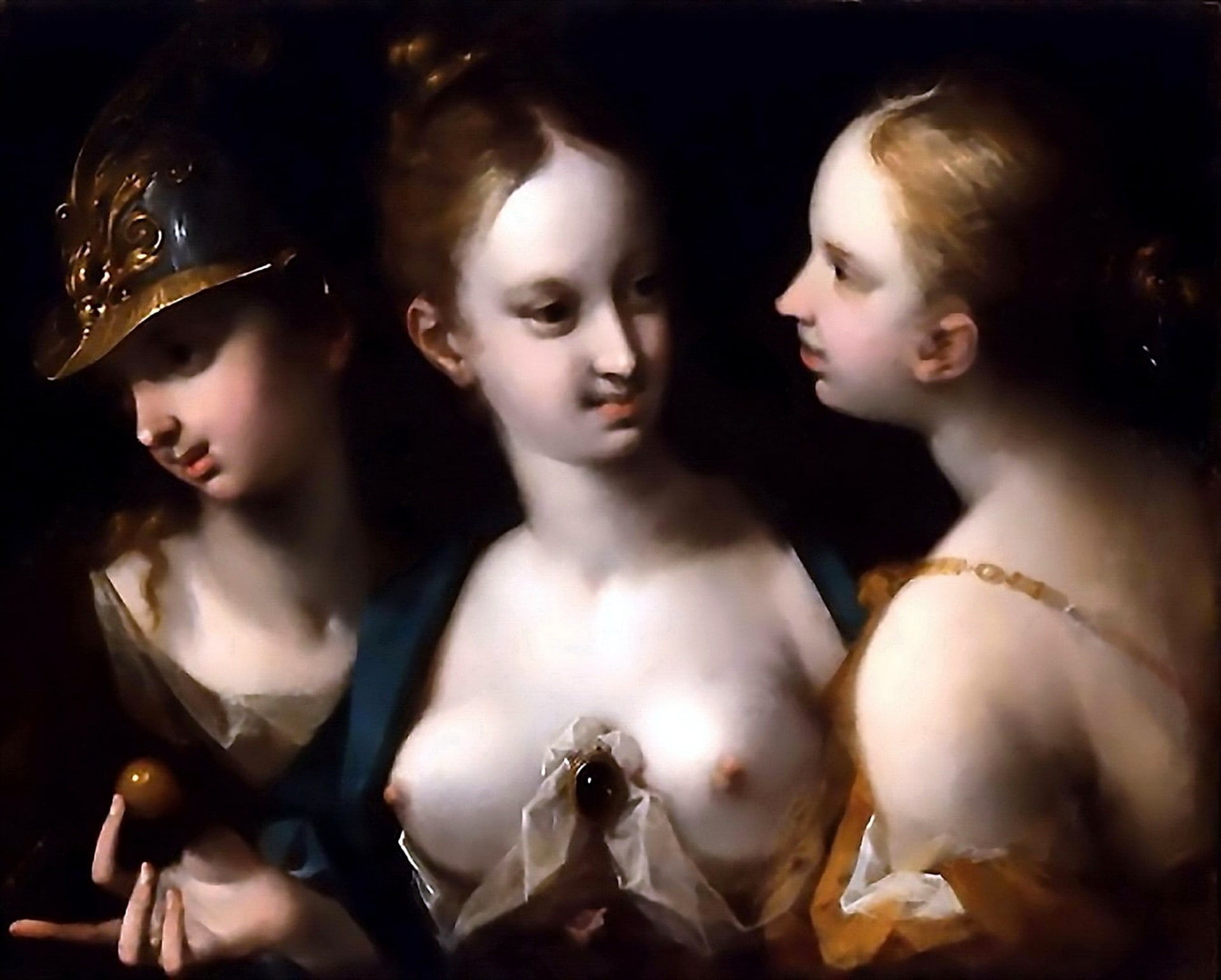
Three erotic Goddesses and Venus is flaunting her beautiful breasts and sexy nipples. These are three very naughty girls having fun together.

Athena, Venus and Juno. Hans von Aachen.

I think Venus the Goddess of Love lost her cherry a long time ago! She has beautiful breasts and very nice nipples on a voluptuous woman with pretty eyes. These are three very hot and sexy women. They all have one thing in common, luscious lips, which are all the better to kiss you with, so look out boys and watch your kisser! These girls are out on the town tonight! Venus The Goddess of Love has the power to overcome the strongest of men's will to resist making love and make them go all weak in the knees! She can even make a gay man go straight for one time with her. The power of the Goddess of Love. Mind you, nymphs can do that too! A nymph can also make a straight girl be gay for a short time! Those naughty nymphs! Just watch out for them on the way home from work! They are dynamite! Even if you are worn out form a hard days work, a nymphs power will help give you a big boost in energy! They are very naughty girls! You can find more Goddess of Love paintings on this site.

Contents.

Lite Erotic Art Page 6 with saucy paintings of naked women as well as hot nude girls and fleshy females You will also find wicked art of luscious ladies There are many naughty females on here for you to look at for sexy fun!
Lite Erotic Art page 8 with sexy paintings of horny nude women and lusty ladies Discover many seductive paintings of arousing naked females for your pleasure Be happy with lovely paintings of hot girls
 
Lite Erotic Art 1 Find pretty paintings of lovely ladies and beautiful naked women.
Sensuous paintings of feminine beauty and lovely nude ladies with flowers and roses.
Paintings of very famous lesbians and their lovers.
Naughty nymphs lust for sexy. They are always horny. The Sirens are close relatives of them.


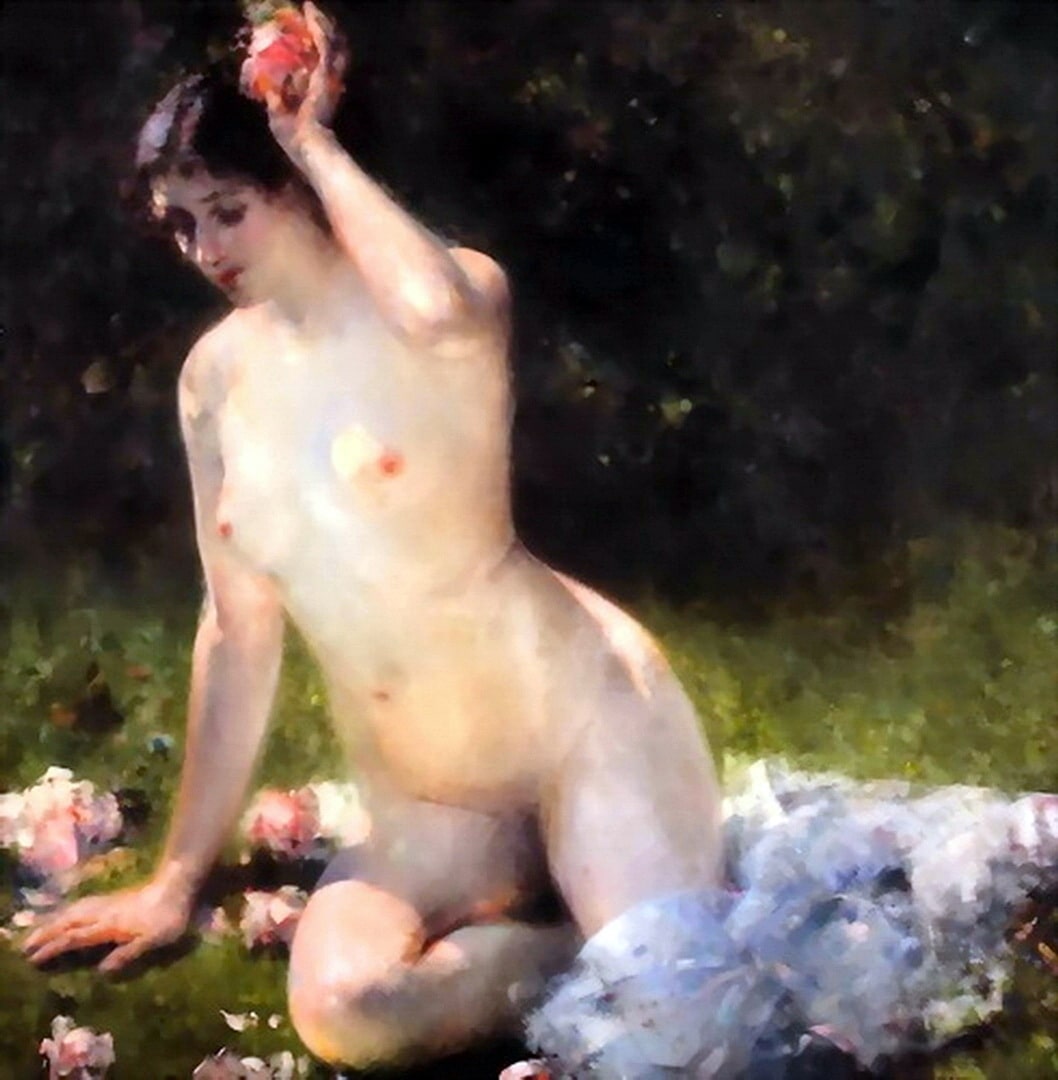
A lovely nude lady with a flower is displaying her breasts and is enjoying the sunshine.

Al Ruscello. Luigi Serralunga.

A pretty nude girl with flowers all around her. The beautiful young woman is seated on the ground displaying her bosoms to the world. The sexy naked lady is getting some sunshine on her body while she is seated on the grass.

Her erotic nipples are enjoying their freedom as are her lovely breasts. She has pretty eyes that have been taking in her splendid surroundings as she is seated in a paddock with pink and white flowers around her. A little thing like sitting naked in the bush can help lose your hang-ups and lead to hotter lovemaking. So if you find yourself a little slow in the making love department, boost your female sexuality by walking around the house naked or out in the bush nude! Make sure there is plenty of covering from drones!

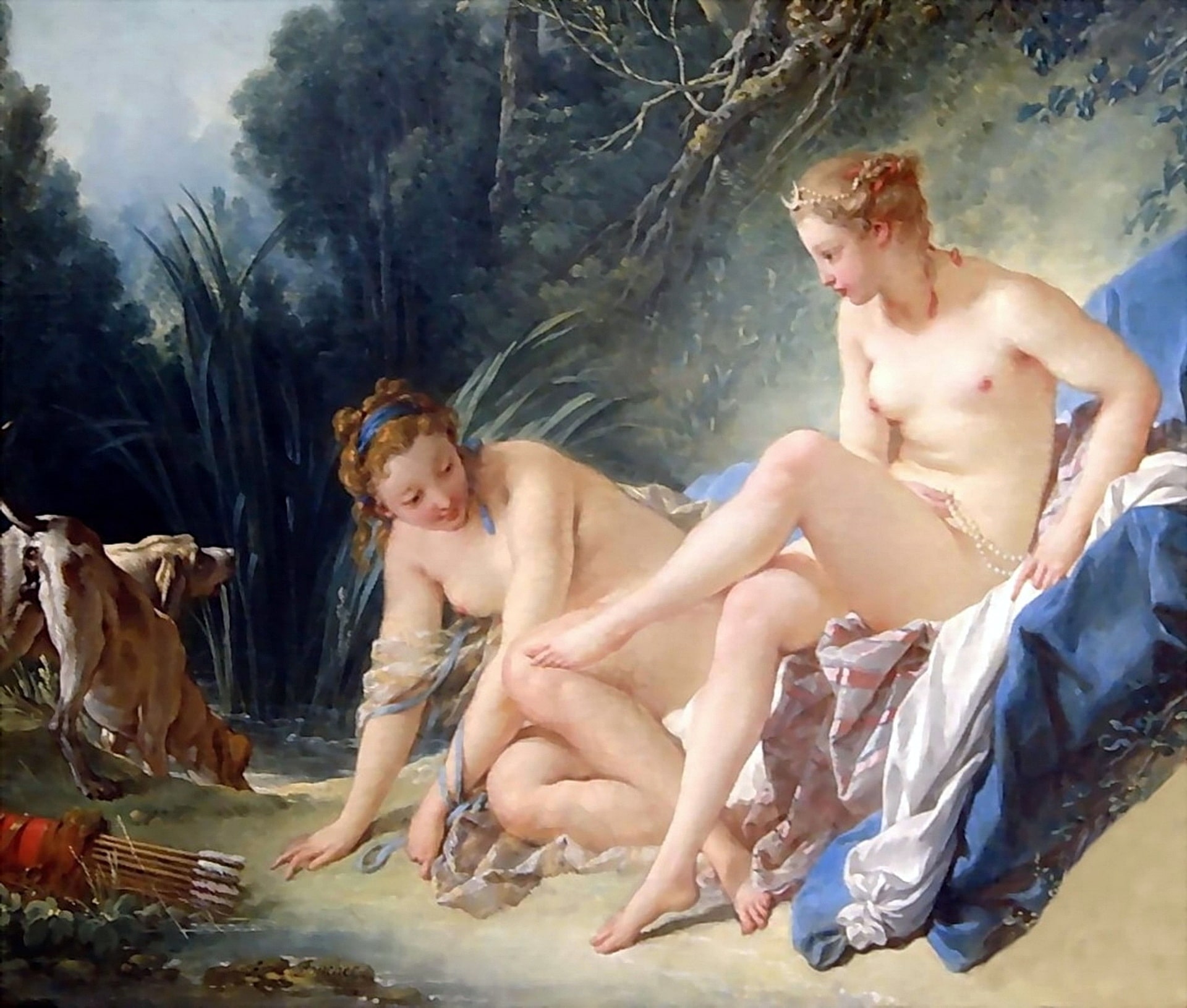
Two naked goddesses' side by side after Diana had a bath and shows off her sexy body.

Diana Leaving Her Bath. Francois Boucher.

Two very pretty naked ladies. These buxom women are enjoying a day out in the sunshine getting the warmth of the sun on their lovely nude bodies. You could say these are a couple of hot sexy girls and they are checking each others bare bodies out after having a bath together. It is fair to say these saucy girls both have beautiful bodies and erotic breasts with outstanding nipples. Keep looking at nude art to boost your sexual desires. Yes ladies, keep up the great work at looking at naked paintings. These sensuous bodies are all the better to love you with, If I told you that you had a beautiful body, would you hold it against me? Make hot love tonight! Move it baby! Move it!

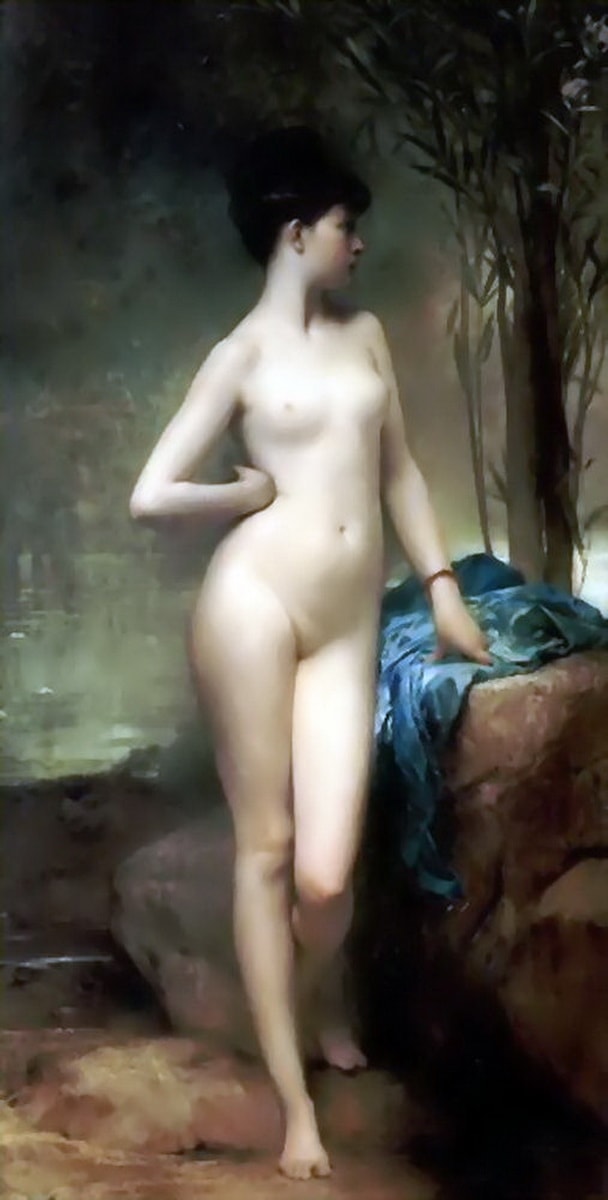
Chloe Jules Joseph LeFebre


Chloe by Jules Joseph Lefebvre.

Showing her delightful nude body to the world. Chloe has lovely long legs and her black hair is tied up at the back as she stands next to a pond. Her dress is covering the big rock she is leaning on. Chloe's elegant body is catching some sunshine and you can see her pretty breasts as she stands with one arm on her waist.

The original painting of Chloe is on display at Young and Jackson's Hotel. Melbourne, Australia, opposite Flinders Street Station. Be sure to check out the largest tram network in the world when you are in the area.

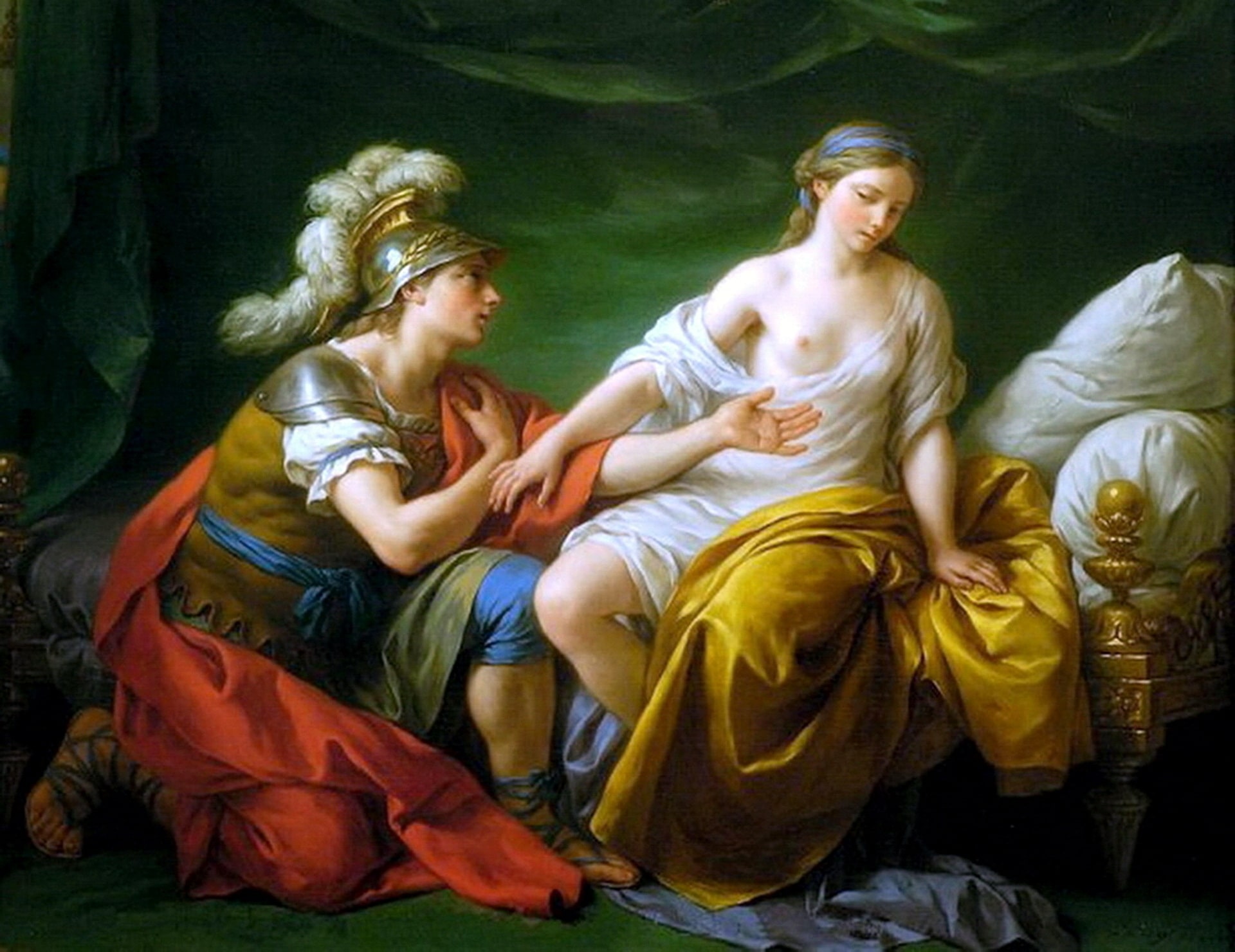
Alcibiades is begging for more from his mistress as she shows off her boob to him.

Alcibiades on His Knees Before His Mistress. Louis Jean Francois Lagrenee.

Please can I have another one? I'll be a good boy. Men! That's all they can think about! Mind you of they are kept busy with sex, there might be fewer wars! Imagine that! Keeping world peace by keeping men happy! That should put a smile on their faces. It should be the  girls and women asking if they can have a another one. If they have three or four in a day they will be too exhausted to go to war! Make Love not war!

Lingerie for sexy ladies and foxy females for hot lovemaking. Find seductive lingerie here.

Buy sexy lingerie for lovely ladies here.

Very, very, sexy! If love is blind, why do they sell so much lingerie? Supercharge your lovemaking with hot sexy lingerie. It's for horny girls too! So you can satisfy your horny desires here! Lure your lover into making love with erotic lingerie. There is plenty of spicy lingerie for hot sexy girls and steamy women. Turn your partner on with hot panties and pretty bras. You know resistance is futile! Your partner will be busting to get into your pants.

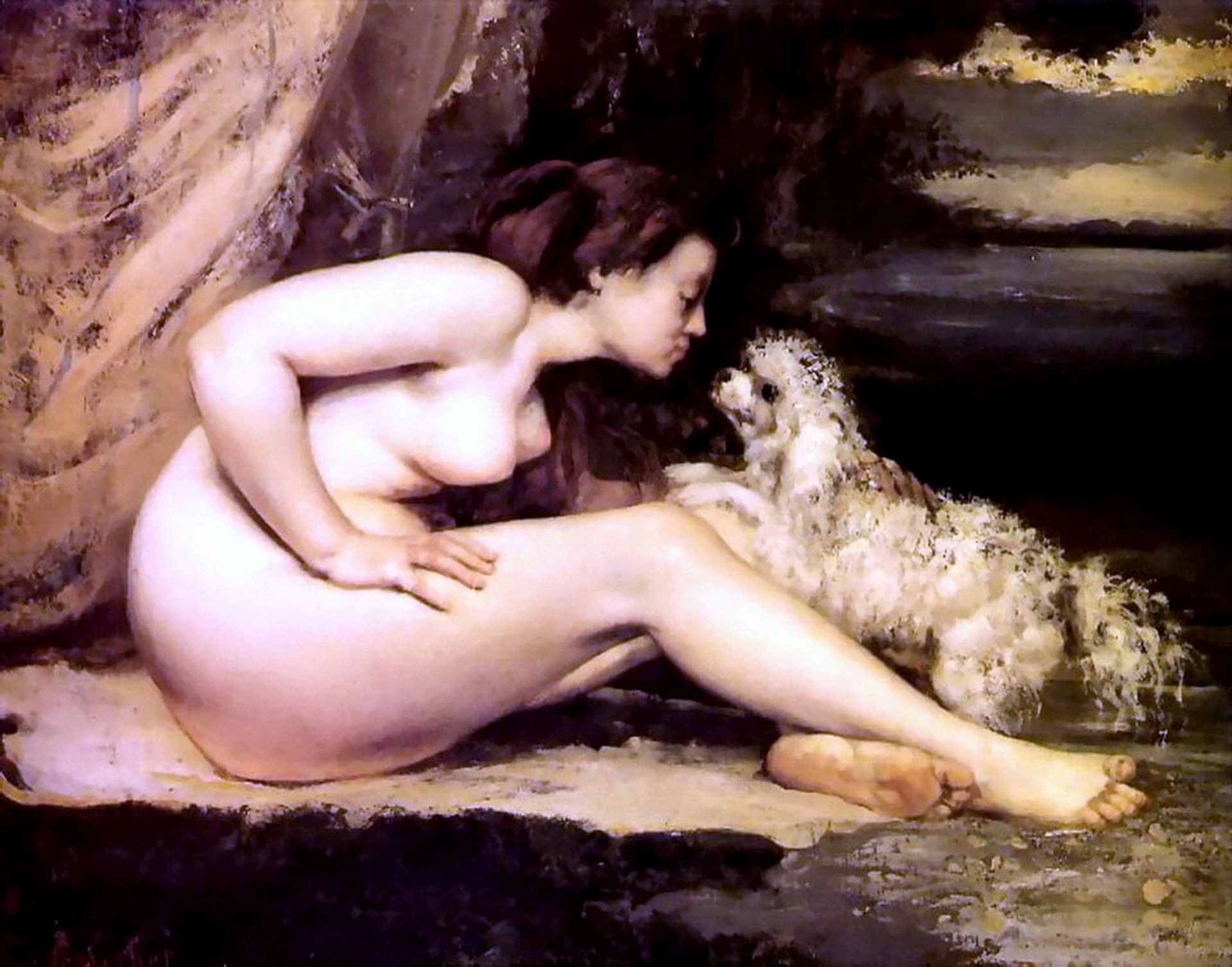
A naked woman with a dog The lady has voluptuous breasts and is comfortable being nude.

Female With a Dog. Gustave Courbet.

The young lady has very arousing breasts. "I bet you can't handle my curves!" said the saucy young girl. Throwing down a challenge for all takers. So the boys and some girls  rushed to join the queue for fun and games. What a hot night she will have in the old town tonight! Yes you to can be a naughty girl. It's very easy to be a naughty girl, but much harder to be a good girl! But then the fun busters will tell you all sorts of things just to spoil your fun!

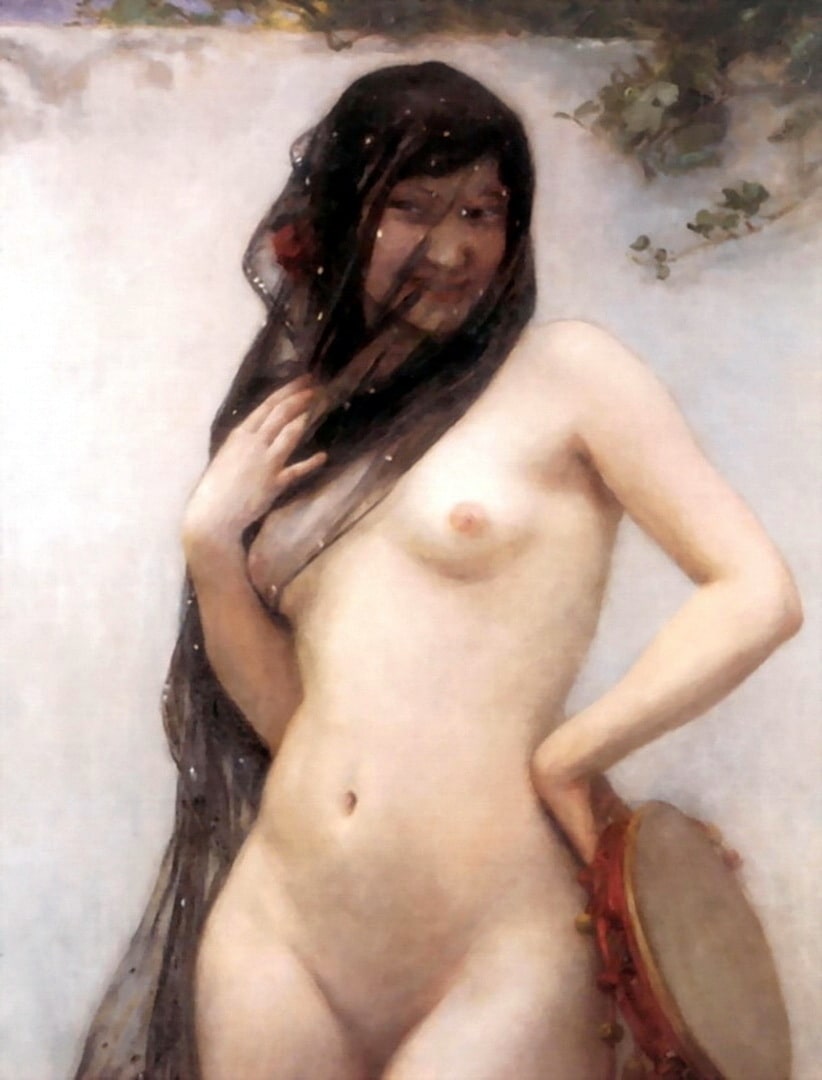
A saucy nude lady with a sheer black garment over her head. She looks very seductive.

Gachucha. Guillaume Seignac.

But it's not her Green Tambourine. The woman has a sheer black garment draped over her head. Very naughty! The Temptress is at work luring lads to their desire for sexual pleasures. I can see the men rushing to fill her lustful desires. But does she want quantity or quality? That is the question. I think most guys would whip it in, whip it out and wipe it, and nothing much else. But maybe that's all she wants. A quick bit of slap and tickle.

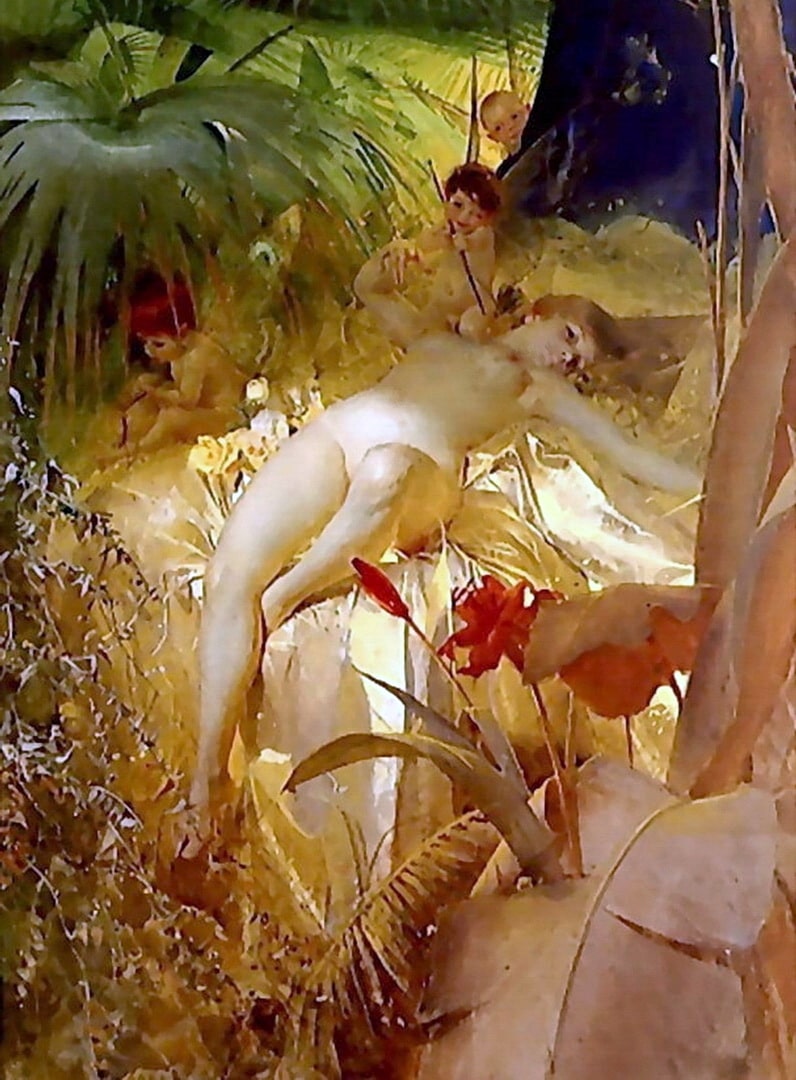
A naked nymph lying on the ground waiting to be sexually satisfied. They love lots of sex.

Karleksnymf. Anders Zorn.

"Here I am ready and waiting!" Said the naughty naked girl."Come and get it!" Nymphs want sex and more sex. This wicked woman is waiting for it. She'll grab anyone going past and just about gobble them all up! More, more, more. How does she like it? As much as possible. Not only that, she has a no discrimination policy between men and women. She's hungry, hungry, hungry and it's time for a big feed. Look out for anyone walking passed, she'll jump at the chance.

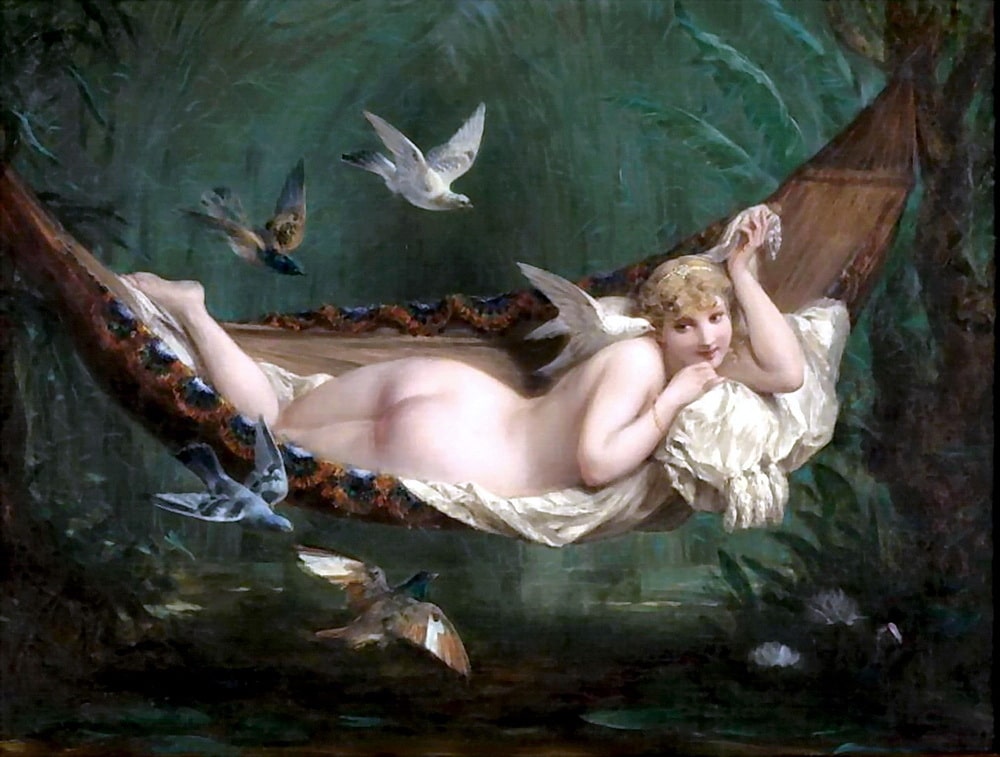
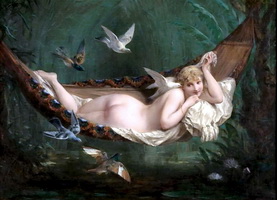
A blond girl with lovely eyes in a hammock showing off her bottom and desiring love.

The Hammock. Henry Pierre Picou.

A woman with pretty eyes and a naughty bottom! "All the better to love you with!" Says the cheeky girl luring lads to lovemaking. Come and visit me and we'll talk about the first thing that pops up! Says the naughty girl! Think dirty, talk dirty and you'll get what you want. Lot's of sex. More than you can eat!

Vibrators boost a woman's orgasms and help her make love more often and have better sex.

Put a tingle in your twat and sing ting-a-ling a-lou! After all, girls just want to have fun and women love sex too! You can be a hotter lover by reading steamy books and looking at erotic art. Not only that, sex toys can help improve your lovemaking and boost female orgasms. Yes, you can become a very horny girl with adult toys. Now ladies don't forget to grab your partners and drag them to bed and make passionate love again and again. It's your duty to help keep the world a happy place. Men, I want you to put your middle foot in and your middle foot out, you can do the hokey, pokey and then do it all again. But be sure to make it as much fun as possible.


Sexy Art for Women 1 Find pretty paintings of lovely ladies and beautiful naked women 2.
Sensuous paintings of feminine beauty and lovely nude ladies with flowers and roses 2.
Paintings of very famous lesbians and their lovers 2. Gay ladies and famous females
The naughty nymph’s, sirens, fairies (related) all lust for sex. They are always hot and horny. They are very wicked girls and have sex with males, females, and Satyrs. Even all three at once!.
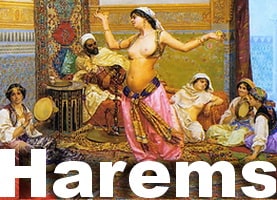
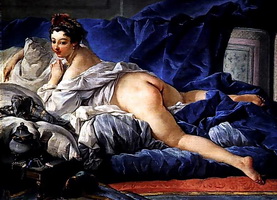
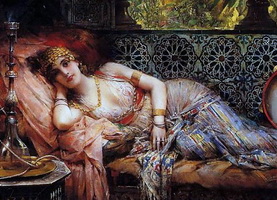
Harems are the home to Odalisques who provide sexual favours to Sultans.
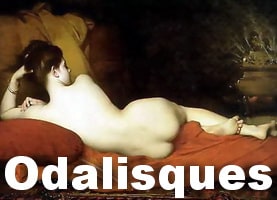
Odelisques are the girls who provide sexual favours to the Sultans.
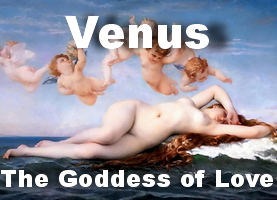
Venus the Goddess of Love. Lust,desire and sexual pleasure are what Venus gives to you.
Sexy Art for Women Page 2 Paintings of nude girls and foxy females Lusty ladies showing off their naked bodies in the name of art.
Sexy Art for Women 03 Nude paintings can help to improve a woman's sexuality and love.
Sexy Art for Women 04 Naked paintings of sexy women can help girls with better lovemaking.
Sexy Art for Women 5 Discover naked paintings of foxy females and lusty ladies in portraits.
Sexy Art for Women 6 Find nude portraits of sensuous women and flirty females having sexy fun.
Sexy Art for Women 7 Find vintage portraits of cute girls showing their sexy breasts.
Sexy Art for Women 8 Beautiful paintings of sexy nude girls and lovely females.
Sexy Art for Women 9 Elegant portraits of sensuous women and seductive females.
Sexy Art for Women 10 Pretty paintings of luscious ladies and dainty females.
Lite Erotic Art Page 1 with saucy paintings of naked women as well as hot nude girls and fleshy females You will also find wicked art of luscious ladies There are many naughty females on here for you to look at for sexy fun!


Sexy Art for Women page 3 with sexy paintings of horny nude women and lusty ladies Discover many seductive paintings of arousing naked females for your pleasure Be happy with lovely paintings of hot girls

Géricault’s Radeau de la Méduse and Delacroix’s Dante et Virgile aux Enfers were acceptable to the public, the one because of its dramatic interest, the other because of its literature. But L’Enterrement à Ornans entirely lacked the popular qualities of these two other pictures. It was full of rugged and hardy precision. Its insolent ugliness of subject-matter and its implied indifference to all tradition, seemed to express the quintessence of artistic degradation and sordidness. At first view the picture appears to have been inspired by El Greco’s Obsequies of the Count of Orgaz, but it is more likely that these peasants of Ornans, each a notable of the town, with their indifferent expressions and awkward gestures, were attributable to The Martyrdom of Saint Bartholomew of Ribera and La Folle of Géricault, rather than to the master of Toledo. But that the Spanish helped paint it is evident: some parts of the landscape are taken bodily from their canvases. Meier-Graefe states that this funeral picture, like most of the representative pictures of the nineteenth century, is not representative of the artist himself. But did Meier-Graefe understand more profoundly the synthesis of composition found in individual painters, he would have seen that here was the famous S composition which was56 used throughout the painter’s life. Instead of being set on end, as was the practice of the Italians, it is used laterally and extends from left to right in depth.

In colour also this picture is representative of Courbet, for it shows his limitations in that medium. Delacroix brought a new palette to painting, but could not use it. Courbet contented himself with a palette as meagre as that of Caravaggio and Guercino. And yet, though colour has come latterly to mean tactile form in its highest sense, this black canvas, when placed beside either an Ingres, a David, a Delacroix or a Gérard, appears less flat and inconsequential than the latter. The form is even suggestive of Rembrandt, Giotto, Cézanne and Renoir.

Champfleury was the only friend of Courbet who dared defend him. Delacroix was set against him, and the critics, without understanding him, obscured the true importance of his art by talking of his want of transcendentalism and sentiment. Especially were his landscapes the butt of their ridicule, for painters up to that time had made use of conventional arrangements of dainty trees copied for their drawing and tone. In Courbet all this was changed. He organised landscapes as he did still-lives and nudes. Objects, as such, meant nothing to him. In this he struck a new and modern note which the good people of his day considered not only bad art but a slur upon the spiritual meanings of nature. Even in Les Baigneuses, where the figures are unimportant, the trees are superb. In La Grotte he went further, for here the figure was part of the whole. His paintings of the 57hills about Ornans had a movement which gave off a sensation of weight entirely new in painting. In Les Grands Châtaigniers he reached his apogee in landscape painting. This picture is greater than those of any of the Englishmen.

Though many critics have written that Millet influenced Courbet, the reverse is the truth. The former’s life work was largely a repetition of the lights and darks found in Courbet’s earlier pictures. Les Casseurs de Pierres is far greater than anything Millet has ever done, despite the vast popularity of such purely sentimental pictures as The Angelus and The Man with the Hoe. Courbet could never have been satisfied with the angularity and absence of rhythm in the other’s work. In Millet’s best canvases one finds at most only a parallelism of lines, and in his lesser pictures even this amateurish attempt at organisation is lacking. But in Les Casseurs de Pierres the arrangement is one which recalls the competency of linear balance and development in Tintoretto’s Minerva Expelling Mars.

When Courbet entered painting, he had neither prejudices nor a parti pris. He tested his ability before engaging his full complement of resources. Though untutored, he had that cast of intelligence which no amount of study can produce and no amount of adverse criticism influence. Delacroix, on the other hand, was the archetype of the highly cultured and educated man. He foresaw the necessity for radical reform, but was unable to bring it about significantly. Courbet instinctively projected himself into that void at the brink of which tradition halts and the unknown begins. And because he was a man of genius58 he did not return empty-handed.

The art of Courbet was too aristocratic to be appreciated. Not aristocratic in the Delacroix sense, but isolated and superior. Rejecting the colour discoveries of his day, he created his own materials. Delacroix foreshadowed the medium which was to serve as a vehicle for the achievement of future generations, but it was Courbet who brought to art a new mental attitude without which there would be no excuse for modern painting. By turning men’s thoughts from ancient Italy to the actualities of their own day, and by expelling the literary canvas from art, he left those who came after him free to evolve a medium which would translate the new vision. Delacroix’s heritage to art was intellectual, Courbet’s dynamic. And though objectively the work of Courbet is the uglier and less gracious, in it there is more of the sublime. But both men are indispensable, and have a just claim to the eternal respect of posterity.

The construction of form as voluminous phenomena that integer of modern painting which was lacking in Delacroix, Turner and Courbet, but which has become one of the leading preoccupations of present-day artists was introduced by Honoré Daumier. This painter who, unlike his three great contemporaries, fought for the pure love of the fight, was celebrated as a caricaturist at twenty-five. Such fame was warranted, for he was unquestionably the greatest and most trenchant caricaturist the world has ever produced. From 1835 to 1848 he made capital of all those many catastrophes which overtook France. Only the curtailing of the freedom of the press on December 2, 1848, put an end59 to his career as publicist. This culmination of his editorial activities was a beneficial thing for both Daumier and the world, for it permitted him freedom to devote himself wholly to the development of the larger side of his genius. He endeavoured to interest his friends in his painting; but too long had he been known as a critic of current topics for them to look with serious eyes upon his more solid endeavours.

But though neglected by his friends, Daumier holds a position of tremendous importance in relation to the moderns. His work developed along lines unthought-of by either Delacroix or Courbet. Even his cartoons were more than clever pictorial comments on national events. Intrinsically they were great pieces of rugged flesh which had all the appearance of having been chiselled out of a solid medium with a dull tool. The richness of his line is as complete as in Rembrandt’s etchings; and his economy of means reached a point to which painters had not yet attained. His significance, however, lies more especially in his new method of obtaining volume than in the flexibility of his line drawings. He built his pictures in tone first. The drawing came afterward as a direct result of the tonal volumes. This new manner of painting permitted him a greater subtlety and fluency than Courbet possessed. In fact, Daumier’s comprehension of form in the subjective sense was greater than that of any Frenchman up to his time. Compare, for instance, Daumier’s canvas, Les Lutteurs, with Courbet’s picture of the same name. The massiveness of the one is monumental. One feels the weight of the 60two struggling men, heavy and shifting, clinging and panting. They are modelled by a craftsman who can juggle deftly with his means. In Courbet’s picture the figures are seen carefully copied in a strained pose by one who has not the complete mastery of his tools. In Daumier’s picture we also sense that elusive but vital quality called mental attitude. Superficially it is almost indistinguishable from its negation, but to those who know its significance, it is of permeating importance.

Contour and shading to his forerunners had meant two separated and distinct steps in the construction of form. Daumier created both qualities simultaneously as one emotion. Depth with other painters was obtained by carrying their figures into the background by the means of line and perspective. With Daumier it meant a plastic building up of volume from the background forward. The feeling we have before his canvases that we are looking at form itself and not merely an excellent representation of it, is as strong as it is in a greater way when we stand before a Leonardo da Vinci. In this he gave proof that he was a draughtsman in the most vital sense. Unless he had felt form uniquely, Le Repos des Saltimbanques and Le Bain would have been impossible of creation. This last picture sums up what Carrière aspired to but failed to attain.

LE BAIN DAUMIER

Recalling the great masters of form we instinctively visualise Michelangelo first. For this reason perhaps Michelangelo is regarded the major influence in Daumier. “Il avait du Michel Ange dans la peau,” say the French: and certain it is that Daumier’s colossal simplicity and feeling for tactility 61were derived from the Renaissance master. But only in one picture, a composition called La République 1848, do we find any direct and conscious influence. Frankly this is but a modernisation of one of the sibyls on the ceiling of the Sistine Chapel. The truth is Daumier is more akin to Rembrandt than to Michelangelo. But there is in him none of the conscious copying of Rembrandt that we find, for instance, in Joshua Reynolds. The latter, admiring Rembrandt, essayed to equal his power by imitating his externals with academic processes. Daumier, temperamentally affiliated with his master, went deeper. Putting aside the results of Rembrandt’s final brush strokes, he studied the very functioning procedure of his art. Both used the human figure as a terrain for the unceasing struggle of light against dark. In the process of painting the infinite play and by-play of opposed values on a given theatre, they produced form as an inevitable result.

A critic has stated of Daumier: “He left hardly anything but sketches, splashes of colour that resolve themselves into faces....” It is said without attempt at profundity. Nevertheless the remark unsuspectingly touches the crucial point of Daumier’s significance. The very resolution of those “splashes of colour” into faces is the prefiguration of the modern conception of form. In this particular Daumier, even more than Rembrandt, was the avant-courier of Cézanne. This latter artist, through his concern with the play of one colour on another, gave birth to form 62more intensely than did either of the older men. Too much stress cannot be laid on Daumier’s contribution to modern painting. By regarding the two drawings, La Vierge à l’Écuelle and Renaude et Angélique the one by Correggio in chalk, the other by Delacroix in water-colour we perceive the attainment of form by less profound methods. But neither possesses the significance of Daumier’s work.

Of Daumier’s colour little need be said. At times it emerges from its sombreness and blossoms forth in all the hot softness of now the Venetians, of again the Spaniards; but compared with the artist’s genius for plastic form it is of subsidiary importance.

Although the inception of Daumier’s greatness can be traced to Rembrandt, he reacted to many influences. Suggestions of Monnier and Granville are to be found in his work. Decamps’s Sonneurs de Cloches was studied by him and emulated. His simplifications stemmed from Ingres, and his caricature of Guizot had the same qualities as that master’s portraits. Delacroix also had some trifling influence on him in such paintings as Don Quichotte. But Daumier’s influence on others is more direct and far-reaching than his own garnerings of inspiration. He foreshadowed the formal abbreviations of Toulouse-Lautrec, Forain and Steinlen, and he affected, more than is commonly admitted, the works of Manet, Degas, and Van Gogh. In his sculptured pieces, Ratapoil and Les Émigrants, he paved the way for Meunier and Rodin. Even such minor men as Max Beerbohm learned much from him without understanding him. And apart from the vital new methods he brought63 to painting, the originality of his subject-matter led modern men to copy him thematically. Le Drame fathered a whole series of Degas’s paintings.

Daumier is only beginning to receive the intelligent appreciation which in time may engulf his eminent contemporary, Courbet. For if choice there is between the intrinsically artistic achievements of the painter of L’Enterrement à Ornans and the creator of Silène, the preference rests with Daumier.

The forces underlying the development of genius, working in conjunction with the right circumstances, produce the fertilising methods which nature uses to bring about a final flowering of a long period of intense germination. Before the greatest eras of all art the battles have been fought and won. The descendants of the pioneers become the introspective and creative souls who open, free from the stain of combat, to the sun of achievement. Delacroix, Turner, Courbet, Daumier these are the men who cleared the ground and thereby made possible a new age of aesthetic creation. To Delacroix belongs the credit for giving an impetus to the vitalisation of colour, and for freeing drawing from the formalisms of the past. Turner raised the tonality of colour, and introduced a new method for its application. Courbet heightened uniformly the signification of objects in painting, and 64handed down a mental attitude of untraditional relativity. And Daumier conceived a new vision of formal construction. These men were the pillars of modern painting.


III

ÉDOUARD MANET

THE purely pictorial has always been relished by the public. The patterns of the mosaicists and very early primitives, the figured stuffs of the East and South, the vases of China and Persia, the frescoes on the walls of Pompeii, the drawings and prints of old Japan all are examples of utilitarian art during epochs when the public took delight in the contemplation of images. Even the delicate designs on Greek pottery, the rigid and ponderous arts of architectural Egypt and the drawings and adorned totem poles of the North American Indians are relics of times when the demand for art was created by the masses. For the most part all these early crafts were limited to simple designs, wholly obvious to the most rudimentary mind. The ancients were content with a representation of a natural object, the likeness of a familiar animal, the symmetry of an ornamental border, an effigy of a god in which their abstract conceptions were given concrete form. At that time the artist was only a craftsman a man with a communistic mind, content to follow the people’s dictates and to reflect their taste. Art was then democratic, understood and admired by all. It did not raise its head about the mean level; it was abecedary, and65 consequently comprehensible.

When the Greek ideal of fluent movement took birth in art and became disseminated, drawing, painting and sculpture began to grow more rhythmic and individual. Slowly at first and then more and more swiftly, art became insulated. The popular joy in the native crafts, despite the impetus of centuries behind it, decreased steadily. The antagonism of the masses to the artist sprang up simultaneously with the disgust of the artist for the masses. It was the inevitable result of the artist’s mind developing beyond them. He could not understand why they were no longer in accord with him; and they, finding him in turn unfathomable, considered him either irrational or given over to fantastic buffoonery. So long had they been the dictator of his vision that his emancipation from their prescriptions left them astounded and angered at his audacity. The nobles then, feeling it incumbent upon them to defend this new luxury of art, stepped into the breach, and for a time the people blindly patterned their attitude on that of their superiors. Later came the disintegration of the nobility; its caste being lost, the people no more imitated it. From that time on, although there were a few connoisseurs, the large majority was hostile to the artist, and made it as difficult as possible for him to live. He was looked upon as a madman who threatened the entire social fabric. His isolation was severe and complete; and while many painters strove to effect a reinstatement in public favour, art for 300 years forced its way through a splendid evolution in the face of neglect, suspicion and ridicule.

For so many generations had66 the public looked upon art as the manifestation of a disordered and dangerous brain that they found it difficult to recognise a man in whose work was the very pictorial essence they had originally admired. This man was Édouard Manet. Instead of being welcomed for his reversion to decoration, strangely enough he was considered as dangerous as his contemporary heretics, Delacroix and Courbet. Courbet was at the zenith of his unpopularity when Manet terminated his apprenticeship under Couture. The young painter had had numerous clashes with his academic master, and the latter had prophesied for him a career as reprehensible as Daumier’s. Spurred on by such incompetent rebukes, Manet determined to launch himself single-handed into the vortex of the aesthetic struggle. This was in 1857. For two years thereafter he put in his time to good purpose. He travelled in Holland, Germany and Italy, and copied Rembrandt, Velazquez, Titian and Tintoretto. These youthful preferences give us the key to his later developments. In 1859 he painted his Le Buveur d’Absinthe, a canvas which showed all the ear-marks of the romantic studio, and which exemplified the propensities of the student for simplification. It was a superficial, if enthusiastic, piece of work, and the Salon of that year was fully justified in rejecting it. Two years later Manet had another opportunity to expose. In the meantime he had painted his La Nymphe Surprise which, though one of his best canvases, contained all the influence of a hurriedly digested Rembrandt and a Dutch Titian.

In 1861 these influences 67were still at work, but the Salon not only accepted his Le Guitarrero but, for some unaccountable reason, awarded it with an honourable mention. In this picture, Manet’s first Spanish adaptation, are also traces of other men. Goya and even Murillo are here the greys of Velazquez and Courbet’s modern attitude toward realism. In this canvas one sees for the first time evidences of its creator’s technical dexterity, a characteristic which later he was to develop to so astonishing a degree. But this picture, while conspicuously able, is, like L’Enfant a l’Épée and also Les Parents de l’Artiste, the issue of immaturity. Such paintings are little more than the adroit studies of a highly talented pupil inspired by the one-figure arrangements of Velazquez, Mazo and Carreño. Where Manet improved on the average student was in his realistic methods. While he did not present the aspect of nature in full, after the manner of Daubigny and Troyon, he stated its generalisations by painting it as seen through half-closed eyes, its parts accentuated by the blending of details into clusters of light and shadow. This method of visualisation gives a more forceful impression as an image than can a mere accurate transcription. As slight an innovation as was this form of painting, it represented Manet’s one point of departure from tradition, although it was in truth but a modification of the traditional manner of copying nature. The public, however, saw in it something basically heretical, and derided it as a novelty. The habit of ridicule toward any deviation from artistic 68precedent had become thoroughly fixed, ever since Delacroix’s heterodoxy.

It was not until 1862 that Manet, as the independent and professional painter, was felt. Up to this time his talent and capabilities had outstripped his powers of ideation. But with the appearance of Lola de Valence the man’s solidarity was evident. This picture was exposed with thirteen other works at Martinet’s the year following. It was hung beside the accepted and familiar Fontaineleau painters, Corot, Rousseau and Diaz; and almost precipitated a riot because of its informalities. In these fourteen early Manets are discoverable the artist’s first tendencies towards simplification for other than academic reasons. Here the abbreviations and economies, unlike those in Le Buveur d’Absinthe, constitute a genuine inclination toward emphasising the spontaneity of vision. By presenting a picture, free from the stress of confusing items, the eye is not seduced into the by-ways of detail, but permitted to receive the image as an ensemble. This impulse toward simplification was prefigured in his Angelina now hanging in the Luxembourg Gallery. Here he modelled with broad, flat planes of sooty black and chalky white, between which there were no transitional tones. While in this Manet was imitating the externals of Daumier, he failed to approach that master’s form. Consequently he never achieved the plasticity of volume which Daumier, alone among the modern men, had possessed. However, despite Manet’s failure to attain pliability, these early paintings are, in every way, sincere efforts toward the creation of an individual style. It was only later, after his first intoxicating taste of69 notoriety, that the arriviste spirit took possession of him and led him to that questionable and unenviable terminus, popularity. One can imagine him, drunk with eulogy, reading some immodest declaration of Courbet’s in which was set forth that great man’s egoistic confidence, and saying to himself: “Tiens! Il faut que j’aille plus loin.”

The famous Salon des Refusés, called by some critics of the day the Salon des Réprouvés, gave Manet his chance to state in striking fashion his beliefs in relation to aesthetics. For whereas mere realism could no longer excite the animosity of the official Salon jury, as it had done twenty years before, immorality or, as Manet chose to put it, franchise could. Therefore Manet was barred from the company of the Barbizon school and the other favourites of the day. In the Salon des Refusés, which must be held to the credit of Napoleon III, those painters who had suffered at the hands of the academic judges were allowed a hearing. Whistler, Jongkind, Pissarro and Manet here made history. Manet sent Le Bain, which, through the insistence of the public, has come to be called Le Déjeuner sur l’Herbe. But despite the precedent of Giorgione’s Rural Concert (the Concert Champêtre in the Louvre), it was looked upon only as the latest manifestation of degeneracy in a man who gave every promise of becoming a moral pariah. The nude, contrasted as it was with attired figures, was too suggestive of sheer nakedness. Had the nude stood alone, as in Ingres’s La Source, or among other nudes, as in Ingres’s Le Bain Turc, the picture would have caused no comment. Its departures in method were not extravagant. The scene is laid out of doors, yet it70 bears all the evidences of the studio conception; and those lights and reflections which later were brought to such perfection in the pictures of the Impressionists and Renoir, are wholly absent. But in one corner is a beautifully painted still-life of fruits, a basket and woman’s attire, which alone should have made the picture acceptable. This branch of painting Manet was to develop to its highest textural possibilities.

From this time on Manet no longer used the conventional chiaroscuro of the academicians. Instead he let his lights sift and dispel themselves evenly over the whole of his groupings. This mode of procedure was undoubtedly an influence of the Barbizon painters who had done away with the brown sauce of the soi-disant classicists. In his rejection of details and his discovery of a means whereby effects could be obtained by broad planes, Manet was forced by necessity to take the step toward this simplification of light. Were colour to be used consistently in conjunction with his technique, it must be spread on in large flat surfaces. By diffusing his light the opportunity was made. He might have omitted the element of colour from his work and contented himself with black and white, as in the case of Courbet; but he was too sensitive to its possibilities. He had observed it in the Venetians and Franz Hals, as well as in nature; and in its breadth and brilliance he had recognised its utility in enhancing a picture’s decorative beauty. Even the colour of Velazquez was at times sumptuous. Manet, because his simplicity of manner permitted a liberal application of colour, was able to augment its ornamental power. It is true that today his large and irregular71 patches of tints appear grey, but, to his contemporaries, their very extension made them seem blatant and bold.

Courbet remained in great part the slave to the common vision of reality. In his efforts to attain results he sacrificed little. This, in itself, delimited his accomplishments. Nature to him appeared nearly perfect, and he painted with all the wonderment of a child opening its eyes on the world for the first time. On the other hand, Manet realised that nature’s forces become objective only through an intellectual process. This attitude marked a decided step in advance of Courbet. Manet painted single figures and simple images devoid of all anecdotal significance, out of his pure love of his medium and his sheer delight in tone and contour. In other words, he represented the modern spirit which repudiates objects conducive to reminiscence, and cares only for “qualities” in art. His intentions were those of Courbet pushed to greater freedom. Unlike his master he was a virtuoso of the brush. His very facility perhaps accounts for his satisfaction with flat decoration, for it concentrated his interest on the actual pâte and thereby precluded a deeper research into the psychology of aesthetic emotion. But in his insistence on the aesthetic rather than the illustrative side of painting he carried forward the ideals which were to epitomise modern methods.

In this lay the impetus he gave to painting. Even with Rubens the necessities of the day forced him, in his choice of themes, to adopt a circumscribed72 repertoire, the subjects of which he repeated constantly. In him we have mastery of composition with the substance as an afterthought. Delacroix conceived his canvases in the romantic mould, and adapted his compositions so as to bring out the salient characteristics of his chosen theme. This was illustration with the arrière pensée of organisation. Daumier struck the average between these two and conceived his subject in the form he was to use. Courbet minimised the importance of objects as such by raising them all to the same level of adaptability: but he invariably chose, as with an idée fixe, his subjects from the life about him. Manet cared nothing for any subject whether traditional or novel. That he generally chose modern themes was indicative of that new mental attitude which recognises the unimportance of subject-matter and urges the painter to abandon thematic research and utilise the things at hand. He made his art out of the materials nearest him, irrespective of their intrinsic topical value.

This was certainly an important step in the liberating of art from convention. It proclaimed the right of the artist to paint what he liked. Courbet would have painted goddesses if he had seen them. Manet would have painted them without having seen them, provided he had thought the result warranted the effort. Courbet, the father of naturalism, extended the scope of subject-matter, while Manet tore away the last tie which bound it to any tradition, whether Courbet’s or Titian’s. After him there was nothing new to paint. It is therefore small wonder that artists should now have become interested in the forces of 73 nature rather than in nature’s mien. Manet, by his consummation of theme, foreshadowed the concern with abstractions which has now swept over the world of aesthetics. Zola, like him in other ways, never equalled him in this. L’Assommoir and Fécondité portrayed only the extremes of realism. Manet painted all things with equal pleasure. Here again is evident the continuation of that mental attitude which Courbet introduced into painting. The qualities in Manet which inclined toward abstraction have secured him the reputation for being a greater generaliser than Courbet whose brutal naturalism could not be dissociated in the public mind from concrete and strict materialism. For this contention there is substantiation of a superficial nature. But a mere tendency toward generalisation, with no other qualifications, does not indicate greatness. In fact, were this purely literal truth concerning Manet conclusive, it would tend to disqualify him in his claim to an importance greater than Courbet’s. Carrière is an example of a painter who is general and nothing more. Manet had other titles to consideration.

What Manet’s enduring contributions to painting were have never been surmised by the public. His recognition, coming as it did years after his most significant works had been accomplished and set aside, was due to a reversion of the public’s mind to its aboriginal admirations. Manet is popular today for the same reason that the lesser works of Hokusai and Hiroshige are popular, namely: they present an instantaneous image which is at once flat and motionless. As in the days of the mosaicists and early primitives, the74 appreciation of such works demands no intellectual operation. Their recognisable subjects only set in motion a simple process of memory. The Olympia, Manet’s most popular painting, illustrates the type of picture which appeals strongly to minds innocent of aesthetic depth. Its mere imagery is alluring. As pure decoration it ranks with Puvis de Chavannes. But in it are all the mistakes of the later Impressionists. Manet consciously attempted the limning of light, but brilliance alone resulted. He did not realise that, in order for one to be conscious of illumination, shadow is necessary. This latter element, with its complementary, produces in us the sensation of volume. True, there is in the Olympia violent contrast between the nude body, the bed and the flowers, on the one hand, and the background, the negress and the cat, on the other; but it is only the contrast of dissimilar atmospheres. The level appearance of the picture is not relieved.

The cardinal shortcoming in a painting of this kind is that it fails to create an impression of either the aspects or the forces of nature. Such pictures are only flat representations of nature’s minor characteristics. The most resilient imagination cannot endow them with form: the intelligence is balked at every essay to penetrate beyond their surface. In contemplating them one is irritated by the emptiness, or rather the solidity, of the néant which lies behind. Courbet called the Olympia “the queen of spades coming from her bath.” Titian, had he lived today, would have styled it a photograph. Goya (who is as much to blame for it as either Courbet or Titian) would have 75 considered its shallowness an inexcusable vulgarity. In painting it undoubtedly Manet’s intention was to modernise Titian’s Venus Reclining now hanging in the Uffizi; just as later it was Gauguin’s intention, in his La Femme aux Mangos, to endow the Olympia with a South Sea Island setting. Such adaptations are indefensible provided they do not improve upon their originals. There is no improvement in Gauguin’s Venus; and Manet’s picture, while it advances on Titian in attitude, is a decided retrogression viewed from the standpoint of form.

In such pictures as the Olympia, Nana and La Jarretière we recognise Manet’s effort to obtain notoriety. He was not an aristocrat as was Courbet or Goya or Titian. It was not a need for freer expression that induced him to paint pictures which shocked by their unconventionality, but a desire to abasourdir les bourgeois. In choosing his subject-matter he always had a definite end in view in relation to the public; but his conceptions were spontaneous and were recorded without deliberation. He painted with but little thought as to his method. This fact is no doubt felt by the public and held in his favour by those who believe in the involuntary inspiration of the artist. But art cannot be judged by such childish criteria. Can one imagine Giotto, Michelangelo or, to come nearer our day, Cézanne painting without giving the closest and most self-conscious study to his procedure? Credence in the theopneusty of the painter, the poet and the musician, should have passed out with the advent of Delacroix; but the seeming mystery of art is so 76 deeply rooted in public ignorance that many generations must pass before it can be eradicated.

The truth is that Manet himself had no precise idea of what he really wished to accomplish. Up to the last year of his life he groped tentatively toward a goal, the outlines of which were never quite distinct. We today, looking back upon his efforts, can judge his motivating influences with some degree of surety. In bringing about the paradox of staticising Courbet, Manet feminised him. He turned Courbet’s blacks and greys into pretty colours, and thereby turned his modelling into silhouette and flattened his volumes. Thus was Courbet not only made effeminate but popularised. Compare the superficially similar pictures, Le Hamac of Courbet and Manet’s Le Repos. In the former the movement in composition accords with the landscape and is carried out in the pose of the woman’s arms and in the disposition of the legs. The figure in the latter picture is little more than an ornament a symmetrical articulation. Manet has here translated the rhythm of depth into linear balance. In this levelling process all those qualities which raise painting above simple mosaics are lost. A picture thus treated becomes a pattern, incapable of embodying any emotional significance. Manet’s paintings are remembered because they are so instantaneous a vision of their subjects. For this same reason Goya is remembered; but beneath the Spaniard’s broad oppositions of tone is a 77 limpid depth in which the intelligence darts like a fish in an aquarium. In Manet the impassable barrier of externals shuts out that world which exists on the further side of a picture’s surface.

In Manet we have the summing up of the pictorial expression of all time. His love for decoration never left him long enough for him to experiment with the profounder phases of painting. In many of his canvases he was little more than an exalted poster-maker. His Rendez-vous de Chats was frankly a primitive arrangement of flat drawing, as flat as a print by Mitsuoki. Even details and texture were eliminated from it. It was a statement of his theories reduced to their bare elements. Yet, though exaggerated, the picture was representative of his aims. A pattern to him was form. Courbet’s ability to model an eye was the cause of Manet’s repudiating the painter of L’Enterrement à Ornans. The two men were antithetical; and in that antithesis we have Manet’s aspirations fully elucidated. Even later in life when he took the figure out of doors he was unable to shake off the influence of the silhouette. But the silhouette cannot exist en plain air. Light volatilises design. This knowledge accounts for Renoir’s early sunlight effects. Manet never advanced so far.

The limitations and achievements of Manet are summed up in his painting, Le Déjeuner sur l’Herbe. This picture is undoubtedly interesting in its black-and-white values and in its freedom from the conventions of traditional composition. At first view its theme may impress one as an attempt at piquancy, but on closer inspection the actual subject diminishes so much in importance that it might have been with equal effect a simple landscape or a still-life. There78 is no attempt at composition in the classic sense. Even surface rhythm is entirely missing: the tonal masses decidedly overweigh on the left. But the picture nevertheless embodies the distinguishing features of all Manet’s arrangements. It is built on the rigid pyramidal plan. From the lower left-hand corner a line, now light, now dark, reaches almost to the upper frame at a point directly above the smaller nude; and another line, which begins in the lower right-hand corner at the reclining man’s elbow, runs upward to his cap, and is then carried out in the shadow and light of the foliage so that it meets the line ascending from the other side. The base of these two converging lines is formed by another line which runs from the man’s elbow along his extended leg. This is the picture’s important triangle. But a secondary one is formed by a line which begins at the juncture of the tree and shadow in the lower right-hand corner, extends along the cane and the second man’s sleeve to his head, and then drops, by way of the large nude’s head and shoulder, to the basket of fruit at the bottom. This angularity of design is seen in the work of all primitive-minded peoples, and is notably conspicuous in the early Egyptians, the archaic Greeks and the Assyrians of the eighth century B.C. It is invariably the product of the static intelligence into which the comprehension of aesthetic movement has never entered. It is the result of a desire to plant objects solidly and immovably in the ground. Those artists who express themselves through it are men whose minds are incapable of grasping the rhythmic attributes of profound 79 composition. Manet repeats this triangular design in the Olympia where the two adjoining pyramids of contour are so obvious that it is unnecessary to describe them. The figures in canvases such as La Chanteuse des Rues, La Femme au Perroquet, Eva Gonzalès and Émile Zola are constructed similarly; and in groups like En Bateau and Les Anges au Tombeau (the latter of which recalls, by its arrangement and lighting, the Thétis et Jupiter of Ingres) is expressed the mental immobility which characterised Conegliano, Rondinelli, Robusti and their seventeenth-century exemplars, de La Fosse, Le Moyne and Rigaud.

LE DÉJEUNER SUR L’HERBE

MANET


If, however, Manet failed in the larger tests, he excelled in his ability to beautify the surfaces of his models. His painting of texture is perhaps the most competent that has ever been achieved. In his flesh, fruits and stuffs, the sensation of hard, soft, rough or velvety exteriors reaches its highest degree of pictorial attainment. These many and varied textures are reunited in his Le Déjeuner a canvas which must not be confused with Le Déjeuner sur l’Herbe. Here we have a plant, a vase, four different materials in the boy’s clothing, a straw hat, a brass jug with all its reflections, a table cloth, a wall, an old sword, glassware, fruit and liquid. It is an orgy of textures, and Manet must have gloried in it. One critic of the day wondered why oysters and a cut lemon lay on the breakfast table. But we wonder why a cat with fluffy fur is not there also. Castagnary suggested that Manet, feeling himself to be the master of still-life, brought 80 every possible texture into a single canvas for purposes of contrast and because he delighted in the material quality of objects. But the reason goes deeper. Manet was a superlatively conscious technician, and that sacrée commodité de la brosse, so displeasing to Delacroix, was his greatest intoxication. Hals also was seduced by it. Later, when the new vision of light was communicated to Manet by the Impressionists, his obsession for the purely technical diminished in intensity. In that topical bid for popularity, the Combat du Kerseage et de l’Alabama, we detect his interest in a new economy of means which would facilitate his search for broader illumination. This method took a step forward in Le Port de Bordeaux, and later reached maturity in his canvases painted in 1882, of which Le Jardin de Bellevue is a good example. But despite his heroic efforts, these last pictures, painted a year before he died when paralysis had already claimed him and he was devoting his time almost entirely to still-life, were without fulgency, and never approached the richness of even so slight a colourist as Monet.

Repose is a word used over much by modern critics to designate the dominant quality of Manet’s painting. From an entirely pictorial point of view the word is applicable, but in the precise aesthetic sense it is a misnomer. The illusion of repose in Manet is accounted for by his even use of greys, as in Le Chemin de Fer, Le Port de Bordeaux, the Exécution de Maximilien and the Course de Taureaux. Even in Les Bulles de Savon, the Rendez-vous de Chats, Le Clair de Lune and Le Bar des Folies-Bergère canvases in which is exhibited Manet’s greatest opposition of tones the ensemble is expres81sive of monotony. Real repose, however, is something much more recondite than uniformity or tedium. It is created by a complete harmonious organisation, not by an avoidance of movement. Giotto’s Death of Saint Francis and El Greco’s Annunciation have a simultaneity of presentation as unique as in Manet; but, because their compositions are so rhythmically co-ordinated, they present an absolute finality of movement and thus engender an emotional as well as an ocular repose.

Manet’s actual innovations are small, smaller even than Courbet’s. However, many critics credit him with grotesque novelties. There are very few books dealing with modern painting which do not assert that he was the first to note that flesh in the light is dazzlingly bright and of a cream-and-rose colour. But in this particular there is no improvement in Manet on the pictures of Rubens. He may have unearthed this illustrative point; certain it is he did not originate it. Yet no matter how slight his departures, we enjoy his pictures for their inherent aesthetic qualities, and not for their approximation to nature. Manet made many mistakes, but this was natural when we remember that in the whirlpool of new ambitions one is prone to forget the lessons of the past. Only by profiting by them can one go on toward the ever advancing goal of achievement. We must not forget that this new spirit of endeavour is only an impulse towards something greater, a rebellion against arbitrarily imposed obstacles. If men like Manet lost track of the fundamentals of the great art which had preceded them, it was only that their vision was clouded by new experiments.82

The actual achievements of Manet epitomise the secondary in art. His attempt to combine artistic worth with popularity restricted him. That he was misunderstood at first was his own fault in continually changing his style. But acceptance or rejection by popular opinion does not indicate the measure of a painter’s significance. And Manet is to be judged by his contributions to the new idea. His importance lay in that he took the second step of the three which were to exhaust the possibilities of realism. In art every genuine method is consummated before a new one can take its place. Michelangelo brought architecture to its highest point of development; Rubens, linear painting; the Impressionists, the study of light; Beethoven, the classic ideal in music; Swinburne, the rhymed lyric. In fact, only after the épuisement of a certain line of endeavour, is felt the necessity to seek for a new and more adequate means of expression. Manet helped bring to a close a certain phase of art, thus hastening the advent of other and greater men. His accomplishments now stand for all that is academic and student-like; and although his interest as an innovator passed out with the appearance of Pissarro and Monet, men go on imitating his externals and using his brushing. In the same sense that Velazquez is a great painter, so is Manet. His influence has served the purpose of helping turn aside the academicians from their emulation of Italian painting. Continued on the bottom of the next page.

Lite Erotic Art Page 1 with saucy paintings of naked women as well as hot nude girls and fleshy females You will also find wicked art of luscious ladies There are many naughty females on here for you to look at for sexy fun!


Sexy Art for Women page 3 with sexy paintings of horny nude women and lusty ladies Discover many seductive paintings of arousing naked females for your pleasure Be happy with lovely paintings of hot girls

© 7th June 2024 sexyartforwomen.

Paintings of spicy girls and hot sexy females along with horny ladies. Sexy Art for Women who like Female Erotica and Feminine Beauty.