Sexy Art for Women.

Delphin Enjolras 3.

Female Erotica and Feminine Beauty.

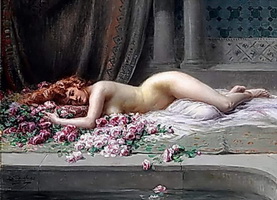
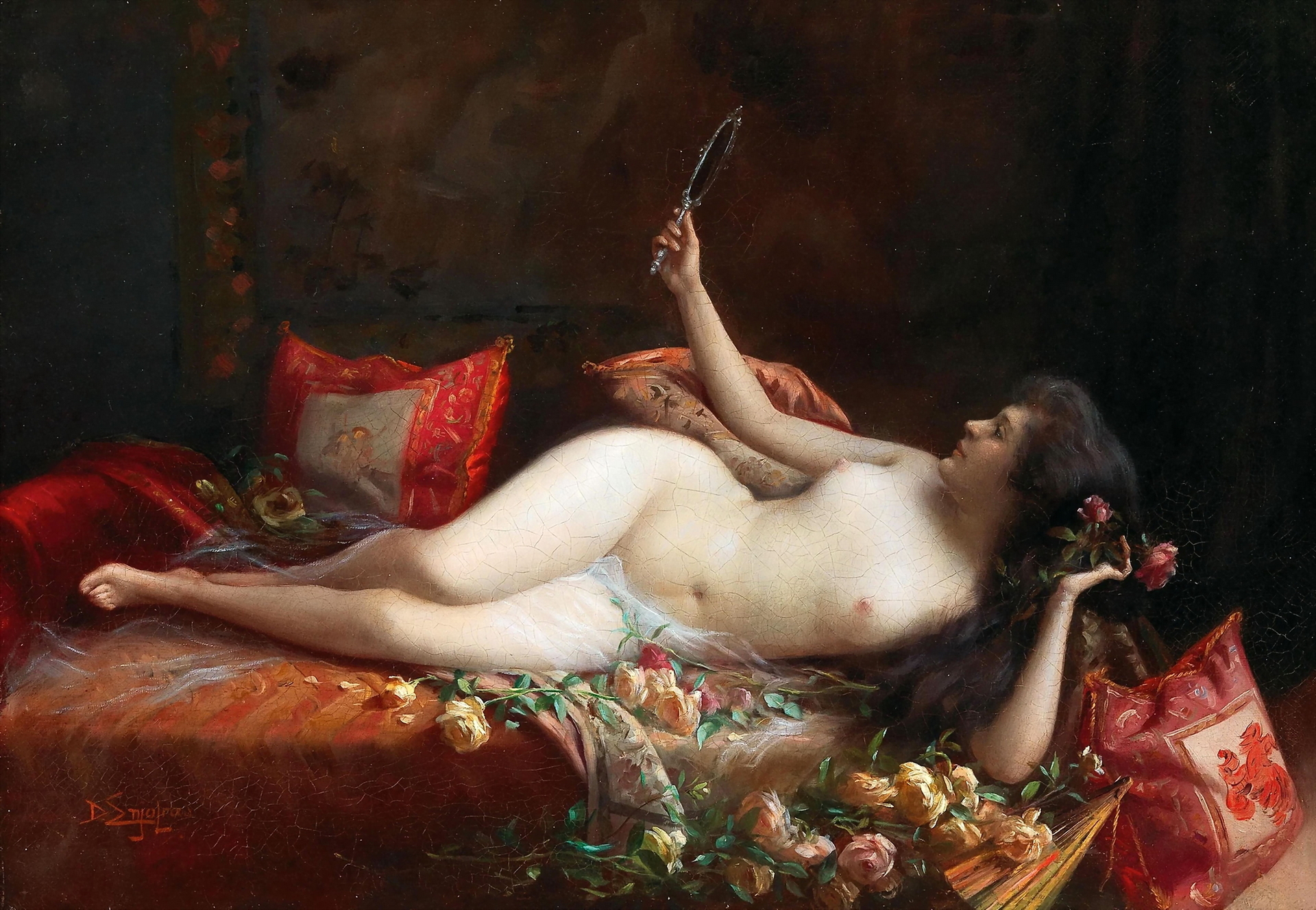
The nude women has roses everywhere. Pink, yellow and red roses as well as that she has nice boobs.

A Bed of Roses. Delphin Enjolras.

A pretty naked girl with long dark hair flowing down passed her beautiful breasts. The hot sexy girl has yellow roses around her couch and flowers in her hair.

Delphin Enjolras Page 2 Sensuous paintings of lovely ladies and foxy females.
To Page 4 for elegant paintings Venus the Goddess of Love.
Lite Erotic Art 1 Find pretty paintings of lovely ladies and beautiful naked women. That's right! Horny artwork for boosting a girls desires for sexual pleasure. That's right! Horny artwork for boosting a girls desires for sexual pleasure.
Sensuous paintings of feminine beauty and lovely nude ladies with flowers and roses.
Paintings of very famous lesbians and their lovers.
Venus the Goddess of Love along with lust, desire, and sensual pleasures.


This post contains affiliate links, we may receive a commission if you make a purchase using these links.
Contents.


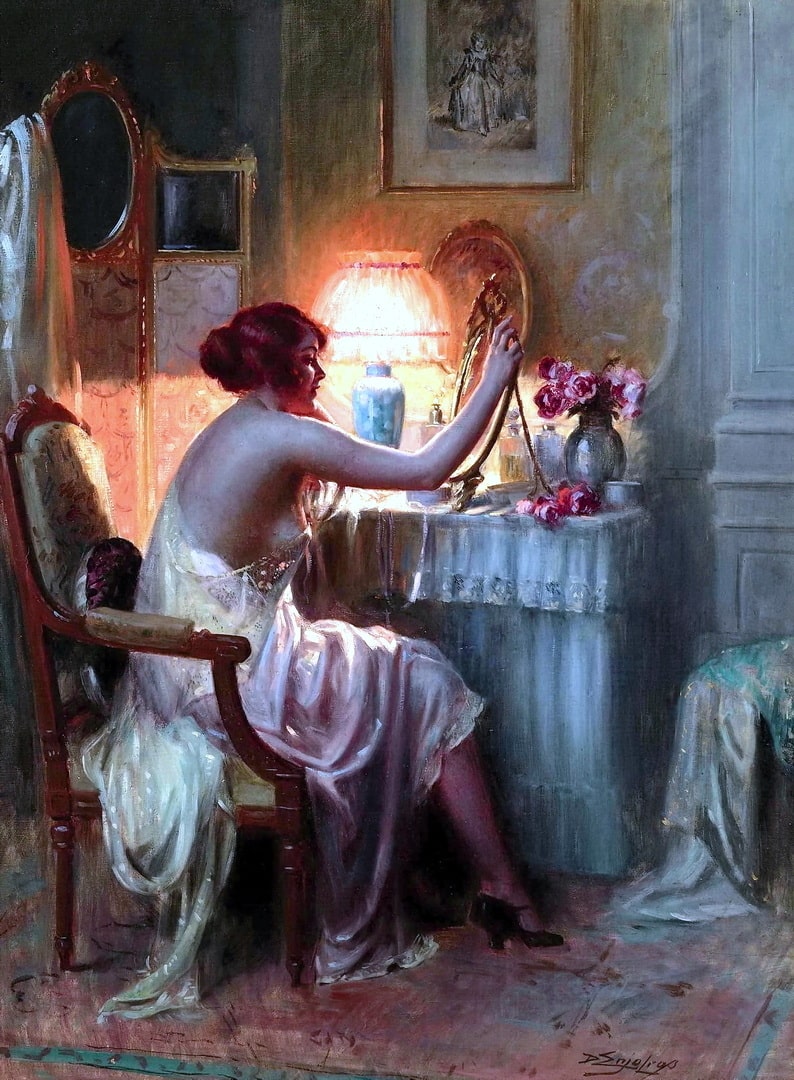
A lady in a pink sexy nightie looking at herself in the mirror. There are nice pink flowers on the dressing table.

In the Boudoir. Delphin Enjolras.

A woman in a pink slinky nightie. Checking herself out in the mirror. There are lovely pink roses on the table.

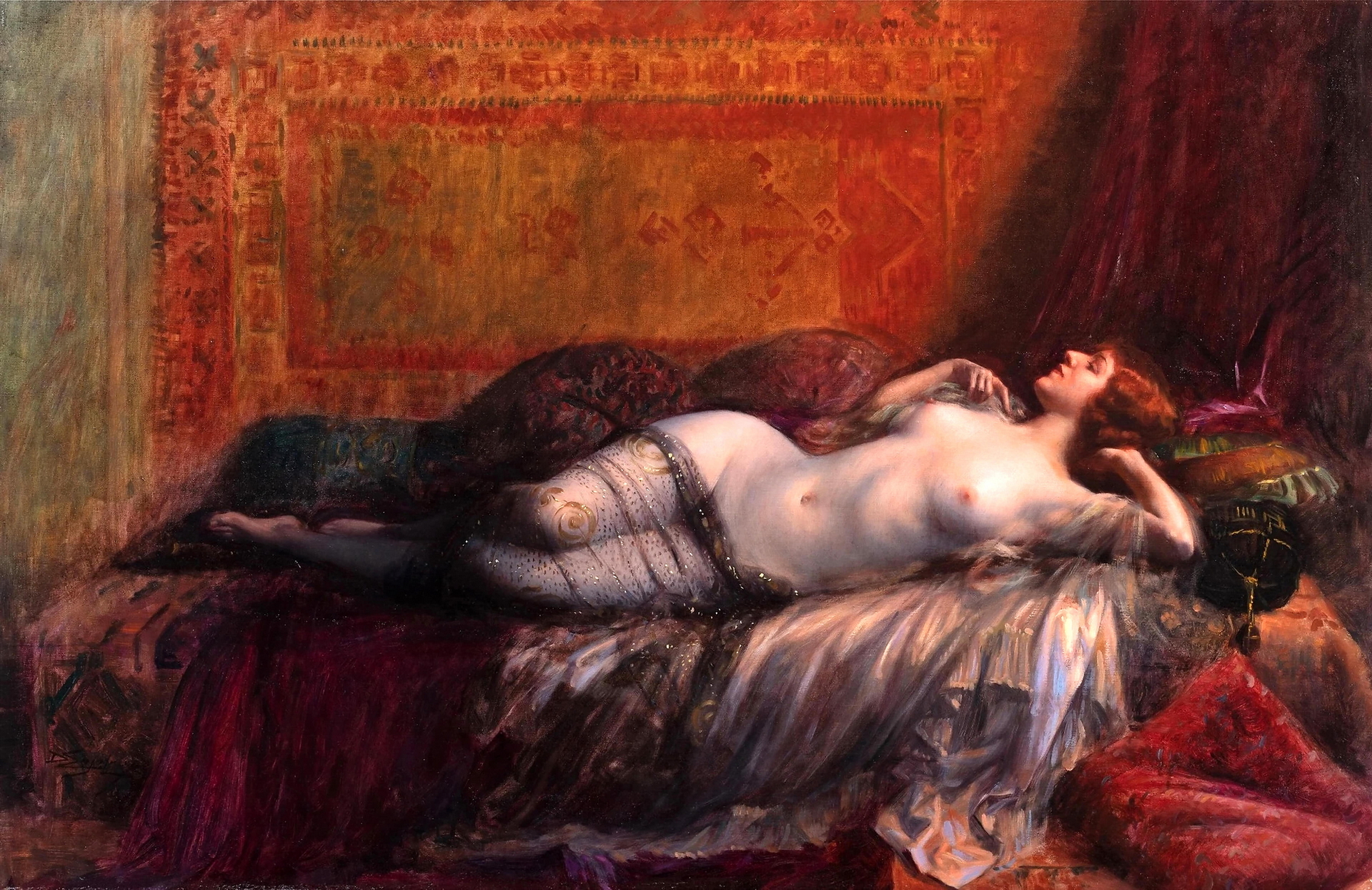
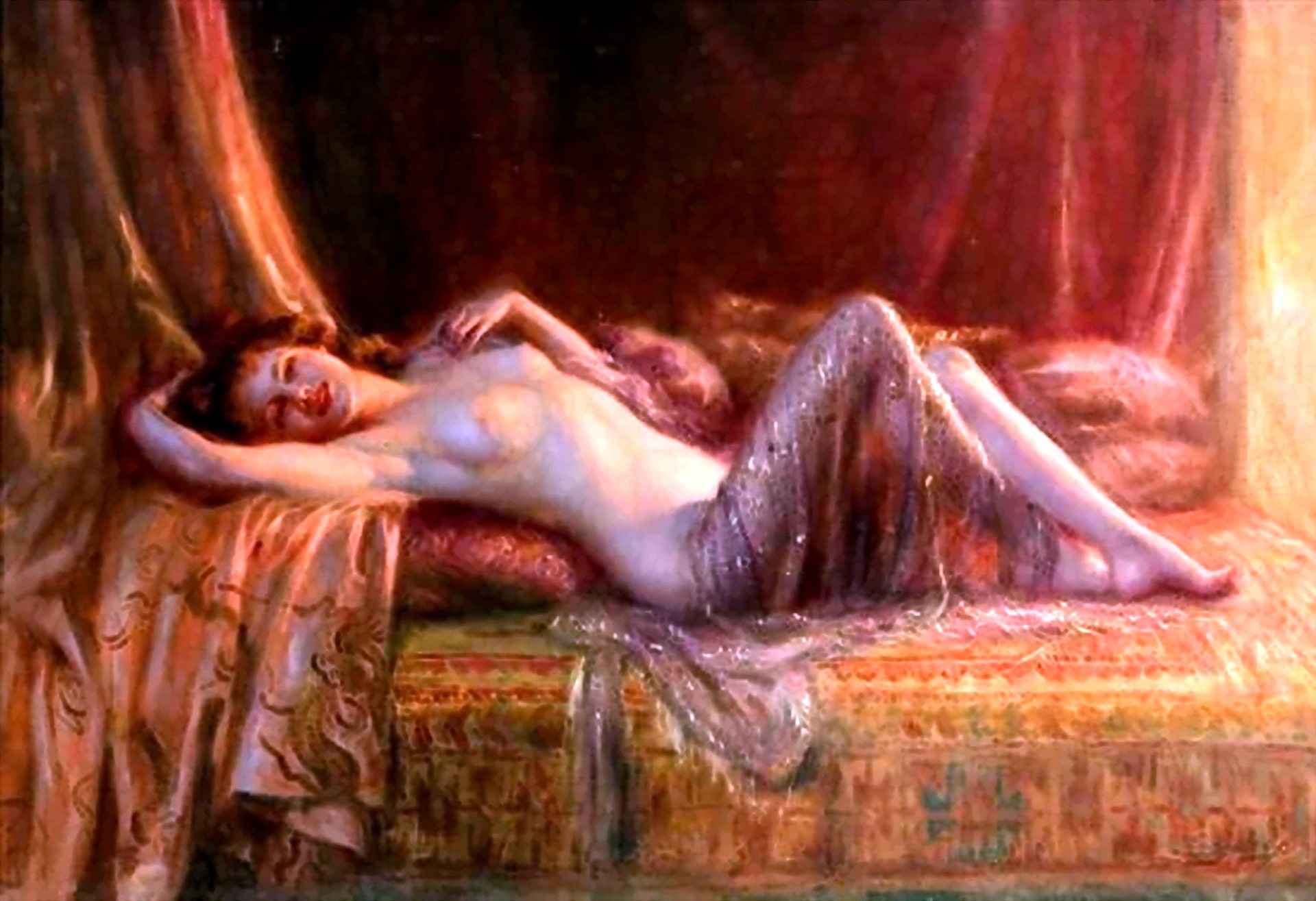
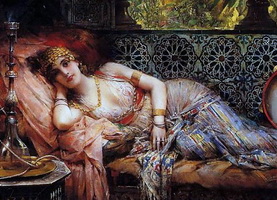
A woman from a harem lying half naked showing lovely bosoms and a very see-through covering over her legs.

Odalisque. Delphin Enjolras.

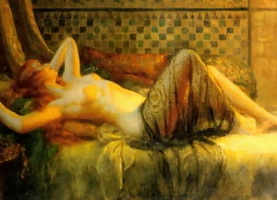
The bare breasted woman is lying semi-naked on her bed with a black very sheer shawl over her legs in a harem. An odalisque is a harem girl.

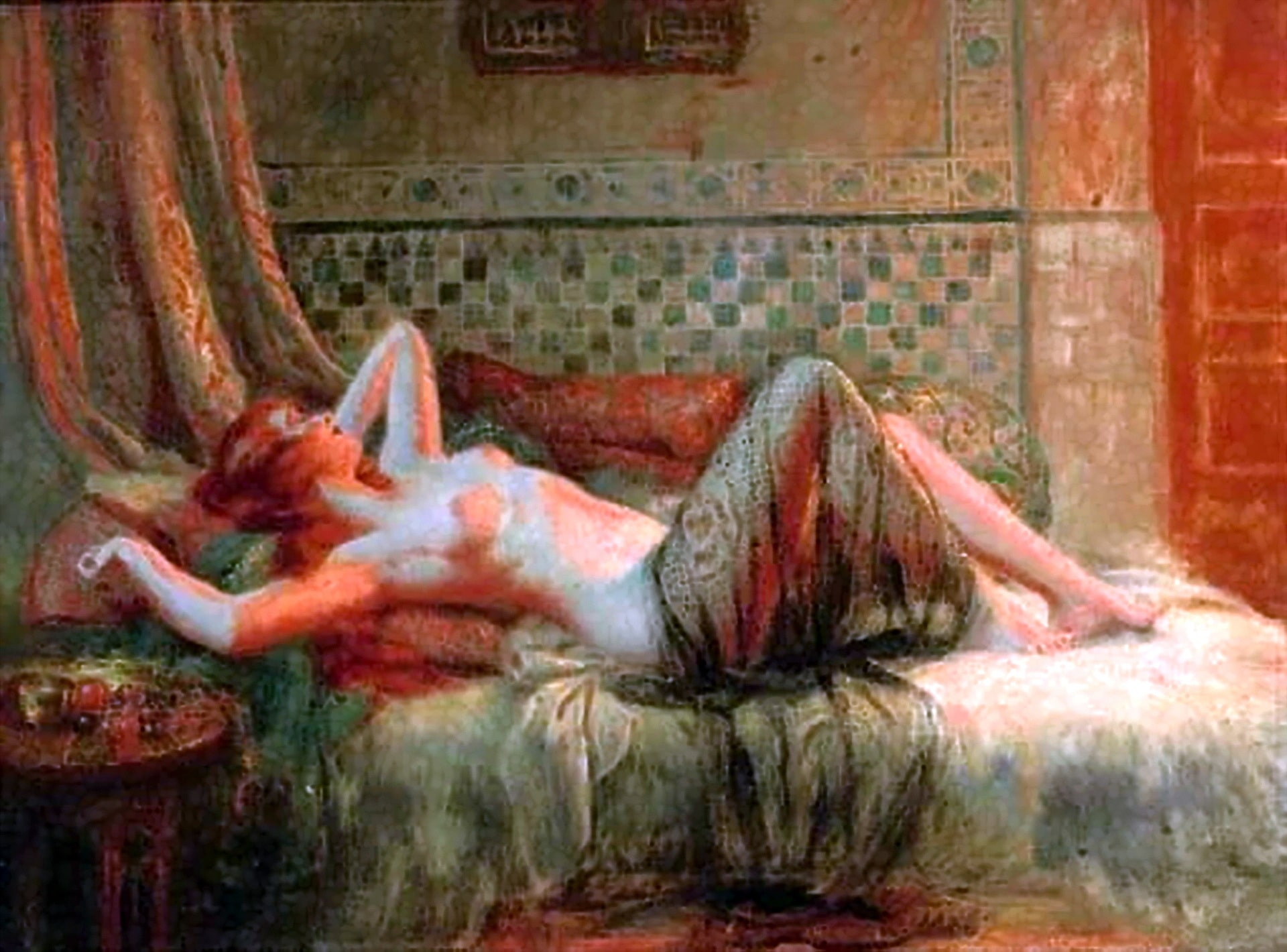
A lovely nude red haired girl has buxom breasts as she is lying back relaxing in the harem.

Reclining in the Harem. Delphin Enjolras.

A pretty red haired girl lying back relaxing on her bed. The young naked lady has beautiful bosoms and a black see-though shawl is covering her legs. The odalisque is enjoying some time for herself.

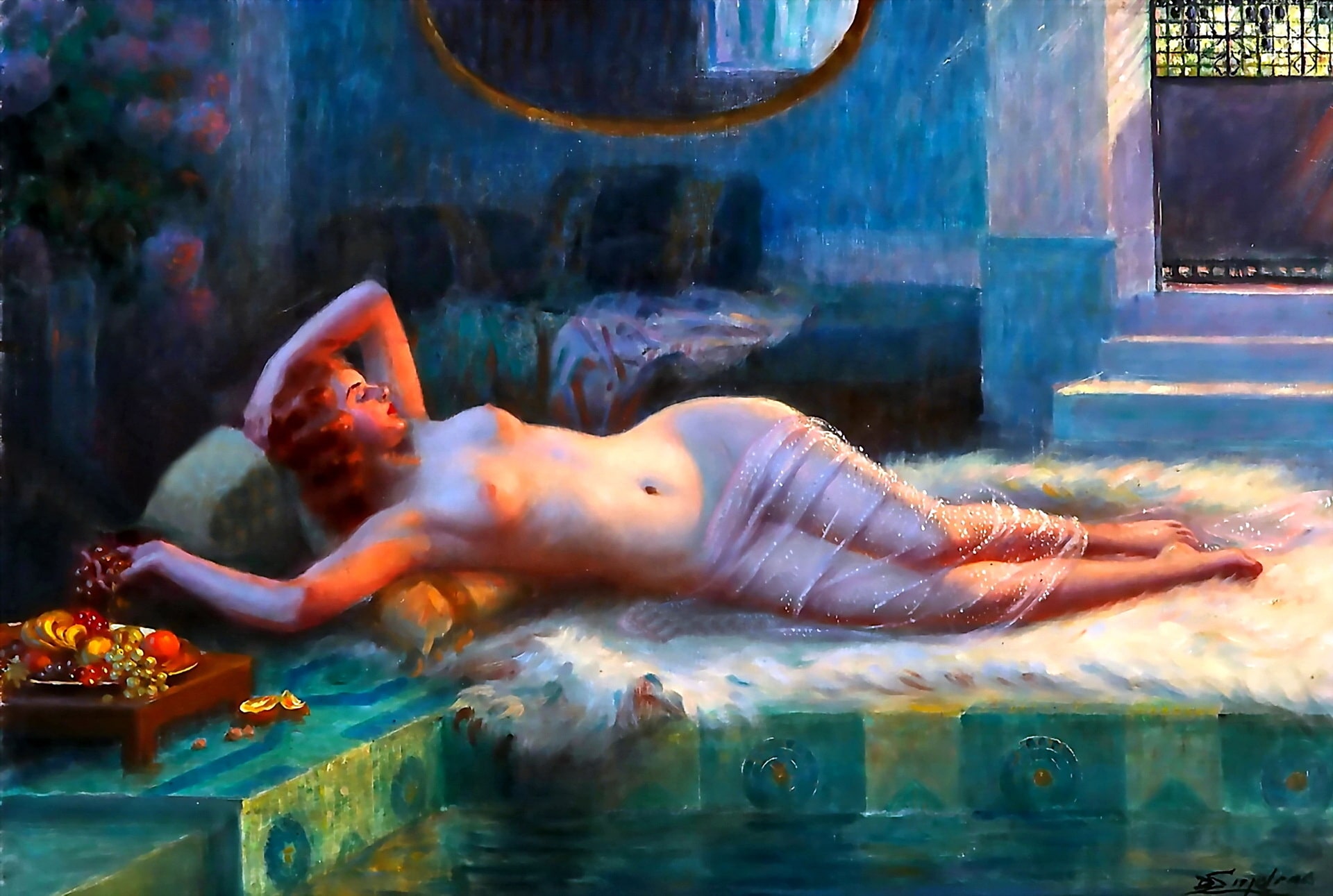
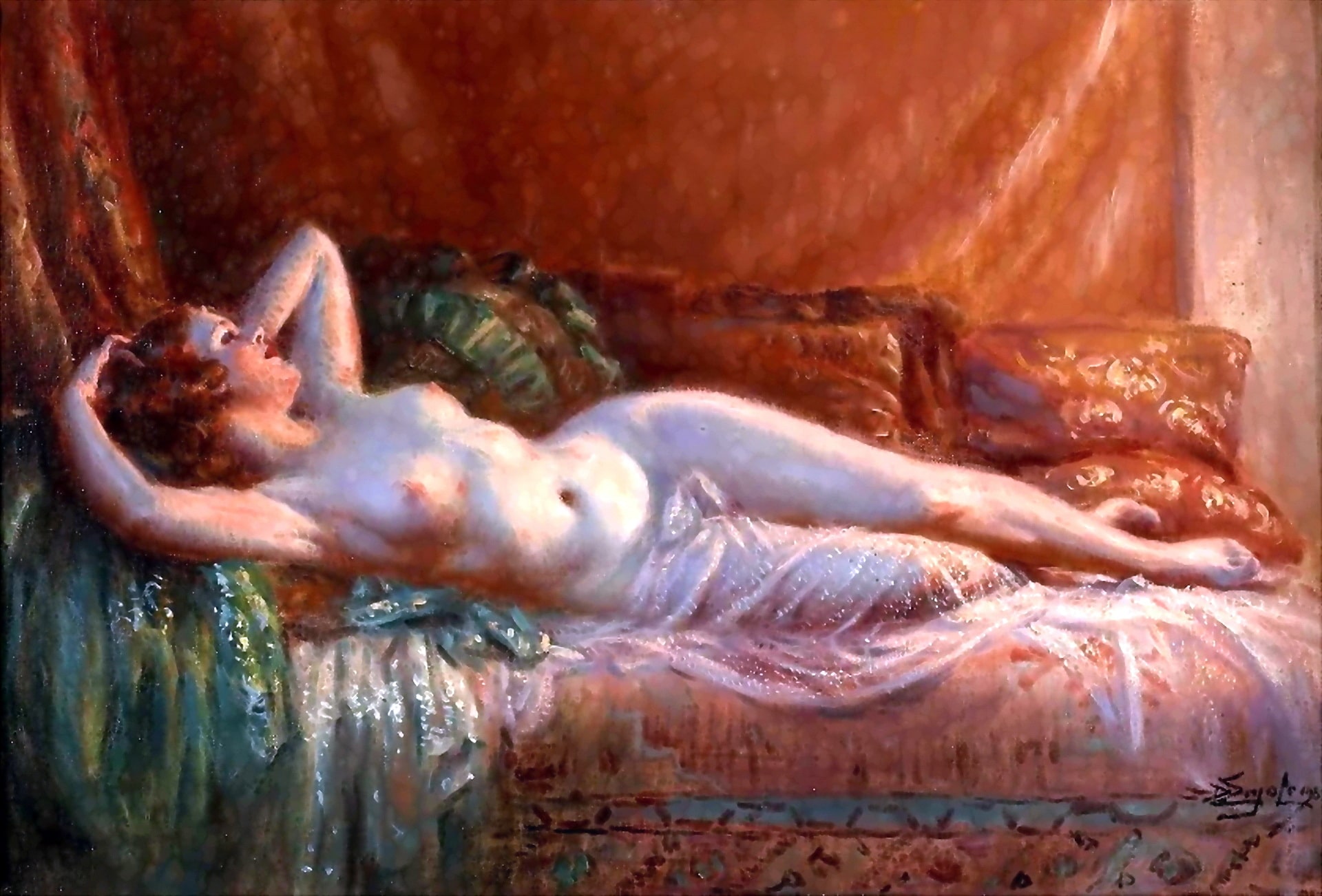
A pretty nude lady with voluptuous breasts and lovely red hair has a very sheer pink shawl over her legs.

Reclining Nude 2. Delphin Enjolras.

A beautiful naked woman with luscious lips and sensuous breasts is lying stretched out looking as lovely as every on her bed eating grapes. With a sheer pale pink shawl draped over her elegant legs. What a temptress! She is waiting for her lover to come home.

Buy luscious lingerie online here.

Saucy lingerie for hot lovers.

The naked lady from the harem has a see-through black shawl covering her sexy long legs. The foxy female has sensuous breasts and pretty eyes.

Reclining Odalisque. Delphin Enjolras.

The nude girl from the Harem is stretched out on her bed relaxing. She has lovely long legs, beautiful bosoms and luscious lips. The young woman has a sheer black shawl draped over her legs. She is relaxing between her visits to the Sultan for sex.

A nude girl leaning on a couch enjoying a bit of relaxation time. She has lovely breasts and nice lips.

Reclining Nude Female. Delphin Enjolras.

A naked woman is leaning on a cushion displaying her buxom bosoms. The young lady has luscious lips that are all the better to kiss you with!

A beautiful naked lady is lying on her couch with buxom boobs and sexy long legs. The alluring woman has scrumptious lips for kissing.

Reclining Odalisque. Delphin Enjolras.

The nude woman in the harem is stretched out on a couch showing her lovely breasts. The lady has long sexy legs and luscious lips for sensuous kissing. She has a see-though pink shawl draped over her leg.

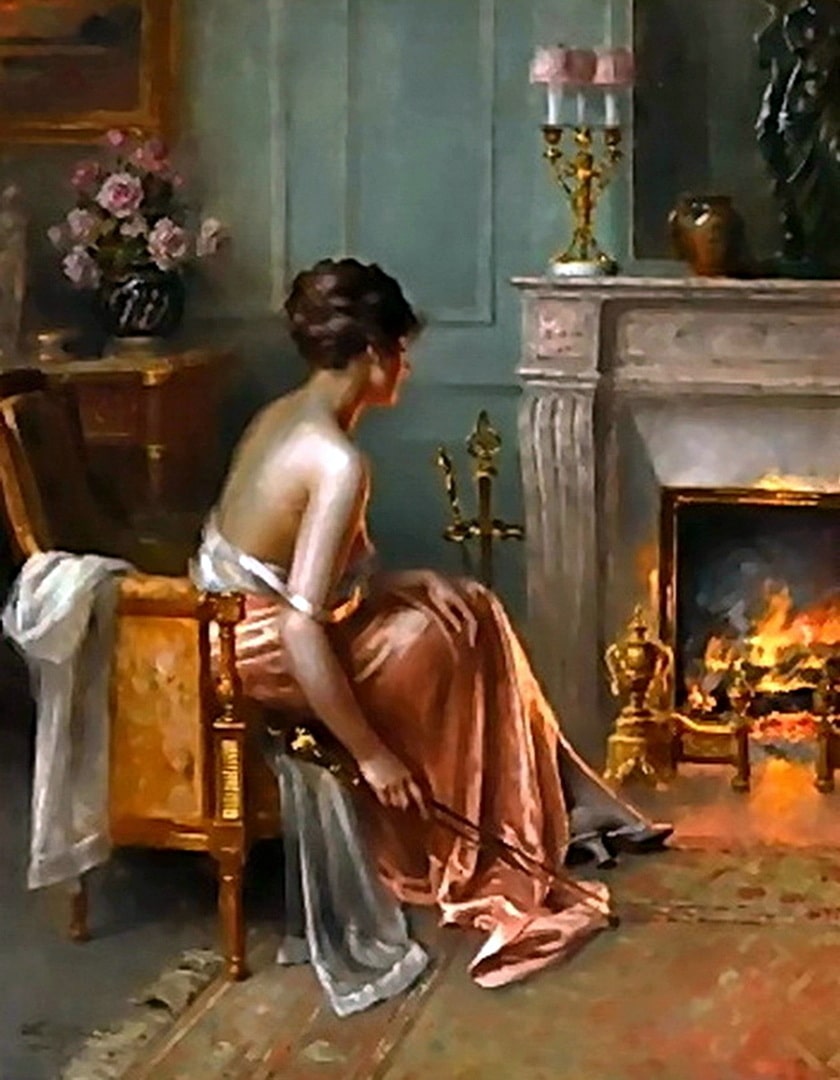
The nude woman is sitting in front of the fire enjoying the warmth on her breasts.

Relaxing by the Fire. Delphin Enjolras.

The young lady is feeling the warmth of the fire on her naked body as she sits there in deep thought.

The beautiful woman is in her pink nighty daydreaming in front of a fire with pretty roses behind her.

Reverie In Front Of The Fire. Delphin Enjolras Artwork.

The lovely lady is daydreaming as she enjoys the warmth of the fire and on the table behind her there are some pretty pink roses.

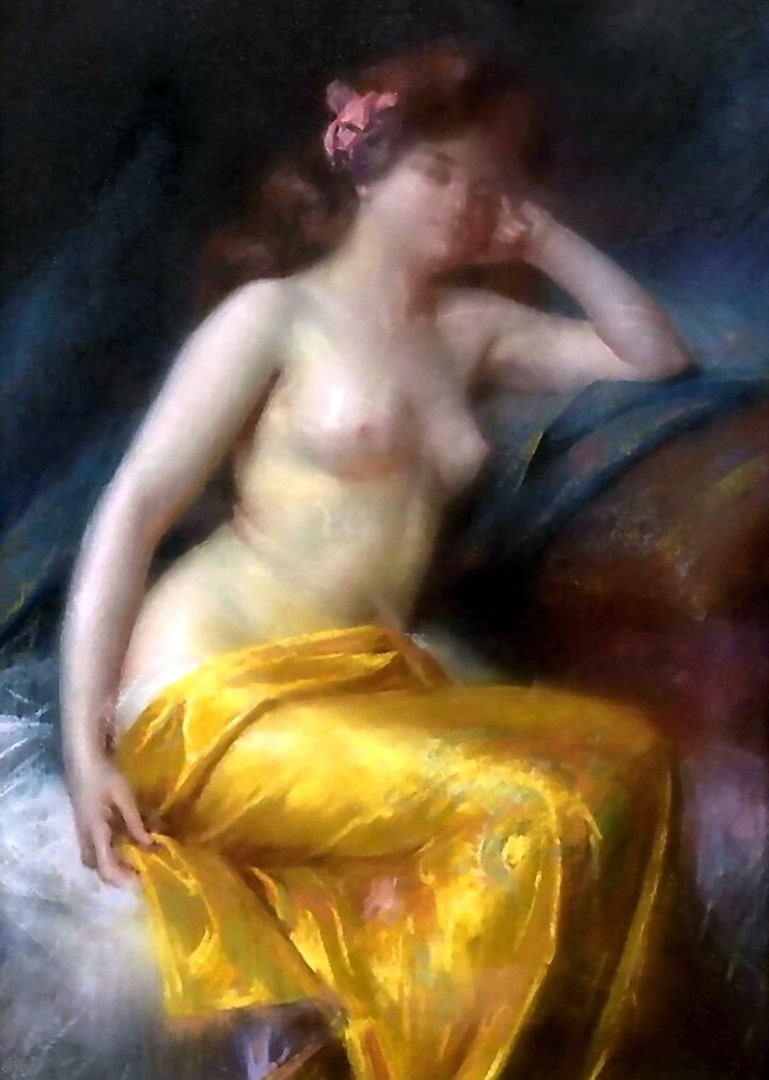
The lady is sitting semi naked with a yellow wrap over her lap. Her sexy bosoms are displayed nicely.

Seated Woman Boudoir. A painting by Delphin Enjolras.
The buxom lady is relaxing on a seat enjoying her peaceful surroundings.

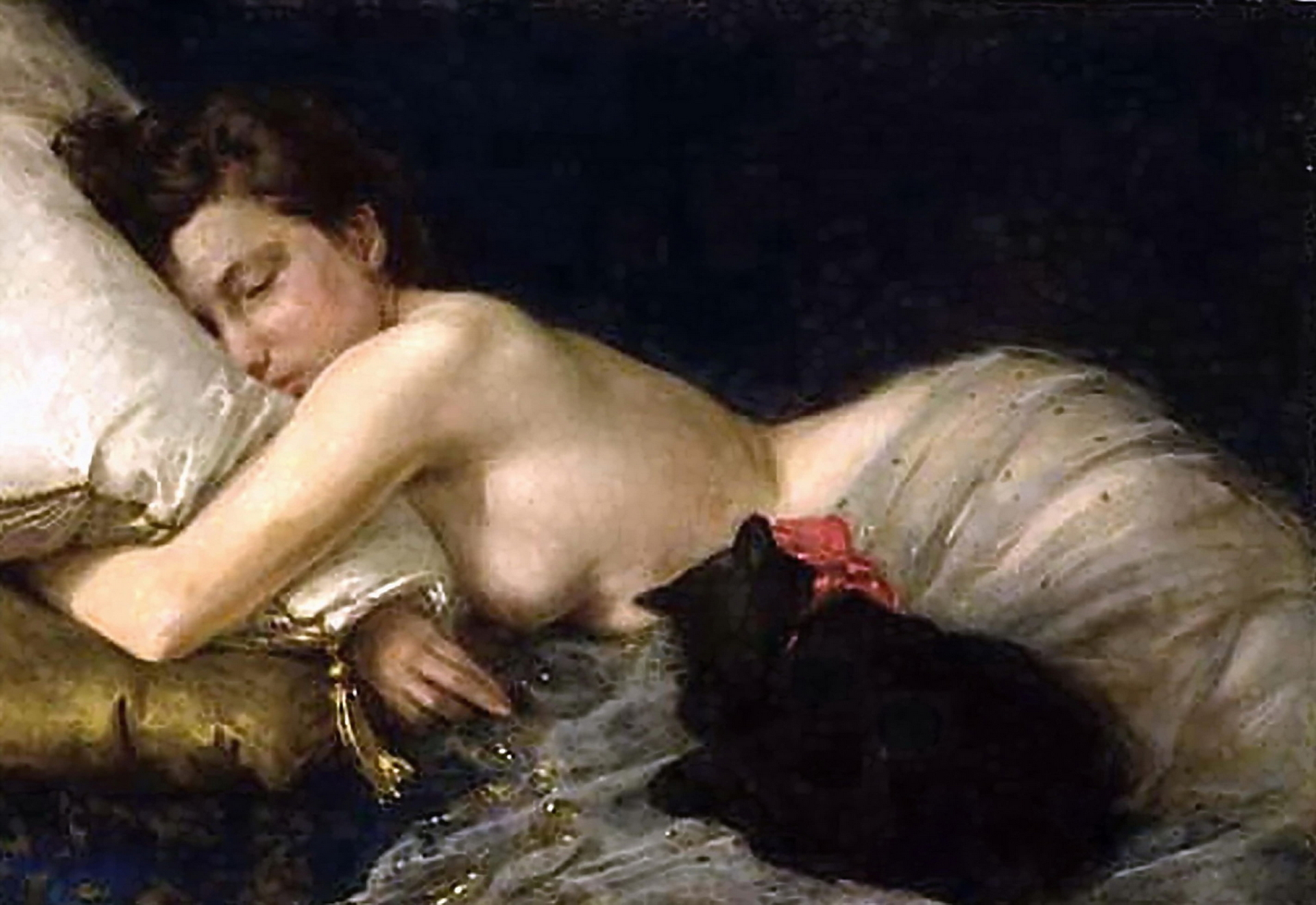
The nude woman is asleep with a see-through shawl over her body. A black cat with a pink ribbon around its neck is asleep too.

Sleeping Nude with Black Cat by Delphin Enjolras.

The lady is lying face down with her head on a pillow. A cat with a pink ribbon is by her side and covering her naked body is a sheer shawl. She has a nice pussy!

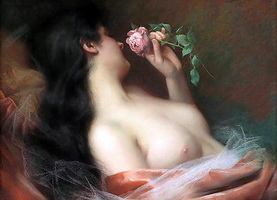
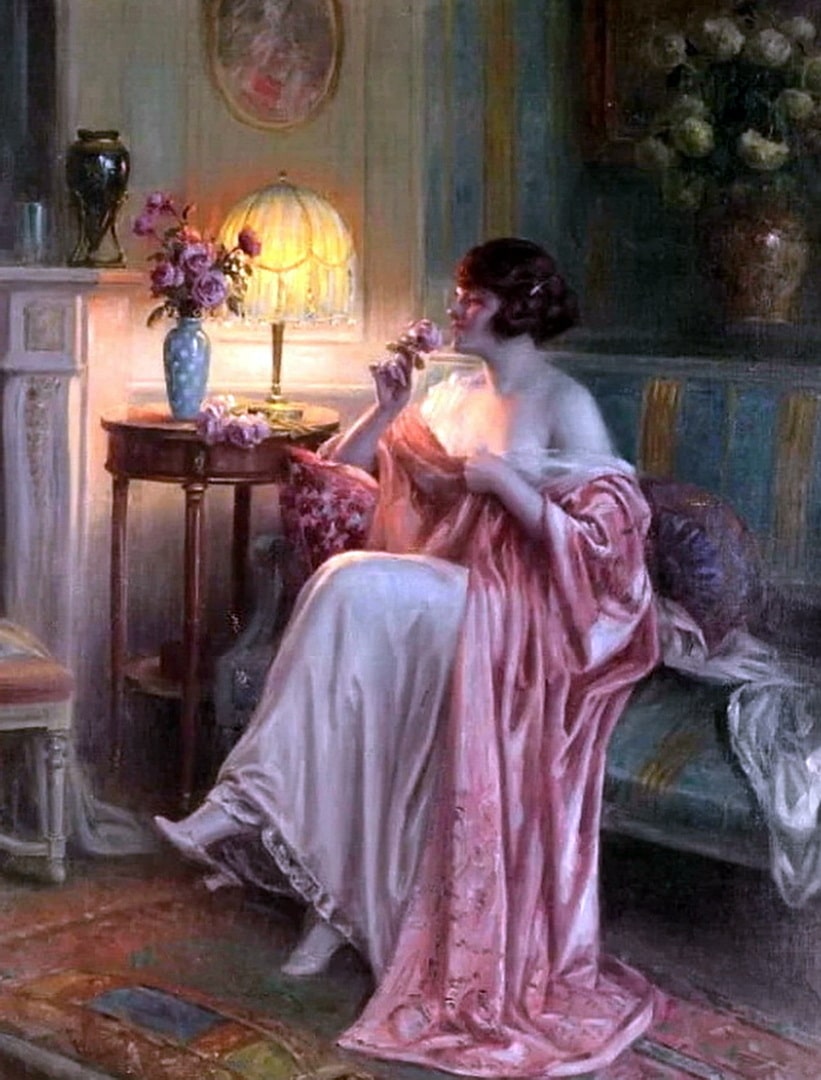
The elegant woman in a pink nighty is enjoying the lovely smell of a pink rose.

The Beautiful Rose. Delphin Enjolras.

A woman is sitting on a couch as she smells the pink rose. The woman is wearing a pretty pink nightie as she enjoys the smell of the flower from her lover.

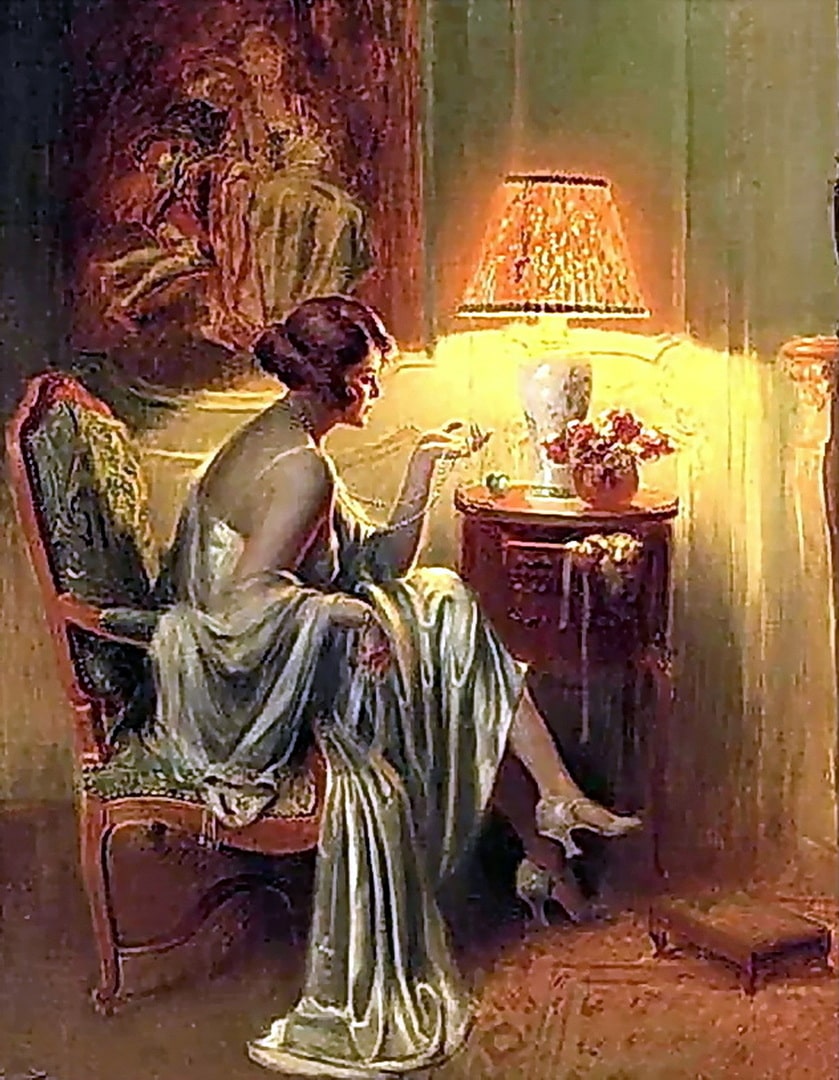
A lady is holding her pearl necklace in her hand as she sits in her nighty with flowers on the table beside her.

The Pearl Necklace in the Boudoir. A painting by Delphin Enjolras.

The lovely woman is looking at her beautiful necklace that she holds in her hand. The lamp table has a vase of flowers on it.

Buy pretty jewelry online here.


Buy Elite Jewelry here.
Sexy Art for Women 1 Find pretty paintings of lovely ladies and beautiful naked women 2.
Sensuous paintings of feminine beauty and lovely nude ladies with flowers and roses 2.
Paintings of very famous lesbians and their lovers 2. Gay ladies and famous females
The naughty nymph’s, sirens, fairies (related) all lust for sex. They are always hot and horny. They are very wicked girls and have sex with males, females, and Satyrs. Even all three at once!.
Harems are the home to Odalisques who provide sexual favours to Sultans.
Odelisques are the girls who provide sexual favours to the Sultans.
Venus the Goddess of Love. Lust,desire and sexual pleasure are what Venus gives to you.
Sexy Art for Women Page 2 Paintings of nude girls and foxy females Lusty ladies showing off their naked bodies in the name of art.
 
Sexy Art for Women 03 Nude paintings can help to improve a woman's sexuality and love.
Sexy Art for Women 04 Naked paintings of sexy women can help girls with better lovemaking.
Sexy Art for Women 5 Discover naked paintings of foxy females and lusty ladies in portraits.
Sexy Art for Women 6 Find nude portraits of sensuous women and flirty females having sexy fun.


Sexy Art for Women 7 Find vintage portraits of cute girls showing their sexy breasts.
Sexy Art for Women 8 Beautiful paintings of sexy nude girls and lovely females.
Sexy Art for Women 9 Elegant portraits of sensuous women and seductive females.
Sexy Art for Women 10 Pretty paintings of luscious ladies and dainty females.
Delphin Enjolras Page 2 Beautiful paintings of pretty women and girls.
To Page 4 for alluring paintings of Venus the Goddess of Love.

NYMPHS DANCING WITH SATYRS.

TO THE READER
The tales I have gathered here were written between 1894 and 1898; they represent my first attempts at storytelling, and for that reason, I had neglected to publish them.

The very title of this collection dates from that period; it has always appealed to me--not only because it evokes a harmonious image, but because the oscillation it expresses between the grace of pure forms and the often desolate or bitter grimace of that malice I perceive in the face of the world seems to me to characterize a state of mind found in all my books.

R. B.

Pietro Aretino--dubbed "the Divine" thanks to his renown--lived in a house on Venice's Grand Canal, near the Rialto Bridge and the city markets. He himself took care to tell us that the place was "flawless" and commanded the most delightful view in the world. A thousand gondolas would pass by, whether during the hours of provisioning or at times reserved for leisurely outings. As the Rialto district was the hub of commerce, the old wooden bridge teemed with a colorful crowd of merchants, speculators, and foreigners from every nation that traded with the Republic. Add to this the fact that the Mocenigo family--a ducal dynasty--had their palace nearby; this brought frequent comings and goings of princely carriages and ambassadors, as well as the distinctive bustle and incomparable splendor surrounding the famous state galley, the "Bucentaur". Yet Aretino was more powerful than the Doge; everyone whom protocol led to the Doge’s presence made a point of visiting the illustrious writer, and he received a great many others besides.

In the delightful hour of evening just before sunset, Messer Pietro Aretino--having kept a few of his visitors for supper--stood with them on the balcony of that famous house. Among them were his good friend Titian, the great painter, and the sculptor Sansovino, no less renowned; Nicolo Franco, Aretino’s secretary; and several women of great beauty and lively spirit, whose conversation possessed the grace and agility of the free--flying birds found in such abundance in the enchanted gardens of Murano. And while it was indeed pleasant to gaze from the balcony at the shifting spectacle of the Canal, many a gondolier and boatman would spontaneously slow the rhythmic sweep of his oar, giving passersby a chance to admire the magnificent entourage of Aretino--the scourge of princes. The ladies, already arrayed for supper, outshone the finest goldsmith’s work with the splendor of their attire; their hair was dyed and dried, and their shoulders and bosoms--perfumed and painted--bloomed above their brocades and beneath their pearls like cultivated flowers, whose allure leaves one wondering whether it springs from sheer beauty or artifice. The master himself drew every eye with his florid complexion, his long beard, and his crimson doublet, upon which gleamed an exquisitely wrought gold chain--the latest token of friendship from His Holiness the Pope. Titian, a lover of color, was clad in black velvet fabrics of half a dozen different shades. Sansovino, whose sobriety was the subject of friendly teasing, wore a long black serge robe fastened at the neck simply with silver clasps.

They had spent the day in conversation, making music and drinking wine. Aretino had spoken of twenty great lords in terms that were at once the boldest, the most cowardly, and the most extravagant; he had deeply scandalized his audience while simultaneously greatly entertaining them. More than once, the good sculptor had been on the verge of anger with him, only to be disarmed each time by his unexpected retorts and an exuberance that was as childish as it was disconcerting. Titian--more concerned with the happy effect of the whole than with the individual merit of its parts, and keenly appreciative of witty sallies and high spirits--looked upon his strange friend with unfailingly indulgent eyes. Moreover, Aretino understood the arts and judged them with great discernment and sincere love; thus, the illustrious painter felt he was not mistaken in blindly admiring that extraordinary force--that prodigious vitality which, driving Aretino to every extreme, led one to foresee that his audacity might give birth to something excellent just as easily as to something execrable.

Leaning over the balcony with his elbow resting on a Levantine rug, Aretino let his wit flow freely, directed at the passing boats. He dispensed greetings, waves, loud compliments, and smiles; yet, occasionally pressing his ring--laden hand to his lips, he would fling a scathing remark at those around him--a word that could ruin a man or instantly shatter a noblewoman’s honor. There were exclamations, protests, and laughter. Laughter swept everything before it. And even those resistant to such amusement found themselves softened by the interplay of twilight light upon the glittering water, the opulent sterns of the gondolas, and the marble--that kindred spirit of the light itself.

Thus--amidst luxury, beauty, pleasure, slander, greetings, kisses, chatter, music, and promenades--ended a day in Venice during the era of her glory.

Suddenly, a group of young boys coming from the Merceria--Venice’s main shopping street--burst onto the Rialto Bridge, clutching broadsheets and shouting at the top of their lungs:

"Hear ye! Hear ye! The news of the day: war with the Turk! Hear ye! Hear ye!… a rupture with His Majesty the Emperor!… Hear ye! Hear ye!… the wretched state of the Republic’s galleys! The Arsenal secretly sold off!… etc., etc."

Although such events were not unprecedented--poor folk had been seen scattering pamphlets across the city since the early years of the century--this sudden eruption and the gravity of the news (plausible, after all) threw the elegant craft plying the Grand Canal into a state of great agitation within a minute. For a moment, there was a frantic crush around the bridge. Gondoliers were dispatched to buy the printed sheets; soon, the vendors were raining them down upon the curious crowd, who tossed sequins and coins of silver and gold in return, haphazardly. Several people fell into the water; a few perished there. Little notice was taken; a feverish excitement had seized everyone, and the Venetians dispersed while discussing the news, leaving the Grand Canal deserted within a quarter of an hour.

Meanwhile, the general alarm had reached the balcony of Pietro Aretino. Good Sansovino and Titian--men of simple nature and excellent heart--were deeply agitated; two women had swooned, and the secretary Franco was busily loosening their bodices. A throng of servants had flooded the apartments; And Aretino, imperturbable, had pointed out to his friends two Black men from his household who were taking advantage of the commotion to escape by swimming, each with his waistband laden with the finest pieces of his gold tableware. Will you have them hanged?” said Titian.

“No!” said Aretino, “I will get a new dinner service from His Majesty the Emperor…”

Upon hearing the Emperor’s name, they approached Aretino.

“You speak of the Emperor with ease,” ventured Sansovino; “but if there is any truth to the papers that have just been distributed and that have troubled the whole city, His Majesty is not about to shower the Venetians with gifts, even in the person of their most illustrious citizen!”

“Messer Jacopo,” said Aretino, “your brain is, at this moment, made of clay, and you grasp public affairs with the ease a blind man would have in discovering that turquoise at the bottom of the Grand Canal.” (And saying this, he dropped one of his rings into the water, which filled his entourage with admiration.) Now I, Pietro Aretino, wager that before the month is out, without bothering to write a sonnet, and on the mere sound of the desire I have just expressed to recover my gold tableware, I will obtain from the august liberality of Charles V a service more beautiful than the one that has just been stolen from me, and a stone bigger than the one from which the divers you see from here are going to make a fortune.

"Ho! ho!" cried those around him; for, though his habitual recklessness was well known, this time he seemed to be going too far. They listened anxiously; he had assumed that peculiar smile which, it was said, made him look like a wolf.

"For you must know," he continued, "that His Majesty, upon hearing of the troublesome rumors circulating in Venice regarding the Empire's relations with the Republic--rumors of a sort to upset the balance of Christian states!--His Majesty, I say, will turn to the only man whose very breath has the power to stifle them..."

"Because he is the only one..." ventured Sansovino--rightly suspicious, and already pale with indignation.

"Out with it, then!" mocked Aretino.

"...who spread them!" the poor sculptor murmured, already turning to leave.

"You said it!" cried Aretino. And he made the whole palace shake with his booming laughter.

He was the only one laughing in all of Venice. For several seconds, the echo of his mirth filled the darkened canal and made the windowpanes rattle in the houses where citizens fretted over the sinister antics of this colossal buffoon.

As this laughter spread throughout Aretino’s house, and Sansovino himself indulged his crony in this latest piece of folly--for one grows lenient when relieved of a worry--someone pointed out, in the gathering gloom settling over the deserted canal, a sumptuous gondola; its carpets brushed the water’s surface as it advanced with the slow pace typical of lovers’ outings. Its occupants were clearly far removed from the city’s current preoccupations; indeed, their attention must have been utterly captivated by something else, given their lack of concern regarding the canal’s unusual appearance or the complete isolation of their craft amidst a heavy silence broken only by the outbursts from Aretino’s balcony.

Everyone expected the master’s high spirits to prompt him to shout insults at the passersby. Sure enough, Aretino leaned forward, straining to make out their silhouettes or features in the fading light.

The gondola drew nearer, peaceful and silent as a piece of bark drifting with the current.

"I see only a woman," someone said.

"And I, only a man."

"Fools!" cried Aretino. "Can’t you see they are lovers?… Torches! Bring torches!…"

The balcony was suddenly illuminated. The gondola immediately made a movement to retreat, like a living creature sensitive to light; yet it did not pull away fast enough to prevent their faces from being glimpsed.

"By the Madonna!" exclaimed Aretino. "There is a girl more beautiful than the Most Holy Mother of God!"

They thought he had spoken only to blaspheme. Franco, having set the ladies to rights, burst out laughing and began to hurl jests at the amorous couple, thinking to flatter his master. But the latter slapped him across the face and called him a filthy pig. No one said another word.

"Who knows this young woman?" asked Aretino.

None of those present had ever seen her before.

"She is not from Venice," said Titian; "she has the delicate, translucent flesh seen in the Virgins painted by the great masters of Cologne, and the pious grace of the Sienese maidens immortalized by the gentle Sano di Pietro--a man wholly given to God, as he is called."

"She is made of ivory," said Sansovino. "In Rome, at the home of the illustrious Agostino Chigi, I saw finely carved statuettes that were the little sisters of this child. Their bodies are slightly curved, and they are so frail that one longs to relieve them of the infant that seems to weigh down their arms..."

"And the man? The man? Who knows him?" asked Aretino impatiently.

He was unknown as well. The gondola was moving away; Aretino stamped his feet. He called for servants. He chose the strongest among them, named Tommaso; unfastened the dagger at his belt and handed it to him.

"Cast off Aretino's livery," he said, "go naked if need be, and run through the narrow streets until you think you have outpaced that gondola--moving at the speed you see--by a hundred fathoms. At that distance, return to the canal, untie the first boat you find, and row out to meet the gondola. Hide your weapon, but keep it within easy reach. Approach and ask politely for the lady's name. If they give it to you, bow and withdraw; the matter is of no consequence. If the gentleman springs up at your approach, get the name--at any cost. Go!" "My friend," said Titian, "consider that they are two young lovers--betrothed, perhaps even husband and wife: they are happy and radiant with beauty!..."

Sheltered by the great painter's authority, everyone crowded around this man known for his formidable whims, and all eyes pleaded with him.

"Ladies," said Aretino gallantly, "and gentlemen--to the table! Tonight we have capercaillie livers that our friend Titian has had sent from his country house in Cadore; they deserve to be celebrated both for their excellence and for the quality of the donor--a divine artist... For my part, I have a hearty appetite."

The warmth of the meal distracted the guests from dwelling too much on the scene unfolding simultaneously on the Grand Canal under the cover of night. The host took his seat between Madame Angela Zaffetta--an exquisite courtesan whose shoulders and bosom were as rounded as her temperament was genial--and the famous singer Franceschina, who would sometimes grow vexed when the meaning of her lyrics was lost on listeners captivated by the enchanting music of her voice. Several other remarkable figures were present as well, distinguished either by their beauty or by the vivacity and uninhibited nature of their passions.

Upon sitting down, the guests exclaimed at the magnificence of the glassware adorning the table. It was a surprise Aretino had prepared for his company, and at the same time, a revolution in the arts that he was bringing about with the utmost elegance. The Murano workshops had begun to stagnate, endlessly repeating the same old designs, when Aretino--having received as a tribute a reproduction of the arabesques and ornaments Giovanni da Udine had created for the Vatican--conceived the idea of applying these charming motifs to embellish Murano glass. He had just received the most successful prototypes of this experiment and was now displaying these marvels--creations his initiative would soon spread across the globe, thereby generating a new source of wealth for his country.

Titian, a man so moved by the sight of a beautiful object that it could bring him to tears, forgot both food and drink as he turned the delicate masterpieces over in his steady, powerful hands. He played with the way the light caught their varied hues; meanwhile, the myriad whimsical interlacing patterns, grotesque masks, and satyr heads seemed to entwine, tease, and dazzle his mind within the twists and turns of their voluptuous labyrinth. Sansovino, more reserved, observed and judged in silence. He was given to abrupt--even violent--retorts, as is often the case with men of great integrity. La Zaffetta, standing at his right--and more accustomed to witnessing the flare of men’s passions than the wisdom that channels them into virtuous deeds--feared that the sculptor’s earlier flashes of temper might lead him to view Aretino’s idea unfavorably. Leaning against his arm and pressing close with her lush, blooming body, she pointed out the son of Venus--visible within the transparent glass as he drew his formidable weapon--and said to him:

"Careful, Messer Sansovino, for this little rascal is so lifelike one might think he is about to run one of us through..."

And she drew so close that the old fellow could do nothing but kiss her shoulder, his lips already quivering.

"Well, no!" he said, suddenly rising. "If I am to treat myself to the relish of a kiss this evening, I shall not bestow the favor upon La Zaffetta--beautiful though she is, unceasingly so--but rather upon my friend Aretino. He may show less constancy in virtue, yet he sometimes rises to the sublime in it, as witness this work, which creates a second Murano. And I hope these fine glasses come to be known as 'Aretinos'!"

And the great artist left his seat to embrace Aretino, amidst the applause of the company, who--whether one by one or all at once--followed his example.

Titian said:

"Aretino, in gratitude for the pleasure I have known, I shall paint a copy of the figure of Our Lord being struck by soldiers--with the bust of Tiberius in the background above the Praetorium gate--a work destined for His Majesty the Emperor; and I shall give it to you."

It was a royal gift, and one that was indeed presented on Christmas Day of that same year.

Franco poured forth a torrent of libertine inventions into the lap of the courtesan Pocofila. The fresh laughter of this young woman--renowned more for the purity of her form than for her wit--cast the illusion of a clear, gushing spring over the festive table; her delightful cries awakened echoes in the throat of Aretino himself; a radiant gaiety animated the company, and everyone clamored for the master to recount some of those famous "conversations," the audacity of which surpassed anything previously written for the amusement of ladies.

Aretino alone, beneath a veneer of boisterous mirth, betrayed a hint of anxiety, turning his head sharply whenever the door opened. Yet, in truth, as everyone had already forgotten the cause, no one paid it any heed.

"By the Madonna," he said, "today I shall yield the kingship of Priapic revelry to my excellent Franco, who earlier displayed such skill in the laps of my loveliest friends--whereas I, for my part, was ill--prepared for the task, having begun the day by translating one of the Penitential Psalms into the vernacular..."

And, amidst the laughter that greeted these words, he took one of the sacred verses as a springboard to construct a tale so scandalous that even guests unaccustomed to prudishness blushed at it, mentally repeating its most striking phrases to gauge their effect on acquaintances. At that moment, a commotion arose near the doors, and Aretino could not hide his sudden agitation upon recognizing his servant Tommaso, who was returning from the Grand Canal expedition in a sorry state, supported under the arms as if about to collapse.

Aretino rose hurriedly:

"Tommaso," he said, "did you accomplish your mission?"

Tommaso signaled that he had.

"Well! I am listening," the master said impatiently; "will you speak?"

"My lord..." stammered Tommaso, and he staggered.

"Speak! By all the devils! Do you have the name?"

Tommaso made a violent effort and said:

"I have it, my lord!"

Aretino ordered a seat brought forward for the unfortunate man. They gave him some spiced wine; he regained consciousness. The women had risen and gathered around him, eager to know if he was wounded; but Aretino, leaning over him with eyes fixed on the movement of his lips, was intent only on the woman's name about to be uttered--the name that would allow him to pursue the enchanting creature he had glimpsed that evening to the ends of the earth, even if it meant stirring up every state in Europe.

Tommaso gathered enough strength to speak:

"I carried out Your Lordship's orders," he said. "I rowed out to intercept the gondola and made a respectful bow, first to the young woman and then to the young man. But before I could speak, the young man--who has a hot temper, my lord--reached for his dagger... I held Your Lordship's stiletto firmly; without making a threatening move, I simply asked for the name and leaned close to the young woman, who was terrified. I thought she would give it to me just to put an end to the scene. My guess was partly right, for the lady, noticing her companion's threatening stance, blurted out her name; but at that very moment, I was struck from behind--a nasty stab between the shoulder blades..."

"The man is wounded!" cried La Zaffetta, La Franceschina, and La Pocofila in unison, reaching out to unfasten his clothing.

"And the name! The name!" Aretino roared, hanging on Tommaso's lips. "Her name is Périna Riccia, my lord; she is a dove of the good Lord, a child who would fit in Your Lordship's hand..."

Aretino whispered the name, savoring its syllables in anticipation--Périna Riccia--caressing them with his lips as their pleasing cadence rang out.

"Where is she at this moment?" he demanded imperiously of the faltering messenger.

"May Your Lordship have pity on me," said Tommaso. "I could not feel that prick without instantly jerking toward that young lord; and since my hand was firmly gripping Your Lordship's blade, he felt the steel--a bit too deeply, no doubt, for he toppled into the Canal. I never saw him again..."

"You wretch!" someone exclaimed. "The gondolier will denounce you!"

"The gondolier," said Tommaso, "is Piero Becchino, from Chioggia--he is a friend of mine; he will serve His Lordship, provided His Lordship is willing to pay him..."

"And Périna?" interrupted Aretino.

"She is here, my lord; we brought her back unconscious in the gondola; she is as pale as the moon and looks just like Our Lady the Virgin..."

The whole party rushed toward the vestibule, which led to the marble steps where the gondola was moored. In the commotion, someone jostled Tommaso’s shoulder; he let out a faint cry and died. Sansovino--who felt no curiosity--and Franco--who had no taste for sickly, pale women--had stayed behind and were the only ones to notice the incident. The good sculptor was about to cry out when...

"Hush!" said Aretino’s secretary, who knew his master’s mind. "The loss of this man suits our purposes perfectly; for with him gone, nothing prevents the young lady Périna Riccia--once she wakes from her swoon--from believing she has been taken into a hospitable home after some unfortunate mishap..."

And the two men carried Tommaso’s body into a small room overlooking a dark canal.


Périna Riccia awoke in an alcove featuring gilded caryatids and silk hangings striped with gold leaf; the space was pleasantly illuminated by several small lanterns with twisted columns suspended from the ceiling, and mirrors were so skillfully arranged that the effect on the room's panels resembled chiaroscuro paintings. At fairly regular intervals, the flickering light drew from the shadows rich console tables laden with tall ceramic pieces or gold and silver vases, as well as display cases filled with fine antique fragments or books bound in tooled leather; on the walls, one could see beautiful Venetian mirrors, medals, paintings, and musical instruments.

The night was far advanced; the guests had departed and the servants had retired; Aretino’s house was wrapped in complete silence. He alone had insisted on keeping watch over the young woman--whom the hastily summoned physicians had declared out of danger, at least for the moment, though she was of an extremely delicate constitution and frail of chest.

Kneeling at a prie--dieu, Aretino leaned his head toward the sleeping beauty; he was so intently focused on that fragile face that it seemed his own life depended solely on the almost imperceptible breath escaping her graceful, translucent nostrils--delicate as fine, milk--hued glassware. He wished to witness the slow reawakening of this charming creature whose past existence he had just severed, and who was now, within his arms, to be reborn into a new life. Her features gradually came to life; slight, nervous movements stirred the skin around her eyelids, and her temple took on that indefinable quality that life imparts to that part of the face. She stirred gently, and the first word she uttered was:

— Polo!…

The name echoed in the silence. She had not yet opened her eyes, and the memory was taking shape at the very moment of waking. Suddenly, she burst into sobs and let out heart--rending cries. Aretino prepared to play the mother, opening his arms to cradle her aching head. She caught sight of him and was frightened by his bearded face.

"Where am I?" she cried. "Holy Madonna, have pity on me!"

"The Madonna," said Aretino, "has watched over you and sent you to rest in a friendly house, where lords and servants alike lie at the feet of Your Grace, my lovely lady..."

"Ha! ha! ha!" she exclaimed. "I am undone! And was it not you who killed Polo, my lover?"

"I know not, my child, whom you mean by that pretty name of Polo; my men found you this evening, alone and unconscious in a boat... I brought you here so that you might be more comfortable than adrift on the water..."

"Ha! ha! They killed him--I see it clearly now--and it matters not to me whether I am here or elsewhere, without my beloved Polo!..."

She was seized by a fresh fit of weeping and writhed in despair, biting at the quilt.

Aretino tried to restrain her and keep her from dashing her head against something; feeling her forehead within reach of his lips, he planted a kiss there. But she recoiled with such violent revulsion that he himself instinctively drew back; he stood watching from a distance the anguish of this distraught young woman--surely the most maddeningly desirable of lovers, yet the first creature ever to reject his caresses.


Périna was not recovering. Music and song were used to soothe her pain. Her room had become a gathering place for the entire Aretino household; the poet’s mistresses treated her kindly, for they were accustomed to setting jealousy aside and felt deep pity for her wretched plight. Indeed, Périna radiated an infinite charm through her grace and gentleness.

In a corner of the room stood an organ; its casing was delightfully painted, depicting lovely ring--dances of children in "grisaille", as well as a nymph hunt--complete with greyhounds and wild boars--rendered in vivid colors and meticulous detail. The musician Franceschina rarely left the keyboard; letting her fingers wander nonchalantly, she would accompany herself with her magnificent voice. Aretino, who played the archlute passably well, would also play at times, turning devoutly toward the cherished object of his desire; and it happened that Périna thanked him for the pleasure he had given her. Aretino felt then that all the debaucheries in the world were paltry things compared to that simple "thank you" falling from beloved lips. Yet, when he ventured to address a madrigal to her--one that sought a promise for the future--Périna, calm and solemn as an ivory virgin, simply replied:

"Never!"

Pleasant games would interrupt the music, and the company was in the midst of one of the most entertaining--known as the "bath game"--when the arrival of an extraordinary envoy from His Majesty the Emperor was announced. Aretino sent word back that, for the moment, the lovely Périna--the lady who held his heart--was enjoying the pleasures of the bath, and that His Excellency was free either to wait or to join in the company's diversions.

It was an act of such impertinence that no prince in Europe would have dared to commit it. Several of those present trembled at the thought and remarked upon it aloud. Aretino pointed at Périna:

Périna was not recovering. Music and song were used to soothe her pain. Her room had become a gathering place for the entire Aretino household; the poet’s mistresses treated her kindly, for they were accustomed to setting jealousy aside and felt deep pity for her wretched plight. Indeed, Périna radiated an infinite charm through her grace and gentleness.

In a corner of the room stood an organ; its casing was delightfully painted, depicting lovely ring--dances of children in "grisaille", as well as a nymph hunt--complete with greyhounds and wild boars--rendered in vivid colors and meticulous detail. The musician Franceschina rarely left the keyboard; letting her fingers wander nonchalantly, she would accompany herself with her magnificent voice. Aretino, who played the archlute passably well, would also play at times, turning devoutly toward the cherished object of his desire; and it happened that Périna thanked him for the pleasure he had given her. Aretino felt then that all the debaucheries in the world were paltry things compared to that simple "thank you" falling from beloved lips. Yet, when he ventured to address a madrigal to her--one that sought a promise for the future--Périna, calm and solemn as an ivory virgin, simply replied:

"Never!"

Pleasant games would interrupt the music, and the company was in the midst of one of the most entertaining--known as the "bath game"--when the arrival of an extraordinary envoy from His Majesty the Emperor was announced. Aretino sent word back that, for the moment, the lovely Périna--the lady who held his heart--was enjoying the pleasures of the bath, and that His Excellency was free either to wait or to join in the company's diversions.

It was an act of such impertinence that no prince in Europe would have dared to commit it. Several of those present trembled at the thought and remarked upon it aloud. Aretino pointed at Périna:

"Look," he said, "she is smiling at the unexpected witticisms arising from our current amusement, and I call Heaven to witness that I would have my valet receive Our Lord the Pope rather than interrupt the lovely curve of her mouth."

The ambassador chose to treat the matter lightly--an approach that doubtless best served His Majesty's interests. He entered without further ceremony, followed by several Venetian, Spanish, and German nobles, and immediately inquired about the rules of the game.

"Let Your Excellency," said Aretino, "imagine himself afflicted by some ailment or infirmity, just as all the men in our gathering have done. Each of these ladies, conversely, possesses--among other virtues--that of a healing spring; depending on the nature of our malady, we are sent to one of them, who administers whatever treatment she sees fit. The rule is to observe it as scrupulously as a solemn oath, and a traitor is he who shirks it!..."

"That is easily done!" said the ambassador--a portly, guileless man from Augsburg. "By my faith," he declared, "I suffer from a certain heaviness I would gladly be rid of by spending a season at these ladies' waters. The ailment stems," he added with a smile, "from the graciousness of His Majesty the Emperor, who entrusted me with a few rather heavy gifts for the illustrious Aretino..."

By common consent, the assembly chose the gentle Périna, who for the moment presided over the fountain that cures oppression, suffocation, nausea, and grave sins. The ambassador, making no secret of his satisfaction at the stroke of luck that brought him closer to the favorite, made his way to the bed where Périna lay; then, dropping to one knee and kissing the small, translucent hand extended to him, he listened with the utmost gravity to the treatment the new water nymph was administering.

"Your Lordship," said Périna, "will proceed in your gondola--still bearing the weight of His Majesty's gifts--to the spot where the Canal begins to veer left and the tip of San Giorgio Maggiore comes into view, halting five fathoms from the bank. Once there, Your Lordship shall cast His Majesty's presents into the Canal, one by one, until the very last has been thrown. That done, you must summon skilled divers to return directly to me every single recovered object--down to the smallest--as well as any other items found in that same spot or within a radius of fifty cubits along the canal bed. I have no further instructions for Your Lordship."

This extravagant whim was a resounding success; everyone applauded its feminine folly and ineffable absurdity. Only a few--those who recalled the drama that had unfolded on the Grand Canal just days earlier, at the very spot Périna had designated--felt a dark foreboding that the affair might end in tragedy. Yet among those who remembered was Aretino, who turned visibly pale; he immediately began to laugh loudly and openly, hoping to mock the young woman's caprice. Nevertheless, such was the respect accorded to the ladies' decrees during the bathing games that no one even considered evading the obligation Périna Riccia had imposed.

Judges of honor were appointed to assist the ambassador in his mission, and the entertainment and music continued while the company awaited the return of this strange expedition.

All day long, a procession moved between the spot on the Grand Canal designated by Périna and Aretino’s house. Each diver, accompanied by one or more honorary judges, brought in the recovered objects one by one. The window of the apartment facing the canal was kept open, and the man--naked and still breathless from his underwater exertion--would hoist onto the balcony the dripping wreckage of the imperial gift.

Little harm had come to the gold chains or the fine enameled plaques; these were immediately tended to with great care and restored to their gleaming state. But it was a sorry sight to see the muddy, foul--smelling water yield up a magnificent gold--brocade gown--crimson--embroidered with sleeves lined in "petit--gris" fur--and another, featuring a gold and violet ground and long sleeves trailing to the ground, lined with ermine and richly trimmed. These splendid garments looked like the rags one sees hanging from the small windows of the Ghetto--fit only to cover the backs of miscreants. Anything recovered that was not part of His Majesty’s gifts was set aside; these items were, in truth, a most varied and motley assortment. A fit of uncontrollable laughter greeted the display of old shoes--half--rotted in the oozy riverbed--and a corset heavily reinforced with steel strips, likely discarded by some lady in distress during a gondola ride. Aretino started sharply when a dagger appeared bearing his name in full across the crossguard: "Divus Aretinus, flagellum principum".

"What is that?" he was asked.

"That," he replied instantly, "is a weapon that was stolen from me recently."

Périna asked for it to be handed to her. Aretin himself placed it in her hands, though he would not meet her gaze. The young woman examined the blade with particular attention. She even declared that she would never part with it again. Many thought she had lost her mind.

Seeing her excitement and the color returning to her cheeks, Aretin tried to tease her and move in to kiss her--for his passion was mounting, and everyone could see it. She coldly signaled him to back away. When he showed no sign of doing so, she calmly told him that, armed as she was with the dagger, she could easily keep him at bay. He tried to laugh off the remark. But she pricked him so deftly that he sprang up, clapping his hand to his chest where a bead of blood was welling up. Périna smiled. No one dared take offense at the young woman's boldness, for it was plain to all that Aretin was now captivated by her.

Just then, a commotion arose beneath the window; heated arguments could be heard between the occupants of a gondola and members of the party standing on the balcony, who were the first to announce the nature of the objects being fished out of the water.

"It’s impossible," voices called from the balcony. "You cannot do it!"

"The rules are strict," replied the umpires, "and we shall carry out our duty to the very end." "But this is not an object..."

"It was found less than twenty fathoms from the designated spot; we shall bring it in just like the rest."

"No! No! You cannot do it!"

Aretin stepped toward the window.

"What is it?" he asked.

They whispered what it was into his ear. In a flash, a violent inner crisis seized him. He leaned against a chest, closed his eyes, then the blood quickly returned to his face; he composed his features and answered in a serene tone--addressing Périna, who was imperiously demanding from her bed the cause of the commotion:

"My dear, it is the body of a man they found in the bed of the Canal--that channel so rich in surprises. Does it suit your plans to have him laid out here amidst our chains and finery?"

Périna let out a loud cry and fell back onto her pillows. They thought she had fainted, but she rose almost at once; nearly naked, she stood in the room and rushed toward the balcony to catch an early glimpse of the grim wreckage.

"Bring him in, then!" said Arétin.

The corpse's head had been covered; the rest of the body was dressed most elegantly. It was the body of a young, well--built man.

No sooner had Périna glimpsed the lingering color of the doublet and one of the bloodless hands--which dangled limply as the heavy burden was hoisted onto the balcony--than she fell to her knees, invoking the Virgin Mary and crying out to everyone that Polo, her beloved lover, had been murdered. It was a scene at once unseemly and touching; for in truth, this macabre spectacle was merely part of a delightful game, and the onlookers--gathered there for amusement--found themselves suddenly plunged into acute distress at the sight of such profound despair.

At that same moment, the ambassador returned with all his pomp and retinue, having completed his mission. He was greatly disconcerted by the unexpected results of his zeal and--so much faith did he place in Italian subtleties--ventured to ask whether what he was witnessing was not merely the continuation of some game of which he was unaware. He was told, on the contrary, that a matter of the utmost gravity was unfolding, and that no one could say whether it would end well.

Périna embraced the lifeless body and rolled wildly over those wretched remains, heedless of their filth or the scant decency of her attire--which, already minimal, tore and gaped open in the heat of her frenzy. With her fingernails and teeth, she quickly shredded the velvet doublet and the fine shirt right where the dagger had left its small bite. She did not flinch at the sight of the narrow, gaping wound, which remained fresh from contact with the water. Doubtless, like the women of her time, she was well--versed and accustomed to wounds of this sort. The thought occurred to her to fetch Aretino’s dagger--found in the canal not far from that beloved body--and, bringing the short, sharp blade close, she assessed it keenly and swiftly with an expert, sure eye.

She suddenly straightened up, brandishing the dagger that had pierced her lover’s heart. And she read a second time the inscription in relief on the gilded hilt: "Divus Aretinus, flagellum principum".

"The divine Aretino, scourge of princes!" she cried out to the gathered crowd. Her tone was mocking and ironic. She saw all those silent people; she saw His Imperial Majesty’s ambassador, timid and trembling amidst the display of his gifts--soiled for the mere whim of a woman loved by Aretino. She reflected for a moment, then spoke again in a different tone, one that betrayed a sense of the man’s true power:

"The divine Aretino, scourge of princes!"

She fell into thought; then she searched for him with her eyes; at first, she did not spot him.

He was at the far end of the hall, seated in a high Gothic chair of state, his chin resting on his fist, his eyes keen. A strange smile played across his thick lips. People had stepped aside to make way for him. He stared fixedly at Périna, deriving a dark, violent pleasure from the intensity of her grief.

She saw him and defied him from afar, certain that his hand had guided the dagger she now held. She heaped insults upon him--bravely, and with utter scorn. She flung every vile and abusive word she knew right in his face. That fiery passion and those words contrasted sharply with her frail body and virginal features. Amidst that inert crowd, submissive to their all--powerful host, she drew a secret strength from her solitude and her righteous anger. She climbed onto her lover’s corpse to hurl her insults at the murderer from a greater height. She took on an extraordinary beauty.

From his high seat, Aretino continued to smile. That composure--even more than the magnitude of the crime--was beyond the young woman's comprehension. She pressed her hand to her eyes and forehead, as if questioning her own sanity, wondering if perhaps "she" was the one who was deluded, standing amidst this chorus of deference toward the man she so fiercely reviled. She tried to recall the sequence of events; her thoughts grew muddled in her feverish state, yet one remained clear: the certainty that Aretino was Polo’s murderer. She steeled herself not to let any other consideration sway her; And she implored that powerful conviction to take full possession of her and to arm her hand for the deed she wished to perform then and there, in the midst of that vile rabble of courtiers.

Clumsy with the dagger, she clutched its hilt in her small, frail hand. Her hand, her arm, and her entire body trembled. Yet she raised her hand and lunged forward.

She thought she caught glimpses of smiles, as if her intended action made her look ridiculous. The whole world was surely against her; and nothing is more awkward than challenging established power. She felt she was right against everyone, and this struggle against a formidable, unseen opposition only strengthened her resolve. She lost count of her steps; she felt only that she was advancing toward the place where she would carry out a righteous deed. She fixed her gaze on Aretin like a beast of prey. Though she believed she was moving swiftly and felt herself swooping down upon him, why had justice not yet been done? Aretin stared back at Périna with equal tenacity, his perpetual smile never wavering. Which of the two was the predator? Which was destined to be destroyed by the other?

All this happened in the blink of an eye, yet seemed to last an eternity in their minds. As she drew closer, Périna’s fervor mounted at the thought of the colossus she was about to bring down--aided by some divine power she dared not doubt. She thought of Goliath and David. Aretin’s figure loomed ever larger in her mind, mirroring the swelling, joyful pride she felt in the imminent deed. The wretch appeared immense and magnificent upon his makeshift throne, surrounded by his court, wearing the disdainful air of a demigod. One hand rested on his beard, which he let cascade gently through his fingers, stroking the long, silky strands; his elbow was propped on his knee, his gaze fixed and locked with that of Périna Riccia. Few men, having tasted the harsh, burning joys of passion, ever approached the acute ecstasy this fierce lover must have savored as he watched his adored creature advancing upon him--filled with hatred, drunk in anticipation on his blood, and, in the tumult of her rage, conflating the craving for her enemy’s death with the fascination of the power he unfailingly exerted over her.


As Périna’s foot touched the dais upon which the Gothic chair was raised, she spat in Aretino’s face, let out a hoarse cry, and lunged. The onlookers started; some rushed forward, despite the master’s gesture forbidding it. But Aretino, with an agile movement, had seized her slender, murderous hand; he held Périna’s body in his powerful arms--shaken by sobs, trembling, and suddenly swooning from the most terrible shock and the strangest emotional reversal a woman’s nature can undergo. The sheer audacity of his cynicism and the violence of the clash plunged her into a delirium of both mind and senses. Suddenly intoxicated by being so violently subdued, so utterly conquered, she surrendered herself with all the blissful grace and lovely, natural daze of a weak creature finding a master. He wiped the tears from the poor girl’s lips; he kissed her face and the shoulder he had bruised while halting her lunge; then he rose and carried off his conquest--proud, calm, and unhurried, like a magnificent tiger bearing its gasping prey in its jaws.

The courtiers applauded; the corpse of the unfortunate Polo was cleared away, and the compliant women of Arezzo celebrated the triumph of their shared lover in song. To the ambassador of His Majesty the Emperor--who dared to complain that he had been unable to present the purpose of his mission to Aretino due to the latter’s new amours--Secretary Franco, a man of unbridled and at times bombastic speech, replied:

--He who, through the virtue of audacity--that divine gift--rises to the point of commanding the very arrows of the god of Love, is inferior to no king.

     
Delphin Enjolras Page 2 Beautiful paintings of pretty women and girls.
To Page 4 for alluring paintings of Venus the Goddess of Love.


©7th June 2024 sexyartforwomen.

Find lovely ladies and wonderful women in nude paintings. There are many sexy females and girls for you to enjoy. There are hot babes galore.

Sexy Art for Women. Delphin Enjolras 3. Female Erotica and Feminine Beauty.